
Key Takeaways
- New Year is Albania’s biggest celebration — bigger than any religious holiday, and the one event that unites every Albanian regardless of faith, region, or generation.
- The communist era made it this way. For over 40 years, religious holidays were banned. New Year became the only celebration people could freely enjoy, and that tradition stuck.
- Food is the centerpiece. Families spend days preparing — oven-roasted turkey, seafood with pershesh, Russian salad, baklava, kadaif — with tables loaded to signal abundance and hope for the year ahead.
- Fireworks are an obsession. Albanians love fireworks like few other nations. The midnight sky across the country erupts into chaos, color, and noise.
- Family comes first, then the party. New Year’s Eve dinner is a family affair that stretches for hours. After midnight, the younger generation heads out to town squares, bars, and concerts.
- Visiting traditions continue into January. The first days of the new year are spent visiting extended family and neighbors, exchanging wishes, and competing to serve the best sweets.
Table of Contents
- Why New Year Matters So Much in Albania
- The Communist Era: When New Year Became Everything
- The Preparations: A Week of Getting Ready
- Traditional New Year’s Eve Foods
- My Family’s Turkey Tradition
- The New Year’s Eve Celebration
- After Midnight: Fireworks, Music, and Chaos
- How Things Are Changing
- The January Visiting Traditions
- Tips for Visitors Celebrating New Year in Albania
- Frequently Asked Questions
Introduction
If you ask most people around the world what the biggest holiday of the year is, they will probably say Christmas, or Eid, or Diwali, depending on where they come from. Ask an Albanian — any Albanian, Muslim, Catholic, Orthodox, or none of the above — and the answer is almost always the same: New Year.
I am Elvis, and I have celebrated every single New Year of my life in Albania. I grew up during the communist era when Christmas was not just forgotten — it was forbidden. I have sat at tables where my mother spent three days cooking. I have stood on balconies at midnight watching the entire sky over Tirana turn into a warzone of fireworks. I have carried on a turkey tradition that my grandfather started decades before I was born.
New Year in Albania is not just a party. It is the one celebration that survived dictatorship, survived poverty, survived everything — and came out the other side as the single most important event on the Albanian calendar. This is the story of how we celebrate it, why it matters so much, and what it looks like from the inside.
Why New Year Matters So Much in Albania
Planning a Trip to Tirana?
Get my free Tirana in 48 Hours checklist with day-by-day itinerary, prices, and local tips.
Get the Free Checklist →In most countries, New Year is one celebration among many. You have Christmas a week before, maybe Thanksgiving a month before that, national holidays scattered through the year. New Year’s Eve is a good time, but it shares the spotlight.
In Albania, New Year does not share the spotlight with anything. It is the main event. The biggest dinner. The most fireworks. The most family time. The most food on the table. The most effort put into preparation.
To understand why, you need to understand what happened during the communist years — and how that shaped a tradition that runs deeper than any single religion or political system.
The Communist Era: When New Year Became Everything
Albania’s communist regime did something that no other European dictatorship managed to do: it banned religion entirely. Not just discouraged it. Not just controlled it. In 1967, Albania declared itself the world’s first atheist state. Churches were turned into warehouses. Mosques became sports halls. Religious practice of any kind — praying, fasting, celebrating Christmas or Bajram — could get you imprisoned or worse.
The last Christmas greeting card I have ever seen archived from that era dates to 1966. After that, Christmas simply stopped existing in public life. For more than 40 years, there was no Christmas. No Easter celebrations. No Bajram. Nothing.
Did you know?
In 1967, Albania declared itself the world’s first officially atheist state. All 2,169 religious buildings in the country were closed, repurposed, or destroyed. Religious practice was not just banned — it was criminalized. This lasted until 1991, when democracy arrived.
But people still needed something to celebrate. Humans need joy, ritual, gathering — especially when life is hard. And life in communist Albania was hard. The economy was poor. Food options were limited. Luxuries were non-existent. The borders were sealed shut.
New Year was the one holiday the regime allowed. December 31 was ideologically neutral — it was not religious, it was not tied to any banned tradition. So the state permitted it, and the people poured everything they had into it. All the joy that would normally be spread across Christmas, Easter, birthdays, and religious holidays got concentrated into a single night.
Workers received small gifts from their factories and offices — usually something for the children. State-run stores, which were normally sparse, would suddenly overflow with foods that were hard to find the rest of the year. It was the one time when the system tried to make people feel that things were okay.
And people responded by making New Year enormous. If this was the only celebration allowed, they were going to make it count.
That instinct — that need to go all-in on New Year — did not disappear when communism fell in 1991. If anything, it got stronger. Now people had more food, more freedom, more options. But the habit of treating New Year as the crown jewel of the year was already set in stone.
The Preparations: A Week of Getting Ready
New Year in Albania does not start on December 31. It starts at least a week before, when the entire household shifts into preparation mode.
The Deep Clean
First comes the cleaning. And I do not mean a quick vacuum and wipe-down. Albanian women — and it was mostly women, especially in the older generations — treated the pre-New Year clean as a serious operation. Curtains came down and were washed. Blankets were aired out. Floors were scrubbed. Windows were polished until they sparkled. Every corner of the house had to be spotless before the new year arrived.
The idea behind it was simple and deeply felt: you do not carry the dirt and mess of the old year into the new one. A clean house meant a fresh start. Some families even bought new furniture or household items to mark the transition — a new tablecloth, new curtains, a new set of glasses for the table.
Shopping and Stocking Up
Then came the shopping. In the communist era, this was an event in itself. Stores that were half-empty most of the year would suddenly have things you could not normally find — imported chocolates, special cuts of meat, dried fruits. People lined up. They planned. They saved money throughout December specifically for New Year shopping.
Today, the shopping frenzy has moved to supermarkets and malls, but the spirit is the same. The weeks before New Year are the busiest shopping period of the Albanian year. People buy food in quantities that would seem absurd for a regular week — but New Year is not a regular week.
Baking Begins
The most serious preparation happens in the kitchen. Albanian families start baking traditional New Year’s baklava days in advance. This is not the quick store-bought version — this is homemade baklava with layers of thin phyllo dough, walnuts, butter, and sweet syrup. It takes hours to prepare and is made in enormous trays because you need enough for the family dinner, for the visitors who will come in the first days of January, and for the plates of sweets you will bring when visiting others.
The kitchen becomes a production zone. The oven runs constantly. The smell of baking fills the house and spills into the hallway of the apartment building. You can tell New Year is coming just by walking through an Albanian neighborhood and breathing in.
Traditional New Year’s Eve Foods
If there is one rule about the Albanian New Year’s table, it is this: there must be more food than anyone could possibly eat. The table should be overflowing. Having a modest, reasonable amount of food on New Year’s Eve would be considered almost embarrassing. The abundance is the point — it symbolizes wealth, well-being, and hope that the coming year will be generous.
Families prepare at least double what they would normally cook. The best they can afford, and sometimes a little more than they can afford. This is not about showing off to guests. It is about the simple joy of having a full table when the new year arrives.
Here are the dishes you will find on most Albanian New Year tables:
Oven-Roasted Turkey
The turkey is the king of the Albanian New Year’s dinner. A whole bird, stuffed and slow-roasted in the oven for hours, is the centerpiece of the table in many Albanian households. The bigger, the better. We are talking 5, 6, 7 kilogram turkeys — birds that barely fit in the oven.
The turkey tradition has deep roots in Albanian family life, and I will tell you about my own family’s story with turkey in the next section.
Seafood and Pershesh
In many families, especially along the coast and in central Albania, seafood plays a starring role. Roasted or fried fish — mullet, sea bass, or whatever the fishermen brought in — served alongside pershesh (puhr-SHESH), a traditional pasta dish that is uniquely Albanian.
Pershesh is made from small pieces of homemade pasta mixed with the pan juices from the seafood. The pasta soaks up all the flavor from the fish and olive oil, creating something that is rustic, rich, and completely addictive. It is peasant food elevated to celebration status, and it belongs on a New Year table as much as any fancy dish.
Russian Salad
No Albanian New Year is complete without sallate ruse — Russian salad. This is the Eastern European version: boiled potatoes, carrots, peas, pickles, and sometimes boiled eggs, all bound together with mayonnaise. Every family has their own variation, and everyone is convinced that their mother’s version is the best.
Russian salad is one of those dishes that sounds simple but is surprisingly hard to get right. The vegetables need to be diced small and evenly. The mayonnaise ratio matters. Too much and it is sloppy. Too little and it is dry. Getting it perfect is a point of quiet pride.
Baklava and Kadaif
The sweets table at an Albanian New Year is dominated by two classics: baklava and kadaif (kah-dah-EEF).
Baklava needs no introduction — layers of phyllo, walnuts, and sweet syrup. Albanian baklava tends to be less cloyingly sweet than some Middle Eastern versions, with a stronger emphasis on the walnut filling and butter.
Kadaif is made from shredded phyllo dough (it looks like thin noodles or angel hair pasta) wrapped around a walnut filling, baked until golden, and soaked in syrup. It is crispy on the outside, soft and nutty on the inside, and absolutely irresistible.
Regional Variations
Coastal areas (Vlora, Durres, Saranda): Fish casserole takes center stage. Whole baked fish, seafood platters, and pershesh dominate the table. Meat is secondary.
Northern Albania (Shkodra, Kukes): Veal or lamb roasts are more common than turkey. The northern table tends to be heavier, with more meat dishes and richer preparations.
Southern Albania (Gjirokastra, Korca): Pork dishes appear alongside lamb, and the sweets tend to include more variety — oshaf (dried fruit compote), sheqerpare (semolina cookies in syrup), and regional baklava variations.
Tirana: The capital borrows from everywhere. A Tirana New Year table might have turkey AND seafood AND lamb, plus Russian salad, plus baklava, plus kadaif. When in doubt, make everything.
Regardless of region, the principle is the same: the table must be full, the food must be good, and there should be enough to feed twice the number of people actually sitting down. Anything less would not feel right.
My Family’s Turkey Tradition
I want to tell you a story about turkey, family, and why some traditions matter more than you think.
A few years ago, my father brought home a large turkey for New Year’s Eve. Seven kilograms — a massive bird. I looked at it and asked him, half joking: “Why so much turkey? Who is going to eat all of this?”
His answer stopped me in my tracks.
He told me about my grandfather. Every single year, without fail, my grandfather would buy not one but two turkeys for New Year. He would travel back to his home village to get them — live turkeys, from people he knew, the way things were done. He would bring them back and help prepare them for the whole family’s celebration.
Two turkeys. Every year. For the entire family.
I never got to see my grandfather do this. By the time I was old enough to remember, the tradition had passed to my father, who scaled it down to one turkey but kept the spirit alive. He bought the biggest bird he could find, and he made sure it was on our table every December 31.
Standing in the kitchen with that seven-kilogram turkey, listening to my father talk about his father, I realized something. This was not about the food. It was about continuity. My grandfather had done it. My father continued it. And now the question was sitting in front of me: would I carry it forward?
Yes, I am crazy for turkey. But it is not really about the turkey. It is about sitting at a table and knowing that my grandfather sat at a similar table, with a similar bird, telling similar stories. That is what tradition is — not a recipe, but a thread that connects you to the people who came before.
I decided that year that I would keep the tradition going. Every New Year, there is a turkey in my house. It does not matter how many people are coming or whether we will have leftovers for a week. The turkey is there because my grandfather would have wanted it there, and my father would be disappointed if it was not, and someday I hope my own children will tell their children about the crazy amount of turkey their father insisted on every December 31.
That is how Albanian traditions work. Nobody writes them down in a rule book. They pass from hand to hand, from kitchen to kitchen, from one generation to the next. Sometimes you do not even realize you are carrying a tradition until you stop and ask: “Why do we do this?”
And the answer is almost always: “Because my father did. And his father before him.”
The New Year’s Eve Celebration
The New Year’s Eve dinner in Albania is not a meal — it is an event that starts in the evening and stretches into the next day. Families gather at the table around 8 or 9 PM, and the eating, talking, toasting, and laughing can go on for four, five, even six hours.
The Family Table
The core of the Albanian New Year is the family dinner. Extended family — grandparents, aunts, uncles, cousins — gathers at one home, usually the parents’ or grandparents’ house. The table is set with everything the family has been preparing for days. Plates are passed. Raki is poured. Stories are told. Arguments happen (this is an Albanian family dinner, after all). Children run around the house while the adults eat and talk.
There is no rush. Nobody is checking the time until it gets close to midnight. The dinner is the celebration itself, not just the prelude to a countdown.
Watching TV Together
During the communist era, there was exactly one TV channel in Albania. One. State-run, government-controlled, and on New Year’s Eve, it ran a special program that the entire country watched because there was literally nothing else to do. The whole family would sit around the single television set — if they were lucky enough to have one — and watch together.
That tradition of gathering around the TV on New Year’s Eve never went away. What changed was the number of channels and the quality of the shows.
Today, the big battle is between the comedy and variety shows on Albanian TV. Portokallia and Al Pazar are two of the most popular New Year’s Eve programs — comedy shows with sketches, musical performances, and Albanian humor that you need to be Albanian to fully appreciate. Families debate which channel to watch the way Americans argue about which football game to put on during Thanksgiving.
The TV stays on in the background through dinner, getting more attention as midnight approaches and the countdown begins.
The Midnight Moment
As the clock ticks toward midnight, the energy in the room shifts. People stop eating (temporarily). Someone turns up the volume on the TV. Children are rounded up. The countdown begins — sometimes following the TV broadcast, sometimes just looking at phones and clocks.
When midnight hits, the room erupts. Hugging, kissing, “Gezuar Vitin e Ri!” (guh-ZOO-ar VEE-tin eh REE — “Happy New Year!”) shouted over and over. Glasses of raki or champagne are raised. And then, almost immediately, the fireworks start — and that is when things get really Albanian.
After Midnight: Fireworks, Music, and Chaos
Albanians love fireworks. This is not a gentle understatement. Albanians are absolutely, completely, unreservedly obsessed with fireworks. The smell of gunpowder, the colors in the sky, the loud blasting sounds that shake windows — all of it. New Year’s Eve at midnight is when this obsession reaches its peak.
The Fireworks
At the stroke of midnight on December 31, every city, town, and village in Albania explodes. Not just organized, official fireworks displays — though those happen too — but thousands of individuals, families, and neighborhood groups setting off their own fireworks from balconies, rooftops, yards, and streets.
In Tirana, the sky becomes a solid wall of color and noise for a good 20 to 30 minutes. It is beautiful and terrifying in equal measure. The sound is deafening. Car alarms go off. Dogs howl. Small children cry and then laugh. The air fills with smoke and the sharp, unmistakable smell of spent fireworks.
It is glorious.
It is also, frankly, dangerous. For years, Albania had a serious problem with New Year’s fireworks injuries. People used professional-grade pyrotechnics without proper safety measures. Casualties have diminished significantly in recent years thanks to stricter regulations and public awareness campaigns, but the problem has not disappeared entirely.
But has that stopped Albanians from shooting fireworks? Not even close.
Going Out
After the midnight fireworks and the family toasts, the younger generation heads out. This is especially true in Tirana, where the New Year’s Eve nightlife is a massive scene.
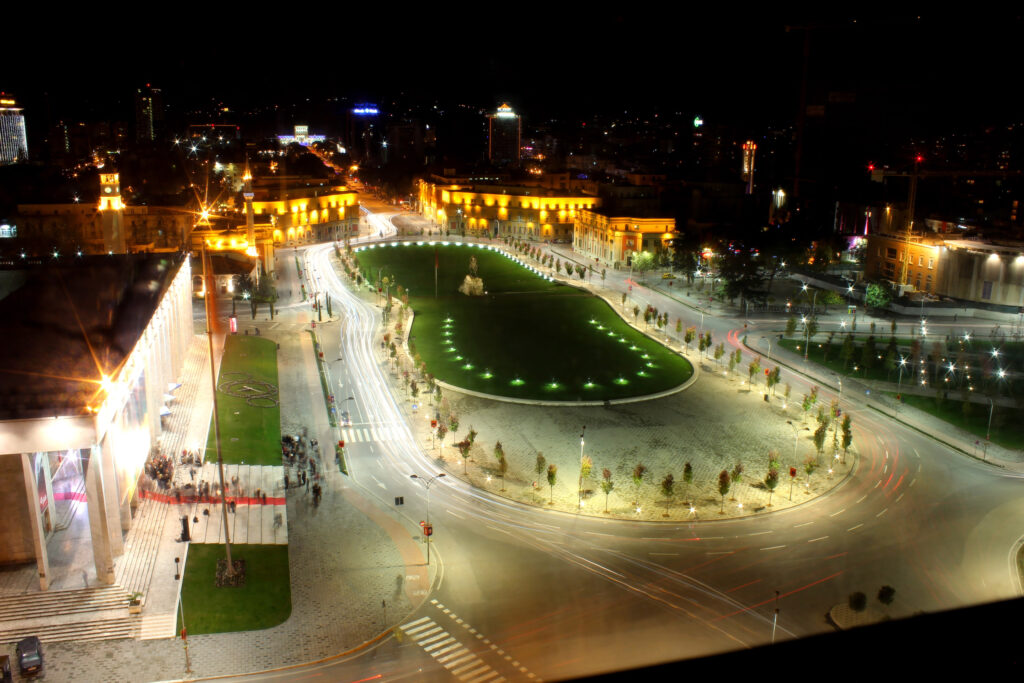
Skanderbeg Square, the main square in Tirana, fills with tens of thousands of people for organized concerts and celebrations. The energy is electric — live music, street performers, people dancing, friends finding each other in the crowd. The Blloku area, Tirana’s main nightlife district, is packed with people moving between bars and clubs.
In smaller cities, the scene is similar on a smaller scale. Town squares host concerts or DJ events. Local bars and restaurants run parties until the early morning hours. Young people walk the streets in groups, shouting “Gezuar!” to strangers, setting off the occasional firecracker, and simply enjoying the feeling of a brand new year.
The parties run until 4 AM, 5 AM, sometimes dawn. New Year’s Day itself starts late in Albania — nobody is waking up early on January 1.
How Things Are Changing
Albanian New Year celebrations are evolving, and you can see the generational shift happening in real time.
The Rise of Restaurants
One of the biggest changes in recent years is the growing number of families who celebrate New Year’s Eve at a restaurant instead of at home. Hotels and restaurants across Albania now offer fixed-price New Year’s Eve dinner packages with multi-course menus, live music, and a midnight champagne toast.
This was unheard of a generation ago. New Year’s Eve was always at home, always with family, always with food made by hand. But for younger couples, the appeal of not spending three days cooking (and three days cleaning up afterward) is real. A nice restaurant meal with a set menu, no dishes to wash, and a party atmosphere right there — it is an increasingly popular option.
That said, restaurant New Year’s Eve dinners are expensive by Albanian standards. A fixed-price menu at a good restaurant in Tirana can run 5,000 to 15,000 lek (roughly 50 to 150 euros) per person. For many families, that is simply out of budget, and the home celebration remains both the tradition and the practical choice.
Smaller, More Intimate Gatherings
The younger generation is also quietly changing the shape of the gathering itself. Where their parents would have had the entire extended family around one giant table, many young couples now cook an intimate New Year’s Eve meal for their nuclear family — just parents and children, or a small group of close friends.
This does not mean family does not matter. It means the definition of the New Year’s gathering is broadening. Some families do both — a big family dinner on December 30 or earlier in the week, and then a smaller, more personal celebration on the 31st.
Social Media and the Countdown
The midnight moment has also changed. Where once everyone watched the single state TV channel for the countdown, now half the room is on their phones at 11:59 PM — filming the fireworks for Instagram stories, sending WhatsApp messages, posting “Gezuar Vitin e Ri!” on Facebook. The celebration is the same, but it now has a digital layer that would have been unimaginable even 15 years ago.
Some older Albanians find this annoying. “Put down the phone and be present!” is a sentiment you will hear from any Albanian father at midnight. He is not wrong.
The January Visiting Traditions
New Year in Albania does not end at midnight, or even on January 1. The first days of January are dedicated to visiting — and this tradition is one of the most distinctly Albanian parts of the entire holiday.
The Visiting Circuit
Starting on January 1 and continuing for several days, Albanian families visit extended family members and neighbors to exchange New Year’s wishes. This is not casual dropping by. It is a structured, expected social obligation with its own unwritten rules.
You visit the older family members first — grandparents, then aunts and uncles, then close family friends. Each visit involves sitting down, being served coffee and sweets, exchanging wishes for the new year, and catching up on family news. A single visiting day can include three, four, or five different households.
The Sweets Competition
Here is something that outsiders find both charming and overwhelming: Albanian families quietly compete to have the best sweets table for their New Year visitors.
When guests arrive, the host brings out a spread of homemade baklava, kadaif, cookies, dried fruits, chocolates, and whatever else they have prepared. The variety and quality of the sweets table is a point of pride. Nobody says it out loud, but everyone notices. “Did you see what Teuta served? Three kinds of baklava and that new cake recipe.” It is a gentle, friendly competition — and it pushes everyone to put in their best effort.
The visitors, for their part, are expected to eat at least a little something at every stop. By the end of a full day of visiting, you have consumed enough sugar and coffee to fuel a small power plant. This is normal. This is January in Albania.
Exchanging Wishes
The standard New Year’s greeting — “Gezuar Vitin e Ri! Shendet, lumturi, e mbaresi!” (Happy New Year! Health, happiness, and prosperity!) — is exchanged at every visit. Health always comes first in Albanian wishes. You can wish someone wealth, success, love — but health is always the lead wish. Albanians understand, instinctively and from experience, that nothing matters without health.
Tips for Visitors Celebrating New Year in Albania
If you are visiting Albania over the New Year holiday, you are in for a treat. Here are some practical tips to help you make the most of it:
- Book restaurants well in advance. If you want to celebrate at a restaurant, book at least two to three weeks ahead. New Year’s Eve dinners sell out fast, especially at popular spots in Tirana, Vlora, and Saranda.
- Be prepared for noise. The fireworks at midnight are not subtle. If you are sensitive to loud sounds or have small children or pets, prepare accordingly. Earplugs are not a bad idea. This is not a few fireworks — it is sustained, citywide, all-directions noise for 20 to 30 minutes.
- If you get invited to a family dinner, accept. This is the highest form of Albanian hospitality. Bring a gift — wine, chocolates, flowers, or a dessert. Do not show up empty-handed. And be ready to eat a lot. Saying “I am full” will be met with “just a little more” at least three times.
- Head to Skanderbeg Square in Tirana for midnight. The main square hosts a free public celebration with concerts and a massive fireworks display. Get there by 11 PM to find a good spot. Dress warmly — December nights in Tirana are cold (typically 2 to 8 degrees Celsius).
- Try the food. If you have access to homemade Albanian New Year’s food, do not hold back. The baklava, the turkey, the pershesh, the Russian salad — this is Albanian cooking at its most celebratory. Ask your hosts about what they prepared. They will be thrilled to tell you.
- Learn the greeting. “Gezuar Vitin e Ri!” (guh-ZOO-ar VEE-tin eh REE) means “Happy New Year.” Say it to everyone. Say it to your waiter, your taxi driver, the person next to you in the square. Albanians will light up when a foreigner says it correctly.
- Do not plan anything for January 1. The country moves slowly on New Year’s Day. Most shops and businesses are closed. People sleep late. The streets are quiet until the afternoon. Use the morning to recover and the afternoon to join the visiting traditions if you are staying with an Albanian family.
- Consider the coast. Vlora, Saranda, and Durres offer beautiful New Year’s Eve celebrations with seafood-heavy dinners, beachfront fireworks, and a slightly warmer climate than Tirana. If you want a Mediterranean New Year with an Albanian twist, the coast is a great option.
Frequently Asked Questions
Is New Year bigger than Christmas in Albania?
Yes, by far. New Year is the dominant celebration in Albania, and it has been for decades. This is largely because of the communist era (1944-1991), when religious holidays including Christmas were banned. New Year became the one celebration everyone could share, and that tradition persisted long after communism ended. Today, Christmas is celebrated by some families — especially in urban areas and among younger generations — but New Year remains the undisputed main event.
What do Albanians eat on New Year’s Eve?
The Albanian New Year’s table typically includes oven-roasted turkey, seafood with pershesh (a traditional pasta dish), Russian salad (potatoes, carrots, peas, and mayo), and a generous spread of sweets including homemade baklava and kadaif. Regional variations exist — coastal areas emphasize fish and seafood, while northern regions lean toward veal or lamb. The key principle is abundance: the table should overflow with food as a symbol of prosperity for the coming year.
Are fireworks legal in Albania on New Year’s Eve?
Regulations have tightened in recent years, and there are restrictions on the types and sizes of fireworks that individuals can purchase and set off. However, enforcement is uneven, and the reality is that huge amounts of fireworks are still set off by private citizens at midnight on December 31. The government has run public awareness campaigns about fireworks safety, and injury rates have declined, but the Albanian love of fireworks remains strong.
What is the best city in Albania for New Year’s Eve?
Tirana offers the biggest and most energetic celebration, with the Skanderbeg Square concert, the Blloku nightlife district, and hundreds of restaurants and bars. Vlora and Saranda are excellent for a coastal, seafood-focused celebration. Korca has a charming, colder, more intimate atmosphere. Shkodra offers a traditional northern Albanian experience. Each city has its own character — there is no wrong choice.
Do Albanians exchange gifts on New Year?
Gift-giving is not as central to Albanian New Year as it is to Christmas in Western countries. During the communist era, workers received small gifts from their workplaces — usually something for the children. Today, some families exchange gifts, especially for children, but the focus is much more on food, family time, and the celebration itself rather than presents. The abundance of the dinner table is the gift.
Closing
Every year when December rolls around, I find myself doing the same things my parents did. Cleaning the house a little more thoroughly than usual. Making a shopping list that seems unreasonable for the number of people coming. Arguing with myself about whether this year’s turkey really needs to be seven kilograms (it does).
New Year in Albania is not glamorous or Instagram-perfect. The fireworks are too loud. The food is too much. The visits in January go on too long. Your aunt will ask why you are not married yet, or why you have not had a second child, or whether you have gained weight.
But that is the whole point. Albanian New Year is not a curated experience. It is messy, overwhelming, generous, exhausting, and deeply human. It is the one time of year when the entire country — every region, every religion, every generation — does the same thing at the same time: gathers around a table that has too much food on it, watches the clock tick toward midnight, and steps into a new year together.
My grandfather did it with two turkeys and a village full of family. My father did it with one turkey and a state TV broadcast. I do it with a turkey, too many fireworks, and half the room filming the countdown on their phones.
The details change. The feeling does not.
Gezuar Vitin e Ri.
Subscribe to monthly updates
Get honest Albania travel tips, local guides, and new posts straight to your inbox. No spam, unsubscribe anytime.
