
Key Takeaways
- Built in 1988 as a museum glorifying dictator Enver Hoxha — the most expensive building in Albania’s history at the time
- After communism fell, it became a nightclub, NATO base, TV station, and eventually a graffiti-covered ruin
- Renovated by Dutch firm MVRDV and reopened in 2023 as a cultural center and free tech school for youth
- You can climb the exterior steps to the top — it’s free, open to everyone, and has the best views in Tirana
Table of Contents
No building in Tirana has lived as many lives as the Pyramid. I’ve watched it go from communist monument to crumbling ruin to the thing teenagers climb for selfies, and now to something nobody in 1988 could have predicted: a place where 12-year-olds learn to code. If you want to understand Tirana — really understand it, not just photograph it — this is where you start.
The Pyramid sits right on Dëshmorët e Kombit Boulevard, Tirana’s main axis. You can’t miss it. And that’s always been part of the problem and the point.
Built for a Dictator
The Pyramid was built in 1988 as the Enver Hoxha Museum, a monument to Albania’s communist dictator who had died three years earlier. It was designed by a team that included Pranvera Hoxha (Enver’s daughter), her husband Klement Kolaneci, along with architects Pirro Vaso and Vladimir Bregu. The cost was over $4 million — an extraordinary sum for a country that was, at the time, one of the poorest in Europe.
The interior was built as a series of platforms arranged in an amphitheater layout, with a white marble statue of Hoxha at the center, carved from Pentelikon marble — the same stone used to build the Parthenon. The irony of that material choice was apparently lost on everyone involved. The museum displayed artifacts glorifying Hoxha’s life and regime in the classic style of communist personality cults.
Did you know?
The Pyramid operated as a Hoxha museum for only about 3 years (1988–1991) before communism collapsed. It was the most expensive building in Albanian history, built to last forever, and its original purpose was obsolete within 36 months.
The Many Lives of the Pyramid
Planning a Trip to Tirana?
Get my free Tirana in 48 Hours checklist with day-by-day itinerary, prices, and local tips.
Get the Free Checklist →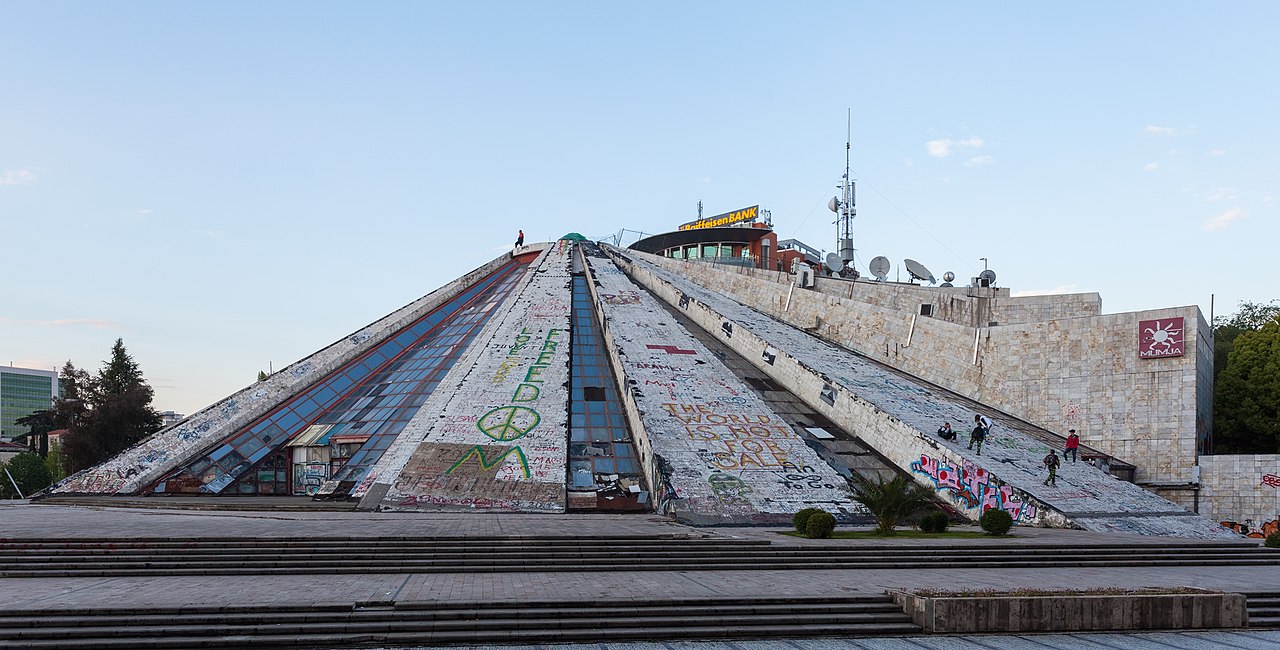
After communism fell in 1991, nobody knew what to do with the Pyramid. And for the next three decades, Albania tried everything:
1991–1990s: Stripped of Hoxha exhibits, renamed the International Centre of Culture. Used for conferences, exhibitions, and fairs.
Mid-1990s: A nightclub called “Mumja” (The Mummy) operated inside. If that sounds surreal, welcome to 1990s Albania.
1999: During the Kosovo War, NATO and humanitarian organizations used it as a base of operations.
2001 onward: Top Channel TV and Top Albania Radio set up broadcasting studios inside part of the building.
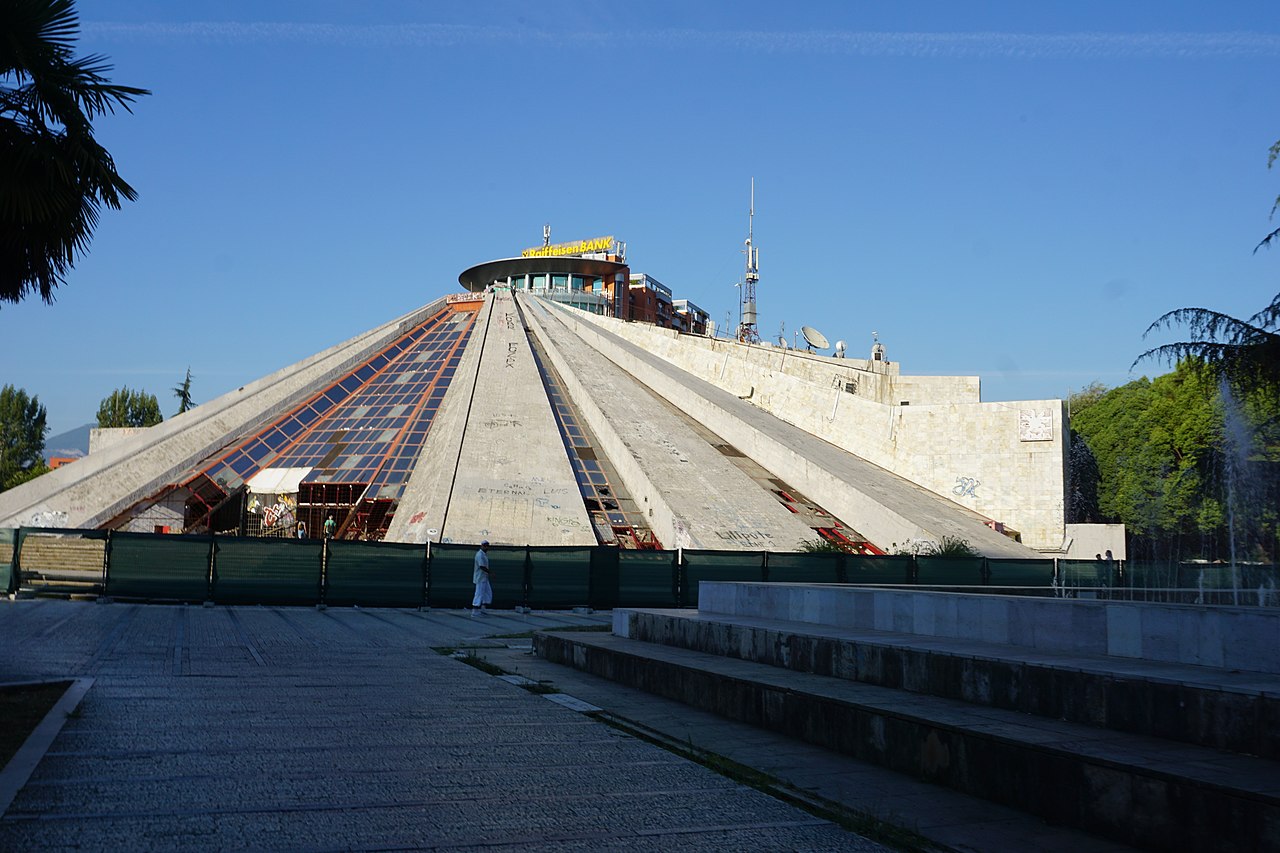
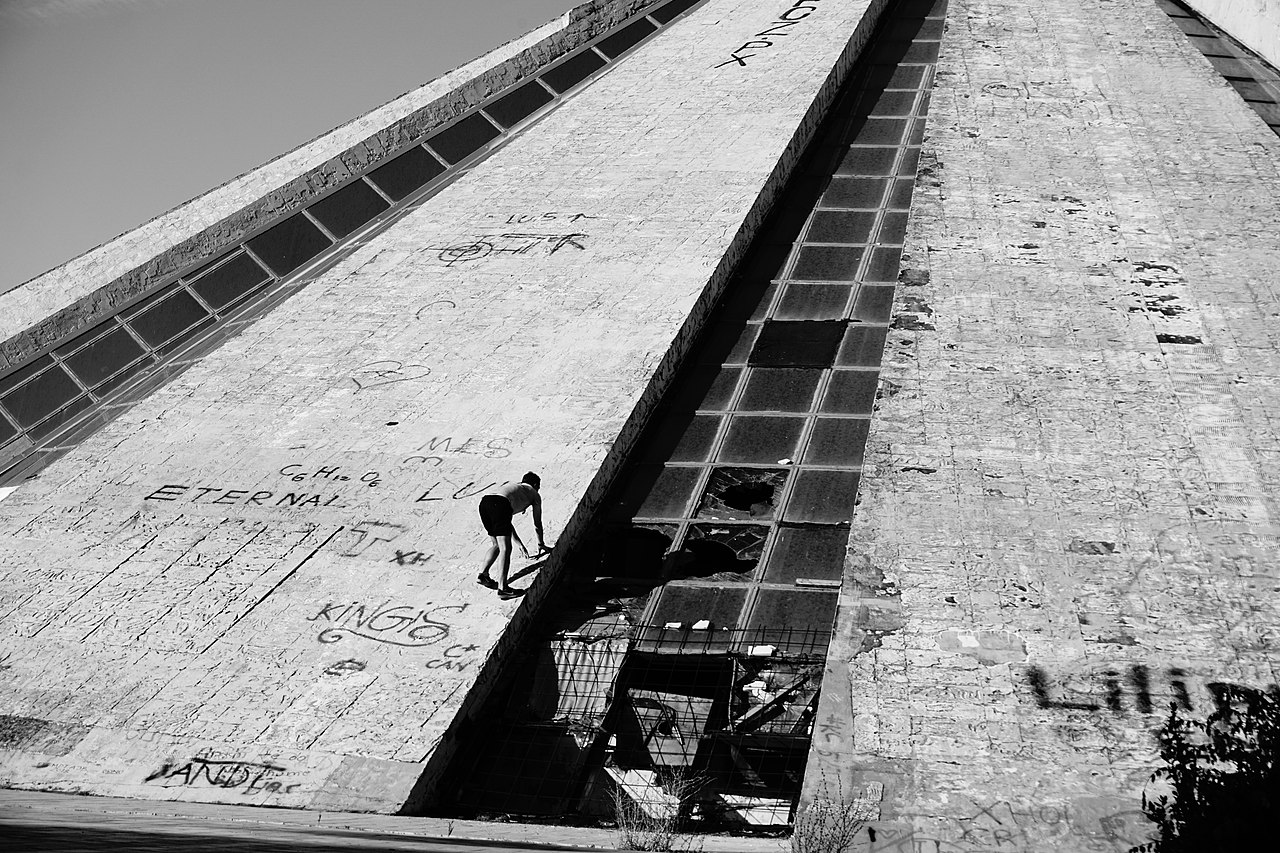
2000s–2020: Progressive decay. The marble cladding was stripped. Windows smashed. Graffiti covered every reachable surface. The building became a ruin — and, in its own strange way, more beautiful and honest than it had ever been as a museum.
During those years of decay, something unplanned happened. People started climbing the Pyramid. Young Albanians and tourists would scramble up the sloped concrete exterior, sit at the top, and look out over Tirana. It became a rite of passage — a quiet, casual act of defiance. You were literally standing on top of the dictator’s monument, and nobody could stop you. I climbed it myself more than once.
Demolish or Keep?
For over a decade, the Pyramid was at the center of one of Albania’s fiercest public debates. In 2010, Prime Minister Sali Berisha announced the government would tear it down and build a new parliament building on the site. An international competition was won by Austrian firm Coop Himmelb(l)au, with an estimated cost of €110 million for the replacement.
The argument for demolition was straightforward: why keep a monument to a dictator? The argument against was more nuanced. Historian Ardian Klosi organized a petition that gathered around 6,000 signatures. Former political prisoners — people who had suffered directly under Hoxha’s regime — argued against demolition. Artan Shkreli, former director of the Institute of Monuments, put it bluntly: “The ideological arguments for the demolition of the building are absurd. The architectural values of the pyramid cannot be wiped out.”
The preservationists won. In 2017, it was officially announced the Pyramid would be renovated, not demolished. Looking back, it was the right call — though reasonable people disagreed at the time, and some still do.
The MVRDV Renovation
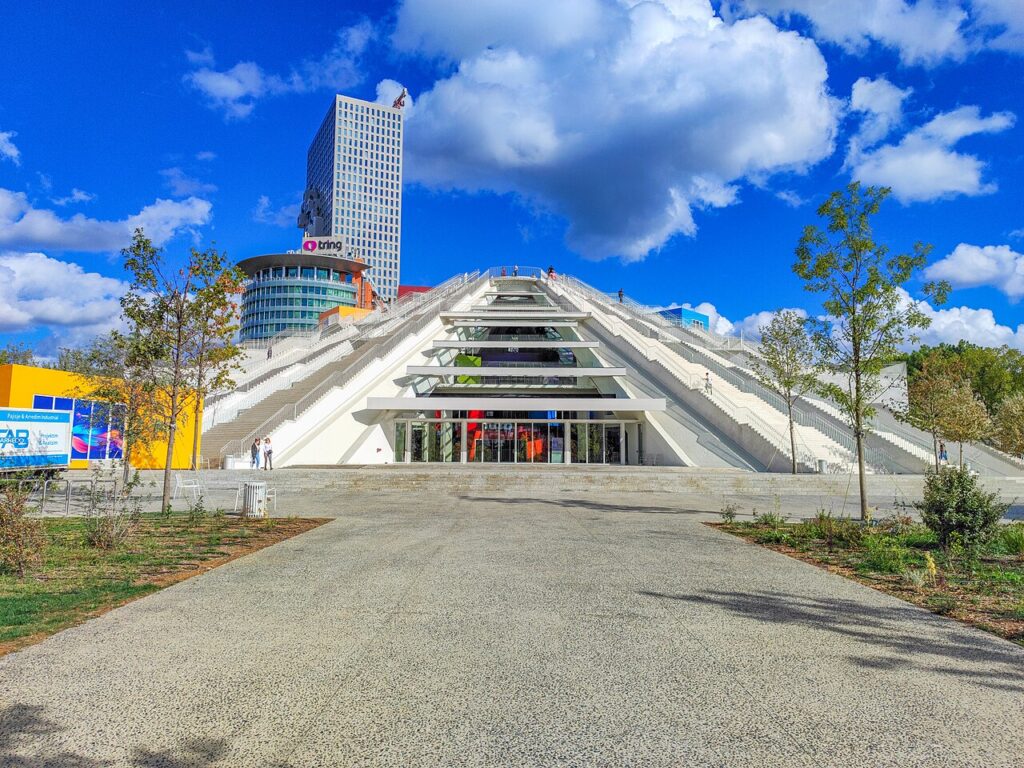
The renovation was designed by MVRDV, the Dutch architecture firm, in collaboration with local firm iRI Architecture. Construction began in February 2021, and the Pyramid reopened to the public in October 2023.
The concept was bold: strip the building to its concrete skeleton, keep it open like a ruin in a park, and fill it with colorful modular boxes that “squat” inside and around the structure. As MVRDV founding partner Winy Maas described it: “A monument for the people and their ability to overcome and outlive dictators.”
The most striking feature is the exterior. The entire pyramid is now covered with cascading concrete steps that rise along all four sloped facades. You can climb from ground level to the top — about 21 meters up — on proper steps with railings. One section even has a slide for coming back down. An elevator on the west side provides access for those who can’t climb.
The renovation cost approximately €15 million, funded primarily by the Albanian-American Development Foundation (AADF) with co-financing from the Municipality of Tirana. Compare that to the €110 million that demolition plus a new parliament would have cost. Sometimes the cheaper option is also the better one.
What’s Inside Now
The anchor tenant is TUMO Tirana, a free education center for young people aged 12 to 18. TUMO is part of a global network that started in Yerevan, Armenia, and now operates across 15 countries, serving 35,000 students weekly. There are no entrance exams, no requirements, and no fees. Any kid can walk in and start learning.
The programs cover exactly the skills Albania’s economy needs: animation, game development, graphic design, filmmaking, music production, 3D modeling, robotics, and software development. Students work through self-learning modules combined with hands-on workshops, building real portfolios as they go.
The rest of the colorful boxes house cafés, start-up offices, incubators, studio spaces, and event venues. The exposed concrete skeleton creates an industrial-meets-park atmosphere, softened by trees, plants, and green spaces around the base. It feels like a community park, tech campus, and cultural center merged into one.
A building designed to worship the past is now dedicated to the future — specifically, to young people learning to code, animate, and create. The dictator’s monument is now a place where 12-year-olds build their first video game. I can’t think of a better revenge.
Visiting the Pyramid
| Detail | Info |
|---|---|
| Location | Dëshmorët e Kombit Blvd / Papa Gjon Pali II Street, central Tirana |
| Admission | Free — climbing the exterior and entering public areas costs nothing |
| Can you climb it? | Yes — proper steps on all sides, plus a slide section and an elevator |
| Hours | Daily ~8 AM – 10 PM (exterior steps may be accessible longer) |
| Nearby | Skanderbeg Square (5 min walk), National Art Gallery, Bunk’Art 2 (10 min), Blloku (5 min) |
| TUMO contact | [email protected] | +355 4 452 4065 |
What It Means
I’ve thought about this building a lot over the years. The Pyramid has lived through every chapter of modern Albanian history: communist grandeur, post-communist chaos, democratic growing pains, and whatever you want to call what we’re doing now. Each era left its mark on the structure — literally, in the case of the graffiti years.
What strikes me most is that the building was almost destroyed multiple times — by neglect, by politicians, by the simple passage of time — and survived all of it. And now it’s being used for something its builders could never have imagined: giving young Albanians the skills to build futures that don’t depend on anyone’s ideology or permission.
That’s not a bad metaphor for Albania itself. We’re still figuring it out. The Pyramid is still figuring it out. But at least now, when you climb to the top and look out over Tirana, you can see a city that’s moving forward — chaotically, imperfectly, but forward. That view alone is worth the climb.
Subscribe to monthly updates
Get honest Albania travel tips, local guides, and new posts straight to your inbox. No spam, unsubscribe anytime.
