
Key Takeaways
- Berat is a UNESCO World Heritage Site just 2 hours from Tirana — one of the oldest continuously inhabited cities in the world and absolutely worth the trip.
- Getting there is easy and cheap: buses from Tirana’s South Terminal cost around 1,000 ALL (~€8), or you can drive in under 2 hours via SH72.
- The Mangalem and Gorica Ottoman quarters plus the still-inhabited Berat Castle (Kalaja) are the main draws — wear comfortable shoes for the cobblestones.
- A day trip works perfectly, but if you can swing an overnight stay, the sunset and sunrise views over the Ottoman houses are unforgettable.
- Traditional restaurants serve excellent local food at honest prices — expect 500–1,200 ALL per main course.
Table of Contents
First Glimpse: The Drive to Berat
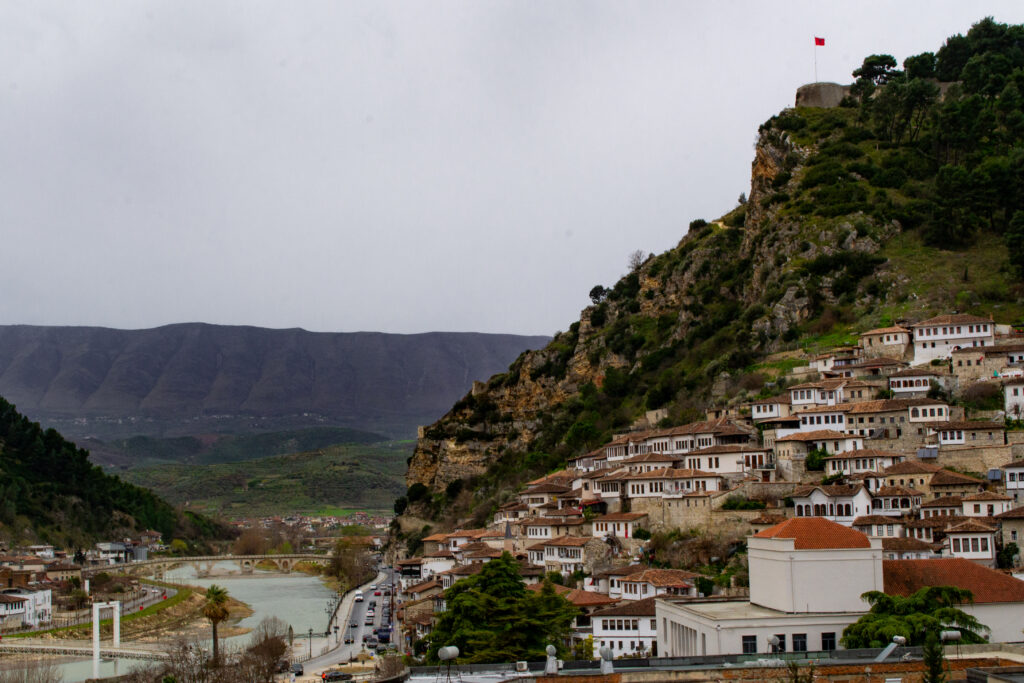
There is a moment on the drive to Berat that catches every first-timer off guard. You have been winding through central Albanian countryside for an hour or so — olive groves, small villages, the occasional donkey cart on the shoulder — and then the road curves around a final hill, and there it is. White Ottoman houses stacked impossibly on top of each other, climbing the hillside all the way up to the castle walls. Hundreds of windows staring back at you like something out of a painting you were not quite sure existed.
I have been living in Albania for over two decades now, and I still find excuses to drive down to Berat. Not because I have run out of things to show people — though it is one of the first places I take visitors — but because the town genuinely changes with the light. Morning sun makes the white walls almost blinding. Late afternoon turns them golden. And at sunset, the whole scene goes pink and orange in a way that no photograph quite captures.
The first time I saw it, I was driving south from Tirana on a random weekend trip in the early 2000s, and I remember thinking: this is what Albania looks like when the world is not paying attention. The town had barely any tourists back then. The cobblestones were crumbling in places, the castle was half-abandoned, and the restaurants were mostly locals drinking raki at plastic tables. A lot has changed since. But the core of what makes Berat special — the architecture, the river, the castle looking down at all of it — that is exactly the same.
If you are based in Tirana and looking for a day trip that delivers, Berat is the one I recommend first. Here is everything you need to know.
Why Berat?
Planning a Trip to Tirana?
Get my free Tirana in 48 Hours checklist with day-by-day itinerary, prices, and local tips.
Get the Free Checklist →Berat is one of those rare places that lives up to its reputation. In a country full of underrated destinations, this is the one that even the Albanian tourism board gets right.
The city earned its UNESCO World Heritage status in 2008, recognized as a “rare example of an architectural character typical of the Ottoman period.” But Berat’s history stretches back far further than the Ottomans. People have been living here continuously for about 2,400 years. That is not a typo. The Illyrians built a fortress on the hilltop in the 4th century BC, the Romans came through, the Byzantines left their churches, the Ottomans built the houses you see today, and somehow — remarkably — people are still living inside those castle walls right now.
The nickname “City of a Thousand Windows” comes from those rows and rows of Ottoman houses with their large, symmetrical windows facing the Osum River valley. Stand on the Gorica side and look across, and you will understand the name immediately. The windows are everywhere, stacked in perfect rows going up the hillside, each one framing a different sliver of the same valley view.
What makes Berat special compared to other Ottoman-era cities in the Balkans? Three things. First, the dual-quarter layout — Mangalem and Gorica face each other across the Osum River, connected by an old stone bridge. Second, the castle is not a ruin or a museum piece — it is a living neighborhood where families still go about their daily lives. Third, the sheer concentration of historical architecture in such a compact area. You can walk the entire old town in a few hours, and every turn reveals something worth stopping for.
For anyone interested in Albanian history, Berat is essentially a crash course you can walk through.
Planning your Berat day trip?
Two ways to do it:
- Don’t want to drive? — go with Esther, our partner local guide: a full day in Berat from Tirana, guiding €22 per person with castle entry included, optional wine tasting. See Esther’s Berat day. (Esther is our partner guide; we receive a small share of her guiding fee.)
- Doing it yourself? — renting a car gets you the morning light and a near-empty castle. Compare deals on DiscoverCars.
Affiliate links — they cost you nothing and help keep this blog going.
Getting There from Tirana
The good news is that getting to Berat from Tirana is straightforward, and you have several options depending on your budget and comfort level.
| Transport | Cost | Duration | Notes |
|---|---|---|---|
| Bus | ~1,000 ALL (~€8) | ~2 hours | Departs from South Terminal (Terminali i Jugut). Several daily departures, usually starting around 6:30–7:00 AM. |
| Furgon (minibus) | ~800–1,000 ALL | ~2–2.5 hours | Smaller minibuses, depart when full. Also from South Terminal area. Less predictable schedule. |
| Driving | Fuel only (~1,500–2,000 ALL) | 1.5–2 hours | Via SH72 through Elbasan or via Lushnja. Road is in good condition. Free parking near the old town. |
| Organized tour | €25–50 per person | Full day | Multiple operators run day trips from Tirana. Convenient but less flexible. |
My recommendation: drive if you can. Not because the bus is bad — it is perfectly fine — but because having a car gives you the flexibility to stop at viewpoints along the way, take the scenic route, and leave Berat whenever you are ready rather than hunting for the last bus back.
The main route is SH72, which takes you south through Elbasan and then west to Berat. The road is two lanes most of the way but well-maintained. If you are coming from the coast or from Fier, there is also a route via Lushnja that is slightly shorter.
If you are taking the bus, head to Tirana’s South Terminal (Terminali i Jugut), located near the Dinamo Stadium area. Buses run several times daily, with the earliest departures around 6:30–7:00 AM. Buy your ticket at the counter or directly from the driver. No advance booking needed — just show up.
Furgons (shared minibuses) are the more adventurous option. They leave from the same area, are slightly cheaper, and depart when every seat is filled. This can mean a quick departure or a 30-minute wait, depending on the day.
For a more detailed breakdown of all transport options across the country, check out our complete guide to getting around Albania.
Mangalem Quarter
Mangalem is the postcard. It is the side of Berat you have seen in every travel photo, every Instagram reel, every Albania tourism ad — and it deserves every bit of the attention.
This is the quarter on the eastern bank of the Osum River, directly below the castle. The famous rows of white Ottoman houses rise steeply from the riverbank, their dark-framed windows looking out over the valley in that characteristic pattern that earned Berat its nickname. Walking through Mangalem is like stepping into a living architectural museum, except the museum is also a neighborhood where people hang their laundry and grow tomatoes in window boxes.
The streets are narrow cobblestone paths that wind uphill between the houses. Some are barely wide enough for two people to pass. Doorways open into hidden courtyards. Cats sleep on every available stone surface. The further up you go, the better the views get, until you eventually reach the castle entrance at the top.
What to look for in Mangalem:
- The Lead Mosque (Xhamia e Plumbit). A 16th-century Ottoman mosque near the riverbank, named for the lead used in its dome construction. Small but elegant, and one of the oldest mosques in Albania.
- The Bachelor’s Mosque (Xhamia e Beqareve). Another Ottoman-era mosque with a distinctive portico and wooden interior. It was traditionally used by young unmarried men of the quarter.
- The Ethnographic Museum. Housed in a beautifully restored 18th-century Ottoman house, this small museum gives you a feel for what daily life looked like inside these homes. Period furniture, textiles, and traditional crafts on display.
- The Thousand Windows viewpoint. About halfway up the quarter, there are several spots along the main path where you can turn around and see the full sweep of white houses below you. This is where most of the famous photos are taken.
Take your time in Mangalem. The temptation is to rush through on the way to the castle, but the quarter itself is the attraction. Sit on a wall, watch the light move across the facades, listen to the muezzin call echoing off the hillside. This is Berat at its most atmospheric.
Gorica Quarter
If Mangalem is the famous face, Gorica is the quiet sibling across the river. And honestly, I sometimes prefer it.
Gorica sits on the western bank of the Osum, connected to Mangalem by the Gorica Bridge — a stone Ottoman bridge that is itself one of Berat’s most photographed landmarks. The bridge is pedestrian-friendly and wide enough to stop in the middle and look both ways: upstream toward the canyon where the Osum River enters the town, and downstream toward the newer parts of the city.
The houses in Gorica have the same Ottoman architecture as Mangalem — white walls, dark window frames, tiled roofs — but the quarter feels noticeably calmer. Fewer tourists make the walk across the bridge, which means you get more of the neighborhood to yourself. The streets are just as winding and photogenic, but you are more likely to encounter a grandmother shelling beans on her doorstep than a tour group.
Gorica is also where you get the best views of Mangalem. Standing on the Gorica side, looking across the river at that famous wall of windows rising up to the castle — this is the definitive Berat panorama. Early morning and late afternoon are the best times for photos, when the light hits the Mangalem facades at an angle and the shadows give the whole scene depth.
Walking across the Gorica Bridge and back is a ten-minute round trip, but I would suggest giving Gorica at least 30–45 minutes. Walk up into the residential streets, enjoy the quiet, and take advantage of the viewpoints. There are a couple of small cafes on the Gorica riverbank where you can sit with a coffee and look across at Mangalem without the crowds.
For anyone exploring Albanian culture and traditions more broadly, seeing these two quarters face each other across the river gives you a sense of how tightly communities were organized in Ottoman-era Albania — something I dig into more in our guide to Albanian culture.
Berat Castle (Kalaja)
Most castle visits in Europe involve walking through empty stone corridors and reading information plaques. Berat Castle is different. People live here. Not in a reconstructed heritage-village kind of way, but actually live here — with satellite dishes on their roofs, dogs in their yards, and cars somehow squeezed through gates that were designed for horses.
The castle sits at the top of the hill above Mangalem, and you reach it by walking up through the quarter on a cobblestone path that gets steeper as you go. The main entrance is through a series of fortified gates that have been in continuous use since at least the 13th century, though the foundations of the fortress go back to the 4th century BC.
Once inside the walls, you find yourself in what is essentially a small hilltop village. There are narrow lanes, stone houses, a few guesthouses, a couple of restaurants, several churches, and a mosque — all within the castle enclosure. This is one of the things that makes Berat Castle genuinely unique in the Balkans. It is not a preserved monument. It is a neighborhood that happens to be inside a medieval fortress.
Did you know?
The Onufri Museum inside Berat Castle houses works by Onufri, a 16th-century Albanian master icon painter whose use of a unique shade of red — still not fully replicated today — made his work famous across the Orthodox world. The museum is inside the Church of the Dormition of St. Mary (Kisha e Shën Mërisë), which alone is worth the climb.
What to see inside the castle:
- The Onufri Museum. The highlight for most visitors. Houses 16th-century icons by Onufri and his son Nikolla, displayed inside the beautiful Church of the Dormition. Entry is 400 ALL. Open daily in summer, reduced hours in winter.
- The Red Mosque (Xhamia e Kuqe). A 15th-century mosque, now partly in ruins but with distinctive red-brick walls. One of the earliest Ottoman structures in the castle.
- The Church of the Holy Trinity. A 13th-century Byzantine church with faded but visible frescoes. Small, easy to miss, and absolutely worth ducking inside.
- The inner citadel walls and cisterns. Explore the upper fortifications for panoramic views of the Osum valley. The old water cisterns are a reminder of how the castle sustained itself during sieges.
- The residential streets. Just walk. The houses inside the castle are lived-in Ottoman-era structures, and wandering the narrow lanes is one of the most rewarding experiences in Berat. Be respectful — these are people’s homes.
The climb from Mangalem to the castle entrance takes about 15–20 minutes at a comfortable pace. It is steep in places, and the cobblestones can be slippery when wet. But the views on the way up are spectacular, so you will want to stop frequently anyway.
For historical context on the different civilizations that built and rebuilt this fortress, our Albanian history guide covers the major eras.
Where to Eat in Berat
Berat is not a fine-dining destination, and that is exactly what makes eating here so good. The restaurants are unpretentious, the portions are big, and the prices are honest. You are eating food that local families eat, prepared the way it has been prepared for generations.
Most restaurants in the old town serve traditional Albanian cuisine — slow-cooked meat, grilled vegetables, fresh salads, homemade bread, and local wine or raki. Expect to pay between 500 and 1,200 ALL per main course, which works out to roughly €4–10. A full meal with drinks for two people rarely exceeds 3,000–4,000 ALL (~€25–33).
Restaurants worth trying:
Antigoni Restaurant
Located in Mangalem with a terrace overlooking the river. Classic Albanian dishes done well — try the tavë kosi (lamb baked in yogurt) or the grilled lamb chops. Prices are mid-range for Berat, around 600–1,000 ALL per main. Popular with both locals and visitors, which is usually a good sign.
Mangalemi Restaurant
Right in the heart of the quarter, with outdoor seating on a cobblestone terrace. The menu covers all the Albanian staples — fërgesë (peppers and cheese baked in a clay pot), grilled meats, stuffed peppers, fresh trout. Mains around 500–900 ALL. The house wine is surprisingly good and very cheap.
Restaurant Onufri
Inside the castle walls, so you are paying a small premium for the location — but the views from the terrace justify it completely. Solid traditional food. Grilled meats, salads, and cold starters. Mains 700–1,200 ALL. Good for lunch after exploring the castle.
White Terrace (Gorica side)
If you cross the bridge to Gorica, this spot has one of the best views of Mangalem and the castle. The food is traditional with some modern touches. Try the grilled vegetables and the local u00c7obo wine. It is quieter than the Mangalem restaurants and feels more like a local find.
A few local specialties to look for: Tavë kosi (the national dish — lamb and rice baked under a yogurt crust), fërgesë Berati (Berat-style peppers with cheese and tomatoes), grilled lamb or veal, fresh trout from the river, and qifqi (rice balls) which are specific to the Berat region. For drinks, try the local raki (grape brandy) and the wines from the Berat region — u00c7obo Winery produces some of Albania’s best reds.
Day Trip vs. Overnight?
Let me be honest with you: a day trip to Berat works, but an overnight stay is better.
If you leave Tirana by 8:00 AM, you can be in Berat by 10:00. That gives you a solid six to seven hours to explore Mangalem, cross to Gorica, walk up to the castle, have lunch, and still catch a late-afternoon bus back or drive home before dark. It is absolutely doable and you will see the highlights.
But here is what you miss with a day trip: the sunset and the sunrise.
Berat at sunset is one of the most beautiful things I have seen in Albania — and I have been saying that for twenty years. The light turns the white houses gold and then pink, the castle walls catch the last rays, and the whole town goes quiet in that way Albanian towns do when the heat of the day breaks. You sit on a terrace with a glass of u00c7obo red wine, the muezzin calls from somewhere below, and for a few minutes everything just stops.
Berat is one of those places that rewards you for staying past the point when the tour buses leave. The town belongs to its residents again after 5 PM, and that is when the real magic happens.
And in the morning, if you wake early and walk up to the castle before the day trippers arrive, you get the whole fortress to yourself. Just you, the residents starting their day, and the Osum valley filling with light below.
Accommodation in the old town is charming and affordable. Guesthouses in restored Ottoman houses run between €30–60 per night for a double room, and many include breakfast. Booking ahead in summer is wise, but in spring or fall you can usually find a room on the day.
My advice: if this is your first time, plan a day trip. If you fall in love with the place — and you probably will — go back for a night or two. It is a completely different experience.
If you are planning a longer stay in the capital, our Tirana 72-hour guide can help you decide which days to dedicate to day trips.
Practical Tips
A few things I have learned from many trips to Berat that will make yours smoother.
- Wear comfortable shoes with good grip. This is the single most important piece of advice. Cobblestones are everywhere — in Mangalem, in Gorica, on the path to the castle, and inside the castle walls. They are uneven, sometimes loose, and slippery when wet. Sandals and fashion sneakers will make you miserable. Proper walking shoes or hiking sandals are the way to go.
- Bring water, especially in summer. The walk up to the castle is exposed to the sun for most of the route. Temperatures in Berat regularly hit 35–40°C in July and August. There are a couple of shops near the castle entrance, but carry at least a liter with you.
- Start early to avoid the heat. If you are visiting between June and September, aim to be at the castle by 9:00–10:00 AM. By midday, the climb is punishing. Spend the hottest hours at a riverside restaurant, and save Gorica for the late afternoon.
- Bring cash. While some restaurants and guesthouses accept cards, many smaller spots in the old town are cash-only. There are ATMs in the new part of town near the main boulevard. Albanian Lek (ALL) is the currency.
- Respect the residents. This is especially important in the castle, which is a real neighborhood. Do not walk into people’s courtyards uninvited, ask before photographing residents, and keep noise down in the residential lanes.
- Check opening hours for museums. The Onufri Museum and Ethnographic Museum have seasonal hours. In summer (May–September), they are typically open 9:00–18:00. In winter, hours are reduced and sometimes unpredictable. Entry is 400 ALL per museum.
- Download an offline map. Cell service is generally fine, but the narrow lanes in the old town can be confusing. Having Google Maps or Maps.me downloaded offline helps when you inevitably lose your bearings between identical-looking white houses.
Frequently Asked Questions
Is Berat worth visiting for just one day?
Yes, absolutely. A full day gives you enough time to explore both Ottoman quarters (Mangalem and Gorica), walk up to the castle, visit the Onufri Museum, and have a traditional lunch. You will not see everything, but you will see the highlights. Start early to maximize your time.
How much does a Berat day trip cost from Tirana?
Budget around 5,000–7,000 ALL (~€40–58) per person for a comfortable day trip. This covers bus tickets (~1,000 ALL return), museum entry (400 ALL per museum), lunch (1,000–1,500 ALL), coffee and drinks (300–500 ALL), and miscellaneous spending. If you drive, add fuel costs (~1,500–2,000 ALL round trip) but save on bus tickets.
What is the best time of year to visit Berat?
Spring (April–May) and early autumn (September–October) are ideal. The weather is warm but not oppressive, the light is beautiful for photos, and the tourist crowds are manageable. Summer (July–August) is hot and busy. Winter is quiet and atmospheric, but some museums have reduced hours and the castle walk can be muddy.
Can I visit Berat without a guide?
Definitely. Berat is compact and walkable, and most attractions are well-signed. A guide adds historical depth, but you do not need one to enjoy the town. This article and a downloaded offline map are all most visitors need.
Is the walk to Berat Castle difficult?
It is moderate. The path from Mangalem to the castle entrance is about 15–20 minutes uphill on cobblestones. There are no handrails and it gets steep in places. Anyone with reasonable fitness can manage it, but it is not suitable for wheelchairs or pushchairs. Take it slow, bring water, and stop for the views.
Go See It for Yourself
I have been writing about Albania for over twenty years, and Berat remains one of the places I return to most often. Not because it is the most dramatic landscape in the country — the Riviera and the Albanian Alps both have stronger claims to that — but because Berat has something harder to find: a sense of continuity. People have been living on that hillside for two and a half thousand years, and the town still feels lived-in rather than preserved.
Every time I visit, I notice something I missed before. A carved doorframe I walked past last time. A new cafe tucked into a restored Ottoman house. The way the light hits the castle walls differently in October than it does in June.
Berat is the kind of place that rewards attention. And of all the day trips you can do from Tirana, it is the one I would choose first, every time.
If you are planning your Albania itinerary, start with our Tirana city guide and build out from there. Berat should be near the top of your list.
Prefer to go with a guide? Esther, our partner local guide, leads a full day in Berat from Tirana: the castle, the Mangalem and Gorica quarters, and an optional wine tasting. See Esther’s Berat day → (partner guide; we receive a small share of her fee)
Subscribe to monthly updates
Get honest Albania travel tips, local guides, and new posts straight to your inbox. No spam, unsubscribe anytime.
