
Key Takeaways
- Durres is just 40 minutes from Tirana via the A2 highway — Albania’s easiest day trip or beach escape
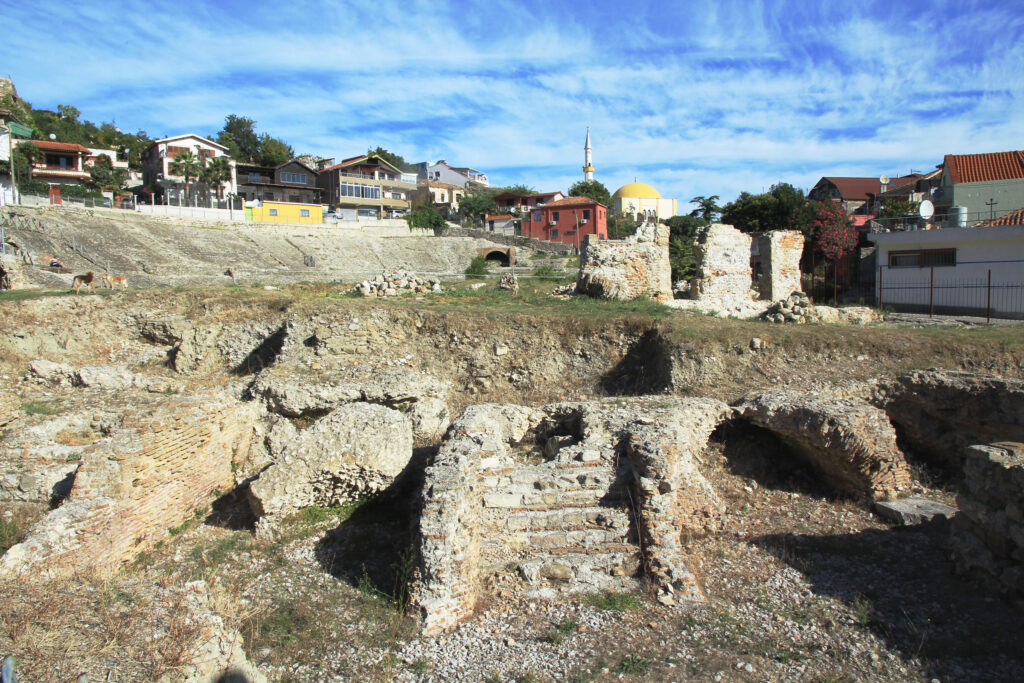
- The Roman Amphitheatre (2nd century AD, 20,000 capacity) is one of the largest in the Balkans and sits right in the city center
- Beaches improve as you go south — skip the crowded main beach and head to Golem or Lalzit Bay
- Durres is a working port city with ferries to Bari and Ancona, Italy — not a resort, and that’s part of its charm
- Best visited as a half-day history trip combined with an afternoon at a nearby beach
Table of Contents
Every Albanian knows the Tirana-Durres drive. It is one of those routes that is woven into the rhythm of life here — the weekend beach run, the summer exodus, the quick escape when the city heat becomes unbearable. I have made this drive hundreds of times over the past two decades, in every season, in every mood, and at every hour of the day.
For visitors, Durres tends to sit in an awkward spot. It is not the dramatic Albanian Riviera that Instagram has made famous. It is not a hidden gem. It is a working city with a real port, real traffic, and real history — the kind of place that rewards you for knowing where to look and what to expect.
This guide is my honest take on Durres after 21 years of living in Albania. I will tell you what is genuinely worth your time, what has changed recently, and what you should probably skip. No sugarcoating, no filler — just the city as I know it.
Seeing Durrës from Tirana?
Esther, our tour partner, organises a Durrës day from Tirana: the Roman amphitheatre and old town, then an afternoon on the beach, with a certified local guide. Personal quote on request.
See Esther’s Durrës day →Esther is our tour partner; we receive a small share of the tour price.
Getting to Durres from Tirana
The good news: Durres is the easiest day trip you can take from Tirana. The A2 highway connects the two cities in about 35 to 40 minutes, and the road is genuinely good — a proper divided highway, which is still something worth mentioning in Albania.
You have several options for getting there:
By bus. Regular buses depart from Tirana’s Western Bus Station (Stacioni i Autobusave Perendimor) throughout the day, roughly every 30 minutes from early morning until evening. The fare is around 300 ALL (about 2.80 EUR), which makes this one of the cheapest day trips you will ever take. The ride takes about 50 minutes to an hour, depending on traffic and how many stops the bus makes.
By furgon. These shared minivans are the Albanian public transport staple. They leave when full, which usually means every 15 to 20 minutes during peak hours. Same price as the bus, sometimes slightly less, and often a bit faster since drivers tend to be — let’s say, motivated. You will find furgons at the same station or nearby.
By car. Take the A2 highway (Autostrada Tiranë-Durrës) westward. It is well-signed and hard to miss. Parking in Durres can be tricky near the center and waterfront during summer, but manageable the rest of the year. There are paid parking areas along the promenade.
By taxi. A taxi from central Tirana to Durres will run you somewhere between 2,500 and 3,500 ALL (roughly 23 to 32 EUR). Use one of the Albanian ride-hailing apps — Speed Taxi, Clust, or VrapOn — to get a fair price and avoid the negotiation dance. This is a good option if you are a group of three or four splitting the cost.
One practical note: if you are heading to the beaches south of Durres center (Golem, Lalzit Bay), having your own transport or a taxi makes a real difference. The bus drops you in Durres city center, and getting to the better beaches from there adds another leg to the journey.
The Roman Amphitheatre
Planning a Trip to Tirana?
Get my free Tirana in 48 Hours checklist with day-by-day itinerary, prices, and local tips.
Get the Free Checklist →If Durres has one must-see, this is it. The Roman Amphitheatre of Durres (Amfiteatri i Durrësit) sits right in the middle of the modern city, surrounded by apartment buildings and shops — a jarring, wonderful collision of ancient and contemporary that is so typically Albanian.
Built in the 2nd century AD during the reign of Emperor Trajan, this was one of the largest amphitheatres in the Balkans. At its peak, it could hold an estimated 20,000 spectators — an enormous number for the region at the time. Durres (then called Dyrrachium by the Romans, and Epidamnos before that by the Greeks) was a major city on the Via Egnatia, the road that connected Rome to Constantinople. This was not some provincial backwater. This was a place that mattered.
Did you know?
The Durres Amphitheatre was only rediscovered in 1966 when a local farmer was digging on his property. Much of the structure had been buried under centuries of urban development. Excavations are still ongoing today — archaeologists estimate that only about one-third of the original amphitheatre has been fully uncovered. A small Byzantine chapel with early Christian wall mosaics was found inside the tunnels, making it one of the few amphitheatres in the world with a church built within its walls.
Walking through the amphitheatre today is a slightly surreal experience. You descend stone steps into arched galleries and tunnels that are genuinely 1,900 years old, while laundry hangs from balconies above you. The site is partially excavated — you can see where modern buildings were literally built on top of the ancient structure. Some sections are open air, others are underground passages that once served as animal pens or gladiator waiting areas.
The entrance fee is modest (around 400 ALL / 3.70 EUR as of 2026), and you can walk through the site in about 30 to 45 minutes. There are some informational signs, but I would recommend reading up beforehand or hiring a local guide — the site does not do a great job of explaining itself. The Byzantine chapel with its mosaic fragments is the highlight within the amphitheatre, so make sure you do not miss the side tunnel that leads to it.
The amphitheatre is on the UNESCO Tentative List, and there is a long-running campaign to get it full World Heritage status. Given how much of it remains unexcavated beneath the surrounding neighborhood, it is easy to understand both the archaeological potential and the logistical nightmare of digging further.
The Beaches — An Honest Assessment
Let me be direct: Durres is not where you go for Albania’s best beaches. If you have seen photos of Ksamil, Dhermi, or Himara and think Durres will be similar, adjust your expectations now. Durres is the Adriatic coast, not the Ionian. The water is shallower, the sand is different, and the development is denser.
That said, there is a range of beach experiences around Durres, and some are genuinely pleasant:
Durres Main Beach (Plazhi i Durrësit). The long stretch right in front of the city. It is wide, sandy, and easily accessible — and it gets absolutely packed in July and August. The water quality has improved significantly over the past decade (the city invested in wastewater infrastructure), but this is still a city beach with all that implies. Sunbed operators line up like soldiers, beach bars blast music, and finding a quiet spot in summer is a real challenge. In June or September, it is a completely different experience — much more relaxed and actually enjoyable.
Golem Beach. About 8 to 10 kilometers south of Durres center, Golem is where many Tirana families have summer apartments. The beach is cleaner and less chaotic than the main Durres strip. The water is slightly better, the crowds slightly thinner (relatively speaking), and there are plenty of restaurants and bars along the shore. This is where I would personally go for a casual beach day if I was coming from Tirana and did not want to drive all the way to the Riviera.
Lalzit Bay (Gjiri i Lalzit). Further south still, Lalzit Bay has been developing rapidly and offers what is probably the best beach experience in the greater Durres area. The bay is more sheltered, the sand is softer, and several newer resort-style developments have popped up with better facilities. It is a good compromise if you want something nicer than Golem but do not want to commit to a full Riviera road trip. Some of the beach clubs here are genuinely nice.
Shengjin. Technically not Durres — it is about 60 kilometers north — but I mention it because some travelers consider it as an alternative. Shengjin has a quieter, more local feel, with a long sandy beach and significantly fewer crowds. The trade-off is that it is further from Tirana (about 1.5 hours), the infrastructure is more basic, and there is less to do beyond the beach itself. If you are specifically looking for a quieter Adriatic beach day, it is worth knowing about.
Live prices: where to stay in Durres
Set your dates on the map below to see live availability and nightly rates across the major booking sites in one view.
Booking through this map earns me a small commission, at no extra cost to you. More on that here.
Where to Eat in Durres
Durres is a port city, and port cities know their seafood. The promenade (Rruga Taulantia and the waterfront strip) is lined with restaurants, and while quality varies, the average is surprisingly solid. Prices are fair — noticeably cheaper than Tirana for comparable quality — and the setting of eating fresh fish with the Adriatic right there is hard to beat.
Here is where I would point you:
Along the Promenade. The string of restaurants along Rruga Taulantia and the harbor front is the obvious choice, and several are genuinely good. Look for places where you can see the fish displayed on ice before ordering — that is your freshness indicator. Grilled sea bream (koce), octopus salad (sallatë me oktapod), and fried calamari (kalamari të skuqur) are the staples, and most places do them well. A full seafood meal with wine or raki for two will run you 3,000 to 5,000 ALL (28 to 46 EUR), which is honest value.
Taverna Aragosta. One of the better-known seafood restaurants in Durres, situated right along the waterfront. They have been around for years and maintain good quality. The mixed grilled fish platter is a safe and satisfying choice. Expect to pay a bit more than the average promenade spot, but the consistency justifies it.
Bar Restorant Ili. A local favorite that does not try to be fancy — just solid, well-prepared Albanian and Mediterranean food at fair prices. The grilled meats are excellent if you want a break from seafood, and the service has that comfortable, unhurried Albanian style that I genuinely enjoy.
Golem restaurants. If you end up at Golem beach, you will find a row of beach restaurants that serve fresh fish and Albanian standards. Quality is inconsistent — some are great, some are tourist-trap level — so look for places that are busy with Albanian families (always a reliable indicator) rather than the ones with the biggest signs.
Street food and quick bites. Do not overlook the simple stuff. Durres has great byrek (savory filled pastry) shops, qofte (grilled meatballs) stands, and sufllaqe (the Albanian take on doner/gyros). For a quick, cheap, and authentically Albanian lunch, these are hard to beat. A byrek and a yogurt drink will cost you about 200 ALL (1.85 EUR) and keep you fueled for an afternoon of exploring.
One tip: avoid restaurants that have someone standing outside aggressively trying to wave you in. In my experience, the places that need to hustle hardest for customers are usually the ones where the food alone will not do the selling.
If you are weighing the beach against slides for the children, note that the aquapark most people mean is not in Durrës at all — it is inland at Kashar, on the road between Tirana and here. I covered which parks are real, what they cost and which listings are dead in my guide to water parks in Albania.
Durres as a Day Trip vs. Beach Day
This is the key question most visitors ask, and the answer depends on what you want.
As a history day trip (half day): Durres is ideal for a morning excursion from Tirana. Visit the amphitheatre, walk the old town streets, see the Venetian Tower and the remains of the Byzantine city walls along the harbor, stop by the Archaeological Museum (which has a solid collection of Greek and Roman artifacts from the region), and grab lunch on the promenade. This fills about 3 to 4 hours comfortably, and you are back in Tirana by mid-afternoon.
As a beach day: If the beach is your primary goal, I would suggest driving past Durres center entirely and heading straight to Golem or Lalzit Bay. Spend the day there, have a long seafood lunch, and drive back in the evening. The main Durres beach is fine for a quick dip, but it is not worth building a whole day around unless you are there in the off-season.
The best combo: If you have a full day and a car (or are willing to taxi), my ideal Durres day looks like this: leave Tirana around 9 AM, spend the morning at the amphitheatre and old town (2 to 3 hours), drive south to Golem or Lalzit Bay for lunch and an afternoon at the beach (3 to 4 hours), then head back to Tirana as the sun gets low. This gives you the best of both worlds — culture and coast — without feeling rushed.
For practical transport information on getting around Albania more broadly, including bus networks and rental cars, see my complete guide to getting around Albania.
The Port of Durres
Durres is Albania’s main port, and it has been one since antiquity. If you are traveling between Albania and Italy, the Durres-Italy ferry connection is the most practical route and one that thousands of people use every week.
Here is what you need to know:
| Route | Duration | Frequency | Approx. Price (2026) |
|---|---|---|---|
| Durres → Bari | 8–9 hours | Daily (seasonal) | From €45 one-way |
| Durres → Ancona | 18–20 hours | Several per week | From €60 one-way |
The Durres to Bari route is the most popular — an overnight ferry that departs in the evening and arrives early morning. Several operators run this route, with Adria Ferries and Ventouris Ferries being the main ones. Prices vary significantly by season: summer (July-August) can be double the off-season rate, so book early if you are traveling then.
The Durres to Ancona route is longer but connects you to central Italy, which is useful if you are heading to Rome, Florence, or northern Italy. It is an overnight and most-of-the-next-day kind of journey.
Practical tips for the ferry:
- Book online in advance. Walk-up prices are higher, and in summer, ferries can sell out. The operator websites work fine for booking.
- Arrive at the port at least 2 hours early. Check-in and customs can be slow, especially in summer. The port area is not exactly pleasant to wait in, so bring something to read.
- Bring your own food. Ferry restaurant prices are steep for what you get. Pack sandwiches and water.
- A cabin is worth it. Deck class saves money, but after 8 hours on a plastic chair, you will wish you had sprung for even the cheapest cabin. The price difference is usually 15 to 25 EUR.
- Cars cost extra. Vehicle passage adds significantly to the cost. If you are just crossing for a short trip, it may be cheaper to leave the car and rent on the other side.
The port itself is not a tourist attraction — it is a working commercial port that also handles passenger ferries. But for travelers connecting Albania to Italy (or vice versa), it is an important and affordable gateway. For many Albanians, especially the diaspora in Italy, this ferry route is a lifeline — the most practical way to go home and come back.
What’s New in 2026
Durres is changing, and the pace of that change has accelerated noticeably in the past few years. Some of it is positive. Some of it is concerning. Here is what I have noticed:
The promenade redevelopment. The city has invested in upgrading the waterfront walkway. New paving, better lighting, more greenery, and designated cycling paths have made the evening promenade (xhiro, as we call it) a genuinely pleasant experience. The stretch from the harbor area south toward the main beach has improved dramatically compared to even three years ago.
New restaurants and cafes. A wave of newer, more design-conscious restaurants has opened along the waterfront and in the old town area. These are not the plastic-chair-and-tablecloth joints of old Durres — some of these places would hold their own in Tirana’s Blloku neighborhood. The food scene is leveling up, especially for seafood.
Coastal development boom. The stretch between Durres and Golem is seeing enormous construction activity — new apartment buildings, hotels, and resort complexes going up at a pace that is hard to keep track of. This is driven largely by demand from Tirana residents wanting summer apartments and by international investment. Whether this is good news depends on your perspective: more options for visitors, but the coastline is losing some of its character in the process.
Infrastructure improvements. The road from Tirana to Durres remains Albania’s best highway. Within Durres, some secondary roads have been repaved, and the city center is marginally easier to navigate than it was a few years ago. Public transport between Durres and the southern beach areas is still patchy, though.
Cultural events. Durres has been making more effort to attract cultural events and summer festivals. There have been concerts at the amphitheatre (yes, they sometimes use the ancient amphitheatre for events, which is both amazing and slightly nerve-wracking), film screenings, and food festivals along the promenade. Check local listings when you visit.
The overall trajectory is positive, but it comes with the growing pains that any Albanian city undergoing rapid development experiences. If you visited Durres five years ago, you will notice the difference.
The Honest Downsides
I promised honesty in this guide, so here it is. Durres has real drawbacks, and pretending otherwise would not help you plan a good trip.
The main beach is overcrowded in summer. July and August on Durres main beach is not a relaxing experience. It is shoulder-to-shoulder sunbeds, constant noise from competing beach bars, and vendors working the sand every few minutes. If your only option is peak summer, go to Lalzit Bay or Golem instead. Or better yet, make the drive south to the Albanian Riviera for a genuinely different beach experience.
Water quality varies. The Adriatic along the Durres coast is not the crystal-clear turquoise of the Ionian side. It can be murky, especially after rain or when the sea is rough. The city has invested heavily in wastewater treatment, and things have improved enormously from a decade ago, but it is still not comparable to Albania’s southern beaches. The further south you go from the city center (Golem, Lalzit), the better the water tends to be.
Overdevelopment is real. The construction boom along the coast between Durres and Kavaja has turned parts of the shoreline into a wall of apartment buildings. Some areas look like they were built fast with little thought to aesthetics or urban planning. It is the familiar story of rapid development outpacing regulation, and it has changed the character of some previously charming coastal stretches.
Traffic in summer. The road into Durres and especially along the coastal strip toward Golem can become genuinely gridlocked on Friday evenings and Saturday mornings during July and August, as half of Tirana heads to the coast. If you are driving, time your departure carefully — early morning or midweek are significantly better.
The city center can feel neglected. While the promenade has improved, some parts of downtown Durres still feel rough around the edges. Streets behind the main drag can be poorly maintained, with uneven sidewalks and spotty lighting. This is not a safety issue — Albania is very safe for visitors — but it does affect the aesthetic experience.
“Durres is not trying to be Santorini or Dubrovnik. It is a real Albanian city with a real port, real history, and real people living their lives. When you stop expecting it to be something it is not, you start seeing what makes it genuinely interesting.”
Frequently Asked Questions
How far is Durres from Tirana?
About 38 kilometers via the A2 highway, which takes 35 to 40 minutes by car. By bus or furgon, expect about 50 minutes to an hour depending on traffic and stops. It is the shortest and easiest day trip from Albania’s capital.
Is the Durres beach worth visiting?
It depends on your expectations and timing. The main Durres beach is wide and sandy but gets extremely crowded in July and August. For a better beach experience, head south to Golem or Lalzit Bay. In June or September, the main beach is much more pleasant. If you want Albania’s truly stunning beaches, the Ionian coast (Dhermi, Himara, Ksamil) is a different league entirely — but it is also a much longer drive.
Can I take a ferry from Durres to Italy?
Yes, and it is one of the most popular Albania-Italy connections. Ferries run regularly to Bari (8-9 hours, from about €45 one-way) and Ancona (18-20 hours, from about €60). Book in advance during summer. The main operators are Adria Ferries and Ventouris Ferries.
Is Durres safe for tourists?
Yes, very safe. Albania in general has low crime rates, and Durres is no exception. Normal travel precautions apply (watch your belongings in crowded places, be aware of traffic), but violent crime against tourists is essentially unheard of. Read more in my full guide on whether Albania is safe for visitors.
What is the best time to visit Durres?
Late May through June and September are the sweet spots. The weather is warm enough for the beach (25-30°C), the water is pleasant, and the crowds are a fraction of what they are in July-August. For a purely historical/cultural visit, spring (April-May) or early autumn (September-October) are ideal — comfortable temperatures for walking and exploring without the summer chaos.
Final Thoughts
Durres will never be the Albanian destination that goes viral on social media. It does not have the jaw-dropping cliff-backed beaches of the south or the Instagram-perfect old towns of Berat or Gjirokaster. And honestly, that is fine.
What Durres has is something different: layers of history going back 2,600 years, the energy of a working port city, seafood restaurants where you eat what was caught that morning, and the simple pleasure of being at the coast just 40 minutes from the capital. It is the city that every Albanian has a relationship with, whether they admit it or not. Weekend memories, summer apartments, ferry departures — Durres is part of the Albanian experience in a way that more photogenic places are not.
My advice: do not compare it to the Riviera. Come for the amphitheatre, stay for a seafood lunch, and if the mood strikes you, drive south to one of the quieter beaches for the afternoon. Expect a real city, not a resort, and you will have a good time.
If you are planning a longer stay in the capital, check out my 72-hour Tirana city guide for ideas on how to fill your days. And for the bigger picture of Albanian history and why places like Durres matter, my Albanian history for beginners guide gives you the context that makes exploring this country so much richer.
Have a question about visiting Durres? Drop a comment below or join our community — I am always happy to help fellow travelers figure out the real Albania.
Prefer to go with a guide? Esther, our tour partner, organises a Durrës day from Tirana: Roman history in the morning, the beach in the afternoon. See Esther’s Durrës day → (tour partner; we receive a small share of the tour price)
Subscribe to monthly updates
Get honest Albania travel tips, local guides, and new posts straight to your inbox. No spam, unsubscribe anytime.
