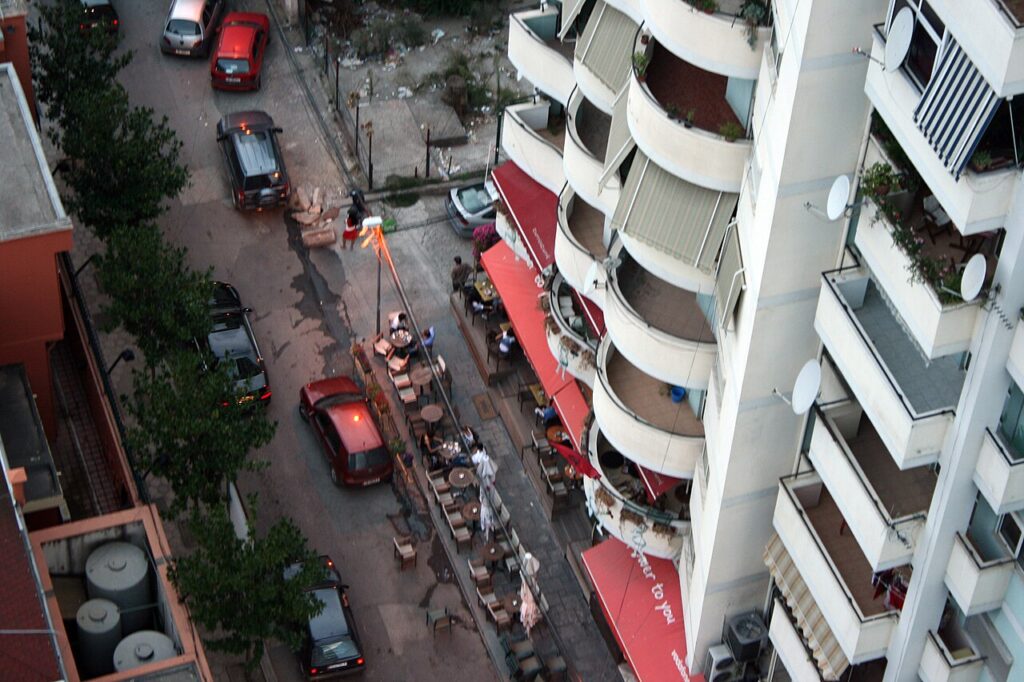
Nightlife in Tirana is vibrant and remarkably affordable. Blloku transforms into a bustling bar and club district every weekend. Cocktail bars, rooftop lounges, live music venues, and underground clubs — there is something for every taste. A cocktail costs $4-7, a beer $2-3. The scene runs late — dinner at 9 PM, bars at 11, clubs until 4 AM or later. Even on weeknights, the terraces are full.
For the full picture — transportation, social customs, nightlife, and weekend trips: Daily Life in Tirana.
The Digital Nomad Scene in Albania
Albania’s digital nomad community has grown from practically nonexistent to genuinely vibrant in just a few years. Tirana, in particular, has positioned itself as a Balkan hub for remote workers — and the math makes sense: fast internet, cheap rent, good coffee, walkable city, one-year visa-free stay.
Coworking Spaces
Tirana now has several dedicated coworking spaces. Some notable ones include Destil Creative Hub, Ofiqi Coworking, and various cafe-coworking hybrids that have popped up around Blloku and the city center. Monthly memberships range from $50-150 depending on the space and plan. Many cafes are also perfectly workable — as long as you order something every couple of hours, nobody cares if you camp with your laptop all day.
The Community
The nomad/expat community in Tirana is still small enough to feel personal but large enough to sustain regular meetups, networking events, and social gatherings. Facebook groups, Telegram channels, and word-of-mouth are the main connectors. Unlike Bali or Lisbon, you will not find a corporate nomad infrastructure — no “nomad hostels” with matching branding and Instagram walls. What you will find is a genuinely interesting mix of people who chose Albania deliberately, not because it was the obvious choice.
For coworking recommendations, community links, and practical nomad tips: Albania for Digital Nomads.
“The best thing about being a nomad in Tirana is that the city does not cater to you, and that is exactly what makes it real. You are living in an actual place, not a nomad theme park.”
— A recurring sentiment from expats I have spoken with
Moving to Albania: The Practical Checklist
If you have read this far and you are seriously considering the move, here is what the actual process looks like.
Before You Arrive
- Passport validity: Ensure your passport is valid for at least 6 months beyond your intended stay.
- Health insurance: Arrange international health insurance before arriving. SafetyWing and Genki are popular among nomads.
- Accommodation: Book an Airbnb or hotel for your first 1-2 weeks while you apartment hunt in person.
- Cash: Bring some euros. You can exchange them at banks or exchange offices (“kembim valutor”) upon arrival.
- VPN: Some streaming services and banking apps may require a VPN. Set one up before you leave.
Your First Week
- SIM card: Buy a local SIM at the airport or any phone shop. Vodafone and One are the main carriers. $5-10 gets you a SIM with data.
- Apartment hunting: Start immediately. Facebook groups + walking neighborhoods + agents.
- Explore your area: Find your local supermarket, cafe, pharmacy, and gym. These become your anchors.
First Month
- Internet: Set up your fiber connection (takes 1-3 days after request).
- Bank account: Open one if needed for long-term stay.
- Residency: If staying beyond the visa-free period, start the permit process early — it takes time.
- Community: Join the Tirana expat Facebook groups and attend meetups. Having a social network makes everything easier.
I have written a complete step-by-step guide for the entire relocation process: Moving to Albania in 2026: The Complete Expat Guide.
The Albanian Diaspora: Coming Back Home
One of the most interesting trends of the last decade is Albanian diaspora members returning home. After the mass emigration of the 1990s and 2000s — when an estimated one-third of Albania’s population left — the reverse current has begun.
Albanians who grew up in Italy, Greece, Germany, the UK, and the US are coming back. Some are returning to start businesses, leveraging their Western experience and connections. Others are drawn by the rising quality of life, the lower cost of living compared to their adopted countries, and the pull of family and culture.
For second-generation Albanians, the experience is uniquely complex. They often speak Albanian with an accent (or not at all), navigate a cultural identity that is genuinely split between two worlds, and face both the warmth and the intensity of Albanian family expectations.
If you are Albanian diaspora considering a return — or even a trial period — I have written about this specifically: Albania for the Diaspora. And for deeper context on the culture itself: Understanding Albanian Culture.
What Nobody Tells You: The Honest Downsides
I love living in Albania. But I would be doing you a disservice if I did not lay out the things that drive me absolutely crazy after 21 years.
Bureaucracy is Byzantine. Any interaction with government offices — taxes, permits, registrations — can be an exercise in patience-testing absurdity. Rules change without notice. Different offices give contradictory information. The phrase “eja neser” (come back tomorrow) is the unofficial national motto of Albanian public administration.
Noise pollution is real. Construction starts at 6 AM (sometimes earlier, illegally). Car horns are used as punctuation. Neighbors play music at volumes that would get you evicted in any Western European city. If you are noise-sensitive, invest in quality earplugs and choose your apartment carefully.
Air quality in Tirana is mediocre. The combination of traffic, construction dust, and winter heating (some areas still burn wood) means Tirana is not winning any clean-air awards. It has improved, but it is not great.
Infrastructure gaps. Sidewalks that end abruptly. Roads that flood after heavy rain. Elevators in new buildings that break down. Public transportation that is unpredictable. These things improve every year, but they are still part of daily life.
The language barrier is real. Many young Albanians speak English, but older generations often do not. Government offices, utility companies, and local businesses operate in Albanian. You do not need to become fluent, but learning basic phrases makes your life significantly easier and earns you enormous goodwill.
“It is not Germany.” This is something I tell every expat who complains about something not working perfectly. Albania is a country in transition. Things are improving at a remarkable pace, but if you need everything to work perfectly, predictably, and on time — you will be constantly frustrated. The people who thrive here are the ones who can laugh at the chaos and appreciate the compensating warmth, beauty, and freedom.
Loneliness can creep in. For all the warmth Albanians show, building deep friendships as a foreigner takes time. Albanian social circles are tight-knit and often family-centered. The expat community helps, but if you are coming from a large city with a robust social life, expect a transition period. The people who do best are those who make an effort to learn some Albanian and participate in local life, not just the expat bubble.
Limited public services. There is no reliable public transit system in Tirana — just an informal network of buses and minibuses (furgonet) with no fixed schedules and no maps. Recycling barely exists. Public parks are improving but still lag behind Western European standards. If you are used to Scandinavian-level public infrastructure, Albania will be a shock. If you are used to most of the rest of the world, it will feel familiar.
The construction boom has a dark side. While new buildings are going up everywhere, the pace of development has outstripped urban planning. Traffic congestion is worsening. Green spaces are being lost to new towers. And some construction is of questionable quality, particularly from smaller developers cutting corners. If you are renting or buying, due diligence on the building itself — not just the apartment — matters.
Frequently Asked Questions
Do I need to speak Albanian to live in Albania?
No, but it helps enormously. In Tirana, you can get by with English in most restaurants, shops, and social situations. However, for government offices, utility companies, landlords, and anything “official,” Albanian is often necessary. Learning even basic phrases (“faleminderit” — thank you, “sa kushton” — how much, “ku eshte” — where is) opens doors and earns genuine respect. There are several language schools in Tirana offering Albanian courses for foreigners.
Can I drive with my foreign license?
You can drive with a foreign license for up to one year. After that, you technically need to convert it to an Albanian license — a process that involves a medical check, a theory test, and a practical exam. Many long-term expats continue driving on their foreign license, but this is a legal gray area. An International Driving Permit (IDP) is also accepted.
Is Albania in the EU?
No, but it is an EU candidate country and has been in accession negotiations since 2022. EU membership is likely still years away, but the process is driving significant reforms in governance, infrastructure, and legal frameworks. For expats, the practical implication is that Albania is not part of the Schengen zone — your time here does not count against your 90/180-day Schengen allowance, which is actually a benefit for travelers who want to split time between Albania and the EU.
What is the tax situation for foreigners?
If you spend more than 183 days per year in Albania, you are considered a tax resident. Albanian tax rates are relatively favorable: income tax ranges from 0% (on the first ~30,000 ALL/month) to 23% on higher incomes. Freelancers operating as small businesses can benefit from simplified tax regimes. However, your home country’s tax obligations may still apply — consult a tax professional who understands both jurisdictions.
Can I buy property in Albania as a foreigner?
Yes. Foreigners can buy apartments and commercial property in Albania without restrictions. Land purchases require establishing a business entity. Property prices in Tirana range from $800-2,000/sqm depending on location and quality, which is still a fraction of Western European prices. The buying process involves a notary, property registration, and due diligence on ownership documents — always use a reputable lawyer.
How do I get to Albania?
Tirana International Airport (TIA) has direct flights to most major European cities including London, Rome, Milan, Vienna, Munich, Istanbul, Athens, and many more. Budget airlines like Wizz Air and Ryanair serve Tirana, making flights surprisingly affordable. The new Vlora International Airport on the southern coast is also open, adding another entry point. Overland, you can enter from Montenegro, Kosovo, North Macedonia, or Greece.
Is Albania good for families with children?
It can be, with some caveats. Albanians adore children, and the family-oriented culture is a genuine plus. There are several international schools in Tirana (World Academy of Tirana, Albanian College, Tirana International School) with instruction in English. Public schools are free but operate in Albanian. The main challenges for families are traffic safety (sidewalks and crossings are unreliable), limited green play spaces compared to Western cities, and the language barrier for younger children. That said, families who commit to it generally find it a wonderful, if imperfect, place to raise kids.
Ready to Make the Move?
Albania is not for everyone. But for the right person — someone who values authenticity over polish, adventure over predictability, and community over convenience — it might be exactly what you are looking for.
I came here 21 years ago on a whim and never left. Not because Albania is perfect — it is spectacularly imperfect. But because it is real. The people are warm, the food is honest, the coffee is strong, the mountains are breathtaking, and the cost of a good life is still within reach of normal people.
If you are considering a move, start with a visit. Rent an Airbnb for a month. Walk the streets. Talk to people. Try the byrek at 7 AM from a street vendor. Sit in a cafe at sunset and watch the xhiro unfold. And then decide.
If you want to go deeper into any aspect of life here, explore the guides I have linked throughout this article. And if you have questions I have not covered, feel free to reach out — after 21 years, there is not much about living in Albania that I have not experienced firsthand.
Explore more:
- Cost of Living in Tirana (2026)
- Is Albania Safe?
- Internet and TV Services in Albania
- Weather in Tirana: Month-by-Month Guide
- Daily Life in Tirana
- Moving to Albania (2026 Expat Guide)
- Albania for Digital Nomads
- Albania for the Diaspora
- Understanding Albanian Culture
- Interactive Albania Map
Continue Exploring Albania
Cost of transfers: If you earn in USD or EUR and need to convert to Lek, the best rates are typically at dedicated exchange offices (“kembim valutor”) rather than banks. The difference can be significant — 1-3% better rates. Western Union and MoneyGram have offices throughout Albania, but Wise transfers from a foreign account are usually the most cost-effective option for regular international transfers.
Weather and Climate
Albania has a Mediterranean climate, which means hot dry summers and mild wet winters. If you are coming from Northern Europe or North America, the weather will feel like a significant upgrade for about eight months of the year.
Summers (June-September) are genuinely hot — 30-38°C (86-100°F) in Tirana, with July and August being peak heat. The coast is more bearable thanks to sea breezes, but the capital can feel sweltering. Air conditioning is not a luxury here; it is a necessity.
Winters (December-February) are mild compared to most of Europe — temperatures hover around 5-12°C (41-54°F) — but the rain can be relentless. January and February are grey and wet. The upside? Snow is rare in Tirana, and the mountains are just 30-60 minutes away if you want a winter sports fix.
Spring and autumn are glorious. March through May and September through November offer perfect weather — warm but not oppressive, with clear skies and golden light that makes the city look its absolute best.
For month-by-month details, temperatures, and packing tips, see: Weather in Tirana: A Month-by-Month Guide.
Daily Life in Tirana
Tirana runs on its own rhythm, and learning that rhythm is the key to enjoying life here.
Mornings start with coffee — always. Albanians take their coffee seriously, and the cafe culture rivals anything in Italy. An espresso costs $0.60-1.00, and lingering for an hour with your laptop is perfectly normal. Nobody will rush you.
The xhiro (evening walk) is a national institution. Every evening, especially in spring and summer, the streets fill with families, couples, and friend groups walking — just walking. The main boulevard, Rruga Deshmoret e Kombit, becomes a promenade. It is social, it is free, and it is one of the most charming aspects of Albanian culture.
Grocery shopping is a mix of modern supermarkets (Spar, Big Market, Conad) and traditional farmers’ markets (pazari). The Pazari i Ri (New Bazaar) in central Tirana is a must-visit — fresh produce, local cheese, olives, honey, meat, and fish at excellent prices.
Dining out is remarkably affordable and the food scene has exploded in recent years. Beyond traditional Albanian cuisine (which is underrated — think slow-cooked lamb, fresh salads, homemade byrek, and tavë kosi), Tirana now has excellent Italian, Japanese, Thai, Mexican, and fusion restaurants.
Transportation in Tirana is evolving. Most expats walk, use ride-hailing apps (Speed, Bolt), or drive their own car. Taxis are cheap (a cross-town ride is $3-5), but always use an app or agree on the price beforehand. Cycling is possible but not for the faint-hearted — bike lanes exist on some main roads but drivers do not always respect them. Many expats buy scooters, which are practical for navigating traffic.
Weekend escapes are one of the best perks of living in Tirana. The beach at Durrës is 30 minutes away. The stunning Albanian Riviera (Dhermi, Himara, Ksamil) is 3-4 hours south. Berat, the “City of a Thousand Windows,” is 2 hours away. The mountains of Theth and Valbona are a day trip north. Kosovo’s capital Pristina is 2.5 hours by road. You could spend years exploring and never run out of places to discover.
Nightlife in Tirana is vibrant and remarkably affordable. Blloku transforms into a bustling bar and club district every weekend. Cocktail bars, rooftop lounges, live music venues, and underground clubs — there is something for every taste. A cocktail costs $4-7, a beer $2-3. The scene runs late — dinner at 9 PM, bars at 11, clubs until 4 AM or later. Even on weeknights, the terraces are full.
For the full picture — transportation, social customs, nightlife, and weekend trips: Daily Life in Tirana.
The Digital Nomad Scene in Albania
Albania’s digital nomad community has grown from practically nonexistent to genuinely vibrant in just a few years. Tirana, in particular, has positioned itself as a Balkan hub for remote workers — and the math makes sense: fast internet, cheap rent, good coffee, walkable city, one-year visa-free stay.
Coworking Spaces
Tirana now has several dedicated coworking spaces. Some notable ones include Destil Creative Hub, Ofiqi Coworking, and various cafe-coworking hybrids that have popped up around Blloku and the city center. Monthly memberships range from $50-150 depending on the space and plan. Many cafes are also perfectly workable — as long as you order something every couple of hours, nobody cares if you camp with your laptop all day.
The Community
The nomad/expat community in Tirana is still small enough to feel personal but large enough to sustain regular meetups, networking events, and social gatherings. Facebook groups, Telegram channels, and word-of-mouth are the main connectors. Unlike Bali or Lisbon, you will not find a corporate nomad infrastructure — no “nomad hostels” with matching branding and Instagram walls. What you will find is a genuinely interesting mix of people who chose Albania deliberately, not because it was the obvious choice.
For coworking recommendations, community links, and practical nomad tips: Albania for Digital Nomads.
“The best thing about being a nomad in Tirana is that the city does not cater to you, and that is exactly what makes it real. You are living in an actual place, not a nomad theme park.”
— A recurring sentiment from expats I have spoken with
Moving to Albania: The Practical Checklist
If you have read this far and you are seriously considering the move, here is what the actual process looks like.
Before You Arrive
- Passport validity: Ensure your passport is valid for at least 6 months beyond your intended stay.
- Health insurance: Arrange international health insurance before arriving. SafetyWing and Genki are popular among nomads.
- Accommodation: Book an Airbnb or hotel for your first 1-2 weeks while you apartment hunt in person.
- Cash: Bring some euros. You can exchange them at banks or exchange offices (“kembim valutor”) upon arrival.
- VPN: Some streaming services and banking apps may require a VPN. Set one up before you leave.
Your First Week
- SIM card: Buy a local SIM at the airport or any phone shop. Vodafone and One are the main carriers. $5-10 gets you a SIM with data.
- Apartment hunting: Start immediately. Facebook groups + walking neighborhoods + agents.
- Explore your area: Find your local supermarket, cafe, pharmacy, and gym. These become your anchors.
First Month
- Internet: Set up your fiber connection (takes 1-3 days after request).
- Bank account: Open one if needed for long-term stay.
- Residency: If staying beyond the visa-free period, start the permit process early — it takes time.
- Community: Join the Tirana expat Facebook groups and attend meetups. Having a social network makes everything easier.
I have written a complete step-by-step guide for the entire relocation process: Moving to Albania in 2026: The Complete Expat Guide.
The Albanian Diaspora: Coming Back Home
One of the most interesting trends of the last decade is Albanian diaspora members returning home. After the mass emigration of the 1990s and 2000s — when an estimated one-third of Albania’s population left — the reverse current has begun.
Albanians who grew up in Italy, Greece, Germany, the UK, and the US are coming back. Some are returning to start businesses, leveraging their Western experience and connections. Others are drawn by the rising quality of life, the lower cost of living compared to their adopted countries, and the pull of family and culture.
For second-generation Albanians, the experience is uniquely complex. They often speak Albanian with an accent (or not at all), navigate a cultural identity that is genuinely split between two worlds, and face both the warmth and the intensity of Albanian family expectations.
If you are Albanian diaspora considering a return — or even a trial period — I have written about this specifically: Albania for the Diaspora. And for deeper context on the culture itself: Understanding Albanian Culture.
What Nobody Tells You: The Honest Downsides
I love living in Albania. But I would be doing you a disservice if I did not lay out the things that drive me absolutely crazy after 21 years.
Bureaucracy is Byzantine. Any interaction with government offices — taxes, permits, registrations — can be an exercise in patience-testing absurdity. Rules change without notice. Different offices give contradictory information. The phrase “eja neser” (come back tomorrow) is the unofficial national motto of Albanian public administration.
Noise pollution is real. Construction starts at 6 AM (sometimes earlier, illegally). Car horns are used as punctuation. Neighbors play music at volumes that would get you evicted in any Western European city. If you are noise-sensitive, invest in quality earplugs and choose your apartment carefully.
Air quality in Tirana is mediocre. The combination of traffic, construction dust, and winter heating (some areas still burn wood) means Tirana is not winning any clean-air awards. It has improved, but it is not great.
Infrastructure gaps. Sidewalks that end abruptly. Roads that flood after heavy rain. Elevators in new buildings that break down. Public transportation that is unpredictable. These things improve every year, but they are still part of daily life.
The language barrier is real. Many young Albanians speak English, but older generations often do not. Government offices, utility companies, and local businesses operate in Albanian. You do not need to become fluent, but learning basic phrases makes your life significantly easier and earns you enormous goodwill.
“It is not Germany.” This is something I tell every expat who complains about something not working perfectly. Albania is a country in transition. Things are improving at a remarkable pace, but if you need everything to work perfectly, predictably, and on time — you will be constantly frustrated. The people who thrive here are the ones who can laugh at the chaos and appreciate the compensating warmth, beauty, and freedom.
Loneliness can creep in. For all the warmth Albanians show, building deep friendships as a foreigner takes time. Albanian social circles are tight-knit and often family-centered. The expat community helps, but if you are coming from a large city with a robust social life, expect a transition period. The people who do best are those who make an effort to learn some Albanian and participate in local life, not just the expat bubble.
Limited public services. There is no reliable public transit system in Tirana — just an informal network of buses and minibuses (furgonet) with no fixed schedules and no maps. Recycling barely exists. Public parks are improving but still lag behind Western European standards. If you are used to Scandinavian-level public infrastructure, Albania will be a shock. If you are used to most of the rest of the world, it will feel familiar.
The construction boom has a dark side. While new buildings are going up everywhere, the pace of development has outstripped urban planning. Traffic congestion is worsening. Green spaces are being lost to new towers. And some construction is of questionable quality, particularly from smaller developers cutting corners. If you are renting or buying, due diligence on the building itself — not just the apartment — matters.
Frequently Asked Questions
Do I need to speak Albanian to live in Albania?
No, but it helps enormously. In Tirana, you can get by with English in most restaurants, shops, and social situations. However, for government offices, utility companies, landlords, and anything “official,” Albanian is often necessary. Learning even basic phrases (“faleminderit” — thank you, “sa kushton” — how much, “ku eshte” — where is) opens doors and earns genuine respect. There are several language schools in Tirana offering Albanian courses for foreigners.
Can I drive with my foreign license?
You can drive with a foreign license for up to one year. After that, you technically need to convert it to an Albanian license — a process that involves a medical check, a theory test, and a practical exam. Many long-term expats continue driving on their foreign license, but this is a legal gray area. An International Driving Permit (IDP) is also accepted.
Is Albania in the EU?
No, but it is an EU candidate country and has been in accession negotiations since 2022. EU membership is likely still years away, but the process is driving significant reforms in governance, infrastructure, and legal frameworks. For expats, the practical implication is that Albania is not part of the Schengen zone — your time here does not count against your 90/180-day Schengen allowance, which is actually a benefit for travelers who want to split time between Albania and the EU.
What is the tax situation for foreigners?
If you spend more than 183 days per year in Albania, you are considered a tax resident. Albanian tax rates are relatively favorable: income tax ranges from 0% (on the first ~30,000 ALL/month) to 23% on higher incomes. Freelancers operating as small businesses can benefit from simplified tax regimes. However, your home country’s tax obligations may still apply — consult a tax professional who understands both jurisdictions.
Can I buy property in Albania as a foreigner?
Yes. Foreigners can buy apartments and commercial property in Albania without restrictions. Land purchases require establishing a business entity. Property prices in Tirana range from $800-2,000/sqm depending on location and quality, which is still a fraction of Western European prices. The buying process involves a notary, property registration, and due diligence on ownership documents — always use a reputable lawyer.
How do I get to Albania?
Tirana International Airport (TIA) has direct flights to most major European cities including London, Rome, Milan, Vienna, Munich, Istanbul, Athens, and many more. Budget airlines like Wizz Air and Ryanair serve Tirana, making flights surprisingly affordable. The new Vlora International Airport on the southern coast is also open, adding another entry point. Overland, you can enter from Montenegro, Kosovo, North Macedonia, or Greece.
Is Albania good for families with children?
It can be, with some caveats. Albanians adore children, and the family-oriented culture is a genuine plus. There are several international schools in Tirana (World Academy of Tirana, Albanian College, Tirana International School) with instruction in English. Public schools are free but operate in Albanian. The main challenges for families are traffic safety (sidewalks and crossings are unreliable), limited green play spaces compared to Western cities, and the language barrier for younger children. That said, families who commit to it generally find it a wonderful, if imperfect, place to raise kids.
Ready to Make the Move?
Albania is not for everyone. But for the right person — someone who values authenticity over polish, adventure over predictability, and community over convenience — it might be exactly what you are looking for.
I came here 21 years ago on a whim and never left. Not because Albania is perfect — it is spectacularly imperfect. But because it is real. The people are warm, the food is honest, the coffee is strong, the mountains are breathtaking, and the cost of a good life is still within reach of normal people.
If you are considering a move, start with a visit. Rent an Airbnb for a month. Walk the streets. Talk to people. Try the byrek at 7 AM from a street vendor. Sit in a cafe at sunset and watch the xhiro unfold. And then decide.
If you want to go deeper into any aspect of life here, explore the guides I have linked throughout this article. And if you have questions I have not covered, feel free to reach out — after 21 years, there is not much about living in Albania that I have not experienced firsthand.
Explore more:
- Cost of Living in Tirana (2026)
- Is Albania Safe?
- Internet and TV Services in Albania
- Weather in Tirana: Month-by-Month Guide
- Daily Life in Tirana
- Moving to Albania (2026 Expat Guide)
- Albania for Digital Nomads
- Albania for the Diaspora
- Understanding Albanian Culture
- Interactive Albania Map
Continue Exploring Albania
Emergency services: The national emergency number is 127 for ambulance. Response times in Tirana are generally reasonable, though not as fast as you might expect in Western Europe. For serious emergencies, most expats go directly to a private hospital rather than waiting for an ambulance. Having the address of your nearest private hospital saved on your phone is practical advice.
Banking and Money in Albania
Albania uses the Lek (ALL) as its currency, but euros are widely accepted and the dual-currency reality is something every expat needs to understand.
The Basics
- Exchange rate: Approximately 100 ALL = $1 USD (or about 100 ALL = 0.90 EUR). The rate fluctuates, but this round number makes mental math easy.
- Cash is still king. Albania is modernizing fast, but many smaller shops, restaurants, and services are cash-only. Always carry Lek.
- ATMs are everywhere. International cards (Visa, Mastercard) work at all major bank ATMs. Withdrawal fees vary — Raiffeisen, Intesa Sanpaolo, and BKT are the most reliable.
- Wise/Revolut: Many expats use Wise (TransferWise) or Revolut for daily transactions. Wise cards work at most POS terminals in Tirana. Revolut has been gaining acceptance.
Opening a Bank Account
Opening a local bank account is possible but not always straightforward for foreigners. You will typically need your passport, a residency permit (or proof of address), and patience. Raiffeisen Bank and BKT tend to be the most expat-friendly. Having a local bank account is useful for paying rent, utilities, and local subscriptions.
Pro tip: Many landlords prefer cash payments in euros. This is technically a gray area, but it is the norm. If you are paying rent this way, keep records for your own bookkeeping.
Cryptocurrency: Albania has a growing crypto-friendly reputation. Several crypto exchanges operate locally, and there are Bitcoin ATMs in Tirana. The regulatory framework is still evolving, but the general environment is permissive. Some expats use crypto for international transfers to avoid traditional banking fees and delays.
Cost of transfers: If you earn in USD or EUR and need to convert to Lek, the best rates are typically at dedicated exchange offices (“kembim valutor”) rather than banks. The difference can be significant — 1-3% better rates. Western Union and MoneyGram have offices throughout Albania, but Wise transfers from a foreign account are usually the most cost-effective option for regular international transfers.
Weather and Climate
Albania has a Mediterranean climate, which means hot dry summers and mild wet winters. If you are coming from Northern Europe or North America, the weather will feel like a significant upgrade for about eight months of the year.
Summers (June-September) are genuinely hot — 30-38°C (86-100°F) in Tirana, with July and August being peak heat. The coast is more bearable thanks to sea breezes, but the capital can feel sweltering. Air conditioning is not a luxury here; it is a necessity.
Winters (December-February) are mild compared to most of Europe — temperatures hover around 5-12°C (41-54°F) — but the rain can be relentless. January and February are grey and wet. The upside? Snow is rare in Tirana, and the mountains are just 30-60 minutes away if you want a winter sports fix.
Spring and autumn are glorious. March through May and September through November offer perfect weather — warm but not oppressive, with clear skies and golden light that makes the city look its absolute best.
For month-by-month details, temperatures, and packing tips, see: Weather in Tirana: A Month-by-Month Guide.
Daily Life in Tirana
Tirana runs on its own rhythm, and learning that rhythm is the key to enjoying life here.
Mornings start with coffee — always. Albanians take their coffee seriously, and the cafe culture rivals anything in Italy. An espresso costs $0.60-1.00, and lingering for an hour with your laptop is perfectly normal. Nobody will rush you.
The xhiro (evening walk) is a national institution. Every evening, especially in spring and summer, the streets fill with families, couples, and friend groups walking — just walking. The main boulevard, Rruga Deshmoret e Kombit, becomes a promenade. It is social, it is free, and it is one of the most charming aspects of Albanian culture.
Grocery shopping is a mix of modern supermarkets (Spar, Big Market, Conad) and traditional farmers’ markets (pazari). The Pazari i Ri (New Bazaar) in central Tirana is a must-visit — fresh produce, local cheese, olives, honey, meat, and fish at excellent prices.
Dining out is remarkably affordable and the food scene has exploded in recent years. Beyond traditional Albanian cuisine (which is underrated — think slow-cooked lamb, fresh salads, homemade byrek, and tavë kosi), Tirana now has excellent Italian, Japanese, Thai, Mexican, and fusion restaurants.
Transportation in Tirana is evolving. Most expats walk, use ride-hailing apps (Speed, Bolt), or drive their own car. Taxis are cheap (a cross-town ride is $3-5), but always use an app or agree on the price beforehand. Cycling is possible but not for the faint-hearted — bike lanes exist on some main roads but drivers do not always respect them. Many expats buy scooters, which are practical for navigating traffic.
Weekend escapes are one of the best perks of living in Tirana. The beach at Durrës is 30 minutes away. The stunning Albanian Riviera (Dhermi, Himara, Ksamil) is 3-4 hours south. Berat, the “City of a Thousand Windows,” is 2 hours away. The mountains of Theth and Valbona are a day trip north. Kosovo’s capital Pristina is 2.5 hours by road. You could spend years exploring and never run out of places to discover.
Nightlife in Tirana is vibrant and remarkably affordable. Blloku transforms into a bustling bar and club district every weekend. Cocktail bars, rooftop lounges, live music venues, and underground clubs — there is something for every taste. A cocktail costs $4-7, a beer $2-3. The scene runs late — dinner at 9 PM, bars at 11, clubs until 4 AM or later. Even on weeknights, the terraces are full.
For the full picture — transportation, social customs, nightlife, and weekend trips: Daily Life in Tirana.
The Digital Nomad Scene in Albania
Albania’s digital nomad community has grown from practically nonexistent to genuinely vibrant in just a few years. Tirana, in particular, has positioned itself as a Balkan hub for remote workers — and the math makes sense: fast internet, cheap rent, good coffee, walkable city, one-year visa-free stay.
Coworking Spaces
Tirana now has several dedicated coworking spaces. Some notable ones include Destil Creative Hub, Ofiqi Coworking, and various cafe-coworking hybrids that have popped up around Blloku and the city center. Monthly memberships range from $50-150 depending on the space and plan. Many cafes are also perfectly workable — as long as you order something every couple of hours, nobody cares if you camp with your laptop all day.
The Community
The nomad/expat community in Tirana is still small enough to feel personal but large enough to sustain regular meetups, networking events, and social gatherings. Facebook groups, Telegram channels, and word-of-mouth are the main connectors. Unlike Bali or Lisbon, you will not find a corporate nomad infrastructure — no “nomad hostels” with matching branding and Instagram walls. What you will find is a genuinely interesting mix of people who chose Albania deliberately, not because it was the obvious choice.
For coworking recommendations, community links, and practical nomad tips: Albania for Digital Nomads.
“The best thing about being a nomad in Tirana is that the city does not cater to you, and that is exactly what makes it real. You are living in an actual place, not a nomad theme park.”
— A recurring sentiment from expats I have spoken with
Moving to Albania: The Practical Checklist
If you have read this far and you are seriously considering the move, here is what the actual process looks like.
Before You Arrive
- Passport validity: Ensure your passport is valid for at least 6 months beyond your intended stay.
- Health insurance: Arrange international health insurance before arriving. SafetyWing and Genki are popular among nomads.
- Accommodation: Book an Airbnb or hotel for your first 1-2 weeks while you apartment hunt in person.
- Cash: Bring some euros. You can exchange them at banks or exchange offices (“kembim valutor”) upon arrival.
- VPN: Some streaming services and banking apps may require a VPN. Set one up before you leave.
Your First Week
- SIM card: Buy a local SIM at the airport or any phone shop. Vodafone and One are the main carriers. $5-10 gets you a SIM with data.
- Apartment hunting: Start immediately. Facebook groups + walking neighborhoods + agents.
- Explore your area: Find your local supermarket, cafe, pharmacy, and gym. These become your anchors.
First Month
- Internet: Set up your fiber connection (takes 1-3 days after request).
- Bank account: Open one if needed for long-term stay.
- Residency: If staying beyond the visa-free period, start the permit process early — it takes time.
- Community: Join the Tirana expat Facebook groups and attend meetups. Having a social network makes everything easier.
I have written a complete step-by-step guide for the entire relocation process: Moving to Albania in 2026: The Complete Expat Guide.
The Albanian Diaspora: Coming Back Home
One of the most interesting trends of the last decade is Albanian diaspora members returning home. After the mass emigration of the 1990s and 2000s — when an estimated one-third of Albania’s population left — the reverse current has begun.
Albanians who grew up in Italy, Greece, Germany, the UK, and the US are coming back. Some are returning to start businesses, leveraging their Western experience and connections. Others are drawn by the rising quality of life, the lower cost of living compared to their adopted countries, and the pull of family and culture.
For second-generation Albanians, the experience is uniquely complex. They often speak Albanian with an accent (or not at all), navigate a cultural identity that is genuinely split between two worlds, and face both the warmth and the intensity of Albanian family expectations.
If you are Albanian diaspora considering a return — or even a trial period — I have written about this specifically: Albania for the Diaspora. And for deeper context on the culture itself: Understanding Albanian Culture.
What Nobody Tells You: The Honest Downsides
I love living in Albania. But I would be doing you a disservice if I did not lay out the things that drive me absolutely crazy after 21 years.
Bureaucracy is Byzantine. Any interaction with government offices — taxes, permits, registrations — can be an exercise in patience-testing absurdity. Rules change without notice. Different offices give contradictory information. The phrase “eja neser” (come back tomorrow) is the unofficial national motto of Albanian public administration.
Noise pollution is real. Construction starts at 6 AM (sometimes earlier, illegally). Car horns are used as punctuation. Neighbors play music at volumes that would get you evicted in any Western European city. If you are noise-sensitive, invest in quality earplugs and choose your apartment carefully.
Air quality in Tirana is mediocre. The combination of traffic, construction dust, and winter heating (some areas still burn wood) means Tirana is not winning any clean-air awards. It has improved, but it is not great.
Infrastructure gaps. Sidewalks that end abruptly. Roads that flood after heavy rain. Elevators in new buildings that break down. Public transportation that is unpredictable. These things improve every year, but they are still part of daily life.
The language barrier is real. Many young Albanians speak English, but older generations often do not. Government offices, utility companies, and local businesses operate in Albanian. You do not need to become fluent, but learning basic phrases makes your life significantly easier and earns you enormous goodwill.
“It is not Germany.” This is something I tell every expat who complains about something not working perfectly. Albania is a country in transition. Things are improving at a remarkable pace, but if you need everything to work perfectly, predictably, and on time — you will be constantly frustrated. The people who thrive here are the ones who can laugh at the chaos and appreciate the compensating warmth, beauty, and freedom.
Loneliness can creep in. For all the warmth Albanians show, building deep friendships as a foreigner takes time. Albanian social circles are tight-knit and often family-centered. The expat community helps, but if you are coming from a large city with a robust social life, expect a transition period. The people who do best are those who make an effort to learn some Albanian and participate in local life, not just the expat bubble.
Limited public services. There is no reliable public transit system in Tirana — just an informal network of buses and minibuses (furgonet) with no fixed schedules and no maps. Recycling barely exists. Public parks are improving but still lag behind Western European standards. If you are used to Scandinavian-level public infrastructure, Albania will be a shock. If you are used to most of the rest of the world, it will feel familiar.
The construction boom has a dark side. While new buildings are going up everywhere, the pace of development has outstripped urban planning. Traffic congestion is worsening. Green spaces are being lost to new towers. And some construction is of questionable quality, particularly from smaller developers cutting corners. If you are renting or buying, due diligence on the building itself — not just the apartment — matters.
Frequently Asked Questions
Do I need to speak Albanian to live in Albania?
No, but it helps enormously. In Tirana, you can get by with English in most restaurants, shops, and social situations. However, for government offices, utility companies, landlords, and anything “official,” Albanian is often necessary. Learning even basic phrases (“faleminderit” — thank you, “sa kushton” — how much, “ku eshte” — where is) opens doors and earns genuine respect. There are several language schools in Tirana offering Albanian courses for foreigners.
Can I drive with my foreign license?
You can drive with a foreign license for up to one year. After that, you technically need to convert it to an Albanian license — a process that involves a medical check, a theory test, and a practical exam. Many long-term expats continue driving on their foreign license, but this is a legal gray area. An International Driving Permit (IDP) is also accepted.
Is Albania in the EU?
No, but it is an EU candidate country and has been in accession negotiations since 2022. EU membership is likely still years away, but the process is driving significant reforms in governance, infrastructure, and legal frameworks. For expats, the practical implication is that Albania is not part of the Schengen zone — your time here does not count against your 90/180-day Schengen allowance, which is actually a benefit for travelers who want to split time between Albania and the EU.
What is the tax situation for foreigners?
If you spend more than 183 days per year in Albania, you are considered a tax resident. Albanian tax rates are relatively favorable: income tax ranges from 0% (on the first ~30,000 ALL/month) to 23% on higher incomes. Freelancers operating as small businesses can benefit from simplified tax regimes. However, your home country’s tax obligations may still apply — consult a tax professional who understands both jurisdictions.
Can I buy property in Albania as a foreigner?
Yes. Foreigners can buy apartments and commercial property in Albania without restrictions. Land purchases require establishing a business entity. Property prices in Tirana range from $800-2,000/sqm depending on location and quality, which is still a fraction of Western European prices. The buying process involves a notary, property registration, and due diligence on ownership documents — always use a reputable lawyer.
How do I get to Albania?
Tirana International Airport (TIA) has direct flights to most major European cities including London, Rome, Milan, Vienna, Munich, Istanbul, Athens, and many more. Budget airlines like Wizz Air and Ryanair serve Tirana, making flights surprisingly affordable. The new Vlora International Airport on the southern coast is also open, adding another entry point. Overland, you can enter from Montenegro, Kosovo, North Macedonia, or Greece.
Is Albania good for families with children?
It can be, with some caveats. Albanians adore children, and the family-oriented culture is a genuine plus. There are several international schools in Tirana (World Academy of Tirana, Albanian College, Tirana International School) with instruction in English. Public schools are free but operate in Albanian. The main challenges for families are traffic safety (sidewalks and crossings are unreliable), limited green play spaces compared to Western cities, and the language barrier for younger children. That said, families who commit to it generally find it a wonderful, if imperfect, place to raise kids.
Ready to Make the Move?
Albania is not for everyone. But for the right person — someone who values authenticity over polish, adventure over predictability, and community over convenience — it might be exactly what you are looking for.
I came here 21 years ago on a whim and never left. Not because Albania is perfect — it is spectacularly imperfect. But because it is real. The people are warm, the food is honest, the coffee is strong, the mountains are breathtaking, and the cost of a good life is still within reach of normal people.
If you are considering a move, start with a visit. Rent an Airbnb for a month. Walk the streets. Talk to people. Try the byrek at 7 AM from a street vendor. Sit in a cafe at sunset and watch the xhiro unfold. And then decide.
If you want to go deeper into any aspect of life here, explore the guides I have linked throughout this article. And if you have questions I have not covered, feel free to reach out — after 21 years, there is not much about living in Albania that I have not experienced firsthand.
Explore more:
- Cost of Living in Tirana (2026)
- Is Albania Safe?
- Internet and TV Services in Albania
- Weather in Tirana: Month-by-Month Guide
- Daily Life in Tirana
- Moving to Albania (2026 Expat Guide)
- Albania for Digital Nomads
- Albania for the Diaspora
- Understanding Albanian Culture
- Interactive Albania Map
Continue Exploring Albania
Albania is a small country — roughly the size of Massachusetts, with a population of about 2.8 million. But what it lacks in size, it makes up for in geographic and cultural diversity. Within two hours of Tirana, you can be at pristine beaches on the Albanian Riviera, hiking in the Accursed Mountains, exploring Ottoman-era cities like Berat and Gjirokastrë (both UNESCO World Heritage sites), or crossing into Greece, North Macedonia, or Kosovo. The country punches well above its weight in natural beauty.
Cost of Living in Albania: The Real Numbers
Albania remains one of the most affordable countries in Europe, but it is not as dirt-cheap as some YouTube videos would have you believe. Tirana, in particular, has seen significant price increases since 2020 — driven by inflation, the construction boom, and the influx of foreign renters willing to pay higher prices.
Here is a realistic snapshot for 2026:
| Expense | Monthly Cost (Tirana) |
|---|---|
| 1-bedroom apartment (city center) | $400-600 |
| 1-bedroom apartment (outside center) | $250-400 |
| Utilities (electric, water, heating) | $60-120 |
| Groceries (one person) | $200-300 |
| Eating out (mid-range restaurant) | $8-15 per meal |
| Coffee (espresso at a cafe) | $0.60-1.00 |
| Beer (at a bar) | $1.50-3.00 |
| Internet (fiber, unlimited) | $15-25 |
| Mobile plan (unlimited data) | $8-15 |
| Gym membership | $25-45 |
Bottom line: A single person can live comfortably in Tirana for $1,000-1,500/month. A couple, $1,500-2,200. If you want a car, add another $200-300 for fuel, insurance, and parking. These numbers assume a normal lifestyle — not extreme frugality, but not luxury either.
For a much deeper breakdown with neighborhood-by-neighborhood comparisons, I have written a dedicated guide: Cost of Living in Tirana (2026).
Is Albania Safe? (Short Answer: Yes)
This is, without fail, the first question every potential expat asks. And I understand why — Albania has a reputation problem. Hollywood, the news cycle, and plain ignorance have created an image of Albania as some kind of lawless frontier. The reality could not be more different.
I have lived in Tirana for over two decades. I walk home at 2 AM through the city center. My wife walks alone at night. I have never once felt physically unsafe, and I have never been a victim of crime beyond a pickpocket attempt on a crowded bus in 2011.
Violent crime against foreigners is extremely rare. Petty crime exists — as it does in every European city — but at rates lower than Rome, Barcelona, or Paris. The real dangers in Albania are not criminal. They are:
- Traffic. Albanian driving is aggressive, chaotic, and frequently terrifying. Pedestrian crossings are decorative. This is genuinely the biggest physical risk you face.
- Construction quality. Some older buildings have questionable electrical and structural standards.
- Scams. Overcharging tourists at restaurants or taxis. Always agree on a price beforehand or use the app-based services.
For a thorough breakdown including data, neighborhood-specific safety info, and practical tips, read my full guide: Is Albania Safe?
Finding an Apartment in Tirana
The Tirana rental market is a wild ride, and it operates on rules that will make no sense if you are coming from the West. There is no MLS, no standardized listings, and half the best apartments never make it online. Welcome to Albania.
The Best Neighborhoods for Expats
| Neighborhood | Vibe | Rent (1BR) | Best For |
|---|---|---|---|
| Blloku | Trendy, nightlife, cafes | $450-700 | Young professionals, social nomads |
| Qendra (Center) | Central, walkable, busy | $400-650 | Walkability, access to everything |
| Liqeni i Thate | New builds, parks, quiet | $500-800 | Families, couples, long-term residents |
| Komuna e Parisit | Residential, local feel | $300-450 | Budget-conscious, authentic experience |
| Sauk / Lunder | Suburban, green, spacious | $350-550 | Families who want space and nature |
How to Actually Find an Apartment
Online platforms: Merrjep.al and Njoftime.com are the Albanian equivalents of Craigslist. Facebook groups are equally important — search for “Apartments for Rent in Tirana” or “Tirana Expats” groups. Listings are a mix of Albanian and English.
Real estate agents: Local agents (agjenci imobiliare) are everywhere. They typically charge one month’s rent as commission. Some are excellent, some are useless. Ask other expats for recommendations.
Walking around: Seriously. Many landlords just tape a phone number to the window. If you see “Jepet me qira” (For Rent) on a building, call the number. Have a local friend help if your Albanian is limited.
Practical Tips
- Never rent without seeing the apartment in person. Photos can be misleading (and sometimes from a completely different apartment).
- Check the water pressure and heating. Many buildings have water tanks on the roof. If you are on a high floor, pressure can be low. Central heating is rare — most apartments use AC units for both heating and cooling.
- Negotiate. Listed prices are almost always negotiable, especially for long-term leases (6+ months). Offering to pay several months upfront gives you leverage.
- Get a contract. Many landlords prefer informal agreements. Insist on a written contract, especially if you will need it for residency applications.
- Furnished vs. unfurnished: Most rental apartments come furnished, often with questionable taste. If the furniture is truly awful, most landlords will remove it so you can bring your own.
Visas and Residency: Albania’s Secret Weapon
This is where Albania absolutely destroys the competition. While countries like Portugal, Spain, and Thailand have been tightening their visa rules, Albania went the opposite direction.
Here is the headline: citizens of the EU, US, UK, Canada, Australia, and most Western nations can stay in Albania for up to one full year without a visa. Not 90 days. Not 180 days. A full 365 days. This policy, implemented as a rolling program and consistently renewed, makes Albania the easiest country in Europe for extended stays.
Your Residency Options
- Visa-free stay (up to 1 year): For most Western nationalities. No paperwork, no registration. Just show up with your passport. When the year is up, do a border run and start fresh.
- Temporary residence permit: If you want to stay officially, you can apply for a 1-year residence permit. Requires a rental contract, proof of income or employment, health insurance, and a clean criminal record. Process takes 30-60 days and costs around $50-100 in fees.
- Work permit: Required if you are employed by an Albanian company. Your employer typically handles the process. Freelancers and remote workers operating for foreign companies do not technically need one.
- Business registration: Opening a business in Albania is straightforward. An LLC (SHPK) can be registered in 1-2 days. Flat corporate tax of 15%, and small businesses under a certain revenue threshold pay 0%.
- Digital nomad visa: Albania launched a specific program to attract remote workers. While details evolve, the general framework offers a streamlined path for people who can prove remote income.
“I have helped dozens of friends and clients navigate the Albanian residency process. The bureaucracy can be frustrating — this is the Balkans, after all — but the policies themselves are genuinely welcoming. Albania wants you here.”
— Elvis Plaku
Internet and Connectivity
If you work remotely, this section is probably your biggest concern. Here is the good news: Albanian internet has improved dramatically.
Fiber-optic connections are widely available in Tirana and most major cities. The main providers — Albtelecom, Tring, Vodafone, and One — offer plans ranging from 100 Mbps to 500 Mbps. Prices are extremely reasonable: expect to pay $15-25/month for a fast fiber connection.
In my home office in Tirana, I consistently get 200+ Mbps download and 50+ Mbps upload speeds. That is more than enough for video calls, large file transfers, and running a web development agency with international clients.
The caveats:
- Power outages: These have decreased dramatically but still happen, especially in summer. A good UPS (uninterruptible power supply) is essential for remote workers. Cost: $40-80.
- Rural areas: Outside major cities, speeds drop significantly. If you are planning to live in a village or on the coast, check connectivity before committing.
- Mobile data: 4G coverage is excellent across the country. 5G is being rolled out in Tirana. Unlimited mobile data plans cost $8-15/month — useful as a backup.
For provider comparisons, speed tests, and setup tips, check my dedicated guide: Internet and TV Services in Albania.
Healthcare in Albania
Albanian healthcare is a tale of two systems: the public one, which is underfunded and often frustrating, and the private one, which is surprisingly good and shockingly affordable.
Public Healthcare
The public system is technically free for residents, but the reality is more complicated. Public hospitals are often crowded, equipment can be outdated, and the cultural practice of giving “envelope payments” (informal tips to doctors) persists, though it is declining. For minor issues, public clinics are fine. For anything serious, most expats and middle-class Albanians go private.
Private Healthcare
This is where it gets interesting. Tirana has several excellent private hospitals and clinics — Hygeia, American Hospital, German Hospital, and others — with modern equipment, English-speaking doctors (many trained in Italy, Germany, or the US), and prices that would make a Western insurance company weep with joy.
| Service | Typical Cost |
|---|---|
| GP consultation (private) | $20-40 |
| Specialist consultation | $30-60 |
| Blood work panel | $15-40 |
| MRI scan | $100-200 |
| Dental cleaning | $25-50 |
| Dental crown | $100-250 |
| Eye exam + prescription | $15-30 |
Dental tourism is becoming a real thing in Albania. I have had friends fly in from London specifically to get dental work done here — even with the flight cost, they saved thousands.
Health insurance: International health insurance (SafetyWing, Cigna Global, etc.) works in Albania and is recommended for expats. Local private insurance is also available for $200-500/year and covers most private hospital visits.
Pharmacies are everywhere in Albania — on practically every block in Tirana. Many medications that require prescriptions in Western countries are available over the counter here (antibiotics, for example, though this is technically changing with EU-aligned regulation). Pharmacists often speak some English and can advise on common ailments. Prices for medications are significantly lower than in the US or Western Europe.
Emergency services: The national emergency number is 127 for ambulance. Response times in Tirana are generally reasonable, though not as fast as you might expect in Western Europe. For serious emergencies, most expats go directly to a private hospital rather than waiting for an ambulance. Having the address of your nearest private hospital saved on your phone is practical advice.
Banking and Money in Albania
Albania uses the Lek (ALL) as its currency, but euros are widely accepted and the dual-currency reality is something every expat needs to understand.
The Basics
- Exchange rate: Approximately 100 ALL = $1 USD (or about 100 ALL = 0.90 EUR). The rate fluctuates, but this round number makes mental math easy.
- Cash is still king. Albania is modernizing fast, but many smaller shops, restaurants, and services are cash-only. Always carry Lek.
- ATMs are everywhere. International cards (Visa, Mastercard) work at all major bank ATMs. Withdrawal fees vary — Raiffeisen, Intesa Sanpaolo, and BKT are the most reliable.
- Wise/Revolut: Many expats use Wise (TransferWise) or Revolut for daily transactions. Wise cards work at most POS terminals in Tirana. Revolut has been gaining acceptance.
Opening a Bank Account
Opening a local bank account is possible but not always straightforward for foreigners. You will typically need your passport, a residency permit (or proof of address), and patience. Raiffeisen Bank and BKT tend to be the most expat-friendly. Having a local bank account is useful for paying rent, utilities, and local subscriptions.
Pro tip: Many landlords prefer cash payments in euros. This is technically a gray area, but it is the norm. If you are paying rent this way, keep records for your own bookkeeping.
Cryptocurrency: Albania has a growing crypto-friendly reputation. Several crypto exchanges operate locally, and there are Bitcoin ATMs in Tirana. The regulatory framework is still evolving, but the general environment is permissive. Some expats use crypto for international transfers to avoid traditional banking fees and delays.
Cost of transfers: If you earn in USD or EUR and need to convert to Lek, the best rates are typically at dedicated exchange offices (“kembim valutor”) rather than banks. The difference can be significant — 1-3% better rates. Western Union and MoneyGram have offices throughout Albania, but Wise transfers from a foreign account are usually the most cost-effective option for regular international transfers.
Weather and Climate
Albania has a Mediterranean climate, which means hot dry summers and mild wet winters. If you are coming from Northern Europe or North America, the weather will feel like a significant upgrade for about eight months of the year.
Summers (June-September) are genuinely hot — 30-38°C (86-100°F) in Tirana, with July and August being peak heat. The coast is more bearable thanks to sea breezes, but the capital can feel sweltering. Air conditioning is not a luxury here; it is a necessity.
Winters (December-February) are mild compared to most of Europe — temperatures hover around 5-12°C (41-54°F) — but the rain can be relentless. January and February are grey and wet. The upside? Snow is rare in Tirana, and the mountains are just 30-60 minutes away if you want a winter sports fix.
Spring and autumn are glorious. March through May and September through November offer perfect weather — warm but not oppressive, with clear skies and golden light that makes the city look its absolute best.
For month-by-month details, temperatures, and packing tips, see: Weather in Tirana: A Month-by-Month Guide.
Daily Life in Tirana
Tirana runs on its own rhythm, and learning that rhythm is the key to enjoying life here.
Mornings start with coffee — always. Albanians take their coffee seriously, and the cafe culture rivals anything in Italy. An espresso costs $0.60-1.00, and lingering for an hour with your laptop is perfectly normal. Nobody will rush you.
The xhiro (evening walk) is a national institution. Every evening, especially in spring and summer, the streets fill with families, couples, and friend groups walking — just walking. The main boulevard, Rruga Deshmoret e Kombit, becomes a promenade. It is social, it is free, and it is one of the most charming aspects of Albanian culture.
Grocery shopping is a mix of modern supermarkets (Spar, Big Market, Conad) and traditional farmers’ markets (pazari). The Pazari i Ri (New Bazaar) in central Tirana is a must-visit — fresh produce, local cheese, olives, honey, meat, and fish at excellent prices.
Dining out is remarkably affordable and the food scene has exploded in recent years. Beyond traditional Albanian cuisine (which is underrated — think slow-cooked lamb, fresh salads, homemade byrek, and tavë kosi), Tirana now has excellent Italian, Japanese, Thai, Mexican, and fusion restaurants.
Transportation in Tirana is evolving. Most expats walk, use ride-hailing apps (Speed, Bolt), or drive their own car. Taxis are cheap (a cross-town ride is $3-5), but always use an app or agree on the price beforehand. Cycling is possible but not for the faint-hearted — bike lanes exist on some main roads but drivers do not always respect them. Many expats buy scooters, which are practical for navigating traffic.
Weekend escapes are one of the best perks of living in Tirana. The beach at Durrës is 30 minutes away. The stunning Albanian Riviera (Dhermi, Himara, Ksamil) is 3-4 hours south. Berat, the “City of a Thousand Windows,” is 2 hours away. The mountains of Theth and Valbona are a day trip north. Kosovo’s capital Pristina is 2.5 hours by road. You could spend years exploring and never run out of places to discover.
Nightlife in Tirana is vibrant and remarkably affordable. Blloku transforms into a bustling bar and club district every weekend. Cocktail bars, rooftop lounges, live music venues, and underground clubs — there is something for every taste. A cocktail costs $4-7, a beer $2-3. The scene runs late — dinner at 9 PM, bars at 11, clubs until 4 AM or later. Even on weeknights, the terraces are full.
For the full picture — transportation, social customs, nightlife, and weekend trips: Daily Life in Tirana.
The Digital Nomad Scene in Albania
Albania’s digital nomad community has grown from practically nonexistent to genuinely vibrant in just a few years. Tirana, in particular, has positioned itself as a Balkan hub for remote workers — and the math makes sense: fast internet, cheap rent, good coffee, walkable city, one-year visa-free stay.
Coworking Spaces
Tirana now has several dedicated coworking spaces. Some notable ones include Destil Creative Hub, Ofiqi Coworking, and various cafe-coworking hybrids that have popped up around Blloku and the city center. Monthly memberships range from $50-150 depending on the space and plan. Many cafes are also perfectly workable — as long as you order something every couple of hours, nobody cares if you camp with your laptop all day.
The Community
The nomad/expat community in Tirana is still small enough to feel personal but large enough to sustain regular meetups, networking events, and social gatherings. Facebook groups, Telegram channels, and word-of-mouth are the main connectors. Unlike Bali or Lisbon, you will not find a corporate nomad infrastructure — no “nomad hostels” with matching branding and Instagram walls. What you will find is a genuinely interesting mix of people who chose Albania deliberately, not because it was the obvious choice.
For coworking recommendations, community links, and practical nomad tips: Albania for Digital Nomads.
“The best thing about being a nomad in Tirana is that the city does not cater to you, and that is exactly what makes it real. You are living in an actual place, not a nomad theme park.”
— A recurring sentiment from expats I have spoken with
Moving to Albania: The Practical Checklist
If you have read this far and you are seriously considering the move, here is what the actual process looks like.
Before You Arrive
- Passport validity: Ensure your passport is valid for at least 6 months beyond your intended stay.
- Health insurance: Arrange international health insurance before arriving. SafetyWing and Genki are popular among nomads.
- Accommodation: Book an Airbnb or hotel for your first 1-2 weeks while you apartment hunt in person.
- Cash: Bring some euros. You can exchange them at banks or exchange offices (“kembim valutor”) upon arrival.
- VPN: Some streaming services and banking apps may require a VPN. Set one up before you leave.
Your First Week
- SIM card: Buy a local SIM at the airport or any phone shop. Vodafone and One are the main carriers. $5-10 gets you a SIM with data.
- Apartment hunting: Start immediately. Facebook groups + walking neighborhoods + agents.
- Explore your area: Find your local supermarket, cafe, pharmacy, and gym. These become your anchors.
First Month
- Internet: Set up your fiber connection (takes 1-3 days after request).
- Bank account: Open one if needed for long-term stay.
- Residency: If staying beyond the visa-free period, start the permit process early — it takes time.
- Community: Join the Tirana expat Facebook groups and attend meetups. Having a social network makes everything easier.
I have written a complete step-by-step guide for the entire relocation process: Moving to Albania in 2026: The Complete Expat Guide.
The Albanian Diaspora: Coming Back Home
One of the most interesting trends of the last decade is Albanian diaspora members returning home. After the mass emigration of the 1990s and 2000s — when an estimated one-third of Albania’s population left — the reverse current has begun.
Albanians who grew up in Italy, Greece, Germany, the UK, and the US are coming back. Some are returning to start businesses, leveraging their Western experience and connections. Others are drawn by the rising quality of life, the lower cost of living compared to their adopted countries, and the pull of family and culture.
For second-generation Albanians, the experience is uniquely complex. They often speak Albanian with an accent (or not at all), navigate a cultural identity that is genuinely split between two worlds, and face both the warmth and the intensity of Albanian family expectations.
If you are Albanian diaspora considering a return — or even a trial period — I have written about this specifically: Albania for the Diaspora. And for deeper context on the culture itself: Understanding Albanian Culture.
What Nobody Tells You: The Honest Downsides
I love living in Albania. But I would be doing you a disservice if I did not lay out the things that drive me absolutely crazy after 21 years.
Bureaucracy is Byzantine. Any interaction with government offices — taxes, permits, registrations — can be an exercise in patience-testing absurdity. Rules change without notice. Different offices give contradictory information. The phrase “eja neser” (come back tomorrow) is the unofficial national motto of Albanian public administration.
Noise pollution is real. Construction starts at 6 AM (sometimes earlier, illegally). Car horns are used as punctuation. Neighbors play music at volumes that would get you evicted in any Western European city. If you are noise-sensitive, invest in quality earplugs and choose your apartment carefully.
Air quality in Tirana is mediocre. The combination of traffic, construction dust, and winter heating (some areas still burn wood) means Tirana is not winning any clean-air awards. It has improved, but it is not great.
Infrastructure gaps. Sidewalks that end abruptly. Roads that flood after heavy rain. Elevators in new buildings that break down. Public transportation that is unpredictable. These things improve every year, but they are still part of daily life.
The language barrier is real. Many young Albanians speak English, but older generations often do not. Government offices, utility companies, and local businesses operate in Albanian. You do not need to become fluent, but learning basic phrases makes your life significantly easier and earns you enormous goodwill.
“It is not Germany.” This is something I tell every expat who complains about something not working perfectly. Albania is a country in transition. Things are improving at a remarkable pace, but if you need everything to work perfectly, predictably, and on time — you will be constantly frustrated. The people who thrive here are the ones who can laugh at the chaos and appreciate the compensating warmth, beauty, and freedom.
Loneliness can creep in. For all the warmth Albanians show, building deep friendships as a foreigner takes time. Albanian social circles are tight-knit and often family-centered. The expat community helps, but if you are coming from a large city with a robust social life, expect a transition period. The people who do best are those who make an effort to learn some Albanian and participate in local life, not just the expat bubble.
Limited public services. There is no reliable public transit system in Tirana — just an informal network of buses and minibuses (furgonet) with no fixed schedules and no maps. Recycling barely exists. Public parks are improving but still lag behind Western European standards. If you are used to Scandinavian-level public infrastructure, Albania will be a shock. If you are used to most of the rest of the world, it will feel familiar.
The construction boom has a dark side. While new buildings are going up everywhere, the pace of development has outstripped urban planning. Traffic congestion is worsening. Green spaces are being lost to new towers. And some construction is of questionable quality, particularly from smaller developers cutting corners. If you are renting or buying, due diligence on the building itself — not just the apartment — matters.
Frequently Asked Questions
Do I need to speak Albanian to live in Albania?
No, but it helps enormously. In Tirana, you can get by with English in most restaurants, shops, and social situations. However, for government offices, utility companies, landlords, and anything “official,” Albanian is often necessary. Learning even basic phrases (“faleminderit” — thank you, “sa kushton” — how much, “ku eshte” — where is) opens doors and earns genuine respect. There are several language schools in Tirana offering Albanian courses for foreigners.
Can I drive with my foreign license?
You can drive with a foreign license for up to one year. After that, you technically need to convert it to an Albanian license — a process that involves a medical check, a theory test, and a practical exam. Many long-term expats continue driving on their foreign license, but this is a legal gray area. An International Driving Permit (IDP) is also accepted.
Is Albania in the EU?
No, but it is an EU candidate country and has been in accession negotiations since 2022. EU membership is likely still years away, but the process is driving significant reforms in governance, infrastructure, and legal frameworks. For expats, the practical implication is that Albania is not part of the Schengen zone — your time here does not count against your 90/180-day Schengen allowance, which is actually a benefit for travelers who want to split time between Albania and the EU.
What is the tax situation for foreigners?
If you spend more than 183 days per year in Albania, you are considered a tax resident. Albanian tax rates are relatively favorable: income tax ranges from 0% (on the first ~30,000 ALL/month) to 23% on higher incomes. Freelancers operating as small businesses can benefit from simplified tax regimes. However, your home country’s tax obligations may still apply — consult a tax professional who understands both jurisdictions.
Can I buy property in Albania as a foreigner?
Yes. Foreigners can buy apartments and commercial property in Albania without restrictions. Land purchases require establishing a business entity. Property prices in Tirana range from $800-2,000/sqm depending on location and quality, which is still a fraction of Western European prices. The buying process involves a notary, property registration, and due diligence on ownership documents — always use a reputable lawyer.
How do I get to Albania?
Tirana International Airport (TIA) has direct flights to most major European cities including London, Rome, Milan, Vienna, Munich, Istanbul, Athens, and many more. Budget airlines like Wizz Air and Ryanair serve Tirana, making flights surprisingly affordable. The new Vlora International Airport on the southern coast is also open, adding another entry point. Overland, you can enter from Montenegro, Kosovo, North Macedonia, or Greece.
Is Albania good for families with children?
It can be, with some caveats. Albanians adore children, and the family-oriented culture is a genuine plus. There are several international schools in Tirana (World Academy of Tirana, Albanian College, Tirana International School) with instruction in English. Public schools are free but operate in Albanian. The main challenges for families are traffic safety (sidewalks and crossings are unreliable), limited green play spaces compared to Western cities, and the language barrier for younger children. That said, families who commit to it generally find it a wonderful, if imperfect, place to raise kids.
Ready to Make the Move?
Albania is not for everyone. But for the right person — someone who values authenticity over polish, adventure over predictability, and community over convenience — it might be exactly what you are looking for.
I came here 21 years ago on a whim and never left. Not because Albania is perfect — it is spectacularly imperfect. But because it is real. The people are warm, the food is honest, the coffee is strong, the mountains are breathtaking, and the cost of a good life is still within reach of normal people.
If you are considering a move, start with a visit. Rent an Airbnb for a month. Walk the streets. Talk to people. Try the byrek at 7 AM from a street vendor. Sit in a cafe at sunset and watch the xhiro unfold. And then decide.
If you want to go deeper into any aspect of life here, explore the guides I have linked throughout this article. And if you have questions I have not covered, feel free to reach out — after 21 years, there is not much about living in Albania that I have not experienced firsthand.
Explore more:
- Cost of Living in Tirana (2026)
- Is Albania Safe?
- Internet and TV Services in Albania
- Weather in Tirana: Month-by-Month Guide
- Daily Life in Tirana
- Moving to Albania (2026 Expat Guide)
- Albania for Digital Nomads
- Albania for the Diaspora
- Understanding Albanian Culture
- Interactive Albania Map
Continue Exploring Albania
Key Takeaways
- Albania offers one of the lowest costs of living in Europe — a couple can live comfortably in Tirana for $1,500-2,000/month.
- Citizens of the EU, US, UK, Canada, and most Western countries can stay visa-free for one full year — no other European country offers this.
- Internet speeds are solid (100-500 Mbps fiber) and improving fast, making Albania increasingly popular with digital nomads.
- Healthcare is affordable — a private doctor visit costs $20-40, and dental work is a fraction of Western prices.
- The real Albania is nothing like the stereotypes. It is a safe, welcoming country undergoing rapid modernization, but still refreshingly imperfect.
Table of Contents
- Why People Are Moving to Albania
- Cost of Living Overview
- Is Albania Safe?
- Finding an Apartment
- Visas and Residency
- Internet and Connectivity
- Healthcare
- Banking and Money
- Weather and Climate
- Daily Life in Tirana
- The Digital Nomad Scene
- Moving to Albania
- The Albanian Diaspora
- What Nobody Tells You
- Frequently Asked Questions
Why People Are Moving to Albania (And Why I Stayed for 21 Years)
I moved to Tirana in 2005, when the city had exactly one traffic light that actually worked. The streets were chaos. The buildings were grey. Half the sidewalks were missing. And I thought: this is fascinating.
xE2x9ExA1 Read our comprehensive guide: Albania for Digital Nomads: Visa, Cost & Local Tips (2026) — everything you need to know about the nomad visa, coworking spaces, best neighborhoods, and real monthly costs.
Twenty-one years later, I am still here. And in that time, I have watched Tirana transform from a post-communist backwater into one of the most surprising cities in Europe. The grey Soviet-era apartment blocks got painted in wild colors. International restaurants opened on every corner. The cafe culture exploded. A brand-new boulevard connected the city center to the artificial lake. And slowly, word got out.
First it was the backpackers, drawn by the cheap prices and the untouched beaches. Then came the remote workers, looking for fast internet and low rent. Then the retirees, the entrepreneurs, the crypto crowd, the artists. And now, in 2026, Albania is genuinely on the map — not as a tourist curiosity, but as a real place where people move, settle, and build lives.
But here is the thing most “move to Albania” content gets wrong: they either romanticize it beyond recognition or reduce it to a cost-of-living spreadsheet. Albania is neither a cheap paradise nor a developing-world hardship post. It is a complex, contradictory, rapidly changing country that rewards patience and punishes assumptions.
This guide is everything I wish someone had told me before I moved here. It is honest, it is detailed, and it comes from someone who has actually lived the experience — not someone who spent two weeks in an Airbnb and declared themselves an expert.
Let us get into it.
One thing I want to be clear about upfront: this guide is specifically focused on Tirana, because that is where 90% of expats and nomads end up living. The capital is where the infrastructure is, where the expat community exists, and where the fastest modernization is happening. Other cities — Durës, Vlorë, Sarandë, Shkodrë — each have their own appeal, and I will mention them where relevant. But Tirana is the default, and for good reason.
I should also note that my perspective is shaped by running a web development agency here for over two decades. I have seen Albania through the lens of a business owner, a tech professional, a father, and someone who has helped dozens of international clients and friends navigate life here. That perspective informs everything that follows.
Albania is a small country — roughly the size of Massachusetts, with a population of about 2.8 million. But what it lacks in size, it makes up for in geographic and cultural diversity. Within two hours of Tirana, you can be at pristine beaches on the Albanian Riviera, hiking in the Accursed Mountains, exploring Ottoman-era cities like Berat and Gjirokastrë (both UNESCO World Heritage sites), or crossing into Greece, North Macedonia, or Kosovo. The country punches well above its weight in natural beauty.
Cost of Living in Albania: The Real Numbers
Albania remains one of the most affordable countries in Europe, but it is not as dirt-cheap as some YouTube videos would have you believe. Tirana, in particular, has seen significant price increases since 2020 — driven by inflation, the construction boom, and the influx of foreign renters willing to pay higher prices.
Here is a realistic snapshot for 2026:
| Expense | Monthly Cost (Tirana) |
|---|---|
| 1-bedroom apartment (city center) | $400-600 |
| 1-bedroom apartment (outside center) | $250-400 |
| Utilities (electric, water, heating) | $60-120 |
| Groceries (one person) | $200-300 |
| Eating out (mid-range restaurant) | $8-15 per meal |
| Coffee (espresso at a cafe) | $0.60-1.00 |
| Beer (at a bar) | $1.50-3.00 |
| Internet (fiber, unlimited) | $15-25 |
| Mobile plan (unlimited data) | $8-15 |
| Gym membership | $25-45 |
Bottom line: A single person can live comfortably in Tirana for $1,000-1,500/month. A couple, $1,500-2,200. If you want a car, add another $200-300 for fuel, insurance, and parking. These numbers assume a normal lifestyle — not extreme frugality, but not luxury either.
For a much deeper breakdown with neighborhood-by-neighborhood comparisons, I have written a dedicated guide: Cost of Living in Tirana (2026).
Is Albania Safe? (Short Answer: Yes)
This is, without fail, the first question every potential expat asks. And I understand why — Albania has a reputation problem. Hollywood, the news cycle, and plain ignorance have created an image of Albania as some kind of lawless frontier. The reality could not be more different.
I have lived in Tirana for over two decades. I walk home at 2 AM through the city center. My wife walks alone at night. I have never once felt physically unsafe, and I have never been a victim of crime beyond a pickpocket attempt on a crowded bus in 2011.
Violent crime against foreigners is extremely rare. Petty crime exists — as it does in every European city — but at rates lower than Rome, Barcelona, or Paris. The real dangers in Albania are not criminal. They are:
- Traffic. Albanian driving is aggressive, chaotic, and frequently terrifying. Pedestrian crossings are decorative. This is genuinely the biggest physical risk you face.
- Construction quality. Some older buildings have questionable electrical and structural standards.
- Scams. Overcharging tourists at restaurants or taxis. Always agree on a price beforehand or use the app-based services.
For a thorough breakdown including data, neighborhood-specific safety info, and practical tips, read my full guide: Is Albania Safe?
Finding an Apartment in Tirana
The Tirana rental market is a wild ride, and it operates on rules that will make no sense if you are coming from the West. There is no MLS, no standardized listings, and half the best apartments never make it online. Welcome to Albania.
The Best Neighborhoods for Expats
| Neighborhood | Vibe | Rent (1BR) | Best For |
|---|---|---|---|
| Blloku | Trendy, nightlife, cafes | $450-700 | Young professionals, social nomads |
| Qendra (Center) | Central, walkable, busy | $400-650 | Walkability, access to everything |
| Liqeni i Thate | New builds, parks, quiet | $500-800 | Families, couples, long-term residents |
| Komuna e Parisit | Residential, local feel | $300-450 | Budget-conscious, authentic experience |
| Sauk / Lunder | Suburban, green, spacious | $350-550 | Families who want space and nature |
How to Actually Find an Apartment
Online platforms: Merrjep.al and Njoftime.com are the Albanian equivalents of Craigslist. Facebook groups are equally important — search for “Apartments for Rent in Tirana” or “Tirana Expats” groups. Listings are a mix of Albanian and English.
Real estate agents: Local agents (agjenci imobiliare) are everywhere. They typically charge one month’s rent as commission. Some are excellent, some are useless. Ask other expats for recommendations.
Walking around: Seriously. Many landlords just tape a phone number to the window. If you see “Jepet me qira” (For Rent) on a building, call the number. Have a local friend help if your Albanian is limited.
Practical Tips
- Never rent without seeing the apartment in person. Photos can be misleading (and sometimes from a completely different apartment).
- Check the water pressure and heating. Many buildings have water tanks on the roof. If you are on a high floor, pressure can be low. Central heating is rare — most apartments use AC units for both heating and cooling.
- Negotiate. Listed prices are almost always negotiable, especially for long-term leases (6+ months). Offering to pay several months upfront gives you leverage.
- Get a contract. Many landlords prefer informal agreements. Insist on a written contract, especially if you will need it for residency applications.
- Furnished vs. unfurnished: Most rental apartments come furnished, often with questionable taste. If the furniture is truly awful, most landlords will remove it so you can bring your own.
Visas and Residency: Albania’s Secret Weapon
This is where Albania absolutely destroys the competition. While countries like Portugal, Spain, and Thailand have been tightening their visa rules, Albania went the opposite direction.
Here is the headline: citizens of the EU, US, UK, Canada, Australia, and most Western nations can stay in Albania for up to one full year without a visa. Not 90 days. Not 180 days. A full 365 days. This policy, implemented as a rolling program and consistently renewed, makes Albania the easiest country in Europe for extended stays.
Your Residency Options
- Visa-free stay (up to 1 year): For most Western nationalities. No paperwork, no registration. Just show up with your passport. When the year is up, do a border run and start fresh.
- Temporary residence permit: If you want to stay officially, you can apply for a 1-year residence permit. Requires a rental contract, proof of income or employment, health insurance, and a clean criminal record. Process takes 30-60 days and costs around $50-100 in fees.
- Work permit: Required if you are employed by an Albanian company. Your employer typically handles the process. Freelancers and remote workers operating for foreign companies do not technically need one.
- Business registration: Opening a business in Albania is straightforward. An LLC (SHPK) can be registered in 1-2 days. Flat corporate tax of 15%, and small businesses under a certain revenue threshold pay 0%.
- Digital nomad visa: Albania launched a specific program to attract remote workers. While details evolve, the general framework offers a streamlined path for people who can prove remote income.
“I have helped dozens of friends and clients navigate the Albanian residency process. The bureaucracy can be frustrating — this is the Balkans, after all — but the policies themselves are genuinely welcoming. Albania wants you here.”
— Elvis Plaku
Internet and Connectivity
If you work remotely, this section is probably your biggest concern. Here is the good news: Albanian internet has improved dramatically.
Fiber-optic connections are widely available in Tirana and most major cities. The main providers — Albtelecom, Tring, Vodafone, and One — offer plans ranging from 100 Mbps to 500 Mbps. Prices are extremely reasonable: expect to pay $15-25/month for a fast fiber connection.
In my home office in Tirana, I consistently get 200+ Mbps download and 50+ Mbps upload speeds. That is more than enough for video calls, large file transfers, and running a web development agency with international clients.
The caveats:
- Power outages: These have decreased dramatically but still happen, especially in summer. A good UPS (uninterruptible power supply) is essential for remote workers. Cost: $40-80.
- Rural areas: Outside major cities, speeds drop significantly. If you are planning to live in a village or on the coast, check connectivity before committing.
- Mobile data: 4G coverage is excellent across the country. 5G is being rolled out in Tirana. Unlimited mobile data plans cost $8-15/month — useful as a backup.
For provider comparisons, speed tests, and setup tips, check my dedicated guide: Internet and TV Services in Albania.
Healthcare in Albania
Albanian healthcare is a tale of two systems: the public one, which is underfunded and often frustrating, and the private one, which is surprisingly good and shockingly affordable.
Public Healthcare
The public system is technically free for residents, but the reality is more complicated. Public hospitals are often crowded, equipment can be outdated, and the cultural practice of giving “envelope payments” (informal tips to doctors) persists, though it is declining. For minor issues, public clinics are fine. For anything serious, most expats and middle-class Albanians go private.
Private Healthcare
This is where it gets interesting. Tirana has several excellent private hospitals and clinics — Hygeia, American Hospital, German Hospital, and others — with modern equipment, English-speaking doctors (many trained in Italy, Germany, or the US), and prices that would make a Western insurance company weep with joy.
| Service | Typical Cost |
|---|---|
| GP consultation (private) | $20-40 |
| Specialist consultation | $30-60 |
| Blood work panel | $15-40 |
| MRI scan | $100-200 |
| Dental cleaning | $25-50 |
| Dental crown | $100-250 |
| Eye exam + prescription | $15-30 |
Dental tourism is becoming a real thing in Albania. I have had friends fly in from London specifically to get dental work done here — even with the flight cost, they saved thousands.
Health insurance: International health insurance (SafetyWing, Cigna Global, etc.) works in Albania and is recommended for expats. Local private insurance is also available for $200-500/year and covers most private hospital visits.
Pharmacies are everywhere in Albania — on practically every block in Tirana. Many medications that require prescriptions in Western countries are available over the counter here (antibiotics, for example, though this is technically changing with EU-aligned regulation). Pharmacists often speak some English and can advise on common ailments. Prices for medications are significantly lower than in the US or Western Europe.
Emergency services: The national emergency number is 127 for ambulance. Response times in Tirana are generally reasonable, though not as fast as you might expect in Western Europe. For serious emergencies, most expats go directly to a private hospital rather than waiting for an ambulance. Having the address of your nearest private hospital saved on your phone is practical advice.
Banking and Money in Albania
Albania uses the Lek (ALL) as its currency, but euros are widely accepted and the dual-currency reality is something every expat needs to understand.
The Basics
- Exchange rate: Approximately 100 ALL = $1 USD (or about 100 ALL = 0.90 EUR). The rate fluctuates, but this round number makes mental math easy.
- Cash is still king. Albania is modernizing fast, but many smaller shops, restaurants, and services are cash-only. Always carry Lek.
- ATMs are everywhere. International cards (Visa, Mastercard) work at all major bank ATMs. Withdrawal fees vary — Raiffeisen, Intesa Sanpaolo, and BKT are the most reliable.
- Wise/Revolut: Many expats use Wise (TransferWise) or Revolut for daily transactions. Wise cards work at most POS terminals in Tirana. Revolut has been gaining acceptance.
Opening a Bank Account
Opening a local bank account is possible but not always straightforward for foreigners. You will typically need your passport, a residency permit (or proof of address), and patience. Raiffeisen Bank and BKT tend to be the most expat-friendly. Having a local bank account is useful for paying rent, utilities, and local subscriptions.
Pro tip: Many landlords prefer cash payments in euros. This is technically a gray area, but it is the norm. If you are paying rent this way, keep records for your own bookkeeping.
Cryptocurrency: Albania has a growing crypto-friendly reputation. Several crypto exchanges operate locally, and there are Bitcoin ATMs in Tirana. The regulatory framework is still evolving, but the general environment is permissive. Some expats use crypto for international transfers to avoid traditional banking fees and delays.
Cost of transfers: If you earn in USD or EUR and need to convert to Lek, the best rates are typically at dedicated exchange offices (“kembim valutor”) rather than banks. The difference can be significant — 1-3% better rates. Western Union and MoneyGram have offices throughout Albania, but Wise transfers from a foreign account are usually the most cost-effective option for regular international transfers.
Weather and Climate
Albania has a Mediterranean climate, which means hot dry summers and mild wet winters. If you are coming from Northern Europe or North America, the weather will feel like a significant upgrade for about eight months of the year.
Summers (June-September) are genuinely hot — 30-38°C (86-100°F) in Tirana, with July and August being peak heat. The coast is more bearable thanks to sea breezes, but the capital can feel sweltering. Air conditioning is not a luxury here; it is a necessity.
Winters (December-February) are mild compared to most of Europe — temperatures hover around 5-12°C (41-54°F) — but the rain can be relentless. January and February are grey and wet. The upside? Snow is rare in Tirana, and the mountains are just 30-60 minutes away if you want a winter sports fix.
Spring and autumn are glorious. March through May and September through November offer perfect weather — warm but not oppressive, with clear skies and golden light that makes the city look its absolute best.
For month-by-month details, temperatures, and packing tips, see: Weather in Tirana: A Month-by-Month Guide.
Daily Life in Tirana
Tirana runs on its own rhythm, and learning that rhythm is the key to enjoying life here.
Mornings start with coffee — always. Albanians take their coffee seriously, and the cafe culture rivals anything in Italy. An espresso costs $0.60-1.00, and lingering for an hour with your laptop is perfectly normal. Nobody will rush you.
The xhiro (evening walk) is a national institution. Every evening, especially in spring and summer, the streets fill with families, couples, and friend groups walking — just walking. The main boulevard, Rruga Deshmoret e Kombit, becomes a promenade. It is social, it is free, and it is one of the most charming aspects of Albanian culture.
Grocery shopping is a mix of modern supermarkets (Spar, Big Market, Conad) and traditional farmers’ markets (pazari). The Pazari i Ri (New Bazaar) in central Tirana is a must-visit — fresh produce, local cheese, olives, honey, meat, and fish at excellent prices.
Dining out is remarkably affordable and the food scene has exploded in recent years. Beyond traditional Albanian cuisine (which is underrated — think slow-cooked lamb, fresh salads, homemade byrek, and tavë kosi), Tirana now has excellent Italian, Japanese, Thai, Mexican, and fusion restaurants.
Transportation in Tirana is evolving. Most expats walk, use ride-hailing apps (Speed, Bolt), or drive their own car. Taxis are cheap (a cross-town ride is $3-5), but always use an app or agree on the price beforehand. Cycling is possible but not for the faint-hearted — bike lanes exist on some main roads but drivers do not always respect them. Many expats buy scooters, which are practical for navigating traffic.
Weekend escapes are one of the best perks of living in Tirana. The beach at Durrës is 30 minutes away. The stunning Albanian Riviera (Dhermi, Himara, Ksamil) is 3-4 hours south. Berat, the “City of a Thousand Windows,” is 2 hours away. The mountains of Theth and Valbona are a day trip north. Kosovo’s capital Pristina is 2.5 hours by road. You could spend years exploring and never run out of places to discover.
Nightlife in Tirana is vibrant and remarkably affordable. Blloku transforms into a bustling bar and club district every weekend. Cocktail bars, rooftop lounges, live music venues, and underground clubs — there is something for every taste. A cocktail costs $4-7, a beer $2-3. The scene runs late — dinner at 9 PM, bars at 11, clubs until 4 AM or later. Even on weeknights, the terraces are full.
For the full picture — transportation, social customs, nightlife, and weekend trips: Daily Life in Tirana.
The Digital Nomad Scene in Albania
Albania’s digital nomad community has grown from practically nonexistent to genuinely vibrant in just a few years. Tirana, in particular, has positioned itself as a Balkan hub for remote workers — and the math makes sense: fast internet, cheap rent, good coffee, walkable city, one-year visa-free stay.
Coworking Spaces
Tirana now has several dedicated coworking spaces. Some notable ones include Destil Creative Hub, Ofiqi Coworking, and various cafe-coworking hybrids that have popped up around Blloku and the city center. Monthly memberships range from $50-150 depending on the space and plan. Many cafes are also perfectly workable — as long as you order something every couple of hours, nobody cares if you camp with your laptop all day.
The Community
The nomad/expat community in Tirana is still small enough to feel personal but large enough to sustain regular meetups, networking events, and social gatherings. Facebook groups, Telegram channels, and word-of-mouth are the main connectors. Unlike Bali or Lisbon, you will not find a corporate nomad infrastructure — no “nomad hostels” with matching branding and Instagram walls. What you will find is a genuinely interesting mix of people who chose Albania deliberately, not because it was the obvious choice.
For coworking recommendations, community links, and practical nomad tips: Albania for Digital Nomads.
“The best thing about being a nomad in Tirana is that the city does not cater to you, and that is exactly what makes it real. You are living in an actual place, not a nomad theme park.”
— A recurring sentiment from expats I have spoken with
Moving to Albania: The Practical Checklist
If you have read this far and you are seriously considering the move, here is what the actual process looks like.
Before You Arrive
- Passport validity: Ensure your passport is valid for at least 6 months beyond your intended stay.
- Health insurance: Arrange international health insurance before arriving. SafetyWing and Genki are popular among nomads.
- Accommodation: Book an Airbnb or hotel for your first 1-2 weeks while you apartment hunt in person.
- Cash: Bring some euros. You can exchange them at banks or exchange offices (“kembim valutor”) upon arrival.
- VPN: Some streaming services and banking apps may require a VPN. Set one up before you leave.
Your First Week
- SIM card: Buy a local SIM at the airport or any phone shop. Vodafone and One are the main carriers. $5-10 gets you a SIM with data.
- Apartment hunting: Start immediately. Facebook groups + walking neighborhoods + agents.
- Explore your area: Find your local supermarket, cafe, pharmacy, and gym. These become your anchors.
First Month
- Internet: Set up your fiber connection (takes 1-3 days after request).
- Bank account: Open one if needed for long-term stay.
- Residency: If staying beyond the visa-free period, start the permit process early — it takes time.
- Community: Join the Tirana expat Facebook groups and attend meetups. Having a social network makes everything easier.
I have written a complete step-by-step guide for the entire relocation process: Moving to Albania in 2026: The Complete Expat Guide.
The Albanian Diaspora: Coming Back Home
One of the most interesting trends of the last decade is Albanian diaspora members returning home. After the mass emigration of the 1990s and 2000s — when an estimated one-third of Albania’s population left — the reverse current has begun.
Albanians who grew up in Italy, Greece, Germany, the UK, and the US are coming back. Some are returning to start businesses, leveraging their Western experience and connections. Others are drawn by the rising quality of life, the lower cost of living compared to their adopted countries, and the pull of family and culture.
For second-generation Albanians, the experience is uniquely complex. They often speak Albanian with an accent (or not at all), navigate a cultural identity that is genuinely split between two worlds, and face both the warmth and the intensity of Albanian family expectations.
If you are Albanian diaspora considering a return — or even a trial period — I have written about this specifically: Albania for the Diaspora. And for deeper context on the culture itself: Understanding Albanian Culture.
What Nobody Tells You: The Honest Downsides
I love living in Albania. But I would be doing you a disservice if I did not lay out the things that drive me absolutely crazy after 21 years.
Bureaucracy is Byzantine. Any interaction with government offices — taxes, permits, registrations — can be an exercise in patience-testing absurdity. Rules change without notice. Different offices give contradictory information. The phrase “eja neser” (come back tomorrow) is the unofficial national motto of Albanian public administration.
Noise pollution is real. Construction starts at 6 AM (sometimes earlier, illegally). Car horns are used as punctuation. Neighbors play music at volumes that would get you evicted in any Western European city. If you are noise-sensitive, invest in quality earplugs and choose your apartment carefully.
Air quality in Tirana is mediocre. The combination of traffic, construction dust, and winter heating (some areas still burn wood) means Tirana is not winning any clean-air awards. It has improved, but it is not great.
Infrastructure gaps. Sidewalks that end abruptly. Roads that flood after heavy rain. Elevators in new buildings that break down. Public transportation that is unpredictable. These things improve every year, but they are still part of daily life.
The language barrier is real. Many young Albanians speak English, but older generations often do not. Government offices, utility companies, and local businesses operate in Albanian. You do not need to become fluent, but learning basic phrases makes your life significantly easier and earns you enormous goodwill.
“It is not Germany.” This is something I tell every expat who complains about something not working perfectly. Albania is a country in transition. Things are improving at a remarkable pace, but if you need everything to work perfectly, predictably, and on time — you will be constantly frustrated. The people who thrive here are the ones who can laugh at the chaos and appreciate the compensating warmth, beauty, and freedom.
Loneliness can creep in. For all the warmth Albanians show, building deep friendships as a foreigner takes time. Albanian social circles are tight-knit and often family-centered. The expat community helps, but if you are coming from a large city with a robust social life, expect a transition period. The people who do best are those who make an effort to learn some Albanian and participate in local life, not just the expat bubble.
Limited public services. There is no reliable public transit system in Tirana — just an informal network of buses and minibuses (furgonet) with no fixed schedules and no maps. Recycling barely exists. Public parks are improving but still lag behind Western European standards. If you are used to Scandinavian-level public infrastructure, Albania will be a shock. If you are used to most of the rest of the world, it will feel familiar.
The construction boom has a dark side. While new buildings are going up everywhere, the pace of development has outstripped urban planning. Traffic congestion is worsening. Green spaces are being lost to new towers. And some construction is of questionable quality, particularly from smaller developers cutting corners. If you are renting or buying, due diligence on the building itself — not just the apartment — matters.
Frequently Asked Questions
Do I need to speak Albanian to live in Albania?
No, but it helps enormously. In Tirana, you can get by with English in most restaurants, shops, and social situations. However, for government offices, utility companies, landlords, and anything “official,” Albanian is often necessary. Learning even basic phrases (“faleminderit” — thank you, “sa kushton” — how much, “ku eshte” — where is) opens doors and earns genuine respect. There are several language schools in Tirana offering Albanian courses for foreigners.
Can I drive with my foreign license?
You can drive with a foreign license for up to one year. After that, you technically need to convert it to an Albanian license — a process that involves a medical check, a theory test, and a practical exam. Many long-term expats continue driving on their foreign license, but this is a legal gray area. An International Driving Permit (IDP) is also accepted.
Is Albania in the EU?
No, but it is an EU candidate country and has been in accession negotiations since 2022. EU membership is likely still years away, but the process is driving significant reforms in governance, infrastructure, and legal frameworks. For expats, the practical implication is that Albania is not part of the Schengen zone — your time here does not count against your 90/180-day Schengen allowance, which is actually a benefit for travelers who want to split time between Albania and the EU.
What is the tax situation for foreigners?
If you spend more than 183 days per year in Albania, you are considered a tax resident. Albanian tax rates are relatively favorable: income tax ranges from 0% (on the first ~30,000 ALL/month) to 23% on higher incomes. Freelancers operating as small businesses can benefit from simplified tax regimes. However, your home country’s tax obligations may still apply — consult a tax professional who understands both jurisdictions.
Can I buy property in Albania as a foreigner?
Yes. Foreigners can buy apartments and commercial property in Albania without restrictions. Land purchases require establishing a business entity. Property prices in Tirana range from $800-2,000/sqm depending on location and quality, which is still a fraction of Western European prices. The buying process involves a notary, property registration, and due diligence on ownership documents — always use a reputable lawyer.
How do I get to Albania?
Tirana International Airport (TIA) has direct flights to most major European cities including London, Rome, Milan, Vienna, Munich, Istanbul, Athens, and many more. Budget airlines like Wizz Air and Ryanair serve Tirana, making flights surprisingly affordable. The new Vlora International Airport on the southern coast is also open, adding another entry point. Overland, you can enter from Montenegro, Kosovo, North Macedonia, or Greece.
Is Albania good for families with children?
It can be, with some caveats. Albanians adore children, and the family-oriented culture is a genuine plus. There are several international schools in Tirana (World Academy of Tirana, Albanian College, Tirana International School) with instruction in English. Public schools are free but operate in Albanian. The main challenges for families are traffic safety (sidewalks and crossings are unreliable), limited green play spaces compared to Western cities, and the language barrier for younger children. That said, families who commit to it generally find it a wonderful, if imperfect, place to raise kids.
Ready to Make the Move?
Albania is not for everyone. But for the right person — someone who values authenticity over polish, adventure over predictability, and community over convenience — it might be exactly what you are looking for.
I came here 21 years ago on a whim and never left. Not because Albania is perfect — it is spectacularly imperfect. But because it is real. The people are warm, the food is honest, the coffee is strong, the mountains are breathtaking, and the cost of a good life is still within reach of normal people.
If you are considering a move, start with a visit. Rent an Airbnb for a month. Walk the streets. Talk to people. Try the byrek at 7 AM from a street vendor. Sit in a cafe at sunset and watch the xhiro unfold. And then decide.
If you want to go deeper into any aspect of life here, explore the guides I have linked throughout this article. And if you have questions I have not covered, feel free to reach out — after 21 years, there is not much about living in Albania that I have not experienced firsthand.
Explore more: