Tirana Neighborhoods: The Complete Local’s Guide (2026)
I’ve lived in Tirana for over 40 years. In that time, I’ve watched entire neighborhoods transform from communist-era concrete blocks into buzzing cafe districts. I’ve seen streets where we played football as kids turn into construction sites, then into trendy boulevards. And I’ve had this conversation a hundred times: “Where should I stay in Tirana?”
The answer isn’t simple, because Tirana isn’t a one-neighborhood city anymore. According to INSTAT (Albania’s national statistics agency), Tirana’s population grew by 17.8% between 2011 and 2023, reaching over 920,000 residents. That growth reshaped every corner of this city. New towers went up, old villas got demolished, and neighborhoods that nobody cared about 10 years ago are now the places everyone wants to live.
So here’s my honest breakdown. Not what a travel blog will tell you, but what someone who actually lives here thinks about each lagje (neighborhood). Where the rent is fair, where the coffee is best, where you might want to avoid walking alone at 2 AM, and where you’ll find the real Tirana that tourists rarely see.
Key Takeaways
- Blloku is the most popular area for tourists and nightlife, but rents have doubled since 2020
- Tirana’s population surpassed 920,000 in 2023 (INSTAT), reshaping every neighborhood
- Komuna e Parisit and Tirana e Re offer the best value for long-term residents and families
- Budget-conscious visitors should look at Don Bosko or Kombinat, where 1BR apartments start at EUR 200-250/month
Table of Contents
- Blloku: The Former Communist Elite Compound
- What Is Qendra (City Center) Really Like?
- Is Pazari i Ri Worth the Hype?
- Why Do Expats Love Komuna e Parisit?
- Tirana e Re: Is It Really the Best for Families?
- What Makes Sauk Tirana’s Most Exclusive Neighborhood?
- Don Bosko: Should Budget Travelers Consider It?
- Is Selite the Right Choice If You Want Quiet and Green?
- Kombinat: What’s Life Like in Tirana’s Industrial Quarter?
- 21 Dhjetori: The Student Quarter You Haven’t Heard Of
- Tirana Neighborhoods Comparison Table
- How Should You Choose Your Tirana Neighborhood?
- FAQ
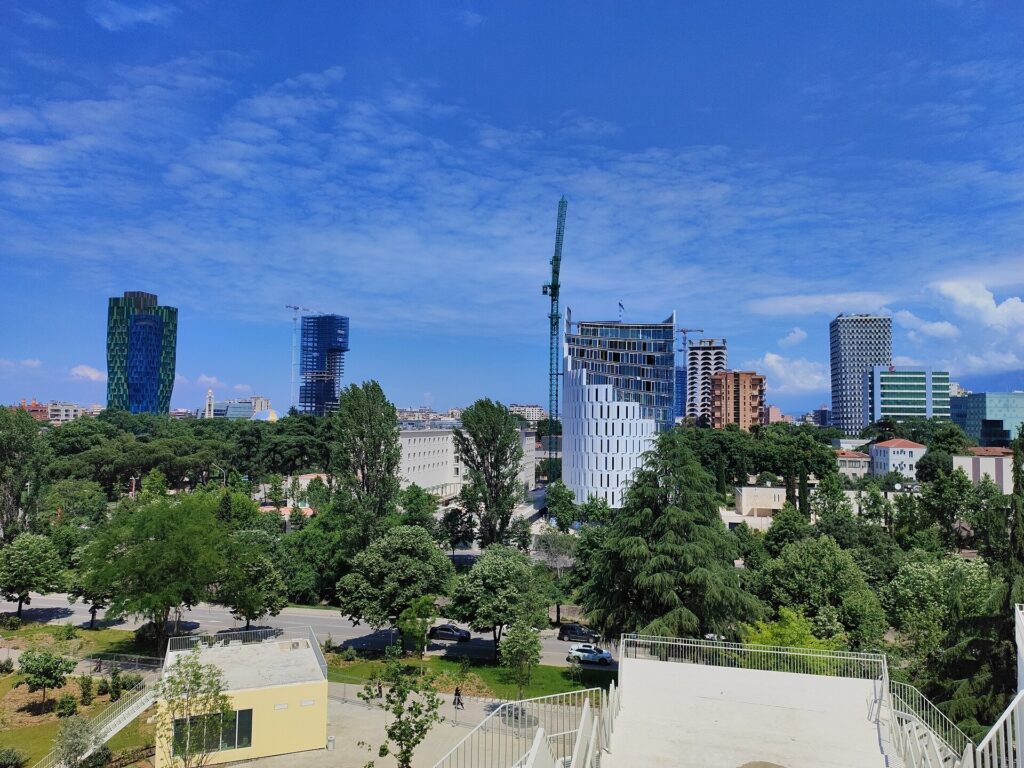
Before we get into them one by one, here is roughly where they all sit. The centre is compact and easy to walk; the outer neighborhoods are a short bus or taxi ride out. Seeing the layout first makes the descriptions below make a lot more sense.

Not sure which part of Tirana to base yourself in?
Esther, our tour partner, organises a 3–4-hour Tirana walk with a certified local guide: a quick way to get your bearings before you pick a base.
Walk Tirana with Esther →Esther is our tour partner; we receive a small share of the tour price.
Blloku: The Former Communist Elite Compound
Blloku is Tirana’s most famous neighborhood, and according to Numbeo’s 2026 data, apartment rents in central Tirana have increased by roughly 35% since 2021, with Blloku leading that surge. This is where Enver Hoxha and the communist Politburo once lived behind guarded walls, and ordinary Albanians weren’t even allowed to walk through. Now it’s the city’s liveliest square kilometer of cafes, bars, restaurants, and boutique shops.
Best for: Tourists, nightlife seekers, short-term visitors, digital nomads who want to be in the center of everything
Avg. rent: EUR 400-700/month for 1BR apartment
Vibe: Trendy, loud, young, international, touristy (but fun)
I remember when Blloku first opened up in the early 1990s. People literally walked through it just because they could. It felt like entering a forbidden zone, which it literally had been. The villas were enormous by Albanian standards, the streets were wider, the trees were older. That mystique still lingers, even though the villas are mostly gone now, replaced by glass-and-steel apartment towers.
The nightlife here is genuine. On a Friday or Saturday night, the streets around Rruga Pjeter Bogdani and Rruga Ismail Qemali are packed. Radio Bar has been a staple for years. Nouvelle Vague draws a slightly older crowd. And there are enough cocktail bars within a five-minute walk to keep you busy for a month.
But here’s the thing. Blloku has become a victim of its own success. Prices are inflated, especially in the restaurants facing the main streets. I’ve seen tourists pay EUR 15 for a pasta that costs EUR 6 two blocks away. The trick is to walk one street back from the main drag. That’s where locals actually eat.
Insider Tips for Blloku
Skip the main pedestrian stretch for meals. Rruga Abdyl Frasheri looks beautiful but the restaurants there charge a premium for the view. Walk to the parallel streets instead. Colonial on Rruga Ibrahim Rugova has better food at half the price of the tourist spots.
For the real Blloku experience, do the xhiro (evening walk). Around 7 PM, the whole neighborhood fills up with families, couples, and groups of friends just walking and talking. It’s an Albanian tradition that’s still alive in Blloku, even among all the modernization.
Safety: Very safe at all hours. It’s probably the most policed area in Tirana because of the former government buildings nearby. I’ve never heard of any serious incidents here, even late at night.
I’ve watched Blloku transform from forbidden zone to Tirana’s main attraction over three decades. The speed of that change still surprises me. What hasn’t changed is the xhiro tradition, which persists despite all the gentrification.What Is Qendra (City Center) Really Like?
Planning a Trip to Tirana?
Get my free Tirana in 48 Hours checklist with day-by-day itinerary, prices, and local tips.
Get the Free Checklist →Qendra, Tirana’s true center, revolves around Skanderbeg Square, which was completely renovated in 2017 at a cost of EUR 11.5 million according to ArchDaily. The project turned what used to be a chaotic traffic roundabout into a massive pedestrian plaza. It’s the heart of the city in every sense: geographically, culturally, and historically.
Best for: First-time tourists, culture seekers, museum lovers, anyone wanting walkable access to major sights
Avg. rent: EUR 350-600/month for 1BR apartment
Vibe: Grand, institutional, busy during the day, quiet at night
This is where most visitors spend their first day, and they should. The National History Museum is right on the square, with that enormous socialist realist mosaic on the facade that you’ve probably seen in every Tirana photo. The Et’hem Bey Mosque sits next to the Clock Tower. The Opera building anchors the south side. Within a 10-minute walk, you’ll hit the Pyramid, BUNK’ART 2, and the start of the Grand Park.
What most people don’t realize is that Qendra isn’t really a living neighborhood the way Blloku or Komuna e Parisit are. During the day, it’s all government workers, tourists, and shoppers. By 9 PM, it empties out. The restaurants close early. The streets get quiet. If you’re looking for nightlife or a neighborhood feel, this isn’t it.
Key Landmarks in Qendra
National History Museum is the must-visit. Give it at least 2 hours. The ancient and medieval sections are the strongest, and the communist-era room will put everything else in context. Entry is 700 ALL (about EUR 6.50).
The Pyramid of Tirana just reopened as TUMO Tirana, a free technology and creative arts center for young people. You can walk up the exterior steps for a city view. I still remember when it was Enver Hoxha’s museum. Now teenagers learn coding inside. That’s Albania in one building.
Safety: Perfectly safe during the day. At night, the areas around the square are fine but can feel deserted. The streets behind the government buildings toward the train station (Stacioni i Trenit) get a bit rougher. I wouldn’t call them dangerous, but they’re noticeably less maintained and less lit than the main boulevard.
Is Pazari i Ri Worth the Hype?
Absolutely. Pazari i Ri (New Bazaar) has become one of Tirana’s most photographed spots, and for good reason. After a EUR 4.7 million renovation funded by the Albanian government and international donors, the market reopened in 2017 with colorful facade restorations, as reported by Albania’s Investment Council. Today it’s equal parts food market, restaurant district, and Instagram backdrop.
Best for: Foodies, photographers, budget travelers, anyone who wants authentic market culture
Avg. rent: EUR 300-450/month for 1BR apartment
Vibe: Colorful, lively, local, up-and-coming, slightly chaotic (in a good way)
I used to come to Pazari i Ri as a kid with my family to buy vegetables and cheese. Back then it was a proper working market, a bit rough around the edges. The renovation kept that market energy but added cafe terraces, wine bars, and restaurants that range from traditional Albanian to modern fusion.
For food, this is the best neighborhood in Tirana. Period. Start at the central market hall in the morning for fresh produce, olives, and local cheese. Mullixhiu is here, one of Tirana’s most respected farm-to-table restaurants. Oda serves traditional Albanian food in a beautifully restored Ottoman house. For quick bites, grab a qofte (meatball) sandwich from one of the small vendors on the market perimeter for about 200-300 ALL (EUR 2-3).
Is Pazari i Ri Good for Living?
It’s getting there. The residential streets behind the market are still a mix of old apartment blocks and new construction. Rents are lower than Blloku but rising fast. The area attracts a younger crowd, artists, and a growing number of expats who prefer the market vibe over the cafe scene.
One honest note: the streets immediately around the market can get noisy early in the morning. Delivery trucks, vendors setting up, that kind of thing. If you’re a light sleeper and considering an apartment facing the market, think twice. One block back and you’re fine.
Safety: Generally safe. The market area is well-lit and busy until late evening. The residential streets behind the bazaar are quieter but still fine. I’d keep an eye on my belongings in the crowded market during peak hours, same as any busy market anywhere in Europe.
Why Do Expats Love Komuna e Parisit?
Komuna e Parisit is where I’d tell most long-term visitors and expats to look first. According to Spot.al, one of Albania’s largest real estate listing platforms, Komuna e Parisit consistently ranks among the top 3 most-searched residential areas in Tirana. It offers what Blloku can’t: genuine neighborhood life without the tourist markup.
Best for: Expats, long-term residents, remote workers, couples, anyone who wants real neighborhood life
Avg. rent: EUR 300-450/month for 1BR apartment
Vibe: Residential, calm, tree-lined streets, local cafes, real community feel
This is what a proper Tirana lagje feels like. Kids playing in the courtyards. Old men drinking kafe (coffee) at the same table every morning. A bakery on every block where you can grab a byrek (savory pastry) for 70-100 ALL (less than a euro). The pace is slower here, and that’s the point.
Komuna e Parisit sits south of Blloku and east of Tirana e Re. You can walk to the Grand Park in 15 minutes. Blloku is a 10-minute walk north. But unlike those areas, the streets here haven’t been overtaken by bars and boutiques. It’s still a place where people actually live.
What Makes It Special?
The mix. You’ve got Soviet-era apartment blocks next to newer 8-story buildings, with the occasional villa in between. The result is a neighborhood that has different price points. A renovated apartment in a new building costs EUR 400-450. An older apartment with original tiles and that particular communist-era layout? EUR 250-300. Both are perfectly livable.
For daily errands, there’s everything you need: supermarkets (Conad and Spar both have locations nearby), pharmacies, a decent gym or two, and plenty of small restaurants. Nothing fancy, nothing touristy. Just a neighborhood that works.
Safety: Very safe. This is a family neighborhood. I’ve never had a concern walking here at any hour. The streets are well-lit and there’s always foot traffic from residents.
Tirana e Re: Is It Really the Best for Families?
For families with children, Tirana e Re (New Tirana) is hard to beat. The neighborhood borders the Grand Park of Tirana, which covers 289 hectares according to Tirana Municipality’s official data, making it one of the largest urban parks in the Balkans. That park is this neighborhood’s defining feature, and it changes everything about living here.
Best for: Families with children, joggers, nature lovers, anyone who values green space over nightlife
Avg. rent: EUR 350-500/month for 1BR apartment
Vibe: Green, family-oriented, active, peaceful, with a weekend-getaway feel
I jog around the Artificial Lake (Liqeni Artificial) at least three times a week. On weekday mornings, it’s mostly retirees walking and a few runners. On weekends, it transforms into a massive outdoor gathering space: families with strollers, kids on bikes, couples eating ice cream, groups doing yoga on the grass. It’s genuinely one of the best things about living in Tirana.
The neighborhood itself is a mix of older and newer construction. The communist-era blocks along the main arteries have been painted in Edi Rama’s famous colorful style (he started the building-painting project when he was Tirana’s mayor in the early 2000s). Newer residential towers have gone up closer to the lake, and those command premium rents.
Where to Eat and Drink
The lakeside has several restaurants, though quality varies. Uka Farm & Winery near the lake area is excellent for Albanian wine and farm-fresh food. There are also plenty of kafe spots along the park perimeter where you can sit for hours with a macchiato and nobody will rush you. That’s one of my favorite things about Albanian cafe culture: nobody ever asks you to leave.
Safety: Excellent. This is one of Tirana’s safest neighborhoods. The park has dedicated running and cycling paths, and there’s consistent foot traffic throughout the day and evening. The only caveat: the area around the zoo and the far edges of the park get quieter after dark. Stick to the main paths and you’re perfectly fine.
What Makes Sauk Tirana’s Most Exclusive Neighborhood?
Sauk is where Tirana’s money lives. Property prices in Sauk are among the highest in Albania, with villa prices reaching EUR 300,000-500,000+ according to listings on MerrJep.al, Albania’s largest classifieds platform. This is the embassy district, home to diplomatic residences, private schools, and villas with actual gardens, something rare in compact, dense Tirana.
Best for: Diplomats, wealthy families, those who want quiet and space, international school parents
Avg. rent: EUR 500-900/month for 1BR apartment; EUR 1,000-2,000+ for villas
Vibe: Upscale, quiet, green, suburban-feeling, almost too quiet for some
If Blloku is Tirana turned up to 11, Sauk is the volume knob turned down to 3. The streets are wider, the buildings are lower, and you can actually hear birds in the morning. Which sounds lovely until you realize that getting to the city center takes 20-30 minutes by car, and there’s no direct public transport that’s reliable enough to depend on.
The international schools are the big draw for families. The Albanian College of Tirana (ACT), one of the country’s most prestigious private schools, is located here. Several embassies have their residences in Sauk, which means the area has that slightly formal, slightly removed feeling of diplomatic quarters everywhere.
Should You Consider Sauk?
Honestly? Only if you have a car and a specific reason to be here. If you’re an expat working for an international organization or an embassy, Sauk makes perfect sense. If you’re a tourist, a nomad, or someone who wants to walk to restaurants and bars, you’ll feel isolated.
There are restaurants up here. Green House is a popular venue for events and dining. But the dining scene is sparse compared to Blloku or Pazari i Ri. You’re trading urban energy for space and quiet. For some people, that’s exactly right.
Safety: Arguably the safest neighborhood in Tirana. Private security is common, streets are well-maintained, and the population density is low. Nothing to worry about here.
Did you know?
During the communist era, Sauk was home to a major military base. After 1991, much of that land was privatized and developed into the villa district you see today. Some of the largest properties in Sauk sit on former military grounds, which is why the plots are unusually large by Tirana standards.
Don Bosko: Should Budget Travelers Consider It?
Don Bosko is working-class Tirana, and it’s one of the city’s most affordable neighborhoods for renters. According to rental listings on Spot.al, one-bedroom apartments in Don Bosko average EUR 200-300/month, roughly half the price of comparable apartments in Blloku. This is where regular Tiranans live, work, and go about their days without any tourist infrastructure around them.
Best for: Budget-conscious long-term visitors, people who want authentic local life, anyone tired of tourist areas
Avg. rent: EUR 200-300/month for 1BR apartment
Vibe: Authentic, working-class, busy, no-frills, real Tirana
I have friends who live in Don Bosko, and they wouldn’t trade it for Blloku. The neighborhood has a rhythm that the tourist areas don’t. Men gathering at the local kafe at 7 AM. The mini-market owner who knows your name after two visits. The byrek shop that’s been there since the 1990s and hasn’t changed its recipe (or its price, seemingly).
From conversations with residents: Don Bosko grocery prices run 10-20% lower than central Tirana shops, and local restaurants serve meals for 400-600 ALL (EUR 3.50-5.50), compared to EUR 8-15 in Blloku.The trade-off is obvious: fewer amenities, less polish. Sidewalks are uneven. Some streets have parking chaos. You won’t find craft cocktail bars or coworking spaces. The restaurant options are traditional Albanian or fast food, with little variety in between. And almost nobody speaks English, which is either a problem or a feature depending on your perspective.
Getting Around from Don Bosko
Don Bosko is about 3-4 km southeast of Skanderbeg Square. A taxi to the center costs about 500-700 ALL (EUR 4.50-6.50). City buses run along the main roads, though schedules are approximate at best. If you have a bicycle, you can reach Blloku in 15 minutes.
Safety: Fine during the day. At night, stick to the main streets. The side streets and dead-end roads in the residential blocks can be poorly lit. It’s not dangerous in a violent-crime sense, but petty theft (parked car break-ins, that kind of thing) is slightly more common in working-class neighborhoods than in the center. Use common sense and you’ll be fine.
Is Selite the Right Choice If You Want Quiet and Green?
Selite sits on Tirana’s southwestern side, next to the Kodra e Diellit hill, where the flat city grid starts giving way to slope. It is one of the quieter corners of Tirana that is still within easy reach of the centre. If you value calm and clean air over nightlife and restaurants, this is about as far from Blloku as you can get without leaving the city.
Best for: People who want a quieter pace, families who love green space, anyone who puts air quality above nightlife
Avg. rent: EUR 250-350/month for 1BR apartment
Vibe: Hillside, green, growing, residential, semi-rural in places
I come out to Selite when I need to breathe. Literally. The air quality difference between central Tirana and the Selite hillside is noticeable, especially in summer. The neighborhood has been growing steadily as new residential developments climb the slope, but it still has a semi-rural character in places. You’ll see small gardens, chicken coops behind apartment blocks, and vegetable patches that would be unthinkable in Blloku.
The appeal is the elevation. Getting even slightly above the traffic changes the air and the noise more than you would expect over such a short distance. One thing worth clearing up, because I get asked it a lot: if it is Mount Dajt and the Dajti Ekspres cable car you are after, those are on the opposite side of the city. The cable car’s lower station is up in the northeast, above Fresku, not out here.
The Practical Side
Selite’s weakness is connectivity to central Tirana. If you don’t have a car, you’re dependent on irregular bus services or taxis. Morning traffic heading into the city can be frustrating. Shopping options are limited to small neighborhood stores, though a few larger supermarkets have opened in recent years along the main road.
That said, construction is booming here. New apartment complexes are going up everywhere, and with them come better roads, new commercial spaces, and gradually improving infrastructure. In 5 years, Selite will look very different from today.
Safety: Safe. It’s a residential area with a village mentality. Neighbors know each other. The main concern is the road conditions in some of the steeper sections, not crime.
Kombinat: What’s Life Like in Tirana’s Industrial Quarter?
Kombinat is named after the textile factory (Kombinati i Tekstileve) that was one of communist Albania’s largest industrial complexes. According to INSTAT, Kombinat’s administrative unit has a population of roughly 80,000, making it one of the most densely populated areas in Tirana. It’s also among the cheapest places to rent in the city.
Best for: Budget travelers on long stays, people wanting the most authentic (and cheapest) local experience
Avg. rent: EUR 150-250/month for 1BR apartment
Vibe: Industrial heritage, working-class, dense, loud, real, raw
Let me be direct: Kombinat isn’t for everyone. The apartment blocks are communist-era construction, meaning they’re sturdy but utilitarian. Elevators may or may not work. The aesthetic is concrete-and-paint, not glass-and-marble. But the people here are some of the warmest in Tirana, and that’s not a cliche. It’s the kind of neighborhood where your neighbor brings you food when you move in.
Kombinat is where you see the real economic divide in Tirana. While Blloku gets its third cocktail bar, Kombinat families are stretching their lek to cover basics. That contrast is part of understanding this city. If you only see Blloku, you don’t really know Tirana.
“The Tirana you see in travel photos is Blloku and Skanderbeg Square. The Tirana most Tiranans actually live in is Kombinat, Don Bosko, and the outer lagje. Understanding both is understanding the city.”
What’s There to Do?
Kombinat has its own commercial strip with everything you need: butchers, vegetable markets, clothing stores, phone repair shops, and more kafe bars than you can count. The food is cheap and abundant. Traditional Albanian dishes at local restaurants cost 400-700 ALL (EUR 3.50-6.50) for a full meal.
Getting to the center takes 20-30 minutes by bus (the Unaza e Re ring road helps) or about the same by taxi (600-900 ALL, EUR 5.50-8). During rush hour, add 15 minutes.
Safety: I’ll be honest. Kombinat has areas where you should be more aware, especially at night. The main roads and commercial areas are fine. But some of the interior residential blocks can feel rough, particularly the older sections closer to the former factory grounds. It’s not that you’ll be in danger, but it’s not the same comfort level as Blloku or Sauk. Use street smarts, don’t flash expensive items, and you’ll be okay.
Most travel guides skip Kombinat entirely, treating it as if it doesn’t exist. But with 80,000 residents, it’s where a significant portion of Tirana actually lives. Ignoring it gives visitors a distorted picture of the city.21 Dhjetori: The Student Quarter You Haven’t Heard Of
21 Dhjetori (also called Ish-Rilindja after the old cinema) is the area around the University of Tirana, which enrolls over 20,000 students according to the university’s official statistics. Those students shape this neighborhood’s character: affordable eateries, copy shops, cheap bookstores, and a general youthful energy that you won’t find in the more established neighborhoods.
Best for: Students, young professionals, budget-conscious visitors who want a central location
Avg. rent: EUR 250-350/month for 1BR apartment
Vibe: Young, studenty, transitional, mixed residential, increasingly modern
This area sits between Qendra and the Grand Park, which makes it surprisingly well-located. You can walk to Skanderbeg Square in 15 minutes heading north, or to the Artificial Lake in 10 minutes heading south. It doesn’t have Blloku’s polish or Pazari i Ri’s charm, but it has something those areas lack: affordability combined with central location.
The restaurant scene here is student-driven. That means large portions, low prices, and no pretense. You’ll find fried chicken shops, traditional Albanian fast food (suflaqe, qofte, byrek), and a few sit-down restaurants where a full meal costs 500-800 ALL (EUR 4.50-7.50). Quality varies, but when a place is packed with students, that’s usually a good sign.
The Changing Face of 21 Dhjetori
Like much of Tirana, this area is in the middle of a construction boom. Older apartment blocks are being replaced by modern residential towers. The Faculty of Natural Sciences building was recently renovated. New cafes and small shops are opening along Rruga e Elbasanit, which runs through the neighborhood.
The result is a neighborhood in transition. Some blocks feel old and neglected. Walk 200 meters and you’re suddenly in front of a sleek new building with a ground-floor espresso bar. That patchwork quality can be disorienting, but it also means you can find real deals on apartments in the newer buildings that haven’t yet been “discovered” by the expat market.
Safety: Mostly safe. The main streets around the university are fine at all hours due to student foot traffic. The residential side streets west of the boulevard can be quiet and poorly lit at night. No major concerns, but standard urban awareness applies.
Tirana Neighborhoods Comparison Table
Here’s a side-by-side comparison to help you quickly assess which Tirana neighborhood fits your priorities. Rents are based on 2026 listings from Albanian real estate platforms Spot.al and MerrJep.al, cross-referenced with what I’ve seen in practice.
| Neighborhood | Best For | Avg. Rent (1BR) | Safety |
|---|---|---|---|
| Blloku | Tourists, nightlife | EUR 400-700 | Excellent |
| Qendra | First-time visitors, culture | EUR 350-600 | Very Good |
| Pazari i Ri | Foodies, budget travelers | EUR 300-450 | Good |
| Komuna e Parisit | Expats, long-term stays | EUR 300-450 | Very Good |
| Tirana e Re | Families, joggers | EUR 350-500 | Excellent |
| Sauk | Diplomats, wealthy families | EUR 500-900+ | Excellent |
| Don Bosko | Budget, authentic living | EUR 200-300 | Good |
| Selite | Outdoor enthusiasts | EUR 250-350 | Very Good |
| Kombinat | Cheapest rents, real Tirana | EUR 150-250 | Fair |
| 21 Dhjetori | Students, young professionals | EUR 250-350 | Good |
How Should You Choose Your Tirana Neighborhood?
After covering all 10 neighborhoods, the choice comes down to three questions: how long are you staying, what’s your budget, and what kind of experience do you want? According to Airbnb data for Tirana, the average nightly rate for a one-bedroom apartment in central Tirana runs EUR 35-55, while monthly rentals drop to EUR 300-500, making long-term stays significantly more economical.
For tourists staying 3-7 days: Blloku or Qendra. You’ll be walking distance from everything, and the tourist markup on restaurants is manageable for a short stay. Blloku for nightlife and energy, Qendra for sightseeing and museums.
For digital nomads staying 1-3 months: Komuna e Parisit or Tirana e Re. Good internet (Albania has fiber broadband averaging 50-100 Mbps in most central neighborhoods), reasonable rents, and walkable to cafes where you can work all day without anyone rushing you.
For expats relocating: Komuna e Parisit or Sauk, depending on budget. Komuna for value and community feel, Sauk for space and prestige. Either way, visit before signing a lease. Photos on Albanian real estate sites can be… optimistic.
For budget travelers: Don Bosko, 21 Dhjetori, or Kombinat. You’ll save EUR 100-300/month on rent compared to Blloku, and you’ll see a side of Tirana that most travel bloggers never write about.
Whatever you choose, here’s what I’ve learned from watching people move here: the neighborhood matters less than you think for the first month, and more than you think after three months. Choose something central for a short stay. Take your time and explore before committing to a long-term lease.
Frequently Asked Questions About Tirana Neighborhoods
What is the safest neighborhood in Tirana?
Sauk, Blloku, and Tirana e Re are consistently the safest. Sauk has low population density, private security, and embassy presence. Blloku is well-policed and busy at all hours. Tirana e Re benefits from the Grand Park’s foot traffic and family-oriented character. That said, Tirana overall has a lower crime rate than most European capitals, according to Numbeo’s Crime Index, which ranks it safer than Rome, Athens, and Paris.
Which Tirana neighborhood is best for digital nomads?
Komuna e Parisit offers the best balance: affordable rent (EUR 300-450/month), reliable fiber internet, walkable cafes, and proximity to both Blloku and the Grand Park. Tirana e Re is the runner-up, especially if you want to jog around the Artificial Lake between work sessions. Blloku works too, but you’ll pay 30-50% more for the same apartment size.
How much does rent cost in Tirana in 2026?
It depends entirely on the neighborhood. A one-bedroom apartment ranges from EUR 150/month in Kombinat to EUR 700+/month in upper Blloku. The city-wide average for a furnished one-bedroom is around EUR 350/month, based on listings across Spot.al and MerrJep.al. Most landlords expect payment in EUR and prefer 6-12 month leases, though shorter terms are negotiable in tourist-heavy areas like Blloku.
Can I get around Tirana without a car?
In the central neighborhoods (Blloku, Qendra, Pazari i Ri, Komuna e Parisit, Tirana e Re, 21 Dhjetori), yes. Tirana is very walkable within the inner ring. For outer neighborhoods like Sauk, Selite, Don Bosko, and Kombinat, you’ll want a taxi app (Speed Taxi or Clust, not Uber or Bolt, which don’t operate in Albania) or your own vehicle. City buses exist but schedules are unreliable.
Where should I stay for my first visit to Tirana?
Blloku or Qendra. Both put you within walking distance of all major sights: Skanderbeg Square, the Pyramid, BUNK’ART, the Grand Park, Pazari i Ri, and the National History Museum. Blloku has better restaurants and nightlife. Qendra is quieter at night but closer to the main museums. For a 3-day first visit, either one works perfectly.
Tirana’s neighborhoods tell the story of this city’s transformation better than any history book. I’ve watched Blloku go from forbidden zone to party district. I’ve seen Pazari i Ri transform from a gritty market into an Instagram destination. I’ve watched Kombinat stay stubbornly, beautifully itself while the rest of the city races to modernize.
What I find most interesting is that every neighborhood still has its own character. Despite the construction boom, despite the expat influx, despite the tourism growth, each lagje retains its identity. The old men still play dominos at the same kafe. The byrek shops still open at 6 AM. The xhiro still happens every evening, even in neighborhoods that now have cocktail bars instead of communist-era shops.
Albania is changing fast. Tirana is changing even faster. But the neighborhoods, the lagje, they hold on to something. And that’s what makes this city worth knowing, one block at a time.
What do you think?
Which Tirana neighborhood are you most interested in? Have you already picked where to stay, or are you still deciding? I’d love to hear what matters most to you in a neighborhood.
Subscribe to monthly updates
Get honest Albania travel tips, local guides, and new posts straight to your inbox. No spam, unsubscribe anytime.

Hey super helpful but I have an obvious request! Why not have a visual map with the areas on it? It’s really hard to just hear the description of the areas. Please consider.
Hi Viv — thank you, this is genuinely useful feedback and you’re right.
Here’s the slightly embarrassing part: we do have one. There’s a full interactive map of Tirana on the site with 400+ places — neighborhoods, restaurants, cafés, nightlife, transport — at albanianblogger.com/map/. The problem is it’s tucked in the menu and never linked from this guide, so you had no reason to know it existed. That’s on us, not on you.
I’m fixing it this week: a map going directly into this article, plus a “show me this area” link on each neighborhood section so you can jump straight from reading about Blloku to seeing exactly where it sits.
Comments like this are how things actually get better — much appreciated. Faleminderit!
— Elvis