
Key Takeaways
- Albania’s tech sector is one of the fastest-growing in Southeast Europe, with IT outsourcing revenue growing double digits year over year.
- Tirana has become a legitimate tech hub with coworking spaces, startup incubators, and a growing community of developers and digital nomads.
- Albania’s young, multilingual workforce combined with low operating costs and EU candidate status makes it increasingly attractive for international tech companies.
- Internet infrastructure has improved dramatically — fiber coverage now reaches most urban areas and 5G rollout is underway.
- The brain drain challenge is real, but a growing number of diaspora Albanians are returning to build companies at home.
Table of Contents
I still remember the first time I connected to the internet in Albania. It was the late 1990s, I was using a dial-up modem that screamed like a fax machine having a nervous breakdown, and loading a single webpage took the kind of patience usually reserved for waiting in line at a government office. The connection dropped every few minutes. Speeds were measured in kilobits. And honestly, most people around me had no idea what the internet even was.
Fast forward to 2026, and Albania has an AI-powered digital advisor helping shape government policy. We have a thriving startup ecosystem in Tirana. We have young developers building products used by millions globally. If you had told teenage me, sitting in front of that 56k modem, that this would happen — I would have laughed in your face.
But here we are. And as someone who has spent over 25 years building websites and digital services in Albania, I have watched this transformation happen in real time. This article is my attempt to give you an honest, insider perspective on where Albania’s tech scene actually stands in 2026 — the genuine progress, the remaining challenges, and why I think the next decade is going to be very interesting.
The AI Minister Story
In 2025, Albania made international headlines when it introduced an AI-powered system as an honorary digital policy advisor. The story went viral — “Albania appoints AI minister!” — and while the headlines were typically sensationalized, the reality behind them is genuinely interesting.
What actually happened is that Albania’s government partnered with international technology organizations to develop an AI system that assists policymakers with data analysis, public service optimization, and digital transformation planning. It is not a “minister” in the traditional sense — nobody is putting a robot in a parliamentary seat. But it represents a real, functional integration of AI tools into government decision-making.
For a country that was still largely offline in the early 2000s, this is a remarkable leap. Prime Minister Edi Rama has been vocal about positioning Albania as a forward-looking digital nation, and regardless of how you feel about the politics, the digital infrastructure investments have been real (see the World Bank Albania overview).
The e-Albania platform — the government’s digital services portal — now handles over 1,200 public services online. Citizens can do everything from registering a business to booking a doctor’s appointment without setting foot in a government office. When I think about the bureaucratic nightmares of the 1990s, this feels like a different country entirely.
“Twenty-five years ago, getting a simple document stamped required visiting three offices and knowing someone who knew someone. Today, I file taxes, renew documents, and register businesses from my phone. Albania’s digital leap is not theoretical — it is something we live every day.”
Albania’s Tech Ecosystem
Planning a Trip to Tirana?
Get my free Tirana in 48 Hours checklist with day-by-day itinerary, prices, and local tips.
Get the Free Checklist →Albania’s tech ecosystem has matured significantly over the past five years. What was once a scattered collection of freelancers and small agencies has evolved into a genuine ecosystem with startups, IT outsourcing companies, product companies, and an increasingly organized community.
The IT outsourcing sector has been the primary economic engine. Albanian companies now provide software development, QA testing, DevOps, and digital marketing services to clients across Europe and North America. The value proposition is straightforward: skilled developers at a fraction of Western European rates, in a compatible time zone, with strong English (and often Italian or German) language skills.
But the more exciting story is the emergence of product-focused startups. A new generation of Albanian founders — many of whom studied or worked abroad — are building their own technology products rather than just servicing foreign clients. Fintech, edtech, and SaaS are the most active verticals.
The government has played a role too. Albania’s Innovation and Entrepreneurship Law, updated in recent years, provides tax incentives for technology startups, including reduced corporate tax rates and simplified registration procedures. The National Agency for Information Society (AKSHI) has driven digitalization across government services, creating both infrastructure and demand for local tech talent.
| Sector | Growth Trend | Key Players |
|---|---|---|
| IT Outsourcing | Strong | Ikubinfo, Soft & Solution, Elsa Solutions |
| Fintech | High Growth | EasyPay, PayLink, local banking apps |
| E-government | Established | AKSHI, e-Albania platform |
| EdTech | Emerging | Akademi.al, local coding bootcamps |
| SaaS / Product | Emerging | Growing number of bootstrapped startups |
Tirana as a Tech Hub
If Albania’s tech scene has a center of gravity, it is undeniably Tirana. The capital has transformed from a chaotic post-communist city into a genuinely vibrant urban center, and the tech community has grown alongside it.
Coworking spaces have proliferated across the city. Destil Creative Hub, Tirana Business Park, and several newer spaces offer modern work environments that would not look out of place in Berlin or Lisbon. These are not just places to rent a desk — they host meetups, workshops, and networking events that form the connective tissue of the local tech community.
The event scene has grown substantially. Open Data Albania hosts regular hackathons. Tirana Tech Meetup brings together developers monthly. Startup Grind Tirana connects founders with mentors and investors. The Albanian ICT Awards recognize outstanding achievements in the sector. And international conferences are increasingly adding Tirana to their circuit.
Startup incubators and accelerators have taken root as well. Programs like Oficina, the Innovation Hub at EPOKA University, and EU-funded acceleration programs provide mentorship, funding, and connections for early-stage companies. The quality varies — some programs are more PR than substance — but the overall trajectory is positive.
The physical transformation of Tirana matters here too. The Blloku neighborhood, once reserved exclusively for communist party officials, is now the beating heart of the city’s creative and tech scene. Walk down its streets any weekday afternoon and you will see laptop-wielding freelancers in every cafe, overhear conversations mixing Albanian and English about product launches and funding rounds. It is a small community, which means everyone knows everyone — and that can be both a strength and a limitation.
Internet Infrastructure
The single biggest transformation in Albania’s tech readiness has been internet infrastructure. And I say this as someone who personally experienced every painful stage of its development. If you want the full story on internet and TV services, I have written a detailed guide to internet and TV services in Albania.
Fiber optic coverage has expanded dramatically. Major providers like ALBtelecom, ONE Telecommunications (formerly Telekom Albania), and Vodafone Albania have invested heavily in fiber-to-the-home (FTTH) networks. In Tirana and other major cities, symmetrical speeds of 100-500 Mbps are now standard, with gigabit plans available in many areas.
The 5G rollout is underway. Vodafone Albania launched its first 5G services in late 2024, with ONE following shortly after. Coverage is currently limited to parts of Tirana, Durres, and a few other urban centers, but the expansion timeline is aggressive. The Albanian government has been proactive about spectrum allocation, which should accelerate deployment.
Did you know?
Albania’s average internet speed has increased by over 400% in the last five years alone. In 2020, the average broadband download speed was around 20 Mbps. By 2026, urban areas routinely see 150-300 Mbps, putting Albania ahead of several EU member states in terms of speed-to-cost ratio.
Mobile data coverage is excellent. 4G LTE covers over 95% of the population, and mobile internet is remarkably affordable by European standards. Prepaid data plans offering 30-50 GB per month cost as little as 5-8 EUR — a fraction of what you would pay in Germany or the UK.
That said, rural areas remain underserved. Once you leave the main cities and the coastal corridor, connectivity drops significantly. Mountain villages in northern Albania may still rely on spotty 3G coverage. This is a real constraint for any talk of decentralizing the tech scene beyond Tirana, and it is something the government needs to address more aggressively.
The Talent Question
Albania’s greatest tech asset — and its most significant challenge — is its people. The country has a young, educated population with a genuine hunger for opportunity. But the talent pipeline has a major leak: brain drain.
Let me be direct about this because too many articles sugarcoat it. Albania has lost a significant portion of its most talented young people to emigration. Developers who learn their craft here can earn 3-5x their Albanian salary by moving to Germany, the Netherlands, or the UK. Many do exactly that. I have personally watched dozens of talented young people leave over the years, and it is a real loss for the ecosystem.
But the picture is more nuanced than pure doom and gloom. Several countervailing trends are at work:
Remote work has changed the equation. A skilled developer can now earn a Western European salary while living in Tirana, where their cost of living is a fraction of Berlin or London. This was not possible before 2020, and it has genuinely changed the calculus for many young Albanians who would otherwise have emigrated.
Diaspora returns are accelerating. I am seeing more Albanians who spent years abroad coming back to start companies or work remotely. They bring capital, connections, international experience, and a mentality that enriches the local ecosystem. This is still a trickle rather than a flood, but the trend is real.
The education pipeline is improving. The Polytechnic University of Tirana, EPOKA University, and the University of Tirana are producing more computer science graduates each year. Private coding bootcamps and training programs have multiplied. Young Albanians are extremely active on platforms like GitHub, Stack Overflow, and freelancing marketplaces. The raw talent is there.
Salaries are rising. As demand for tech talent increases, local salaries are climbing. A mid-level developer in Tirana now earns 1,500-2,500 EUR per month — still well below Western European levels, but increasingly competitive for the region and enough for a very comfortable daily life in Tirana.
Why Tech Companies Are Looking at Albania
International tech companies are paying attention to Albania, and it is not just about cheap labor. Several structural advantages make Albania genuinely compelling for technology operations.
Cost advantage with quality. Operational costs in Albania are 50-70% lower than in Western Europe. But unlike some low-cost destinations, the quality of output is consistently high. Albanian developers are technically skilled, detail-oriented, and culturally aligned with European business practices. The combination of cost and quality is the core value proposition.
EU candidate status. Albania is officially an EU candidate country with accession negotiations actively underway. For companies thinking long-term, this means Albania is progressively aligning with EU regulations, data protection standards (GDPR-equivalent legislation is already in place), and business practices. Setting up operations now means being positioned in what will eventually be an EU member state.
Time zone alignment. Albania operates on Central European Time (CET/CEST), which means seamless collaboration with clients in Western Europe. For North American companies, the overlap with East Coast business hours is workable. This is a practical advantage that matters enormously for service delivery and communication.
Multilingual workforce. Young Albanians are remarkably multilingual. English proficiency is high and growing — it is a mandatory subject in schools and widely used in business. Italian is commonly spoken due to cultural proximity. German, Greek, and Turkish are also widespread. This linguistic flexibility makes Albanian teams effective with diverse international clients.
Flat tax regime. Albania offers a 15% flat corporate tax rate, with reduced rates for qualified technology companies. The simplified tax structure is attractive compared to the complexity of tax systems in larger European countries.
If you are considering moving to Albania to take advantage of this environment — whether as a founder, remote worker, or investor — the barriers to entry have never been lower.
For Digital Nomads and Remote Workers
Albania’s growing tech scene creates real, tangible benefits for digital nomads who choose to base here. It is not just about cheap rent and nice weather — although those help.
The coworking infrastructure means you have professional spaces to work from, not just cafes. The tech meetups and events give you a community of like-minded people. The improving internet infrastructure means you can reliably do video calls and push code without praying to the connectivity gods.
Several practical advantages stand out for remote tech workers:
- Reliable fast internet. Fiber connections of 100+ Mbps are standard in Tirana apartments, and most coworking spaces offer redundant connections. Starlink is also available as a backup.
- Low cost of living. A comfortable one-bedroom apartment in central Tirana runs 400-600 EUR/month. A filling casual meal (byrek, qofte, grill) costs 5-10 EUR; mid-range restaurants run 15-25 EUR per person, and fine dining (Mullixhiu, Padam) runs 30-50 EUR. Your tech salary goes significantly further here.
- Growing tech community. You will not be working in isolation. Between coworking spaces, meetups, and the general cafe culture, it is easy to connect with other tech professionals — both locals and internationals.
- Quality of life. Tirana offers excellent food, a vibrant nightlife, easy access to beaches and mountains, and a genuine warmth from locals that makes daily life pleasant. The city is walkable, safe, and increasingly cosmopolitan.
- Visa flexibility. Citizens of the EU, US, UK, Canada, and many other countries can stay visa-free for up to one year. Albania also introduced a Digital Nomad visa in recent years for those who need longer stays.
The main caveat is that Tirana is the only city where the full nomad infrastructure exists. If you want coworking spaces, tech events, and reliable internet, Tirana is really your only option. The coastal cities are beautiful but not yet set up for remote work at the same level.
Albanian Tech Companies to Watch
The Albanian tech scene is still young enough that a handful of companies can represent the entire ecosystem’s direction. Here are some worth paying attention to:
Ikubinfo
One of Albania’s largest IT companies, providing software development and consulting services to international clients. They have grown from a small Tirana office to a major regional player with hundreds of employees.
EasyPay
Albania’s leading fintech platform for bill payments and financial services. They have digitized utility payments and are expanding into broader financial services — genuinely transforming how Albanians interact with money.
Akademi.al
An edtech platform delivering Albanian-language educational content and professional development courses. Addressing a real gap in local-language quality education materials.
Soft & Solution
A growing IT services company with expertise in enterprise software, web applications, and mobile development. They represent the professionalization of Albania’s outsourcing sector.
Open Data Albania
Not a company in the traditional sense, but an NGO that has been instrumental in building Albania’s data culture. They promote transparency, open government data, and regularly host hackathons that bring the tech community together.
Publer
A social media management platform built by Albanian founders that has gained international traction. Publer is a great example of a product company that competes globally from an Albanian base.
Frequently Asked Questions
Is Albania a good place for tech startups?
Yes, increasingly so. Low operating costs, a young talented workforce, improving infrastructure, and EU candidate status make Albania attractive for bootstrapped startups. The ecosystem is still maturing — do not expect Silicon Valley-level venture capital or support infrastructure — but for capital-efficient companies, Albania offers excellent fundamentals.
How fast is the internet in Albania?
In urban areas like Tirana, fiber connections of 100-500 Mbps are standard, with gigabit plans available. Mobile 4G coverage exceeds 95% of the population, and 5G is rolling out in major cities. Rural areas still lag behind. Check my guide to internet services in Albania for detailed provider comparisons.
What programming languages are most popular among Albanian developers?
JavaScript (including React and Node.js), Python, Java, and PHP are the most widely used. There is also growing interest in Go, Rust, and mobile development with Swift and Kotlin. The local developer community follows global trends closely.
Can I hire Albanian developers remotely?
Absolutely. Many Albanian developers work as remote contractors for international companies. Platforms like Upwork and Toptal have strong Albanian representation. You can also work with local IT agencies like Ikubinfo or Soft & Solution for team augmentation. Expect to pay 15-35 EUR/hour for mid-to-senior level talent, depending on specialization.
Is Albania safe for digital nomads working in tech?
Very safe. Albania has low crime rates, particularly for violent crime. Tirana is a walkable, friendly city where foreigners are welcomed warmly. The main annoyances are typical urban ones — traffic, occasional noise — rather than safety concerns. I have lived here my entire life and worked in tech throughout; safety has never been an issue for me or any of the international colleagues I work with.
Looking Ahead
Albania’s tech scene is at an inflection point. The infrastructure is largely in place. The talent is there, even if retaining it remains a challenge. The government is, for once, pushing in the right direction on digital policy. And the economic fundamentals — low costs, EU trajectory, young population — are genuinely strong.
What I find most exciting is the shift in mentality. When I started building websites in Albania in the early 2000s, people would ask me why I did not just move abroad. Technology was not seen as a serious career path here. Now, I meet young Albanians who are building SaaS products, contributing to open-source projects, and thinking about global markets from day one. That mindset shift matters more than any government policy or infrastructure investment.
Albania’s tech scene will not rival Berlin or London anytime soon — and it does not need to. What it can be is a lean, hungry, cost-effective ecosystem that punches above its weight. A place where smart people build real things without the overhead and noise of bigger tech hubs. For founders, remote workers, and companies looking for their next development hub, Albania deserves serious consideration.
The kid with the dial-up modem would be amazed.
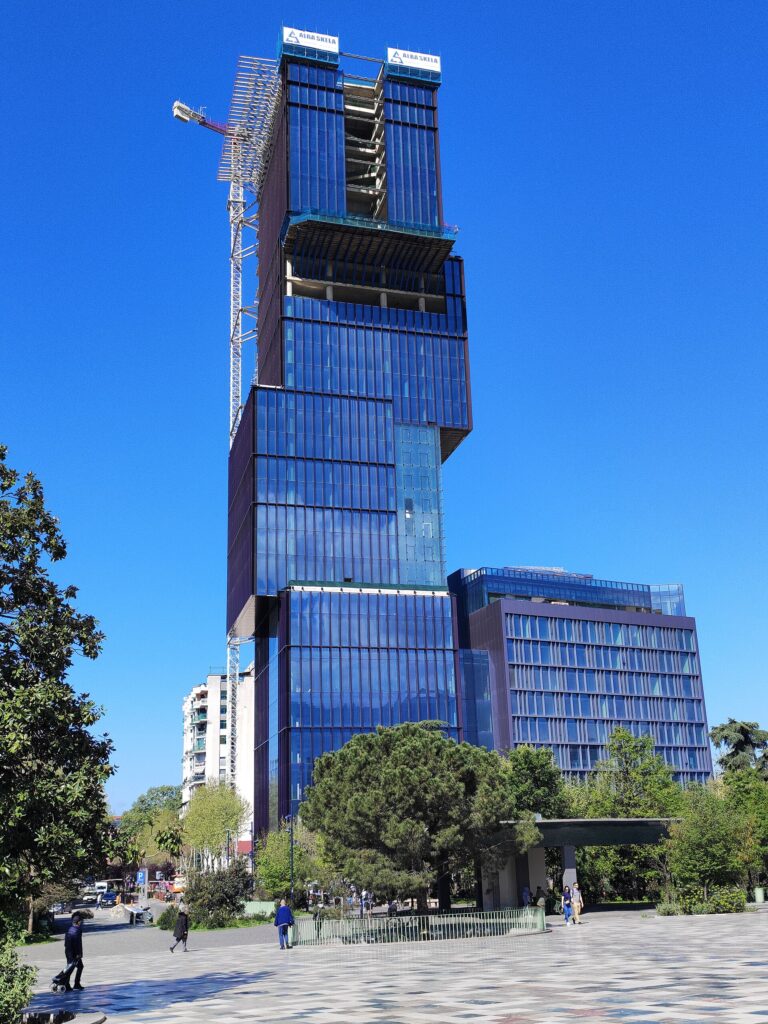
Photo credit: Eyes of Tirana skyscraper by BBB2021, Wikimedia Commons, CC BY-SA 4.0.

Subscribe to monthly updates
Get honest Albania travel tips, local guides, and new posts straight to your inbox. No spam, unsubscribe anytime.
