
Key Takeaways
- Albanian cuisine is a unique blend of Mediterranean, Balkan, and Ottoman traditions — fresh ingredients, olive oil, and slow-cooked meals define it.
- The best Albanian food is homemade. Restaurant versions are good, but nothing compares to what an Albanian grandmother puts on the table.
- Albanians eat seasonally more than most Europeans — what is on your plate depends on when you visit.
- Coffee culture is sacred here. “Let us go for a coffee” means “let us sit together for three hours,” and an espresso costs under 1.50 EUR.
- Albania is one of Europe’s most affordable food destinations — a full restaurant meal with drinks costs 8-15 EUR per person.
Table of Contents
Introduction
Every travel blog about Albania lists “byrek and tave kosi” and then moves on to the next country. I get it — they visited for two weeks, ate at three restaurants in Tirana, maybe drove to the coast. But Albanian food deserves so much better than a paragraph in someone’s “10 days in the Balkans” itinerary.
I am Elvis, and I have lived in Tirana for over 21 years. I grew up eating this food. I have had my grandmother’s byrek hundreds of times — the kind where the filo is stretched by hand across the entire kitchen table, so thin you can read a newspaper through it. I have eaten qofte at roadside grills in every corner of the country. I have argued with friends about which city makes the best fergese (the answer is Tirana, and I will not be taking questions).
This is not a list of “10 Albanian foods to try.” This is a real guide, from someone who actually knows what this food is supposed to taste like — what is genuinely incredible, what is overrated, what the tourist restaurants get wrong, and where to find the stuff that will make you rethink everything you thought you knew about Balkan food.
Fair warning: you are going to be hungry by the end of this.
The Soul of Albanian Cuisine
Planning a Trip to Tirana?
Get my free Tirana in 48 Hours checklist with day-by-day itinerary, prices, and local tips.
Get the Free Checklist →A Crossroads on a Plate
Albanian food does not fit neatly into one category, and that is exactly what makes it special. We sit at a crossroads — Mediterranean to our west, Balkan to our north, and five centuries of Ottoman influence baked into our culinary DNA. You will taste Greek echoes in our olive oil and feta. Turkish roots in our borek and baklava. Italian whispers in our coffee culture and pasta dishes. But the combination? That is purely Albanian.
What most visitors do not realize is that Albanian cooking is fundamentally peasant cuisine in the best sense of the word. These are dishes born from making the most of what the land gives you. Nothing is wasted. Vegetables are seasonal, meat is used sparingly (except on special occasions, when it becomes the centerpiece), and every family has recipes passed down through generations that they will defend with genuine passion.
Seasonal Eating Is Still the Default
Here is something that surprises most Western Europeans: Albanians still eat seasonally, not because it is trendy, but because that is just how food works here. In summer, you will eat tomatoes so sweet they taste like candy — because they were picked that morning from a farm twenty minutes away. In winter, it is heavy stews, beans, and preserved vegetables. You will not find tasteless imported strawberries in January at a traditional Albanian table.
Most vegetables and fruits in Albania still come from small local farms. The country never industrialized agriculture the way Western Europe did, and honestly? Our food is better for it. When people talk about “farm-to-table,” Albanians just call it… food.
Olive Oil and Bread: The Two Constants
Albania is one of Europe’s oldest olive oil producing countries, and it shows. Good olive oil goes on everything — salads, cooked dishes, bread, even some desserts. The southern regions (Berat, Vlora, Himara) produce oil that can compete with anything from Italy or Greece, and most families in those areas have their own olive trees.
And then there is bread. No Albanian meal is complete without bread. It is used to scoop food, to soak up sauces, to accompany cheese and olives, and to fill the gaps between courses. The best bread is still baked in wood-fired ovens — you will find it in villages and at some traditional restaurants. When an Albanian says “let us break bread together,” they mean it literally. Food here is not about feeding yourself. It is about sitting down with people you care about.
The Restaurant vs. Home Cooking Gap
I need to be honest with you: the best Albanian food you will ever eat will be in someone’s home. Restaurant food in Albania can be excellent, and I will recommend specific places later. But there is a gap between what a restaurant serves and what an Albanian mother or grandmother prepares. Home cooking uses slower methods, fresher ingredients (often from the family garden), and recipes that have been perfected over decades.
If you are lucky enough to be invited to an Albanian home for a meal, say yes. Clear your schedule. You will not regret it.
Did you know?
Albania is one of Europe’s most affordable food destinations. A full restaurant meal with drinks costs just 8-15 EUR per person, and an espresso in Tirana runs under 1 EUR.
Must-Try Traditional Dishes
Main Dishes
Tave Kosi (tah-VUH KOH-see) — Baked lamb with yogurt
This is Albania’s national dish, and for good reason. Tender lamb baked in a casserole with rice and a yogurt-egg custard that turns golden on top. When it is done right, the yogurt layer is creamy inside and slightly crispy on the edges. The dish originated in Elbasan, and purists will tell you that is still where you will find the best version.
My take: Tourist restaurants in Tirana serve decent tave kosi, but it is often made with too little lamb and too much rice. The real version should be generous with the meat. Try it at Oda in Tirana or, better yet, at any traditional restaurant in Elbasan.
Byrek (BUE-rek) — Filo pastry pie
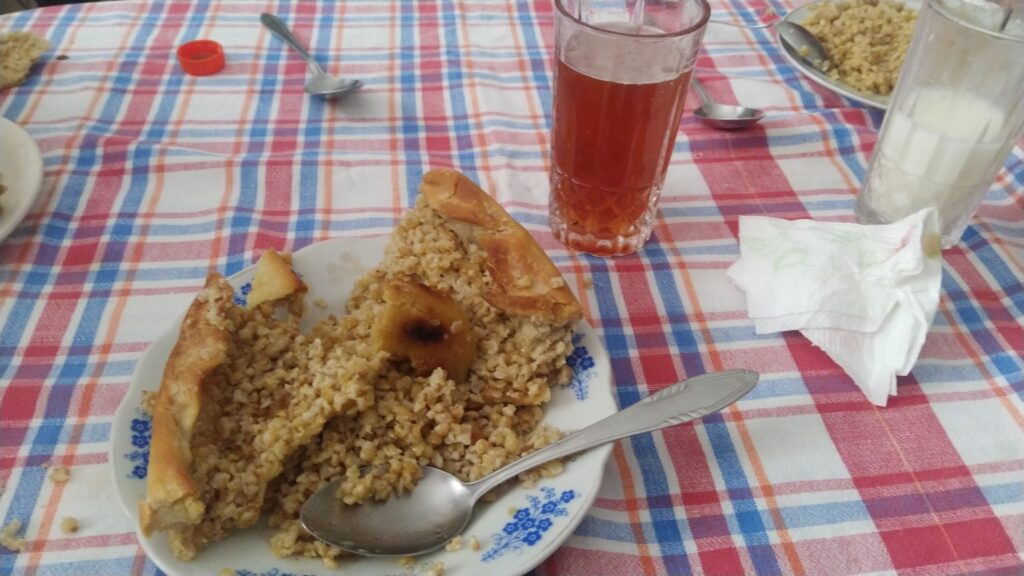
Byrek is to Albanians what pizza is to Italians — it is everywhere, it is cheap, it is the default “I need to eat something right now” food. The classic versions: me gjize (with curd cheese), me spinaq (spinach), me mish (meat), and me laker (cabbage, a winter favorite). The filo pastry is layered by hand, brushed with oil, and baked until flaky.
My take: The best byrek comes from a proper byrekatore — a small shop that makes nothing but byrek. You will find them on every street. Avoid the ones that have been sitting under a heat lamp for hours. Fresh byrek, straight from the oven, with a glass of dhalle (buttermilk) — that is peak Albanian fast food.
Fergese (fuhr-GEH-suh) — Peppers, tomatoes, and cottage cheese, baked
This is comfort food at its finest. Roasted peppers and tomatoes cooked down into a thick sauce, mixed with gjize (Albanian cottage cheese) or sometimes diced liver, and baked until bubbling. It is simple, but the flavors are deep — smoky peppers, tangy cheese, sweet tomatoes. Fergese Tirane (the Tirana version) is the most famous.
My take: This is one of those dishes that tastes like it took all day to make but actually comes together in under an hour. It is on every traditional restaurant menu, and it is hard to get wrong. Eat it with crusty bread — it was born for bread.
Qofte (CHOF-teh) — Grilled meatballs
Every Albanian region has its own qofte recipe, and every region thinks theirs is best. Korce is probably the most famous for them — Korcare-style qofte are elongated, well-spiced, and grilled over charcoal. But you will find excellent qofte everywhere. They are made from a mix of beef and lamb (or just beef), seasoned with onion, herbs, and sometimes bread crumbs for texture.
My take: The grill matters more than the recipe. Charcoal-grilled qofte from a roadside grill beat any restaurant version. If you are driving through Albania and see smoke rising from a small grill with plastic chairs outside, stop. That is where the best qofte live.
Tave Dheu (tah-VUH THEH-oo) — Earthenware baked meat and vegetables
The name literally means “earthen casserole.” Meat (usually lamb or veal), tomatoes, peppers, onions, and sometimes rice, baked slowly in a clay dish until everything melts together. The clay pot is important — it distributes heat differently and gives the dish its distinctive flavor.
My take: This is the kind of dish you order at a traditional restaurant while everyone else is playing it safe with grilled meat. It is slower, quieter, and deeply satisfying.
Speca me Gjize (SPEH-tsa meh GJEE-zuh) — Stuffed peppers with cheese
Sweet peppers stuffed with a mixture of gjize (cottage cheese), eggs, and herbs, then baked. Simple, vegetarian-friendly, and absolutely delicious. The peppers caramelize in the oven, and the cheese filling gets custardy.
My take: This is the dish that convinces vegetarians Albania is not just grilled meat. The peppers need to be good quality though — the dish lives and dies by the sweetness of the pepper.
Japrak / Sarma (yah-PRAHK / SAR-mah) — Stuffed vine leaves or cabbage rolls
Japrak are grape vine leaves stuffed with a rice and meat mixture, cooked slowly until tender. Sarma is the same concept but with cabbage leaves, typically a winter dish. Both are simmered in a tomato-based broth. They take hours to make properly — this is a labor of love.
My take: Japrak made with fresh vine leaves in late spring is a completely different experience from the jarred-vine-leaf version. If you visit in May or June, seek these out.
Kukurec (koo-koo-RETS) — Grilled intestines
I will be honest — this one divides people. Kukurec is lamb or goat intestines wrapped around a skewer and grilled over charcoal. It is crispy on the outside, soft inside, and has a strong, gamey flavor. Albanians love it. Many tourists… need a moment.
My take: If you are adventurous, try it. If intestines are not your thing, absolutely no one will judge you for ordering qofte instead. But kukurec from a skilled grill master, eaten immediately while it is still crackling? It is genuinely one of the best things I have ever eaten.
Street Food
Sufllaqe (soo-FLAH-cheh) — Albania’s answer to the doner/gyro. Sliced grilled meat (chicken or mixed), wrapped in flatbread with fries, vegetables, and sauce. How does it differ from Greek or Turkish versions? Albanian sufllaqe always includes french fries inside the wrap — yes, carbs wrapped in carbs, and it works. The sauces tend to be more varied too. It is cheap (2-3 EUR), filling, and available on every corner after 6pm.
Byrek from the Byrekatore — Already covered above, but it deserves a street food mention. A slice of fresh byrek and a cup of dhalle (buttermilk) for under 2 EUR is the Albanian working person’s breakfast and has been for decades.
Petulla (peh-TOO-lah) — Fried dough, either plain with powdered sugar or stuffed with cheese or jam. Albanians eat petulla for breakfast, as a snack, or honestly whenever they feel like it. Best eaten hot, straight from the fryer, ideally from a grandmother who makes them at a market stall.
Mishmash — Scrambled eggs cooked with roasted peppers, tomatoes, and sometimes cheese. This is a breakfast dish in most of Albania, but honestly, I will eat it any time of day. Simple, cheap, and exactly the kind of thing that tastes twice as good when someone else makes it for you.
Soups and Sides
Jani me Fasule (YAH-nee meh fah-SOO-leh) — White bean soup, slow-cooked with tomato, onion, and olive oil. This is Albanian winter comfort food — thick, hearty, and incredibly filling. Some versions add meat, but the vegetarian version is the classic. Served with bread and raw onion on the side (trust me on the onion).
Sallate e Bardhe — White salad: thick yogurt mixed with cucumber and garlic. It is Albania’s version of tzatziki, essentially, and it goes with everything — grilled meat, bread, rice dishes. Every restaurant serves it.
Tarator — A cold yogurt soup with cucumber, garlic, and sometimes walnuts. Perfect in summer when it is 38 degrees Celsius in Tirana and you need something cooling. It is light, refreshing, and surprisingly filling.
Turshi (TOOR-shee) — Pickled vegetables: peppers, cucumbers, cabbage, cauliflower, green tomatoes. Every Albanian grandmother makes turshi in autumn, filling enormous jars that last through winter. It is served as a side dish with virtually every meat dish and is considered essential to a proper table.
Albanian Desserts and Sweets
Albanian desserts lean heavily on two things: syrup and nuts. Ottoman influence runs deep here, and if you have a sweet tooth, you are going to be very happy.
Ballokume (bah-loh-KOO-meh) — Crumbly cookies made from corn flour, butter, and sugar. These are tied to Dita e Veres (Summer Day), a pagan spring festival celebrated on March 14th, mainly in Elbasan. You can find ballokume year-round now, but eating them on Summer Day in Elbasan is the authentic experience. They melt in your mouth — rich, buttery, and completely addictive.
Trilece (tree-LEH-cheh) — Three-milk cake (tres leches). Yes, it came from Latin America originally, but the Albanian version has become its own thing. Soaked in three types of milk, topped with caramel — it is sweeter and denser than most versions you will find elsewhere. Every restaurant in Albania serves it, and it is almost always good.
Sheqerpare (sheh-chehr-PAH-reh) — Small, round cookies soaked in sugar syrup. They are soft, sweet, and easy to eat five of before you realize what has happened. Classic Ottoman-era dessert that Albanians have fully adopted.
Kadaif (kah-DAH-eef) — Shredded filo pastry layered with walnuts and soaked in syrup. Similar to what you would find in Turkey or Greece, but Albanian kadaif tends to be a bit less sweet — which, in my opinion, makes it better. The best versions have that perfect balance of crunchy pastry, rich nuts, and just enough syrup.
Akullore (ah-koo-LLOH-reh) — Ice cream. Albania’s proximity to Italy shows here. The ice cream culture is strong, particularly in Tirana and the coastal cities. Artisanal gelato shops have exploded in the last decade. In summer, an evening walk (xhiro) ending with ice cream is practically mandatory.
Seasonal fruits deserve a mention too. Albanian figs in August are transcendent. Pomegranates in October. Watermelon everywhere in July and August — sold from trucks on the roadside, always sweet, always cheap. Grapes in September, often from family vines. When Albanians say “we will have fruit for dessert,” it is not a disappointment — it is because the fruit is that good.
Albanian food does not fit neatly into one category, and that is exactly what makes it special. We sit at a crossroads — Mediterranean to our west, Balkan to our north, and five centuries of Ottoman influence baked into our culinary DNA.
Albanian Coffee Culture
If there is one thing you need to understand about Albania before you visit, it is this: coffee is not a beverage here. It is a social institution.
The Ritual
Albanians do not grab a coffee to go. The concept barely exists. Coffee is something you sit down for, with a friend, a colleague, a family member, or sometimes alone with your thoughts. “Do you want to go for a coffee?” is the Albanian equivalent of “let us hang out” — and it can mean anything from a 20-minute catch-up to a three-hour conversation that covers politics, family, football, and the meaning of life.
Kafe Turke — Turkish Coffee
The traditional Albanian coffee is kafe turke — finely ground coffee brewed in a small copper pot called a xhezve. It is strong, unfiltered, and served in a small cup with the grounds settled at the bottom (do not drink the last sip). Sugar is added during brewing, not after — you order it pa sheqer (no sugar), me pak sheqer (a little sugar), or me sheqer (sweet).
Turkish coffee is still the default in many Albanian homes, especially for the older generation. There is a meditative quality to making it — watching the coffee slowly rise in the pot, pouring it at exactly the right moment. It is not fast, and that is the point.
The Espresso Revolution
Italian influence brought espresso culture to Albania, and today, macchiato is probably the most popular coffee order in urban Albania. Albanian macchiato is a shot of espresso with a small amount of foamed milk — closer to the Italian original than the giant Starbucks version.
The quality of espresso in Albania is genuinely excellent. Albanians are particular about their coffee, and a bad espresso will earn a cafe a reputation it will not recover from. Most cafes use Italian machines and beans, and the baristas know what they are doing.
Prices That Will Make You Smile
Here is the beautiful thing: an espresso in Tirana costs 80-150 ALL (0.80-1.50 EUR). A macchiato is similar. Even in the trendiest cafes in Blloku (Tirana’s hip neighborhood), you are rarely paying more than 2 EUR. Compare that to London (4-5 EUR) or Zurich (6+ EUR) and you will understand why Albanians can afford to drink four coffees a day — and many do.
The Morning Coffee, the Afternoon Coffee, and Everything in Between
A typical Albanian day might include: a morning coffee at home or at a cafe near work, a mid-morning coffee with a colleague, an after-lunch coffee, and an afternoon coffee with friends. This is not caffeine addiction (well, not entirely). It is how social connections are maintained. Business deals happen over coffee. Family news is shared over coffee. Problems are solved over coffee.
And Then There Is Raki
No discussion of Albanian drinking culture is complete without raki — homemade grape or plum brandy. Raki is the after-dinner ritual. It is served in small glasses, often with fruit or walnuts, and it is meant to be sipped slowly while the conversation winds down. Most families in rural Albania make their own raki, and offering it to guests is a point of pride. It is strong (40-50% alcohol), warming, and — according to every Albanian uncle — cures everything from a cold to a broken heart.
Where to Eat in Tirana
Traditional Albanian Restaurants
Oda — Set in a beautifully restored traditional Albanian house, Oda serves classic dishes done right. The interior alone is worth the visit — it feels like eating in someone’s living room from 100 years ago. Try the tave kosi and fergese.
Mullixhiu — Albania’s most acclaimed restaurant, and deservedly so. Chef Bledar Kola takes traditional Albanian ingredients and techniques and elevates them into something extraordinary. This is farm-to-table before it was a trend — they source directly from Albanian farmers and foragers. Not cheap by Albanian standards, but exceptional by any standard.
Era — On the top floor of a building near Skanderbeg Square. Good traditional food, reasonable prices, and a view of the city. A solid choice for your first Albanian meal.
Street Food
The best street food in Tirana does not have a name on Google Maps. It is the byrekatore on the corner, the sufllaqe place near Blloku that is packed at midnight, the petulla lady at the market. Walk, explore, and follow the crowds — if there is a line of Albanians, the food is good.
Budget Eating
The area around the University of Tirana has cheap, student-friendly restaurants serving generous portions. Pazari i Ri (the New Bazaar) has both restaurants and fresh produce stalls — eat lunch there and buy ingredients for dinner.
Fine Dining
Mullixhiu (mentioned above) is the standout. For something different, several new restaurants along the Lana River area and in the former Blloku neighborhood are doing creative things with Albanian cuisine. The scene is evolving fast.
Coffee
Anywhere in Blloku, you will find good coffee. The main pedestrian streets have dozens of cafes. Just avoid the ones with English-only menus and 5 EUR cappuccinos — walk one block off the main drag and you will pay half the price for better coffee.
The Albanian Food Calendar
Spring (March – May)
Spring is about freshness. Salads come back to the table — tomatoes, cucumbers, and spring onions dressed with olive oil and salt. Lamb is the star protein, especially around Easter (whether Orthodox or Catholic — both are celebrated in Albania). Dita e Veres (March 14) brings ballokume cookies from Elbasan. Fresh herbs — dill, mint, parsley — appear in everything. Japrak with fresh vine leaves arrive in late spring, and they are incomparably better than any other time of year.
Summer (June – August)
Summer eating is lighter: grilled meats, fresh salads, and seafood if you are on the coast. Watermelon is everywhere — sold from trucks on the roadside for almost nothing. Figs start arriving in August, and they are worth the trip alone. The coast offers grilled fish, octopus, and mussels. In Tirana, outdoor restaurants fill up every evening as temperatures drop from the daytime heat. Ice cream becomes a food group.
Autumn (September – November)
This is preservation season. Grandmothers across Albania are making turshi — pickling everything they can get their hands on. The grape harvest brings fresh grapes, must (mushti), and new raki production. Pomegranates ripen. Figs reach their peak. Heavier dishes start returning to the menu — stews, baked casseroles, and the first byrek me laker (cabbage byrek) of the season.
Winter (December – February)
Winter is comfort food season. Jani me fasule (bean soup) becomes a weekly staple. Byrek consumption increases dramatically. Rich, slow-cooked stews, baked meat dishes, and tave dheu are on every table. New Year brings a feast — turkey or pork, depending on the family — and the table groans with food. Albanian weddings in winter feature enormous spreads that can run to 15+ courses.
Frequently Asked Questions About Albanian Food
What is the national dish of Albania?
Tave Kosi — baked lamb with a yogurt and egg custard, usually served with rice. It originated in Elbasan and is served across the country. Every Albanian has eaten this dish dozens of times, and most have a strong opinion about who makes it best.
Is Albanian food spicy?
No. Albanian cuisine uses herbs, garlic, and black pepper generously, but it is not a spicy cuisine. You will rarely encounter chili heat in traditional dishes. The flavors are savory, tangy (from yogurt and cheese), and herbaceous rather than hot.
Is Albania good for vegetarians?
Better than you might expect. While meat is central to many dishes, Albanian cuisine has excellent vegetarian options: byrek me spinaq (spinach pie), fergese (without meat), speca me gjize (stuffed peppers with cheese), jani me fasule (bean soup), various fresh salads, and seasonal vegetable dishes. Vegans will have a harder time — cheese and eggs feature heavily — but olive oil-based dishes and bean soups work well.
How much does a meal cost in Albania?
Albania is one of Europe’s most affordable food destinations. A byrek and drink from a bakery costs 1-2 EUR. A full restaurant meal with a drink runs 8-15 EUR per person at a mid-range restaurant. Fine dining (like Mullixhiu) might reach 25-35 EUR per person. Street food like sufllaqe is 2-3 EUR. Coffee is 0.80-1.50 EUR. You can eat very well in Albania without spending much.
What is raki?
Raki is Albania’s national spirit — a clear, strong brandy (40-50% alcohol) typically distilled from grapes or plums. Most rural families make their own. It is served after dinner in small glasses and sipped slowly. Refusing raki from an Albanian host is borderline offensive — at least take a sip. It is an acquired taste, but a good homemade raki is smooth and warming.
What should I eat first in Albania?
Start with byrek from a byrekatore — it is cheap, available everywhere, and gives you an immediate sense of Albanian everyday food. For your first sit-down meal, order fergese and qofte with a sallate e bardhe on the side. Save tave kosi for when you find a restaurant that does it well. And have a macchiato — because that is what Albanians do between every meal.
Final Thoughts
Albanian food will not shout at you. It is not trying to be the next big food trend. There is no Albanian restaurant in London charging 30 EUR for deconstructed byrek (yet). And honestly? That is part of its charm.
This is food that is deeply connected to family, land, and season. It is food made by people who grow their own tomatoes, press their own olive oil, pickle their own vegetables, and distill their own raki. It tastes like a place where the modern world has not quite managed to standardize everything yet.
When you visit Albania — and you should — do not just eat at the tourist restaurants. Walk into a byrekatore at 7am and order whatever just came out of the oven. Sit at a cafe for two hours and watch the world go by over a macchiato. And if someone invites you home for dinner, say yes.
The food will tell you more about this country than any guidebook ever could.
Subscribe to monthly updates
Get honest Albania travel tips, local guides, and new posts straight to your inbox. No spam, unsubscribe anytime.
