
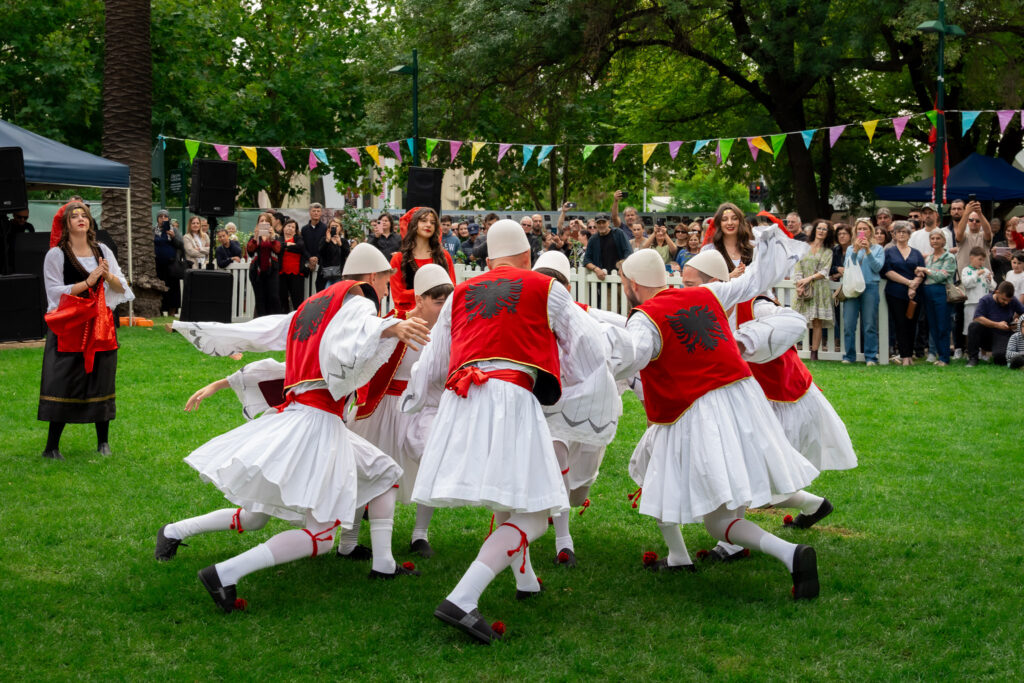
I will never forget the first village wedding I attended in the mountains near Shkodra. I was expecting a modest ceremony — maybe a lunch and some music. What I walked into was a three-day celebration with two hundred guests, a live band that played until dawn, enough food to feed a small army, and a tradition where the bride’s family literally weeps as she leaves their home. I stood there watching grown men cry, children dancing on tables, and grandmothers singing folk songs that were older than the Republic — and I realized that Albanian traditions are not customs you perform. They are the operating system of how people live.
Most guides about Albanian traditions read like a Wikipedia summary. A paragraph about weddings, a paragraph about holidays, and then a stock photo of someone in folk costume. That is not going to cut it here.
I am Elvis, and I have lived in Albania for over two decades. I have sat through engagement ceremonies, argued over who pays the coffee bill (it is never you, the guest), watched entire neighborhoods shut down for a funeral procession, and danced at weddings until 4 AM when the band was still going strong. Albanian traditions are not museum pieces — they are alive, sometimes messy, occasionally contradictory, and always deeply personal.
This guide covers the customs that actually matter in daily Albanian life. Not just the postcard version, but how things really work — including how they are changing, which traditions younger Albanians are keeping, and which ones are quietly fading away.
Key Takeaways
- Hospitality is not optional in Albania — refusing a coffee invitation or ignoring a guest is a genuine social offense, not just bad manners.
- Family is the foundation of Albanian society. Extended family ties, respect for elders, and collective decision-making shape everyday life far more than government or institutions.
- Albanian weddings are multi-day events with deeply specific regional customs — a wedding in Shkodra looks completely different from one in Vlora.
- Religious holidays are shared across faiths. Muslims, Catholics, and Orthodox Christians in Albania regularly celebrate each other’s holidays — this is one of the country’s most distinctive features.
- Traditions are evolving fast. Urban Albanians under 35 are rewriting the rules, keeping what they value and quietly dropping what no longer fits.
- As a visitor, showing respect and willingness to participate matters far more than getting every custom exactly right.
Table of Contents
- Albanian Hospitality Traditions
- Family and Social Customs
- Wedding Traditions
- Birth and Christening Traditions
- Funeral and Mourning Customs
- Seasonal and Calendar Traditions
- Regional Differences: North vs. South, City vs. Village
- How Traditions Are Changing in Modern Albania
- Tips for Visitors: How to Participate Respectfully
- Frequently Asked Questions
- Final Thoughts
Albanian Hospitality Traditions
I have written a full deep dive on Albanian hospitality and the concept of besa (the Albanian honor code that governs how we treat guests). If you want the complete picture, read that article here. But here is the short version as it relates to daily customs.
The Guest Is Sacred
In Albanian culture, the guest — miku (MEE-koo) — holds a near-sacred status. This goes back centuries, long before Albania was a country. The Kanun of Leke Dukagjini, the medieval customary law that governed northern Albanian life for centuries, devoted entire sections to how guests must be treated. The core idea: your guest is under your protection, and their comfort comes before your own.
In practice, this means:
- You will be offered food and drink immediately when you enter an Albanian home. Refusing is awkward. At minimum, accept the coffee.
- The host pays. Always. Arguing about the bill at a restaurant is a real Albanian sport, but the person who invited you expects to cover it.
- You will be given the best seat, the best portion, the first serving. This is not performative — it is automatic.
Coffee as a Social Ritual
Coffee in Albania is not a caffeine delivery system. It is a social institution. Kafe turke (Turkish coffee) or espresso — the drink itself matters less than the act of sitting together. “Do you want to go for a coffee?” (A do nje kafe?) is the Albanian equivalent of “let’s catch up” or “we need to talk.”
The coffee ritual has specific unwritten rules. The host always prepares or orders. The conversation starts light and works its way to the real topic. Rushing through a coffee is considered rude — you sit, you talk, you take your time. I have had “quick coffees” that lasted two hours. That is normal.
For a deeper look at Albanian coffee culture, see my Albanian food guide.
The Xhiro — The Evening Walk
One of Albania’s most beloved daily traditions is the xhiro (JEE-roh) — the evening promenade. Every town in Albania has a main street or boulevard where people walk slowly up and down in the early evening, usually between 6 and 8 PM.
The xhiro is not exercise. It is a social event. You walk, you stop to greet people, you see and are seen. Families walk together. Teenagers walk in groups. Couples stroll arm in arm. Old men sit on benches along the route and watch everyone pass.
In Tirana, the main xhiro happens along Rruga Myslym Shyri and the Blloku area. In Korça, it is the boulevard near the cathedral. In Shkodra, the pedestrian street Kole Idromeno. In Vlora, the seaside Lungomare.
My favorite xhiro story: one evening I walked from my apartment to Blloku to meet a friend for coffee. The walk should have taken fifteen minutes. It took forty-five because I ran into three former colleagues, a neighbor who insisted on telling me about his daughter’s exam results, and an old classmate I had not seen in five years. By the time I reached the cafe, my friend had already ordered for me and was on her second espresso. That is the xhiro — it is not a walk, it is a social marathon.
Family and Social Customs
Planning a Trip to Tirana?
Get my free Tirana in 48 Hours checklist with day-by-day itinerary, prices, and local tips.
Get the Free Checklist →Family Structure
Albania is a family-first society in a way that surprises most Western Europeans. The family unit is not just parents and children — it extends to grandparents, aunts, uncles, cousins, and sometimes even more distant relatives who all function as a tight network.
A few things that catch outsiders off guard:
- Adult children often live with their parents until marriage, and sometimes after. This is not failure to launch — it is the norm. Multi-generational households are common and expected, especially outside Tirana.
- Sunday lunch is a non-negotiable family event in most households. The extended family gathers, the table is covered in food, and you sit for hours. Missing Sunday lunch without a good reason raises eyebrows.
- Family decisions are collective. Major life choices — buying property, choosing a career, getting married — are discussed with the family. This does not mean parents dictate everything, but their input carries weight, especially in traditional families.
Naming Traditions
Albanian naming customs follow some consistent patterns:
- First-born sons are traditionally named after the paternal grandfather. First-born daughters after the paternal grandmother. Second children often get the maternal grandparents’ names. This pattern is still widely followed, though younger parents in Tirana are increasingly choosing names they simply like.
- Name days are celebrated alongside birthdays in some families, particularly among Catholics in the north. Your name day is the feast day of the saint whose name you share.
- Albanian names often carry meanings. Driton means “light,” Besnik means “faithful,” Flutura means “butterfly,” Fatmir means “lucky.”
Respect for Elders
Respecting elders is not a suggestion in Albania — it is one of the deepest social expectations. This shows up in concrete ways:
- You stand when an older person enters the room. You offer your seat on the bus.
- You use polite forms of address. Xhaxhi (JAH-jee) for an older man (literally “uncle”) and teze (TEH-zeh) for an older woman (literally “aunt”), even if they are strangers.
- The oldest person at the table is served first and often leads the conversation.
- You do not openly contradict an elder in public, even if you disagree. You find diplomatic ways to express a different view.
At family gatherings, I still watch how my nieces and nephews navigate the elder respect tradition. They will disagree with their grandfather about politics passionately in private but would never contradict him at the dinner table. My nephew once told me: ‘I know gjyshi is wrong about the EU, but I would never embarrass him in front of guests.’ That unspoken rule — you protect the dignity of your elders, even when you disagree — is one of the traditions that has barely changed.
Did you know?
A typical Albanian wedding can range from 200 guests (considered small) to over 800 guests, and it is not unusual for celebrations in rural areas to last three full days.
Wedding Traditions
Albanian weddings are not events — they are productions. Multi-day, multi-ceremony, involving both families in ways that go far beyond “who is on the guest list.” Wedding customs also vary significantly by region, religion, and family background, so what I describe here is a general picture.
The Engagement — Fejese
Before the wedding comes the engagement, fejesa (feh-YEH-sah). Traditionally, the groom’s family sends representatives — usually male relatives — to the bride’s family home to formally ask for her hand. This is called kerkesa (kuhr-KEH-sah), literally “the asking.”
In traditional families, especially in the north, this is a formal affair with specific protocols. The groom’s family brings gifts — often gold jewelry, sweets, and sometimes raki. The two families negotiate, discuss, and if all goes well, an engagement date is set.
Modern Albanian engagements in urban areas look more like what you would see in Western Europe — a ring, a proposal, and a party. But even in Tirana, the families still meet formally, and the groom’s family still typically brings gifts to the bride’s family.
The Wedding Celebration
A typical Albanian wedding can range from 200 guests (considered small) to 800+ guests (not unusual in rural areas or among large families). The guest list includes extended family, neighbors, work colleagues, and family friends going back generations.
Key elements of an Albanian wedding:
- Live music is essential. A wedding without a live band is barely a wedding. In the south, you will hear iso-polyphony (UNESCO-protected traditional singing) and kaba (instrumental laments). In the north, cifteli (CHEEF-teh-lee) — a two-stringed instrument — and lahuta playing. In modern weddings, a live band plays a mix of traditional and pop music.
- Dancing goes all night. The valle (VAH-leh) — traditional circle dance — is the centerpiece. Everyone participates, from the 5-year-old flower girl to the 80-year-old grandmother. Regional dances vary: the slow, dignified valle e Tropojes in the north versus the energetic dances of the south.
- The bride’s preparation — nusja (NOOSH-yah). On the wedding day, the bride is dressed and prepared at her parents’ home. In traditional weddings, the groom’s party arrives to “collect” the bride with a procession of cars, honking horns, and music. You will hear Albanian wedding convoys on the road before you see them — the honking is impossible to miss.
- Money pinning. During the wedding reception, guests pin money onto the bride’s and groom’s clothing during a special dance. This is the main wedding gift. In some weddings, the amounts are announced publicly.
Regional Differences in Weddings
- Shkodra (north): Known for elaborate, formal weddings with strong Catholic and traditional Gheg customs. The bride wears a specific red belt symbolizing fertility.
- Korça (southeast): Weddings are known for great food and music. Korça has its own serenade tradition.
- Vlora and the south: Weddings tend to include more Tosk folk traditions, with polyphonic singing groups.
- Tirana: Modern weddings in Tirana often blend traditional and Western elements — a church or mosque ceremony followed by a reception at a hotel or event hall. Some couples are now opting for smaller, destination-style weddings, which their grandmothers consider borderline scandalous.
The most memorable Albanian wedding I attended was my cousin’s in a village outside Elbasan. Four hundred guests, a live folk band, and a whole lamb roasting on a spit in the courtyard. At midnight, the groom’s family performed the traditional ‘taking of the bride’ ritual — a mock negotiation at the bride’s family door that involved singing, fake arguments, and eventually cash changing hands. The bride’s grandmother blocked the doorway with her arms crossed, refusing to let anyone pass until the groom’s father recited a traditional verse. Everyone was laughing and crying at the same time. That is an Albanian wedding — pure controlled chaos, fueled by emotion and raki.
Birth and Christening Traditions
The birth of a child, especially the first child, is a major event in Albanian families. Certain customs around childbirth have persisted for generations.
When the Baby Arrives
- Visitors come immediately. In Albanian culture, visiting a new mother in the hospital or at home is expected. Friends, neighbors, and family show up — often in large numbers — bringing gifts, sweets, and gold for the baby.
- Gifts of gold are traditional for newborns. Small gold bracelets, coins, or pendants are common gifts from grandparents, godparents, and close family.
- Sweets for a boy, sweets for a girl. The family distributes sweets and chocolates to announce the birth. Traditionally, a boy’s birth was celebrated more publicly, though this distinction is fading in modern Albania.
The Christening or Naming Ceremony
For Christian families (both Catholic and Orthodox), the pagezimi (pah-guh-ZEE-mee) — baptism — is a major family celebration, often as elaborate as a small wedding. The godparents (nuna and nuni) play a central role and take on a lifelong connection to the child and the family.
For Muslim families, the naming ceremony and sunet (circumcision, for boys) are the key milestones. A celebration follows with family and friends, similar in scale to a christening party.
In both cases, the event is fundamentally about community — welcoming the child into the extended family and social network.
Albanian traditions are not museum pieces — they are alive, sometimes messy, occasionally contradictory, and always deeply personal.
Funeral and Mourning Customs
Death is handled with specific, deeply respected customs in Albania. These vary by religion and region but share common elements across the country.
The Mourning Period
When someone dies, the family enters an immediate mourning period. The home is opened to visitors, and a steady stream of friends, family, neighbors, and acquaintances come to pay respects. Visitors bring flowers, food, and sometimes money to help with funeral costs.
Key customs:
- The family does not cook during mourning. Neighbors and relatives bring food to the grieving household. This is automatic — no one asks, they just show up with pots of food. It is one of the most genuine expressions of community you will see in Albania.
- Mourning dress. Close family members wear black for an extended period — traditionally 40 days to a year, depending on the relationship and how traditional the family is. In rural areas, widows sometimes wear black for the rest of their lives.
- The 40-day memorial is observed by both Christians and Muslims. The family gathers for a meal or religious service marking 40 days since the death. Annual memorials follow.
- Funeral processions are still common in smaller towns and villages. The procession walks through the streets, and people stop what they are doing to show respect. Shops may close temporarily. Drivers pull over.
The Social Obligation
Attending funerals and paying condolences is one of the strongest social obligations in Albania. Missing a funeral of someone connected to your family — even a distant connection — is noticed and remembered. This extends to visiting the grave on anniversaries and religious holidays.
Seasonal and Calendar Traditions
Albania has a unique calendar of celebrations that reflects its mixed religious background and pre-Christian roots.
Dita e Veres — Summer Day (March 14)
Dita e Veres is Albania’s most distinctive national holiday — a pagan spring festival that predates Christianity and Islam. Celebrated on March 14, it marks the end of winter and the return of longer days.
The celebration centers on Elbasan, where the biggest festival takes place. People eat ballokume, a dense, buttery cookie made from corn flour and sugar that is only made for this holiday. Streets fill with people, and it is one of the few Albanian holidays that is purely cultural — no religious component, no political history. Just celebrating the coming of spring.
In 2004, Dita e Veres was officially declared a national holiday, and in 2018, the celebration was inscribed on UNESCO’s list of Intangible Cultural Heritage.
Nowruz / Nevruz (March 22)
Nevruz — the spring equinox — is celebrated primarily by Bektashi Muslims in Albania, but its reach extends beyond any single faith. The Bektashi tradition has deep roots in Albania, and Nevruz celebrations include bonfires, special foods, and family gatherings.
The World Bektashi Center is headquartered in Tirana (on Mount Dajt), making Albania a globally significant center for this tradition.
Religious Holidays — Shared Across Faiths
This is where Albania genuinely surprises outsiders. Albanians celebrate each other’s religious holidays as a matter of course. A Muslim family will cook special food for Christmas. A Christian family will visit their Muslim neighbors during Bajram (Eid). This is not forced tolerance or a government program — it is just how things work here.
The major holidays that most Albanians observe, regardless of personal faith:
- Bajrami i Madh (Greater Eid / Eid al-Fitr) — end of Ramadan. Families visit each other, exchange sweets, and children receive small gifts or money.
- Bajrami i Vogel (Lesser Eid / Eid al-Adha) — the feast of sacrifice. Families who observe it prepare a lamb or goat.
- Krishtlindjet (Christmas) — December 25. Celebrated widely, especially in urban areas, with gift-giving and family meals.
- Pashket (Easter) — especially important for Orthodox Christians. Pashka celebrations include painted eggs, special breads, and lamb.
- Dita e Nene Terezas (Mother Teresa Day, October 19) — honoring Albania’s most famous daughter. A national holiday.
One of my favorite things about living in Albania is how holidays cross religious lines. I am a Christian, but I have celebrated Bajram with Muslim friends every year for as long as I can remember. My neighbor brings us bakllava during Ramadan, and we bring them Easter eggs and pashke bread. During my childhood, it was the same — my parents had Muslim friends over for Christmas dinner and we went to their homes for Bajram. When people ask me how a country with three religions manages to live in peace, I tell them: we have been sharing each other’s holidays for so long that nobody remembers when it started.
New Year‘s Eve
New Year’s (Viti i Ri) is arguably the biggest celebration in Albania. The country goes all-in: fireworks that rival any major city, family feasts, and parties that run until dawn. Tirana’s Skanderbeg Square fills with tens of thousands of people for concerts and midnight fireworks.
The New Year’s table is loaded — lakror (layered pie), roasted meats, salads, dried fruits, and sweets. Many families follow the tradition of having a full, abundant table at midnight to symbolize prosperity for the coming year.
Regional Differences: North vs. South, City vs. Village
Albania is a small country — about 28,750 square kilometers — but the cultural differences between north and south, and between cities and villages, are real.
Gheg North vs. Tosk South
The country splits roughly along the Shkumbin River into two major cultural-linguistic groups:
- Gheg (north): Includes Shkodra, Kukes, Tropoja, Dibra, and the northern highlands. Gheg culture tends to be more conservative, with stronger clan and family structures. The Kanun (customary law) had its strongest influence here. Hospitality customs are more formal. Catholic communities are concentrated in the northwest. Traditional dress, music, and dance styles are distinct.
- Tosk (south): Includes Vlora, Gjirokastra, Korça, Saranda, and Berat. Tosk culture is generally considered more relaxed and cosmopolitan, influenced by centuries of contact with Greece and the Mediterranean. The south is known for its iso-polyphony — the multi-part singing style protected by UNESCO. Orthodox Christian communities are primarily in the south.
These are generalizations, and Albanians will argue about them endlessly. A person from Shkodra and a person from Gjirokastra will tell you their city is the cultural capital of Albania, and both will be completely sincere.
City vs. Village
The gap between urban and rural Albania is one of the biggest cultural divides in the country.
- In Tirana and other cities: Traditions are softer, more flexible. Young people date openly, weddings are getting smaller, Sunday lunch is sometimes brunch at a cafe. Western cultural influence is strong.
- In villages and small towns: Traditions carry the weight of social expectation. Marriage customs are observed closely. Elders hold real authority. Community events — weddings, funerals, holidays — are obligations, not invitations.
This is not a judgment. Both versions are authentically Albanian. But if you spend a weekend in Tirana’s Blloku district and then visit a mountain village in Theth, you might wonder if you are in the same country.
How Traditions Are Changing in Modern Albania
Albania has undergone enormous social change in a short time. The country went from one of the most isolated dictatorships in the world (1944-1991) to a democracy with open borders, internet access, and a young population hungry for connection with Europe and the world.
What is changing:
- Weddings are getting smaller and more personalized. Not everyone wants a 500-person affair anymore. Destination weddings, intimate ceremonies, and non-traditional venues are growing, especially among urban couples.
- Arranged marriages are essentially gone. Even in conservative families, young people choose their own partners. Family approval still matters, but the formal asking is now more of a formality than a negotiation.
- Gender roles are shifting, especially in cities. More women are working, running businesses, and living independently. But progress is uneven — rural areas remain more traditional.
- Religious observance is light for most Albanians. The communist regime banned religion entirely from 1967 to 1990, and while faith returned, Albania never became deeply religious again. Most people identify culturally with a faith (Muslim, Catholic, Orthodox) but do not attend services regularly.
- Emigration has changed family dynamics. With hundreds of thousands of Albanians living in Italy, Greece, Germany, the UK, and the US, family gatherings now sometimes happen over video calls. Diaspora Albanians often hold onto traditions more tightly than those who stayed.
What is staying:
- Hospitality customs. These are non-negotiable and show no signs of fading.
- Family closeness. Even young, cosmopolitan Albanians maintain tight family bonds. Sunday lunch might now be at a restaurant instead of grandmother’s house, but it is still happening.
- The xhiro. Still going strong in every town.
- Wedding and funeral social obligations. You still show up.
Tips for Visitors: How to Participate Respectfully
If you are visiting Albania, you do not need to memorize a rulebook. Albanians are forgiving of cultural mistakes from foreigners — your effort to participate matters more than getting everything perfect.
That said, here are practical tips:
When Invited to Someone’s Home
- Accept the coffee and food. Politely declining a full meal is acceptable if you have genuinely eaten, but at least accept a drink. A flat refusal can feel like a rejection.
- Bring a small gift. Flowers, chocolates, pastries, or a bottle of wine. Not required, but always appreciated.
- Remove your shoes at the door unless told otherwise. Most Albanian homes are shoes-off.
- Compliment the home and the food. Sincerely. Your host has put effort into making you comfortable.
- Do not insist on paying or splitting costs when someone has invited you. They will find it insulting. You can reciprocate by inviting them out another time.
At Social Events
- Dress well. Albanians put effort into their appearance for social events. Showing up underdressed to a wedding, christening, or even a nice dinner is noticed.
- Greet everyone individually. Handshakes for men, kisses on both cheeks for women and between women and men (in most social contexts). Start with the oldest people in the room.
- Be ready for the valle. If you are at a wedding or celebration and someone pulls you into the circle dance, go with it. You do not need to know the steps — someone will guide you, and your willingness to try earns genuine affection.
- Pace your drinking. If raki is being served, sip it. Your host will keep refilling your glass, so drinking it empty quickly is a recipe for a rough morning.
General Etiquette
- Do not talk about Albanian politics or history unless your Albanian friends bring it up first. Opinions are strong and the topics are sensitive.
- Do not compare Albania to Greece, Serbia, or other neighbors in ways that suggest Albania is a lesser version of those countries. Albanians have a strong sense of national identity.
- Learn a few Albanian words. Faleminderit (“thank you”), miredita (“good day”), and gezuar (“cheers”) will get you far.
A British friend once came to visit and, when offered raki at someone’s home, politely said ‘no thank you, I am fine.’ The host looked at him as if he had said something deeply offensive. I quietly told my friend: ‘Just take the raki. You do not have to drink all of it. But refusing the first offer is like telling your host their hospitality is not good enough.’ He took the raki, sipped it, and complimented the host on how smooth it was. The host’s entire face changed — he immediately produced a second, ‘even better’ bottle from a hidden cabinet. My friend ended up staying for four hours and left with a jar of homemade honey as a gift.
Frequently Asked Questions
What is the most important tradition in Albanian culture?
Hospitality — specifically, the obligation to welcome and protect guests. This is rooted in besa, the Albanian honor code, and it cuts across every region, religion, and generation. A guest in your home is under your care, full stop. Read more about Albanian besa here.
Do Albanians celebrate Christmas and Eid?
Yes — many families celebrate both, regardless of their own religious background. Albania’s tradition of interfaith harmony means that Christmas, Bajram (Eid), Easter, and other religious holidays are widely observed as cultural and family occasions. A Muslim family might have a Christmas tree, and a Christian family will visit Muslim neighbors during Bajram.
What should I wear to an Albanian wedding?
Dress formally. Albanian weddings are not casual events. For men, a suit or at minimum dress pants and a button-down shirt. For women, a cocktail dress or formal outfit. Avoid wearing white (reserved for the bride) or anything too casual like jeans or sneakers. When in doubt, overdress — you will fit in better.
Is it true that Albanian families are very strict?
It depends on the family and where they live. Traditional families in rural areas or the north tend to have stricter expectations around marriage, gender roles, and family obligations. Urban families in Tirana, Vlora, or Korça are generally more relaxed and progressive. But even in the most modern Albanian families, strong family bonds and respect for elders remain constants.
What is Dita e Veres?
Dita e Veres (Summer Day) is a national holiday celebrated on March 14. It is a pagan spring festival with pre-Christian roots, celebrated most enthusiastically in Elbasan. People eat ballokume (a traditional corn flour cookie), and the city fills with open-air celebrations. Since 2018, it is inscribed on UNESCO’s Intangible Cultural Heritage list.
Can I attend Albanian traditions as a tourist?
Absolutely. Albanians are genuinely welcoming to outsiders who show interest in their customs. If you are invited to a wedding, a holiday meal, or a family gathering, accept. Show respect, bring a small gift, and be willing to participate. No one expects you to know every custom — your interest and presence are what matter.
Final Thoughts
After more than four decades in Albania, what strikes me most is how traditions adapt rather than disappear. The young couple who streams their wedding on Instagram is still performing the same bride-fetching ritual their grandparents did. The kid who orders everything on his phone still stands up when his grandfather enters the room. The traditions bend — they always have — but the core holds. What I hope visitors take away is that Albanian culture is not a performance or a museum exhibit. It is how people here navigate life — the bonds that hold families together, the rituals that mark time, and the unspoken rules that make this chaotic, beautiful country somehow work.
Albanian traditions are not frozen in amber. They are not relics or tourist attractions. They are a living system of social bonds — ways that families stay connected, communities hold together, and people mark the moments that matter. Some customs are ancient. Some are adapting. Some are quietly disappearing while new ones take their place.
What makes Albanian traditions worth understanding is not their exoticism but their humanity. The grandmother who will not let you leave hungry. The neighbor who shows up with food when someone dies. The teenager who still kisses his uncle’s hand in greeting. The entire street that stops for a funeral procession.
These are not quaint customs from the past. They are happening right now, today, in Tirana and Tropoja and Gjirokastra and every village in between.
Come see for yourself.
Subscribe to monthly updates
Get honest Albania travel tips, local guides, and new posts straight to your inbox. No spam, unsubscribe anytime.
