
Originally published September 2012. Fully updated and expanded March 2026.
Key Takeaways
- A 2012 Telegraph article called Albania “surprisingly” safe and friendly. Fourteen years later, a lifelong local confirms: he was right.
- Albania welcomed 10 million tourist arrivals in 2024, up from roughly 3.5 million in 2012 (INSTAT, 2025).
- From sacred hospitality (besa) to EUR 0.70 macchiatos, the surprises haven’t changed. The country around them has.
Table of Contents
- The Quote That Started It All
- 1. The Hospitality Is Overwhelming
- 2. Everything Is Absurdly Cheap
- 3. The Coffee Culture Will Ruin You
- 4. The Food Is Incredible (and Nobody Told You)
- 5. It’s Genuinely Safe
- 6. Head Nodding Means the Opposite
- 7. The Bunkers Are Everywhere
- 8. Tirana Looks Nothing Like You Expected
- 9. The Beaches Rival Greece and Croatia
- 10. Everyone Wants to Practice Their English on You
- Then vs Now: Albania 2012 to 2026
- FAQ
In 2012, a British journalist named Edward Reeves sat down in a Tirana bar and wrote something that made me smile. He was surprised. Surprised that nobody tried to rob him. Surprised that the beer cost 70p. Surprised that everyone was, in his words, “unfailingly nice.”
I read his piece in The Telegraph and thought: yes, of course. This is what I’d been writing about on this blog since 2004. What took everyone so long?
Here’s the thing. Reeves visited Albania fourteen years ago. The country has changed enormously since then. A new airport terminal, a transformed capital, EU candidate status, a tourism boom that brought 10 million arrivals in 2024 alone (INSTAT, 2025). But the things that surprised him? They haven’t changed at all. If anything, they’ve gotten more surprising, because the gap between Albania’s reputation and its reality keeps growing.
So here’s my response to Edward Reeves, fourteen years late. As someone who’s lived in Albania for over 40 years, these are the 10 things that still surprise every visitor who comes here.
The Quote That Started It All
“This is odd. I’m sitting in a bar in Tirana, Albania, and there’s not a gangster in sight. What there is is a 20ft-long counter packed with an array of enticing meats, a friendly man who grills them on request, and beer at 70p a glass. Everyone speaks English, and everyone is unfailingly nice. Could it be that there’s a mismatch between Albania’s reputation for, how to put this politely, unconventional economic activity, and the modern-day reality? After a week travelling the country with my mother, without so much of a whiff of trouble or a gangster’s cheap cologne, I’d say the answer is a resounding yes.”
Edward Reeves, The Telegraph, 2012
I’ve re-read this paragraph dozens of times over the years. It’s funny, honest, and a little bit painful. Painful because Reeves was genuinely shocked to discover that Albania was… normal. Nice, even. That says more about Albania’s reputation problem than it does about Albania.
But was he right? Completely. And the country he described has only gotten better.
1. The Hospitality Is Overwhelming
Planning a Trip to Tirana?
Get my free Tirana in 48 Hours checklist with day-by-day itinerary, prices, and local tips.
Get the Free Checklist →Albanian hospitality isn’t just friendliness. It’s a moral code. The concept of besa, a sacred honor pledge, has governed Albanian social life for centuries. According to a 2017 study by the Albanian Institute for International Studies, besa traditions remain a core cultural value for over 90% of Albanians surveyed, even among younger generations.
If you ask an Albanian for directions, there’s a decent chance you’ll end up at their house for lunch. I’m not exaggerating. I’ve seen it happen to friends visiting from abroad more times than I can count. A stranger will not only walk you to your destination, they’ll insist on buying you a coffee when you get there.
Refusing a drink, by the way, is almost offensive. When someone offers you a raki or a Turkish coffee, they’re not being polite. They’re extending besa. Saying no feels like rejecting something deeper than a beverage.
I remember a friend visiting from London a few years back. He stopped to ask a shopkeeper where to find a pharmacy. Twenty minutes later, he was sitting in the man’s living room drinking raki at 11 in the morning, being introduced to the entire family. He kept looking at me like, is this normal? Yes. Completely normal.
This is what separates Albanian hospitality from the “friendly locals” you read about in travel blogs. It’s not transactional. It’s not because you’re a tourist with money. It’s because you’re a guest, and in Albania, a guest is sacred.
2. Everything Is Absurdly Cheap
Albania remains one of Europe’s most affordable countries. According to Numbeo’s 2026 cost of living index, Tirana’s consumer prices are roughly 55% lower than London and 50% lower than Berlin. Reeves mentioned 70p beer in 2012. In 2026, a draft beer still costs around EUR 1.50 to EUR 2. Some things barely move.
Your morning macchiato? About EUR 0.70. A full restaurant meal with drinks? Between EUR 5 and EUR 10. Rent a decent one-bedroom apartment in central Tirana? EUR 350 to EUR 500 per month. Try that in Lisbon or Barcelona.
Quick Price Comparison (2026)
Macchiato: EUR 0.70 | Beer: EUR 1.50-2 | Restaurant meal: EUR 5-10 | Monthly rent (1BR, central Tirana): EUR 350-500 | Gym membership: EUR 25-30/month
The catch? Salaries are low too. The average monthly wage in Albania was around EUR 550 in 2024 (INSTAT). So while it’s cheap for visitors, it’s not cheap for everyone. That context matters.
But here’s what surprises visitors most: the quality doesn’t drop with the price. You’re not eating bad food cheaply. You’re eating excellent food cheaply. The ingredients are fresher, the portions are bigger, and the waiter actually seems happy to see you.
3. The Coffee Culture Will Ruin You
Albanians don’t just drink coffee. They build their entire social lives around it. A 2019 survey by the European Coffee Federation found that Albanians spend an average of 2 to 4 hours daily in cafes, among the highest in Europe. And Tirana has more cafes per capita than almost any city on the continent.
The cafe isn’t a pit stop. It’s the office, the meeting room, the therapy session, the gossip hub. You go for a “kafe” and you stay. Nobody rushes you. Nobody brings the check until you ask for it (sometimes not even then).
I’ve lived here for over four decades and I still find myself spending an hour at a cafe when I only planned for ten minutes. It’s magnetic. You sit down, someone you know walks by, they sit down, another coffee gets ordered, and suddenly it’s noon.
What most travel blogs miss is that Albanian coffee culture isn’t about the coffee itself. A macchiato is a macchiato. What’s different is the absence of urgency. There’s no laptop-wielding crowd racing through a flat white. The ritual is the point. And once you experience it, a rushed Starbucks drive-through will never feel the same.
So yes, Albanian coffee culture will ruin you. In the best possible way.
4. Why Does Nobody Talk About Albanian Food?
Albanian cuisine sits at the crossroads of Mediterranean and Balkan traditions, and it’s criminally underrated. According to a 2023 Taste Atlas ranking, Albanian dishes like tave kosi (baked lamb with yogurt) and byrek (savory phyllo pie) scored in the top 100 traditional European dishes. Yet Albania barely registers on most food travel lists.
Let me give you the short version. Byrek (flaky pastry stuffed with cheese, spinach, or meat) is sold on every street corner for about EUR 0.50 a slice. Fergese (a baked pepper and tomato dish with cheese) tastes like summer. Qofte (seasoned meatballs) are grilled fresh everywhere. And tave kosi, which is basically lamb baked in a yogurt custard, is the dish I’d put up against any French casserole.
The secret is the ingredients. Albanian tomatoes actually taste like tomatoes. The olive oil comes from trees your waiter’s grandmother planted. The honey is wild, the feta is house-made, and the lamb was probably walking around a hill last week.
Did you know?
Albania has more than 2 million olive trees, many of them centuries old. The country produces around 15,000 tonnes of olive oil annually, most of it cold-pressed and consumed locally (FAO, 2023).
Visitors always say the same thing: “Why did nobody tell me about this?” Good question. I’ve been trying to tell people since 2004.
5. Is Albania Actually Safe?
Yes. Albania is genuinely safe for visitors, and the statistics back it up. According to UNODC data (2023), Albania’s intentional homicide rate is 1.6 per 100,000, lower than France (1.7) and the United States (6.3). Reeves wrote “not a gangster in sight” in 2012. That still holds.
I’ve walked through Tirana at 2 AM more times than I can remember. I’ve never been mugged, pickpocketed, or threatened. Most Albanians haven’t either. Petty crime exists, just like anywhere, but it’s not something that defines daily life here.
The real danger? Driving. Albanian roads are… an adventure. Lane markings are suggestions. Overtaking on blind curves is considered normal. Pedestrian crossings are decorative. If Albania has a safety problem, it’s behind the wheel, not on the streets.
I tell every visitor the same thing: you’re safer walking through Tirana at midnight than crossing a Tirana street at noon. That’s only half a joke.
The disconnect between Albania’s reputation and its reality is slowly closing. But it’s still there. When I tell people abroad that I live in Albania, I still occasionally get the raised eyebrow. The Taken movie didn’t help. Neither did decades of being lumped in with “the Balkans” as a single monolithic danger zone.
6. Wait, Does Nodding Mean “No” Here?
Albanian head gestures are the opposite of what most visitors expect. According to linguist Morris Desmond’s research on gesture mapping, Albania is one of only a handful of countries worldwide where nodding means “no” and shaking your head means “yes.” It catches every single visitor off guard.
Nod up and down: that means no. Shake your head side to side: that means yes. Simple, right? Except that your brain refuses to cooperate. You’ll spend the first three days in Albania deeply confused about whether the waiter is confirming your order or rejecting it.
I still catch myself mixing them up when I switch between Albanian and English conversations. After 40-plus years. You’d think I’d have it figured out by now. I was on a video call with a client abroad once, nodding along to show agreement, and realized mid-call that I was using the Albanian “no” gesture. They looked very confused.
Most younger Albanians have adapted when speaking English and will use the “international” gestures. But with older folks, especially outside Tirana, you’ll encounter the full traditional system. Just ask verbally if you’re not sure. Nobody minds.
7. Why Are There Concrete Bunkers Everywhere?
Albania has approximately 173,000 concrete bunkers scattered across its landscape. Built under the communist dictator Enver Hoxha between the 1960s and 1980s, they were designed to defend against an invasion that never came (UNESCO World Heritage Centre). They’re on beaches, in fields, next to schools, in people’s backyards. You can’t drive five minutes in Albania without spotting one.
Hoxha was genuinely paranoid. He broke with the Soviet Union, then with China, and convinced himself that everyone, NATO, Yugoslavia, the West, was coming for Albania. So he built bunkers. Everywhere. The estimated cost consumed a significant chunk of Albania’s national budget during those decades.
Today, some bunkers have been repurposed. Bunk’Art 1 and Bunk’Art 2 in Tirana are now excellent museums. Some have been converted into cafes or art installations. But most are just… there. Crumbling grey mushrooms poking out of otherwise beautiful landscapes.
What I find most interesting isn’t the bunkers themselves. It’s how Albanians react to them. There’s no reverence, no hatred. They’re just part of the furniture. Kids play on them. Farmers store tools in them. They’ve been absorbed into daily life like an architectural shrug. That’s Albania in a nutshell: you don’t demolish the past, you just build around it.
8. Tirana Looks Nothing Like You Expected
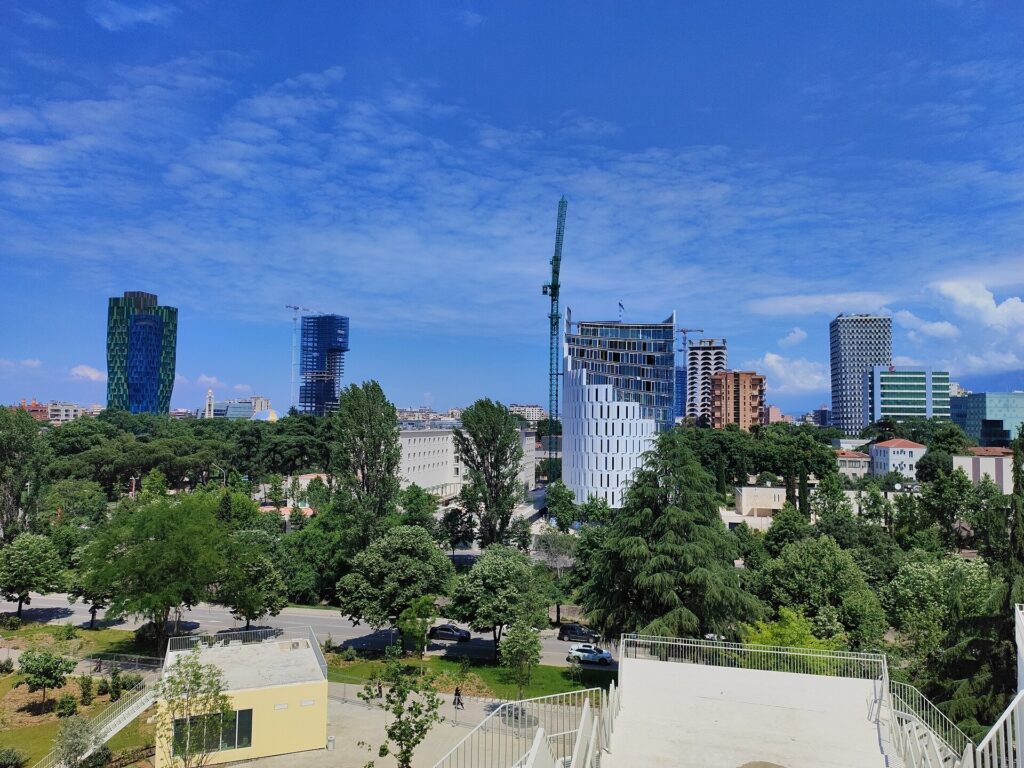
Tirana’s transformation over the past two decades has been dramatic. According to a 2024 World Bank assessment, Albania invested over EUR 1 billion in urban infrastructure between 2015 and 2024, with Tirana receiving the largest share. Most visitors expect grey communist blocks. They get color, glass towers, and a renovated Pyramid.
The color story is real and it started with Edi Rama, Tirana’s mayor in the early 2000s (now prime minister). He had communist-era apartment buildings painted in bright oranges, greens, purples, and yellows. People thought he was crazy. But it worked. The city went from depressing to photogenic almost overnight.
Today, Tirana has a skyline that changes every year. The Pyramid, Hoxha’s former mausoleum, was recently renovated into a cultural and technology center. Skanderbeg Square was redesigned into one of Europe’s largest pedestrian plazas. The New Bazaar (Pazari i Ri) was rebuilt into an Instagram-worthy market with craft beer bars and artisan coffee shops.
Is it perfect? No. Traffic is terrible. Construction is everywhere. Urban planning sometimes feels like an afterthought. But the trajectory is unmistakable. The Tirana of 2026 would be unrecognizable to someone who visited even 10 years ago.
9. Do Albanian Beaches Really Rival Greece?
Albania’s southern coastline is genuinely stunning, and international recognition is catching up. Lonely Planet named the Albanian Riviera one of Europe’s top 10 coastal destinations in 2024. Ksamil’s beaches were ranked among the best in the Mediterranean by European Best Destinations in 2023. And the water? Crystal clear, turquoise, absurdly photogenic.
Ksamil, Dhermi, Himara, Saranda. These names are showing up on every “best beaches in Europe” list now. Five years ago, you could have these beaches almost to yourself. That window is closing fast, but they’re still a fraction of the price of their Greek and Croatian neighbors just across the water.
A sunbed and umbrella at Ksamil costs around EUR 5 to EUR 10 per day. A seafood lunch by the water runs about EUR 8 to EUR 15. Compare that to Mykonos or Dubrovnik and the math does itself.
That said, I should be honest. Infrastructure hasn’t kept up with the tourism boom everywhere. Some beaches have construction nearby. Roads to certain spots are still rough. And in peak August, the most famous beaches get crowded. But the quality of the water and the scenery? They’re world-class. That’s not patriotism talking. It’s just the truth.
10. Everyone Wants to Practice Their English on You
English proficiency in Albania, especially among young people, is remarkably high. According to the EF English Proficiency Index 2024, Albania ranks in the “moderate” band, above several EU member states. Among Albanians under 30 in urban areas, conversational English is nearly universal.
How did this happen? Television. Albanians grew up watching American and British shows with subtitles, not dubbing. Friends, The Simpsons, CNN, BBC. An entire generation learned English from Ross and Rachel before they ever set foot in a classroom.
And it’s not just English. Many Albanians speak Italian fluently (geographical proximity plus Italian TV). German is increasingly common, especially among the diaspora community. You’ll meet people in Tirana who casually switch between four languages mid-conversation.
The result for visitors is striking: you won’t have a language barrier. This surprises people who assumed they’d need a phrasebook and a lot of hand gestures. Instead, the person selling you byrek at the corner shop will ask you where you’re from and then practice their English on you whether you invited the conversation or not.
I’ve watched this shift firsthand over 20 years. In the early 2000s, Italian was the dominant second language. By 2015, English had overtaken it among teenagers. Now, in 2026, I’d estimate 80% of Tirana’s service workers under 35 can hold a full English conversation. That’s a cultural shift driven almost entirely by media consumption, not policy.
Then vs Now: How Albania Changed Since Edward Reeves Visited
Albania’s transformation since 2012 has been one of Europe’s most dramatic national makeovers. International tourist arrivals jumped from roughly 3.5 million in 2012 to over 10 million in 2024 (INSTAT), a nearly threefold increase. Here’s what changed:
| Category | 2012 (When Reeves Visited) | 2026 (Today) |
|---|---|---|
| Tourist arrivals | ~3.5 million | 10+ million |
| Tirana airport | Small, outdated terminal | New international terminal (2024) |
| EU status | EU candidate aspirant | EU candidate (accession talks active) |
| Digital nomad visa | Didn’t exist | Available (1-year renewable) |
| Skanderbeg Square | Traffic roundabout | Europe’s largest pedestrian plaza |
| The Pyramid | Abandoned, graffiti-covered | Renovated tech/culture center |
| Beer price | 70p (~ EUR 0.85) | EUR 1.50-2.00 |
| International perception | “Is it safe?” | “When should I visit?” |
Edward Reeves was right about Albania. He just visited fourteen years too early. The country he found surprising in 2012 has become the country that everyone’s talking about in 2026. The hospitality, the food, the prices, the safety? Those were always there. What’s changed is the infrastructure around them, and the world’s willingness to finally pay attention.
Sometimes I think about what Reeves would write if he came back today. I think he’d be surprised all over again, not by Albania, but by how much more of it there is to discover. The 70p beer might cost a bit more now. But the friendly man at the grill? He’s still there.
Albania is changing fast. Whether that’s entirely good or partially bittersweet depends on who you ask. But for those of us who’ve been here all along, watching the world slowly figure out what we always knew? It’s nothing short of remarkable.
Frequently Asked Questions
Is Albania safe for tourists?
Yes. Albania’s crime rates are below Western European averages. UNODC data (2023) shows an intentional homicide rate of 1.6 per 100,000, lower than France or Belgium. Petty crime exists in tourist areas but is uncommon. The main safety concern is road traffic, not crime. Read our full safety guide here.
Is Albania cheap to visit?
Very. Numbeo’s 2026 index ranks Tirana’s costs roughly 55% lower than London. A macchiato costs EUR 0.70, restaurant meals run EUR 5 to EUR 10, and hotel rooms start around EUR 30 to EUR 40 per night. It’s one of the most affordable destinations in Europe without a drop in quality. See our full cost breakdown.
Do people speak English in Albania?
In Tirana and tourist areas, most people under 35 speak conversational English. Many also speak Italian and increasingly German. Albanian TV shows foreign programs with subtitles rather than dubbing, which means an entire generation learned English organically from American and British media.
What is Albanian besa?
Besa is an Albanian honor code that obligates the host to protect and care for their guest. It’s deeply rooted in the Kanun (customary law) and was famously demonstrated during WWII, when Albanian families sheltered Jewish refugees at personal risk. Today, besa manifests as extraordinary hospitality toward strangers. Learn more about besa.
Has Albania changed since 2012?
Enormously. Tourist arrivals tripled from 3.5 million to over 10 million (INSTAT). Tirana has a new airport terminal, a renovated Pyramid, a redesigned main square, and a growing digital nomad scene. Albania gained EU candidate status and launched a digital nomad visa. The core character, the hospitality, the food, the prices, remains, but the infrastructure is catching up.
What do you think?
Have you been to Albania? What surprised you most? Or if you haven’t visited yet, what’s holding you back? I’d genuinely love to hear your story in the comments.
Subscribe to monthly updates
Get honest Albania travel tips, local guides, and new posts straight to your inbox. No spam, unsubscribe anytime.
