
Key Takeaways
- Albania was under communist rule for 47 years (1944-1991) — one of the most isolated and extreme regimes in European history.
- Private cars were banned, religion was outlawed, and borders were sealed. Albanians lived in a surveillance state with almost no contact with the outside world.
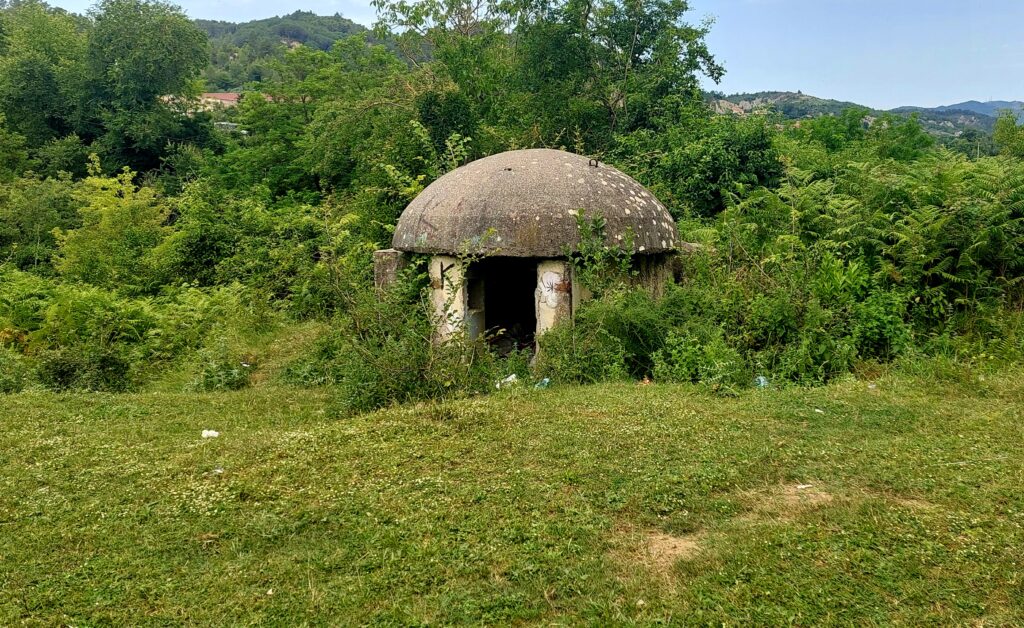
- Thousands of bunkers still dot the Albanian landscape — a lasting symbol of dictator Enver Hoxha’s paranoia about foreign invasion.
- The transition after 1991 was chaotic — mass emigration, pyramid scheme collapse in 1997, and a slow, painful rebuild that shapes Albania to this day.
- Today you can explore this history firsthand in Tirana at Bunk’Art, the House of Leaves, the Pyramid, and the once-forbidden Blloku neighborhood.
Table of Contents
Introduction
Every visitor to Tirana eventually asks the same question: What was it actually like?
You see the bunkers on the beach. You walk through Bunk’Art and stare at interrogation rooms. You notice the brutalist apartment blocks next to the painted buildings. And you want to know — not the Wikipedia version, but the real story.
Most of what’s written about communist Albania comes from foreign journalists, academics, or travel writers who visited for a week. That’s fine as far as it goes. But it doesn’t go far enough.
I was born in the last years of the regime. I grew up in the 1990s, when Albania went from one of the most sealed countries on earth to one of the most chaotic. My parents lived their entire adult lives under Enver Hoxha’s rule. My grandparents remembered a time before — and never stopped comparing.
This isn’t a history textbook. It’s what I know, what my family lived through, and what I see every time I walk through Tirana. If you’re visiting Albania and want to understand the communist chapter — not just the dates and the names, but what it felt like — this is the piece I’ve wanted to write for a long time.
A Brief History of Communist Albania
Planning a Trip to Tirana?
Get my free Tirana in 48 Hours checklist with day-by-day itinerary, prices, and local tips.
Get the Free Checklist →To understand what happened in Albania, you need to understand one thing first: we didn’t just have communism. We had the most extreme version of it that existed anywhere in Europe.
How It Started
When World War II ended in 1944, Enver Hoxha — a former schoolteacher turned partisan leader — took power. He’d led the National Liberation Movement against the Italian and German occupations, and when the war ended, he declared Albania a People’s Republic.
At first, Albania aligned with Yugoslavia under Tito. That lasted until 1948, when Hoxha broke with Tito and sided with Stalin’s Soviet Union instead. Soviet money poured in. Factories were built. Agriculture was collectivized. The familiar playbook.
Then Stalin died in 1953. When Khrushchev began de-Stalinization, Hoxha refused to follow. He saw it as betrayal. So by 1961, Albania broke with the Soviet Union entirely — and turned to Mao’s China.
From China to Total Isolation
The Chinese alliance lasted through the 1960s and 1970s. Chinese engineers helped build factories and infrastructure. But when Mao died in 1976 and China began opening up under Deng Xiaoping, Hoxha broke with China too.
By the late 1970s, Albania stood completely alone. No allies. No trade partners. No foreign contact. The constitution was amended to prohibit foreign loans and aid. Albania became, in practical terms, more isolated than North Korea.
What Made Albanian Communism Different
Every communist country had its own flavor of repression. Albania’s was uniquely severe:
- Religion was completely banned. In 1967, Albania declared itself the world’s first — and only — officially atheist state. Mosques and churches were demolished, converted to warehouses, or turned into sports halls. Practicing any faith was a criminal offense.
- Private cars were prohibited. Ordinary citizens were not allowed to own automobiles. The streets of Tirana were empty of traffic — just buses, government vehicles, and bicycles.
- The borders were sealed. No one could leave. Attempting to cross the border could get you shot or imprisoned. Albania was a cage.
- Bunkers were built everywhere. Driven by paranoia about foreign invasion, the regime constructed an estimated 173,000 concrete bunkers across the country — on beaches, in fields, on mountaintops, beside roads. One for roughly every eleven citizens.
Hoxha ruled until his death in 1985. His successor, Ramiz Alia, tried to maintain the system but couldn’t hold back the tide. By 1990, student protests had begun. By 1991, the regime collapsed.
Forty-seven years. That’s how long it lasted. And the scars run deep.
Did you know?
Albania was under communist rule for 47 years (1944-1991) and built over 170,000 concrete bunkers — roughly one for every 11 citizens. Most still dot the landscape today.
What Daily Life Was Actually Like
Here’s the thing that’s hard to convey to visitors: communism in Albania wasn’t just a political system. It was everything. It structured every single aspect of daily life — what you ate, what you wore, where you lived, what you watched, what you said, and who you trusted.
Food and Rationing
Families received ration books. Each month, you were allotted specific quantities of bread, oil, sugar, meat, and other basics. The amounts were never generous, and they got worse over time as the economy deteriorated.
My mother talks about waiting in line for hours for bread. Not because there was a long queue — sometimes there was simply no bread to buy. When it arrived, you took what you could get. Variety was a foreign concept. You ate what was available: bread, cheese, beans, rice, seasonal vegetables from your garden if you had one.
Meat was a rare luxury. Coffee was rationed — and in Albania, where coffee culture is practically a religion today, that’s saying something.
No Cars, No Travel
Imagine a European capital with almost no cars. That was Tirana. The main boulevard — today’s Deshmoret e Kombit — was wide and empty. People walked or took the bus. Bicycles if you were lucky.
Foreign travel was impossible for ordinary citizens. You couldn’t leave the country. Period. But even internal travel was restricted. You needed permission to move from one city to another. If you were from the countryside, you stayed in the countryside.
The Sigurimi
The Sigurimi — the secret police — was the regime’s eyes and ears. They were everywhere, and so were their informants. Your neighbor might be reporting on you. Your colleague. Even your family member.
My father’s generation grew up knowing that a careless word could cost you everything. People were imprisoned for telling a joke about the regime, for listening to foreign radio, for expressing any doubt about the Party.
The House of Leaves museum in Tirana — which I’ll talk about later — was the Sigurimi’s actual headquarters. Walking through it today gives you a visceral sense of how surveillance permeated daily life.
Entertainment in a Closed World
There was one television channel. State-run. It broadcast a few hours per day — propaganda, approved cultural programming, news about the glorious progress of the socialist state.
Radio was similarly controlled, though some people risked everything to listen to foreign stations — Radio Tirana broadcast abroad, but receiving anything from outside was dangerous.
Books existed, but only approved ones. Foreign literature was heavily censored. Albanian writers who didn’t toe the Party line disappeared — sometimes into prison, sometimes forever.
My parents’ generation found joy where they could: in family gatherings, in folk music, in the small private rituals that the state couldn’t fully control. But the constant awareness that you were being watched — that never went away.
Volunteer Labor
Every citizen was expected to contribute “volunteer” labor to the state. This meant construction projects, agricultural work, digging ditches, building roads. It wasn’t voluntary. You showed up, or there were consequences.
Students were regularly sent to the countryside for weeks or months to help with harvests. My parents both did this. They describe it matter-of-factly — it was just part of life. You didn’t question it, because questioning was not something you did.
The Bunkers
No article about communist Albania would be complete without talking about the bunkers. They’re everywhere. Literally everywhere.
Why So Many?
Enver Hoxha was convinced — or perhaps wanted everyone else to be convinced — that Albania was under constant threat of invasion. NATO from the west. Yugoslavia from the north. The Soviets after the split. The Greeks from the south. Eventually, everyone.
Starting in the 1960s, the regime embarked on one of history’s most bizarre construction programs. Concrete bunkers — small mushroom-shaped pillboxes for a few soldiers, and larger command bunkers for military operations — were built across the entire country. On beaches. In farm fields. Next to apartment buildings. On mountaintops. In city parks.
The commonly cited number is 750,000, though recent research suggests the actual figure is closer to 173,000. Either way, the scale is staggering. The resources poured into bunker construction — concrete, steel, labor — could have built hospitals, schools, housing. Instead, they built monuments to paranoia.
What They Look Like
The most common type is the small, dome-shaped pillbox — about two meters across, with a narrow slit for a gun barrel. They look like concrete mushrooms popping out of the ground. You’ll see them on beaches in Durres, in the hills above Saranda, along the roads in the countryside, and tucked into corners of Tirana’s parks.
The larger command bunkers are more impressive — multi-room underground structures with blast doors, ventilation systems, and communication equipment. The two Bunk’Art museums are built inside these larger bunkers.
What’s Happened to Them
Most bunkers sit abandoned. They’re too solid to demolish easily (they were built to withstand aerial bombardment), and there are too many of them to deal with systematically. Some have been swallowed by vegetation. Some are used by farmers as storage sheds. A few have been converted into cafes, bars, or art installations.
The two most significant conversions are Bunk’Art 1 and Bunk’Art 2 in Tirana — both are now excellent museums documenting the communist period. More on those in the visiting section below.
For visitors, the bunkers are Albania’s most recognizable symbol from the communist era. You can’t miss them. And once you understand why they exist, they take on a haunting quality — thousands upon thousands of concrete shells, built to defend against an invasion that never came.
People were leaving not just because they could for the first time in half a century, but because the economy was collapsing. The 1990s were Albania’s most chaotic decade — and the scars are still visible.
The Fall: 1991 and the Chaos That Followed
The end of communism in Albania wasn’t a single moment. It was a process — messy, terrifying, exhilarating, and deeply traumatic, sometimes all at once.
The Protests
By 1990, the communist regimes across Eastern Europe had already fallen. The Berlin Wall came down in November 1989. Romania’s Ceausescu was executed that December. Albania was the last holdout.
Student protests began at the University of Tirana in December 1990. They demanded democratic reforms. The regime, already weakened and unsure of itself, didn’t crush them the way it would have a decade earlier. Ramiz Alia, who had succeeded Hoxha in 1985, began making cautious concessions — allowing the formation of opposition parties, loosening some controls.
The Statue Falls
The moment that symbolized the end came on February 20, 1991. A crowd gathered in Skanderbeg Square and toppled the massive bronze statue of Enver Hoxha. I was too young to remember it myself, but everyone in my parents’ generation talks about that day. It was the moment they knew the old world was really ending.
Multi-party elections were held in March 1991. The communists actually won — largely because the rural population, uncertain and afraid, voted for what they knew. But by June, the government had collapsed under general strikes and protests. New elections in 1992 brought the Democratic Party to power.
The Exodus
What happened next shocked the world. Thousands of Albanians — desperate, hopeful, terrified — rushed to the ports. In August 1991, a ship called the Vlora arrived in Bari, Italy, carrying an estimated 20,000 Albanians crammed onto its deck. The photographs are iconic: a rusting cargo ship so overloaded with humanity that you can barely see the vessel underneath.
People were leaving not just because they could for the first time in half a century, but because the economy was collapsing. Factories were shutting down. Food was scarce. The structures that had organized daily life — oppressive as they were — were disintegrating with nothing to replace them.
1997: When Everything Collapsed
If you think the early 1990s were bad, 1997 was worse. Much worse.
A series of pyramid investment schemes — essentially Ponzi schemes — had attracted money from a huge percentage of the Albanian population. People sold their homes, their livestock, their land to invest. When the schemes collapsed in early 1997, the country erupted.
Government armories were looted. Armed gangs roamed the streets. The state essentially ceased to function. In parts of southern Albania, there was genuine anarchy.
I remember the sound of gunfire at night. I remember my parents keeping us inside. I remember the confusion of being a child in a country that seemed to be tearing itself apart.
An international peacekeeping force eventually restored order, but the trauma of 1997 cut deep. It set Albania’s development back by years and left a scar of distrust — toward institutions, toward leaders, toward anyone promising easy prosperity.
From Grey to Color
Through all of this, Tirana itself was transforming. Under communism, the city was famously grey — identical apartment blocks, no advertising, no color, no personality. In the early 2000s, Mayor Edi Rama (later Prime Minister) began painting the brutalist buildings in bright colors — orange, pink, green, purple.
It was more than cosmetic. It was psychological. The colors said: that era is over. We are something new.
Walk through Tirana today and you see both worlds layered on top of each other — the grey concrete bones of communism underneath the painted, chaotic, alive city that has grown around them. It’s not always pretty, but it’s real.
What Remains of Communism Today
More than three decades after the fall, communism’s shadow is still visible everywhere in Albania — if you know where to look.
The Architecture
The most obvious legacy is the built environment. Communist-era apartment blocks — the pallatet — still house a significant portion of Tirana’s population. They’re the five-to-eight-story concrete buildings you see throughout the city, often with additions built illegally on top during the chaotic 1990s.
The Pyramid of Tirana is perhaps the most striking piece of communist architecture. Built in 1988 as a museum dedicated to Enver Hoxha, it’s a massive, angular structure that dominates the city’s skyline. After the fall, it served various purposes — a NATO base during the Kosovo crisis, a nightclub, a conference center. For years it sat abandoned, with local kids sliding down its marble-clad sides. It’s currently being transformed into a technology and education center — a fitting metaphor for Albania’s ongoing effort to repurpose its communist inheritance.
The Mentality
This is harder to see as a visitor, but Albanians talk about it openly. Communism shaped attitudes that persist across generations:
- Distrust of institutions. When the state was your oppressor for 47 years, you don’t easily trust government. This shows up in everything from tax compliance to the way Albanians rely on personal networks rather than formal systems.
- Resourcefulness. When you had nothing, you learned to make do. Albanians are among the most resourceful, adaptable people I know. That comes directly from the communist experience.
- The generational divide. Young Albanians — the ones born after 2000 — have no memory of communism and sometimes no real understanding of it. They’re European, digital, outward-looking. Their grandparents lived in a sealed country. The gap between these two worldviews is enormous.
The Museums
Tirana now has several excellent museums dedicated to the communist period. I’ll cover them in detail in the next section, but the fact that they exist at all is significant. For years, Albania didn’t really talk about communism. It was too recent, too raw. The museums represent a country finally reckoning with its past.
Visiting Communist-Era Sites in Tirana
If you’re in Tirana and want to understand the communist chapter, here’s where to go. I’d recommend dedicating at least half a day to this — ideally a full day if you want to include Bunk’Art 1.
Bunk’Art 2 (City Center)
Location: Behind the National History Museum, Skanderbeg Square
Ticket: Around 500 ALL (~$5 / ~4.50 EUR)
Time needed: 1-2 hours
This is the one you shouldn’t miss. Built inside a Cold War-era nuclear bunker right in the heart of Tirana, Bunk’Art 2 focuses on the Sigurimi — the secret police — and political persecution under the regime. The tunnels, rooms, and exhibits are genuinely powerful. You walk through the actual spaces where the machinery of surveillance and repression operated.
House of Leaves (Museum of Secret Surveillance)
Ticket: Around 700 ALL (~$7 / ~6 EUR)
Time needed: 1-1.5 hours
This was the actual headquarters of the Sigurimi. The name “House of Leaves” refers to the listening devices hidden everywhere — microphones in the walls, the ceilings, disguised as everyday objects. The exhibits display the actual surveillance equipment used to spy on Albanian citizens. It’s chilling, fascinating, and incredibly well-presented.
Bunk’Art 1 (Outskirts of Tirana)
Ticket: Around 500 ALL (~$5 / ~4.50 EUR)
Time needed: 2-3 hours
This is the big one — a massive five-story underground bunker originally built for Enver Hoxha and the political elite in case of nuclear attack. It has over 100 rooms spread across 3,000 square meters. The exhibits cover the full sweep of Albania’s 20th-century history, from independence through both world wars to the communist period. It’s more immersive and comprehensive than Bunk’Art 2, but it requires more time and effort to reach.
Pyramid of Tirana
You can’t miss it — it’s the giant angular structure on Deshmoret e Kombit boulevard. Originally built as Hoxha’s mausoleum, it’s been many things since. As of my last visit, the renovation into TUMO Tirana (a technology and creative education center) is underway. Even if you can’t go inside, it’s worth walking around and understanding what it represents.
National History Museum
The large building on Skanderbeg Square with the socialist realist mosaic on its facade. The communist-era section provides good historical context, though it’s less immersive than Bunk’Art or House of Leaves. The mosaic itself — The Albanians — is one of the last major examples of socialist realist art in the country.
Walking the Blloku Neighborhood
During communism, this entire area was walled off and reserved exclusively for the Party elite — Hoxha and his inner circle lived here. Ordinary Albanians couldn’t even walk through it. Today, it’s Tirana’s most vibrant neighborhood — packed with cafes, restaurants, boutiques, and nightlife. The contrast is the point. Grab a coffee at one of the many bars on Rruga Pjeter Bogdani and sit where, 35 years ago, you’d have been arrested for trespassing.
- Check opening hours before you go. Albanian museums don’t always keep consistent schedules, especially on Mondays (many are closed) and public holidays.
- Bring cash. Some smaller sites may not accept cards. ATMs are plentiful in central Tirana.
- Combine Bunk’Art 2 + House of Leaves + Blloku walk into a single morning or afternoon — they’re all within walking distance of each other.
- For Bunk’Art 1, plan a separate trip. It’s about 20-30 minutes by taxi from the center, and you’ll want 2-3 hours inside.
- Audio guides are available at both Bunk’Art locations and House of Leaves — highly recommended.
Frequently Asked Questions
Was Albania really communist?
Yes — and not just communist, but one of the most extreme communist states in history. Under Enver Hoxha (1944-1985), Albania banned religion entirely, prohibited private car ownership, sealed its borders, built thousands of military bunkers, and maintained a pervasive secret police network. It was the last country in Europe to abandon communism in 1991.
How long was Albania under communism?
Albania was under communist rule for 47 years, from 1944 to 1991. Enver Hoxha led the country from 1944 until his death in 1985. His successor Ramiz Alia oversaw the final years of the regime until multiparty elections were held and the system collapsed.
Why did Albania build so many bunkers?
Enver Hoxha was convinced that foreign powers would invade Albania. Over several decades, the regime constructed an estimated 173,000 bunkers across the entire country — on beaches, mountaintops, farmland, and city streets. The bunkers were never used in combat and most remain abandoned today, though some have been converted into museums, cafes, and art spaces.
What happened to religion in communist Albania?
In 1967, Albania became the world’s only officially atheist state. All mosques, churches, tekkes (Bektashi lodges), and religious institutions were closed. Many were demolished or repurposed. Religious practice was criminalized — people faced imprisonment or worse for praying or possessing religious texts. After 1991, religious freedom was restored, and Albania today is known for its religious tolerance and coexistence.
Is it safe to visit communist-era sites?
Absolutely. Tirana’s communist-era museums — Bunk’Art 1, Bunk’Art 2, and the House of Leaves — are well-maintained, professionally run tourist attractions. The Pyramid of Tirana and Blloku neighborhood are in the heart of the city. Abandoned bunkers around the country are generally safe to photograph from outside, but I’d avoid entering unmanaged ones.
What’s inside Bunk’Art?
Bunk’Art 2 (city center) is a former nuclear bunker turned museum focused on the Sigurimi (secret police) and political persecution. Bunk’Art 1 (outskirts) is a massive five-story underground bunker built for the political elite, with over 100 rooms of exhibits covering Albania’s entire modern history. Both feature original Cold War infrastructure, multimedia displays, historical artifacts, and powerful documentation of life under the regime.
Closing: The Scars and the Resilience
People sometimes ask me whether Albania has “moved on” from communism. The honest answer is: yes and no.
Yes, because Tirana today is unrecognizable compared to the grey, silent city my parents grew up in. The cafes are full. The music is loud. Young Albanians travel, study abroad, start businesses, speak three languages. The isolation of the Hoxha years feels like ancient history to anyone under 30.
No, because 47 years of totalitarian rule doesn’t evaporate in three decades. You see it in the distrust of institutions. In the way older people lower their voices when talking about politics — a reflex from a time when the walls had ears. In the unfinished buildings and unresolved property disputes that trace back to communist-era confiscations.
But here’s what I want visitors to understand: Albania’s story isn’t a tragedy. It’s a story of resilience. A country that was sealed off from the world for half a century, that lost an entire generation to fear and silence, that went through the chaos of the 1990s — and came out the other side as one of the most welcoming, vibrant, rapidly changing places in Europe.
When you walk through Bunk’Art and then sit down for a macchiato in Blloku, you’re experiencing that transformation in real time. The bunkers are still there. But so is everything that’s been built on top of them.
That’s the real story of communist Albania. Not just what it was — but what came after.
Want to explore more of Tirana’s history and hidden corners? Check out our interactive Tirana guide and discover the city beyond the tourist trail.
