
Key Takeaways
- Albanians are among Europe’s oldest peoples — descendants of the ancient Illyrians who lived in the western Balkans over 2,500 years ago.
- The Albanian language is unique in Europe — it belongs to its own branch of the Indo-European family, unrelated to any neighboring language.
- Skanderbeg held off the Ottoman Empire for 25 years — and remains the defining national hero to this day.
- Albania spent 500 years under Ottoman rule — which shaped its culture, architecture, cuisine, and religious diversity.
- Independence came late — 1912 — making Albania one of Europe’s youngest nation-states despite having one of its oldest populations.
- The 1990s were brutal — pyramid scheme collapse, armed unrest, and the Kosovo refugee crisis tested the new democracy to its breaking point.
- Every era left something you can visit today — from Illyrian ruins at Butrint to Ottoman towns like Berat to Cold War bunkers turned museums in Tirana.
Table of Contents
- Introduction
- The Illyrians — Albania’s Ancient Roots
- Roman and Byzantine Albania
- The Ottoman Centuries
- Skanderbeg — The National Hero
- The National Awakening (Rilindja Kombetare)
- Independence and the Short-Lived Kingdom
- World War II and the Communist Takeover
- The Post-Communist Transition (1991-2000)
- Modern Albania (2000-Present)
- Historical Sites You Can Visit Today
- Frequently Asked Questions
- Closing
Introduction
A few years ago, I was showing a German friend around Skanderbeg Square when he asked me, ‘So when did Albania become a country?’ I told him Albanians have been here since before the Romans — that our ancestors, the Illyrians, were living in these mountains when the Parthenon was still a construction site. He stared at me like I had made it up. That reaction — genuine disbelief that Albania has one of the oldest continuous histories in Europe — is something I have seen dozens of times. And it is exactly why I wanted to write this.
Here is what I can tell you upfront: Albanian history is one of the most overlooked stories in Europe. This is a country where people have lived continuously for over two millennia, where a medieval warrior held off the most powerful empire on earth, and where — just thirty years ago — it was harder to get into (or out of) than North Korea.
And yet, most people who visit Albania arrive knowing almost nothing about any of it.
That is not a criticism. The information simply is not out there in an accessible form. You will find academic papers and dense Balkan histories, but not much that a regular person planning a trip can sit down and read in one go.
This article is my attempt to fix that. I will walk you through the full sweep of Albanian history — from the ancient Illyrians to today — hitting the key events, the important figures, and most importantly, the places where you can see this history for yourself. No history degree required.
Let us start at the beginning. And in Albania, the beginning goes back a very long way.
The Illyrians — Albania’s Ancient Roots
Planning a Trip to Tirana?
Get my free Tirana in 48 Hours checklist with day-by-day itinerary, prices, and local tips.
Get the Free Checklist →If you want to understand why Albanians are fiercely proud of who they are, start here.
The Illyrians were a collection of tribes that inhabited the western Balkans — roughly modern-day Albania, Kosovo, Montenegro, and parts of Croatia and Bosnia — starting from at least the Bronze Age (around 1000 BC, and likely earlier). They were not one unified nation. They were dozens of separate tribes — the Taulantii near Durres, the Ardiaei along the coast, the Dardani in the north — who shared cultural practices, language roots, and a general distaste for being told what to do by outsiders.
Think of them a bit like the Native American nations before European contact: distinct groups across a region, with shared ancestry but separate identities.
What We Know About Them
The Illyrians were skilled metalworkers, sailors, and fighters. Greek historians — Herodotus, Thucydides, and others — wrote about them, usually when the Illyrians were causing problems for Greek colonies along the coast. The Illyrians traded with the Greeks but also raided their ships. They built fortified hilltop settlements, many of which you can still see the foundations of today.
They had their own kings. Queen Teuta of the Ardiaei (ruled around 231-228 BC) is one of the most famous — she controlled a fleet that terrorized Adriatic shipping until Rome decided enough was enough and sent an army south. That clash with Rome would shape the next chapter of Albanian history.
The Illyrians also developed distinctive art. If you visit the National Historical Museum in Tirana, you will see Illyrian bronze helmets, jewelry, and pottery that show a sophisticated culture with its own aesthetic — not just crude copies of Greek designs.
The Language Connection
Here is something that surprises a lot of visitors: the Albanian language is a complete loner in Europe. It is Indo-European, yes, but it does not belong to the Slavic family, the Romance family, the Germanic family, or any other group. It sits on its own branch, the way Armenian or Greek does.
Linguists believe Albanian evolved from the ancient Illyrian language (or possibly from a closely related Balkan language called Thracian — the debate continues). What is clear is that Albanian has been spoken continuously in this region for a very long time, absorbing Latin, Greek, Turkish, and Slavic vocabulary along the way but maintaining a core structure that is uniquely its own.
When Albanians say “we were here first,” they are not being dramatic. The linguistic and archaeological evidence supports a very old and very continuous presence in these mountains.
Where to See It: Butrint
The single best place to touch Illyrian-era Albania is Butrint, a UNESCO World Heritage Site near Sarande in the south. Butrint has layers — literally. You walk through Illyrian walls, Greek theater foundations, Roman baths, a Byzantine basilica, and a Venetian fortress, all stacked on top of each other on a small peninsula surrounded by a lagoon.
It is one of those places where you can stand in one spot and see 2,500 years of history around you.
The first time I visited Butrint, I was a teenager on a school trip. What struck me most was not any single ruin — it was the silence. You walk through layers of civilization — Greek, Roman, Byzantine, Venetian — all stacked on top of each other in this dense forest by a lagoon. The theater is still there, carved into the hillside, with seats you can sit in. I remember sitting in one of those ancient seats and thinking: someone sat here two thousand years ago and watched a play. If you visit, go early in the morning before the tour buses arrive. That silence is the whole experience.
Did you know?
The Albanian language belongs to its own unique branch of the Indo-European family — unrelated to any neighboring language. Linguists believe it evolved from the ancient Illyrian language, making Albanians among the oldest peoples in Europe.
Roman and Byzantine Albania
Rome came to the western Balkans in stages. After defeating Queen Teuta around 228 BC, Rome gradually expanded its control over Illyrian territory. By 168 BC, the last Illyrian king, Gentius, was defeated, and the region became part of the Roman Republic.
For Albanians, this was not the end of their story — it was a chapter within it. The Illyrian population did not vanish. They were absorbed into the Roman system, served in the Roman legions (several Roman emperors were of Illyrian origin, including Diocletian and Justinian), and continued living in the same mountains and valleys they always had.
What the Romans Built
Rome built infrastructure that literally shaped Albania’s geography for the next two thousand years:
The Via Egnatia — one of the most important Roman roads — ran from Durres (then called Dyrrachium) all the way to Constantinople (modern Istanbul). It was the highway that connected Rome’s western and eastern halves. Parts of it are still visible today, and modern Albanian roads follow its route in several places.
Durres became one of the most important cities in the Roman world. Its amphitheatre — built in the 2nd century AD, with a capacity of around 20,000 — is still there, sitting in the middle of the modern city. You can walk through it. Houses were literally built on top of it over the centuries, and parts of it were only rediscovered in 1966. It is one of the largest amphitheatres in the Balkans.
Apollonia (near modern Fier) was a major Greek and then Roman city. Cicero called it “a great and important city.” Augustus studied there before becoming emperor. Today it is an archaeological park where you can wander among columns, a restored monastery, and the remains of a city that once had 60,000 inhabitants. It is far less crowded than comparable sites in Greece or Italy, which is part of its charm.
I remember visiting the Durres Amphitheatre as a kid and being fascinated by how it sat right in the middle of a residential neighborhood. People had literally built their houses on top of Roman ruins. There was laundry hanging on a line above a section of ancient wall. That image has stayed with me — it captures something essentially Albanian about our relationship with history. We do not put it behind glass. We live on top of it.
The Byzantine Split
When the Roman Empire split in 395 AD, Albania fell on the eastern side — under Constantinople’s control. This is important because it set a cultural pattern that lasted centuries: Albania was technically part of the Byzantine (Eastern Roman) Empire, but it sat right on the fault line between East and West.
Christianity had arrived early. Saint Paul mentioned preaching in Illyricum (the Roman name for the region). Albania was Christian before many parts of Western Europe, and you can see early Christian basilicas and baptisteries at Butrint, Elbasan, and Lin (on the shores of Lake Ohrid).
But the East-West division within Christianity — Catholic in the north, Orthodox in the south — would become a defining feature of Albanian identity that persists today.
The Ottoman Centuries
In 1385, Ottoman forces won the Battle of Savra in central Albania, marking the beginning of Ottoman expansion into Albanian territory. By the mid-1400s — despite fierce resistance that I will get to in a moment — most of Albania was under Ottoman control.
It would stay that way for over 500 years.
Five hundred years. That is longer than the United States has existed. Longer than most European countries have had their current borders. It is an enormous span of time, and it fundamentally shaped the Albania you see today — its architecture, its food, its coffee culture, its religious mix, and its complicated feelings about identity.
What Ottoman Rule Meant
The Ottoman system was different from what most Western visitors imagine. It was not simply “Muslim conquerors oppressing Christian subjects,” though oppression certainly happened. It was a complex imperial structure that offered some paths upward — particularly through conversion to Islam and military service.
Albanian boys were taken through the devshirme system — a sort of forced recruitment where Christian boys were taken from their families, converted to Islam, and trained for the Ottoman military or civil service. It was brutal and traumatic for families, but some of these boys rose to extraordinary power. Dozens of Ottoman grand viziers were of Albanian origin. The founder of modern Egypt, Muhammad Ali, was an Albanian from Kavaje.
Over the centuries, a significant portion of the Albanian population converted to Islam — some through coercion, some through economic incentive (Muslims paid lower taxes), and some gradually through intermarriage and cultural absorption. But here is the thing that makes Albania unusual: conversion did not erase Albanian identity. Albanians who became Muslim did not stop being Albanian. They kept speaking Albanian, maintained their clan structures, and — in the mountains especially — continued living by their own customary law (the Kanun) rather than Ottoman law.
This is why Albania today has a Muslim majority but does not feel like a “Muslim country” in the way that many Western visitors expect. The relationship between Albanian identity and religion has always been complicated, and it goes back to these centuries of Ottoman rule.
What Visitors Can See
The Ottoman centuries left their mark everywhere:
- Berat — the “City of a Thousand Windows” — is a UNESCO World Heritage Site with an intact Ottoman old town. White houses climb a hillside below a massive fortress. The Mangalem and Gorica quarters look much as they did 200-300 years ago.
- Gjirokastra — another UNESCO town — has a dramatic hilltop castle and stone houses with distinctive Ottoman architecture. It was also the birthplace of Enver Hoxha, which adds a complicated layer.
- The bazaars and mosques of towns like Shkoder, Elbasan, and Korce show Ottoman urban planning.
- Albanian food — the byrek (savory pie), Turkish coffee, baklava, and grilled meats that you will eat everywhere — has deep Ottoman roots.
Skanderbeg held off the Ottoman Empire for 25 years with a small army in the Albanian mountains. He remains the defining national hero — his double-headed eagle flag became Albania’s national symbol.
Skanderbeg — The National Hero
Now, about that “fierce resistance” I mentioned.
If you spend more than a day in Albania, you will encounter Skanderbeg. His name is on the main square in Tirana. His helmet-and-goat-head emblem is on the Albanian flag. His statue stands in the center of the capital, and in Kruje, and in Pristina, and in Rome. Streets, schools, beers, and football stadiums are named after him.
Skanderbeg is to Albania what George Washington is to the United States — except he did it 300 years earlier, with fewer resources, against a much larger empire.
Who He Was
His real name was Gjergj Kastrioti. Born in 1405, he was the son of Gjon Kastrioti, an Albanian feudal lord. As a child, he was taken by the Ottomans as a hostage (common practice for keeping local lords in line) and raised in the Ottoman court. He was given the name Iskander (Alexander, after Alexander the Great) and the title Bey — hence “Skanderbeg.”
He was trained as an Ottoman military commander and served in the Ottoman army for years. But in 1443, during a battle in present-day Serbia, he deserted. He rode back to Albania, took the fortress of Kruje, and raised the Albanian flag — a double-headed eagle on a red background, which remains the national flag today.
Twenty-Five Years of War
What followed was remarkable. Skanderbeg united the fractious Albanian lords — which was itself a minor miracle, given how much they loved fighting each other — and for 25 years held off the Ottoman Empire, the most powerful military force in the world at that time.
He won battle after battle using guerrilla tactics perfectly suited to Albania’s mountainous terrain. The Ottomans sent army after army. Sultan Murad II personally led a campaign against him and failed. His successor, Mehmed II — the man who conquered Constantinople in 1453 — also failed to defeat Skanderbeg.
Skanderbeg died of malaria in 1468. Without him, Albanian resistance crumbled. Within a decade, the Ottomans controlled the country. But the legend was permanent.
Pope Pius II called him “the Champion of Christendom.” European rulers sent him money and weapons (though never enough). And for Albanians, he became proof that a small nation can stand against an empire — a theme that runs through Albanian identity to this day.
What You Can Visit
Kruje is the essential Skanderbeg pilgrimage. The castle sits on a rocky ridge about 30 minutes north of Tirana. Inside, the Skanderbeg Museum tells the story through weapons, maps, and replicas. The old bazaar below the castle is one of the best traditional markets in Albania, selling copper work, antiques, and Albanian crafts.
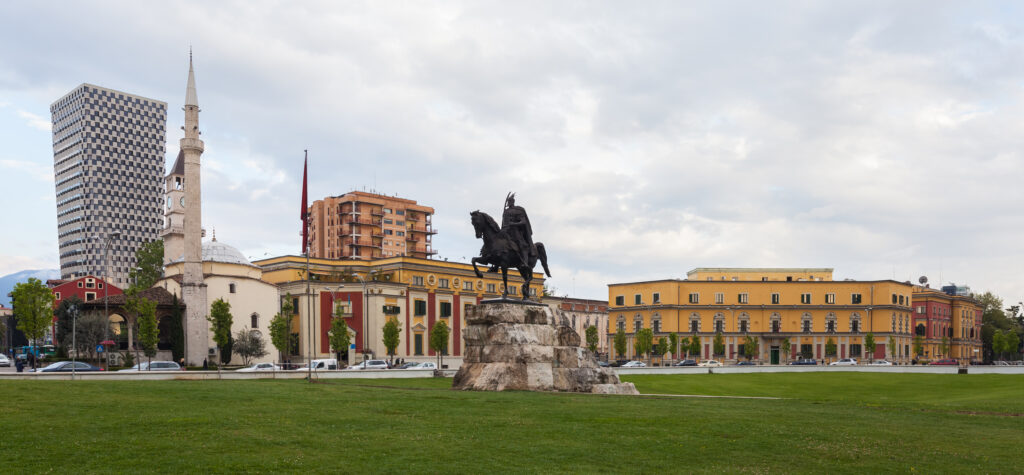
The Skanderbeg statue in Tirana’s main square — Sheshi Skanderbej — is the city’s most recognizable landmark. The square itself was redesigned in 2017 and is now a vast, car-free space surrounded by the national museum, the opera house, and the Et’hem Bey Mosque.
Growing up Albanian, Skanderbeg is everywhere — on the money, on the square, in every history class, in the name of the boulevard you walk on. As a kid, he was a superhero to me. As an adult, I appreciate the real person more than the myth — a brilliant strategist who held together a quarrelsome collection of Albanian lords against the most powerful military on earth. When I take visitors to Kruje and we stand in the castle where he based his resistance, I always feel a quiet pride. This is where a small nation refused to disappear.
The National Awakening (Rilindja Kombetare)
After Skanderbeg’s death, Albania went dark — historically speaking. For four centuries, there was no Albanian state, no Albanian schools, and for most of that time, no standardized Albanian alphabet. Albanian was spoken at home and in the mountains, but it had no official standing under Ottoman rule.
The Rilindja Kombetare — the National Awakening — changed that. It was the 19th-century movement that pulled Albanian identity out of the shadows and eventually led to independence.
Why It Happened When It Happened
Several things converged in the second half of the 1800s:
The Ottoman Empire was weakening. The “Sick Man of Europe” was losing territory across the Balkans — Greece gained independence in 1832, Serbia and Romania were autonomous, Bulgaria was breaking free. Albanian leaders saw the writing on the wall: if they did not act, their territory would be carved up and handed to their neighbors.
The League of Prizren (1878). This was the critical moment. When the Congress of Berlin proposed giving large chunks of Albanian-inhabited territory to Serbia, Montenegro, and Greece, Albanian leaders gathered in Prizren (in modern-day Kosovo) and formed a political league to defend Albanian territorial integrity. It was the first organized Albanian political movement.
The alphabet question. One of the most basic tools of national identity — a shared written language — did not exist for Albanian until surprisingly late. In 1908, the Congress of Monastir adopted the Latin alphabet for Albanian. This seems like a small thing, but it was foundational — you cannot build a national literature, a school system, or a press without a standard way to write your language.
Key intellectuals drove the movement. Figures like Naim Frasheri, considered the national poet, and his brother Sami Frasheri wrote works that defined Albanian identity. Pashko Vasa, a Catholic Albanian from Shkoder, wrote the famous line: “The religion of Albania is Albanism” — arguing that what united Albanians across religious lines was their shared identity, not any particular faith.
That phrase still resonates. It is quoted constantly. And it explains something that visitors often find puzzling: how a country with mosques, churches, and a Bektashi world headquarters can feel so religiously relaxed.
Independence and the Short-Lived Kingdom
November 28, 1912
On November 28, 1912, in the coastal city of Vlore, Ismail Qemali — a veteran Ottoman politician of Albanian origin — raised the flag and declared Albania’s independence.
The timing was desperate. The Balkan Wars were raging. Serbia, Greece, Montenegro, and Bulgaria had ganged up on the Ottoman Empire and were carving up its European territories. If Albania did not declare independence immediately, it would simply be absorbed by its neighbors. The declaration was as much an act of self-preservation as it was a triumph.
November 28th is Albania’s most important national holiday. Every year, every city and town in the country celebrates with flags, concerts, and gatherings. The building in Vlore where Qemali declared independence is now a museum — modest but meaningful.
The Great Powers Draw the Borders
Independence was declared, but it was the Great Powers of Europe — Britain, France, Germany, Austria-Hungary, Russia, and Italy — who actually decided Albania’s borders at the Conference of London in 1913.
The result was painful. Roughly half of the ethnic Albanian population was left outside the new state’s borders, particularly in Kosovo (given to Serbia) and in parts of what is now North Macedonia and Greece. This is the root of the “Albanian question” that haunted the Balkans for the next century and that still shapes regional politics today.
The Albania that emerged was small, poor, and vulnerable. Its first years were chaotic — a German prince (Wilhelm of Wied) was installed as ruler, lasted six months, and left. World War I swept through the region. Various occupying armies came and went.
King Zog
Out of this chaos emerged Ahmet Zogu, a clan chief from the Mat district in central Albania. Zogu became prime minister in 1922, president in 1925, and then declared himself King Zog I in 1928.
Zog was a complicated figure. He modernized some aspects of Albanian life — building roads, establishing a legal code, promoting secular education. He was also authoritarian, survived at least 55 assassination attempts, and increasingly depended on Italy’s Mussolini for financial support.
That dependence would prove fatal. On April 7, 1939, Mussolini’s troops invaded. Zog fled to Greece with his family, taking the country’s gold reserves with him. He never returned. He died in exile in France in 1961.
My grandmother used to talk about the Zog era with a strange mix of nostalgia and sarcasm. ‘At least we had a king,’ she would say, and then laugh. Most Albanians today feel the same ambivalence — Zog modernized the country, opened the first schools, and gave Albania its first taste of European statehood. But he also declared himself king and fled with the gold reserves when things got hard. Every year on Independence Day, November 28, Albanians celebrate in Vlore where independence was declared in 1912 — and someone always brings up Zog, for better or worse.
World War II and the Communist Takeover
This is the hinge point of modern Albanian history, and I will keep it brief here because I have written about the communist era in much more detail in a separate article.
The short version: Italy occupied Albania from 1939, then Germany took over in 1943 after Italy’s surrender. Multiple resistance groups fought the occupation — communist partisans (led by Enver Hoxha), nationalists (Balli Kombetar), and royalists. They spent as much time fighting each other as fighting the occupiers.
When the war ended in 1944, Hoxha’s communist partisans controlled the country. With Yugoslav and Soviet backing, Hoxha consolidated power, eliminated his rivals, and established one of the most extreme communist regimes in European history. Albania would remain under communist rule until 1991 — 47 years of isolation, repression, and economic stagnation.
The Post-Communist Transition (1991-2000)
The fall of communism in Albania was not a smooth handover. It was messy, painful, and at times violent. If you have seen photos of people clinging to ships in Durres harbor in 1991, desperately trying to reach Italy — that is the image that defines this period.
The Exodus
When the borders opened, Albanians left. Not some of them — huge numbers. In March 1991, roughly 20,000 people crowded onto ships in Durres and sailed to the Italian port of Brindisi. Italy initially accepted them. In August, another wave of 10,000-20,000 tried the same thing. This time, Italy sent most of them back.
These images shocked Europe. Here was a European country, just across the Adriatic from Italy, where people were so desperate to leave that they climbed onto rusting cargo ships with nothing but the clothes on their backs.
The early 1990s were a time of extreme hardship. The state-run economy collapsed. Factories closed. Farms that had been collectivized for decades had no system to transition to private ownership. Unemployment was massive. Basic goods were scarce.
The 1997 Pyramid Scheme Crisis
Then came 1997 — the year Albania almost fell apart entirely.
During the mid-1990s, a series of pyramid (Ponzi) schemes swept the country. These were not small operations. They were massive — some were effectively intertwined with the government. For a population with no experience of capitalism, no functioning banking system, and no financial literacy, the schemes looked like legitimate investments.
People sold their houses, their livestock, their land — and put everything into the pyramids. When the schemes collapsed in early 1997, an estimated $1.2 billion vanished. In a country of just 3 million people, that was catastrophic. By some estimates, two-thirds of the population lost money. Many lost everything.
The result was armed chaos. Military armories were looted. Nearly one million weapons flooded the streets. The government lost control of the south. Around 2,000 people died. An Italian-led international force eventually restored order, but Albania’s fragile new democracy had been shattered.
I remember 1997 vividly. I was in my twenties, and like many Albanians, people in my extended family had invested money in the pyramid schemes — some had put in their life savings. When the schemes collapsed, the anger was unlike anything I had seen before. In Tirana, you could hear gunfire at night. Schools closed. People stayed indoors. A neighbor of ours lost everything and stood in his doorway looking like he had aged ten years in a week. It was the moment my generation realized that the transition from communism was going to be far messier and more painful than anyone had promised us.
The Kosovo Crisis (1999)
Albania was still recovering from 1997 when the Kosovo war hit in 1998-1999. Serbia’s campaign against the ethnic Albanian population in Kosovo drove roughly 450,000 refugees across the border into Albania — a country of 3 million people that could barely feed itself.
To put that in perspective: imagine a country the size of Maryland absorbing the entire population of Miami in the space of a few weeks.
Albania, despite its own poverty and instability, took them in. Families opened their homes. There was no refugee camp infrastructure, no budget — just people helping people. It was one of those moments that does not get enough recognition internationally but that Albanians remember with quiet pride.
NATO intervened. The refugees returned to Kosovo. And Albania staggered into the new millennium, exhausted but still standing.
Modern Albania (2000-Present)
The Albania of the early 2000s and the Albania of today are almost unrecognizable as the same country. The transformation has been dramatic — imperfect, frustrating, and incomplete, but dramatic.
Slow Stabilization (2000-2010)
The 2000s were about rebuilding the basics. Democratic institutions strengthened (slowly). The economy stabilized. Foreign investment trickled in. Infrastructure improved.
Two milestones stand out:
NATO membership (2009). Albania joined NATO alongside Croatia. For a country that had been the most isolated in Europe just 18 years earlier, this was a genuine turning point.
EU candidate status (2014). Albania was officially recognized as a candidate for European Union membership. The accession process is ongoing and frustratingly slow, but the direction of travel is clear. Most Albanians strongly support EU membership.
The Infrastructure Boom
If you are visiting Albania now, the physical transformation is the first thing you will notice. Tirana has been rebuilt almost from scratch — new boulevards, the massive Skanderbeg Square redesign (completed 2017), parks, bike lanes, and a construction boom that has reshaped the skyline.
Not all of this is positive. Construction has been chaotic and often illegal. Historic neighborhoods in Tirana have been demolished to make way for apartment towers. Concrete has spread along parts of the coast that were pristine a decade ago. The development is real, but it is not always well-planned.
Emigration and Return
Albania’s diaspora is enormous. Roughly a third of ethnic Albanians live outside Albania — in Italy, Greece, Germany, the UK, the US, Canada, and elsewhere. This mass emigration drained the country of young, educated people.
But something has shifted in recent years. Some Albanians are coming back. Young Albanians who grew up in London or Milan are returning to open businesses, restaurants, and startups. The brain drain is still real — but it is a trend worth watching.
The Tourism Wave
Perhaps the biggest change in the last decade has been tourism. Albania went from a country that barely appeared on any travel list to one of Europe’s fastest-growing destinations. Travel publications started featuring the Albanian Riviera. Backpackers discovered that you could eat like a king for 10 euros. Instagram accounts showcased Ksamil, the Blue Eye, and Theth.
This has brought money and opportunity, but also challenges: overtourism in some spots, environmental pressure on the coast, and a tension between development and preservation that Albania is still figuring out.
Where Things Stand
Modern Albania is a contradiction. It is a NATO member pursuing EU membership that still struggles with corruption and judicial independence. It is deeply traditional in some ways and rapidly modernizing in others. Young Albanians are tech-savvy, multilingual, and globally connected — while their grandparents grew up in a country where owning a television was a privilege and crossing the border was a death sentence.
What gives me hope is the energy of young Albanians. The tech scene barely existed a decade ago — now there are startups, coworking spaces, and kids coding in cafes. What frustrates me is how slowly the institutions change compared to the people. Visitors often tell me they expected something grimmer and found a country that is vibrant, surprising, and full of contradictions. That is the most accurate description of modern Albania I have heard.
Historical Sites You Can Visit Today
One of the best things about Albania is that its history is not locked behind glass in museums. It is scattered across the landscape, often in places you stumble onto by accident. Here is a guide organized by era:
Ancient / Illyrian and Roman
- Butrint (near Sarande) — UNESCO World Heritage Site. Illyrian, Greek, Roman, Byzantine, and Venetian layers all in one stunning archaeological park on a lagoon. Budget at least half a day. One of the top 5 things to see in Albania, period.
- Apollonia (near Fier) — A major Greco-Roman city. The archaeological park is peaceful and uncrowded.
- Durres Amphitheatre — A Roman amphitheatre (2nd century AD) that seats 20,000, sitting right in the middle of a modern city. You can walk through the underground galleries.
- Antigonea (near Gjirokastra) — Ruins of a city founded by King Pyrrhus of Epirus in 295 BC. Less visited, more rewarding for those who make the effort.
Medieval / Skanderbeg Era
- Kruje Castle and Skanderbeg Museum — The castle where Skanderbeg made his stand. The museum inside tells his story with weapons, maps, and artifacts. The bazaar below is worth an hour on its own. Easy day trip from Tirana.
- Skanderbeg Square, Tirana — The equestrian statue of Skanderbeg dominates the city’s main square. The National Historical Museum behind it covers all of Albanian history in one building.
Ottoman Era
- Berat — “The City of a Thousand Windows.” UNESCO World Heritage. Walk the Mangalem and Gorica quarters with their white Ottoman houses. The castle above is still inhabited — people live inside a functioning fortress.
- Gjirokastra — Another UNESCO town. Stone houses, a massive hilltop fortress, and the Ethnographic Museum.
- Shkoder — The largest city in northern Albania, with a sprawling castle (Rozafa), mosques, churches, and a distinct cultural identity.
Communist Era
- Bunk’Art 1 and 2 (Tirana) — Former nuclear bunkers converted into museums. Bunk’Art 2 (city center) covers the Sigurimi secret police. Bunk’Art 1 (outskirts) is a massive five-story underground complex. Both are essential.
- House of Leaves (Tirana) — The former Sigurimi headquarters, now a museum of surveillance and persecution.
- The Pyramid (Tirana) — Originally built as a monument to Enver Hoxha, now repurposed as a youth center and cultural space.
- Bunkers everywhere — You will see the small, mushroom-shaped concrete bunkers all over the country — on beaches, in fields, alongside roads. There are an estimated 173,000 of them.
Modern / Post-Communist
- Skanderbeg Square (Tirana, redesigned 2017) — The pedestrianized central square represents modern Albania’s ambitions. It is car-free and comes alive every evening when families promenade.
- The New Bazaar (Pazari i Ri, Tirana) — A renovated traditional market area that has become a food and nightlife destination.
Frequently Asked Questions
How old is Albanian history?
Albanian history stretches back over 2,500 years. The Illyrians, widely considered ancestors of modern Albanians, inhabited the western Balkans from at least the Bronze Age. Archaeological sites like Butrint show continuous settlement from the 7th century BC.
Who was Skanderbeg and why is he important?
Gjergj Kastrioti Skanderbeg (1405-1468) was an Albanian military commander who led a 25-year revolt against the Ottoman Empire. He united Albanian lords and defeated much larger Ottoman armies using guerrilla tactics in the mountains. He is Albania’s founding national hero — his double-headed eagle is on the flag, his face is on the currency, and his name is on the country’s main square.
When did Albania become independent?
Albania declared independence from the Ottoman Empire on November 28, 1912, in Vlore. However, its borders were drawn by European powers in 1913, leaving roughly half the ethnic Albanian population outside the new state — particularly in Kosovo.
What historical sites can I visit in Albania?
Albania has an extraordinary range of visitable historical sites: Butrint (ancient ruins, UNESCO), Apollonia (Roman city), Durres Amphitheatre, Berat and Gjirokastra (Ottoman towns, UNESCO), Kruje Castle (Skanderbeg), and Bunk’Art museums in Tirana (communist era). Most are affordable and accessible.
Are Albanians descended from the Illyrians?
Most historians and linguists accept the Illyrian origin theory, though details are debated. The Albanian language’s unique position — alone on its own branch of the Indo-European family — supports continuity with ancient populations. DNA and archaeological evidence also support the connection, though centuries of migration and mixing occurred.
What happened in Albania after communism?
The post-communist transition was turbulent. Mass emigration began in 1991, a pyramid scheme crisis in 1997 caused armed chaos and around 2,000 deaths, and the 1999 Kosovo war sent 450,000 refugees into Albania. Stability gradually returned in the 2000s. Albania joined NATO in 2009, became an EU candidate in 2014, and has since experienced significant modernization and a tourism boom.
Closing
Every time I walk through Tirana, I am walking through layers of history. The Ottoman mosque next to the Italian-era ministry next to the communist bunker next to the glass tower that went up last year. That is Albania — not one era, not one story, but all of them at once, stacked on top of each other like the ruins at Butrint. Understanding the history does not just make you a better tourist. It makes you see the country the way Albanians see it — as a place that has survived everything and is still here, still building, still becoming.
This article is part of a series on Albanian culture and life at AlbanianBlogger.com.
