
Key Takeaways
- Saranda is the gateway to the Albanian Riviera — a compact, walkable coastal city with a stunning bay, affordable waterfront dining, and easy access to Butrint UNESCO site, the Blue Eye spring, and Ksamil beaches.
- The drive from Tirana (5-6 hours, ~2,000 ALL by bus) crosses the Llogara Pass, one of the most dramatic coastal roads in Europe — worth the trip on its own.
- June and September are the sweet spot: warm seas, manageable crowds, and lower prices. July-August is packed and pricey. May and October offer shoulder-season charm.
- Saranda is best used as a base for day trips — you can reach Butrint (20 min), Ksamil (15 min), Blue Eye (45 min), and Gjirokaster (1 hour) without a car.
- Skip the overpriced waterfront tourist traps and eat where locals eat — the fish market area and side-street tavernas offer better food at half the price.
Last updated: March 2026 — All prices, routes, and recommendations verified.
Table of Contents
Saranda: From Sleepy Town to Riviera Hub
The first time I saw Saranda, in the early 2000s, it was a quiet coastal town where old men played dominos on the promenade and the loudest sound at night was the waves. There were maybe a dozen hotels, a handful of restaurants, and an air of pleasant neglect that made you feel like you had stumbled onto something the rest of the world had not yet discovered.
That Saranda is gone.
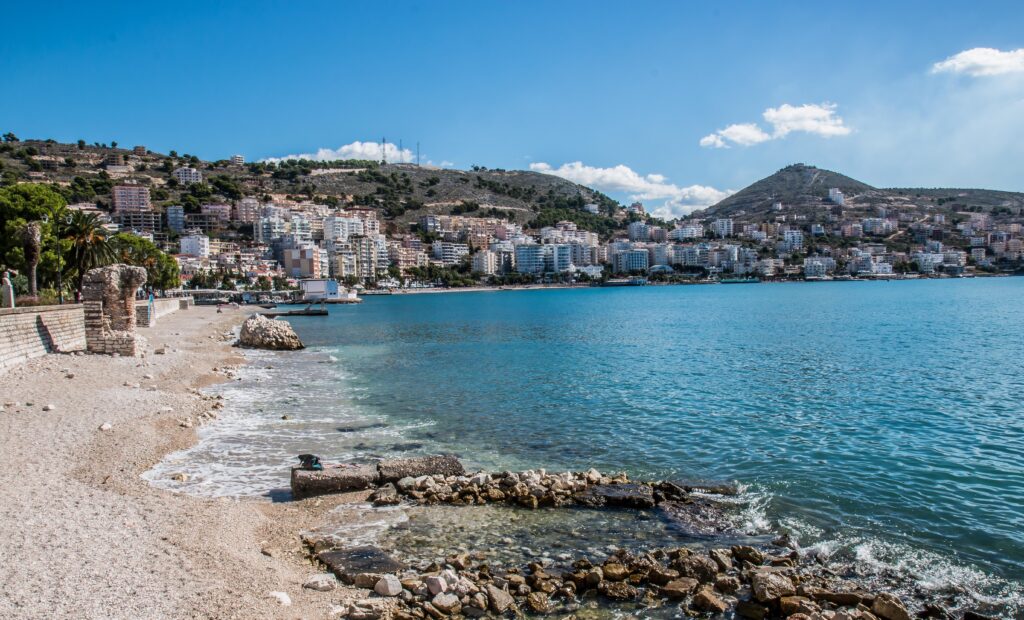
What replaced it is something more complicated and, honestly, more interesting. Today Saranda is a full-blown riviera hub — a city of cranes and construction sites mixed with gorgeous bay views, a waterfront promenade that comes alive every summer evening, and a tourism infrastructure that has gone from almost nothing to genuinely impressive in barely two decades.
Is it perfect? No. The construction has been chaotic. Some of the charm has been traded for concrete. But the bones of Saranda — that horseshoe bay, the turquoise Ionian water, the mountains rising directly behind the city — those remain as stunning as ever. And the things that make it special as a base for exploring southern Albania? Those have only gotten better.
I have watched this city transform for over twenty years. This is what I know about it, honestly told.
Planning your trip to Saranda?
A couple of things that make the Riviera a lot easier:
- Rent a car — Saranda and the Riviera are far simpler with your own wheels, and the Llogara Pass drive is half the fun. Compare deals on DiscoverCars.
- Want a local guide? — Esther, our tour partner, organises day trips from Tirana (Kruja, Berat, Durrës, Dajti) and plans custom routes on request, guided on site by certified local guides and specialists. Ask Esther. (Esther is our tour partner; we receive a small share of the tour price.)
Affiliate links — they cost you nothing and help keep this blog going.
Getting There from Tirana
Planning a Trip to Tirana?
Get my free Tirana in 48 Hours checklist with day-by-day itinerary, prices, and local tips.
Get the Free Checklist →Getting to Saranda from Tirana is not quick, but it is one of the most scenic journeys in all of Europe — and I do not say that lightly. The distance is roughly 280 kilometers, but the road winds through mountains and along coastline in ways that make the 5-6 hour drive feel like an experience rather than a commute.
By bus. Regular buses and furgons (minivans) depart from Tirana’s South Terminal throughout the day, with the most reliable departures in the morning. The ticket costs around 2,000-2,500 ALL (roughly €17-21). The ride takes 5 to 6 hours depending on traffic and how many stops the driver makes. Most buses follow the inland route through Gjirokaster, but the coastal route via the Llogara Pass is the one you want if scenery matters to you.
By car. If you are renting a car — and for the Albanian Riviera, I genuinely recommend it — take the SH8 coastal road through Vlora and over the Llogara Pass. The drive itself is a highlight of any Albanian trip. The road is well-maintained, two lanes, and the views after Llogara are the kind that make passengers go quiet. Budget 5 hours from Tirana with stops.
By ferry from Corfu. If you are coming from Greece, the Corfu-Saranda ferry takes just 30 minutes and runs multiple times daily in summer. Companies like Ionian Seaways and Finikas Lines operate the route. It is the quickest way into Albania’s south and a popular day-trip route for tourists based in Corfu. One-way tickets run €19-25.
The Vlora airport factor. Albania’s new Vlora International Airport is expected to dramatically change access to the south. Once fully operational, it will cut the journey to Saranda to under 2 hours by car. For now, Tirana’s Rinas Airport remains the main entry point, but keep an eye on Vlora — it will reshape how people visit the Albanian Riviera.
The Beaches
Let me be honest about Saranda’s beaches, because too many travel articles oversell them. Saranda is a city beach town, not a pristine-white-sand paradise. The real showstopper beaches are nearby — Ksamil, Mirror Beach, Borsh — and Saranda is the perfect base to reach them. But the city itself has its own waterfront options, and they have their own appeal.
Saranda town beach. The main beach runs along the promenade in the center of town. It is a pebble-and-sand mix, the water is clean and calm (the bay is well-sheltered), and you are steps from cafes and restaurants. It gets crowded in July and August, but on a June morning, it is genuinely pleasant. Sunbeds and umbrellas run 500-1,000 ALL per set. It is not glamorous, but it is convenient and perfectly serviceable.
Mango Beach. Just south of the main bay, Mango Beach is one of Saranda’s better organized beach spots. The water is cleaner here, the setting a bit more relaxed, and there is a decent beach bar. It is walkable from the center or a quick 300 ALL taxi ride. A good option if you want a step up from the town beach without leaving Saranda.
Mirror Beach (Pasqyra). About 15 minutes south toward Ksamil, Mirror Beach is where the water starts to turn that absurd shade of turquoise that makes the Albanian Riviera famous. The beach is small, pebbly, and usually less crowded than Ksamil. The clarity of the water here is genuinely remarkable — you can see every stone on the bottom at three meters. This is the beach I send friends to when they want beauty without the Ksamil crowds.
Borsh Beach. Further south past Saranda (about 40 minutes by car toward Himara), Borsh is the longest beach on the Albanian Riviera — roughly 3.5 kilometers of pebble shoreline backed by olive groves and mountains. It is less developed than Ksamil or Saranda, which is exactly its charm. The water is deep blue, the sunsets are extraordinary, and in shoulder season you might have a hundred meters of coastline to yourself. If you have a car, Borsh is worth a half-day trip.
The honest assessment: come to Saranda for the base, not the beach. Use it as your home for exploring the genuinely world-class beaches within a 30-minute radius.
The Llogara Pass Drive
If you are driving to Saranda from the north, the Llogara Pass is not just the route — it is the reason to drive instead of fly. This stretch of the SH8 highway climbs from the coastal city of Vlora up to 1,027 meters through the Llogara National Park, then drops in a series of hairpin turns to the Ionian coast below. It is, without exaggeration, one of the most dramatic coastal roads in Europe.
The climb through the pass takes you through dense pine forests where the air temperature drops noticeably. At the summit, there is a small cluster of restaurants where you can stop for lamb cooked on a spit and mountain tea — I recommend doing this, because the food is excellent and the view from up here is the kind that resets your brain. On clear days, you can see Corfu.
Then comes the descent. The road curls down the western face of the Ceraunian Mountains, and at every turn the Ionian Sea reveals itself a little more — first a distant strip of blue, then a vast shimmering expanse stretching toward Italy. The beaches of Dhermi, Drymades, and Gjipe appear far below like postcards. This is the stretch that makes people pull over, turn off the engine, and just stare.
Did you know?
The Llogara Pass has been a strategic mountain crossing since antiquity. Julius Caesar himself marched his legions through this very pass in 48 BC during the Roman Civil War, pursuing Pompey south along the Albanian coast. The same road that today gives tourists breathtaking views once carried Roman soldiers to battle.
Driving tips: The road is well-paved but winding — take it slowly, especially the hairpins on the descent. In winter and early spring, the pass can be foggy or icy. Summer is perfect. The entire Vlora-to-Saranda coastal drive takes about 2.5 hours without stops, but plan for at least 3-4 hours because you will want to stop. Repeatedly.
Day Trips from Saranda
This is where Saranda earns its reputation as the best base on the Albanian Riviera. Within an hour’s drive, you have a UNESCO World Heritage site, one of Europe’s most beautiful natural springs, the most photographed beaches in Albania, and an Ottoman-era stone city. No other town on the coast gives you this range.
Butrint (20 minutes). Albania’s crown jewel archaeological site and a UNESCO World Heritage Site since 1992. Butrint sits on a peninsula surrounded by a lagoon, and layers of Greek, Roman, Byzantine, and Venetian history literally stack on top of each other. The Roman theater, the Baptistry mosaics, and the Venetian fortress are the highlights, but the whole site — set in dense subtropical forest with water on every side — has an atmosphere that photographs cannot capture. Budget 2-3 hours. Entry is 1,000 ALL. Go early morning to beat the tour groups.
Blue Eye / Syri i Kaltër (45 minutes). A natural karst spring where impossibly blue water bubbles up from a depth that has never been fully measured (divers have gone past 50 meters without reaching the bottom). The “eye” effect comes from the dark center surrounded by rings of electric blue. It is genuinely one of the most mesmerizing natural sights in Albania. The 15-minute walk through the forest to reach it is beautiful too. Entry is 100 ALL. The site gets crowded by midday in summer — arrive before 10 AM if you can.
Ksamil (15 minutes). Four small islands just offshore, water that rivals the Caribbean, and a string of beach bars that have turned this sleepy village into Albania’s most Instagram-famous destination. The reality: Ksamil’s water really is that blue, but in July-August the main beaches are packed shoulder-to-shoulder. The trick is to rent a paddleboard or small boat (2,000-3,000 ALL) and find your own stretch on one of the islands. Off-peak, Ksamil is magical. For more on getting around here, see our complete guide to transportation in Albania.
Gjirokaster (1 hour). Another UNESCO World Heritage Site, the “City of Stone” is an Ottoman-era hillside town that looks like a film set. The castle dominates the skyline, the old bazaar is one of the best-preserved in the Balkans, and the traditional tower houses (kulla) are architectural wonders. If you have even a passing interest in history or Albanian culture, Gjirokaster is non-negotiable. Combine it with a stop at the Blue Eye on the way — they are on the same road.
Where to Eat
Saranda’s food scene has improved dramatically, but you still need to know where to look. The waterfront promenade is lined with restaurants, and about half of them are tourist traps serving mediocre food at inflated prices. The other half are genuinely good. Here is how to tell the difference, and where to eat well.
The fish market area. Walk one block inland from the southern end of the promenade and you will find the fish market. Several small restaurants here cook whatever was caught that morning. Point at what looks good, they grill it, and you eat it with salad, bread, and lemon. A full fish meal for two runs 2,500-4,000 ALL (€21-34). This is the most authentic seafood experience in Saranda.
Waterfront restaurants worth your money. Not all promenade restaurants are overpriced. Look for ones where Albanian families are eating, not just tourists with menus in five languages. Hyrja and Limani are two that consistently deliver good seafood at fair prices. A seafood pasta or grilled fish plate runs 800-1,500 ALL. Calamari, mussels, and octopus salad are the safe bets everywhere.
Side-street tavernas. The best value meals in Saranda are found on the streets running perpendicular to the waterfront. Small family-run places serve traditional Albanian dishes — tavë kosi (baked lamb with yogurt), fergese (peppers and cheese), grilled meats — at local prices. A full meal with a beer: 800-1,200 ALL per person. These places do not have English menus or sea views, but the food is honest and plentiful. For a deeper dive into what to order, check our complete guide to Albanian food.
Tourist trap warning signs: Aggressive touts standing outside, menus with photos of every dish, prices listed in euros only, and phrases like “best view in Saranda.” The best restaurants do not need to advertise — they are full because the food is good.
Price guide:
| Meal Type | Price Range (ALL) | Price Range (€) |
|---|---|---|
| Coffee on the promenade | 100–200 | €0.85–1.70 |
| Local taverna meal (per person) | 800–1,200 | €7–10 |
| Waterfront seafood dinner | 1,500–3,000 | €13–25 |
| Fish market grilled catch (for two) | 2,500–4,000 | €21–34 |
| Beer (draft, local) | 200–400 | €1.70–3.40 |
| Cocktail at a beach bar | 600–1,000 | €5–8.50 |
Nightlife and Social Scene
Saranda’s nightlife is not Ibiza, and that is exactly the point. It is a Mediterranean promenade town where the evening ritual is more about the passeggiata — the slow walk along the waterfront — than about clubs and bottle service. And honestly, it is better for it.
The promenade after dark. Starting around 7 PM in summer, the entire city migrates to the waterfront. Families with strollers, teenagers in groups, couples, old friends — everyone walks. The bars and cafes along the promenade fill up. The vibe is social and relaxed, the kind of evening energy that Mediterranean cultures do better than anyone. This is the Saranda nightlife experience, and it is genuinely wonderful.
Bars and cocktail spots. A handful of cocktail bars and lounge-style spots have opened in the last few years, mostly along the promenade and the streets running one block inland. Expect decent cocktails (600-1,000 ALL), music that shifts from chill afternoon beats to louder as the night progresses, and a mixed crowd of Albanian and international visitors. The scene peaks around 11 PM-1 AM.
Beach bars. During the day these are lounging spots; at night some of them transform into proper party venues with DJs, especially on weekends in July and August. Mango Beach and a few spots toward Ksamil lead this scene.
Summer festivals and events. Saranda hosts various music events and festivals throughout the summer, especially in August when the city is at peak capacity. These range from small live music nights at beach bars to organized festivals. Check local social media groups closer to your visit — event promotion in Albania is still very much a word-of-mouth and Facebook affair.
“Saranda at night is not about where you go — it is about the walk. The slow promenade along the bay with the lights reflecting off the water and half the city out doing the same thing. It is the simplest kind of magic, and it never gets old.”
Live prices: where to stay in Saranda
Set your dates on the map below to see live availability and nightly rates across the major booking sites in one view.
Booking through this map earns me a small commission, at no extra cost to you. More on that here.
Where to Stay
Saranda’s accommodation has come a long way from the bare-bones hotels of fifteen years ago. You now have everything from €15 hostels to €150+ boutique hotels, and the choice of neighborhood matters more than most guides tell you.
The promenade/center. This is where most visitors stay, and for good reason — you are walking distance from everything. Hotels and apartments along or near the waterfront promenade put you steps from restaurants, bars, the beach, and the ferry port. The tradeoff: noise in peak summer (bars stay open late) and higher prices. Budget €40-80/night for a decent double room in summer.
The hillside above the center. Saranda is built on a slope, and the apartments and hotels slightly uphill from the waterfront offer something valuable: balcony views of the entire bay, usually at 30-40% less than equivalent waterfront properties. You trade a 5-10 minute walk for a view that waterfront rooms rarely have (most face the promenade, not the sea). This is where I tell friends to book. Budget €25-50/night.
South toward Ksamil. If you have a car and want quieter evenings, several hotels and villa rentals between Saranda and Ksamil offer a middle ground — close enough to town for dinner, far enough for peace. The beaches in this stretch are better than Saranda proper. Budget €30-70/night.
Budget options. Hostels and basic guesthouses run €10-20/night. Several Albanian-run guesthouses offer clean rooms, homemade breakfast, and genuine hospitality at prices that would not cover a parking spot in Dubrovnik. Ask locally — some of the best budget stays are not on Booking.com.
Booking tips for summer:
- Book July-August accommodation by May. The best properties sell out early, especially apartments with sea views. September is more flexible.
- Negotiate directly. If you find a place you like on Booking.com, try contacting the owner directly (often through their Facebook page). Many will give you a better rate to avoid platform fees.
- Apartments beat hotels for value. For stays of 3+ nights, a rented apartment with a kitchen saves significant money on food and gives you more space.
- Check the reviews for noise. If a property is near the promenade, read recent reviews for noise complaints — summer nightlife goes past midnight.
Best Time to Visit
The short answer: June or September. The long answer involves what you are willing to trade off.
June is my personal pick. The sea is warm enough for swimming (22-24°C), the days are long and sunny, the restaurants and bars are all open, but the crowds have not reached their July-August peak. Prices are 20-30% lower than peak summer. Butrint and the Blue Eye are busy but manageable. The evenings are perfect — warm without being heavy.
September is the other sweet spot. The sea is actually warmer than June (still 24-25°C from a summer of heating), the crowds thin dramatically after August 20th, and many restaurants offer late-season deals. The light in September is beautiful — softer, more golden. The only downside: some beach bars and seasonal businesses start closing toward the end of the month.
July-August is peak season. Everything is open, the energy is high, the promenade is buzzing — but the beaches are packed, prices are at their highest, and accommodation must be booked well in advance. If this is your only option, go for it — Saranda in August is still a great time — but know that you will be sharing it with half of Albania and a growing number of international tourists.
May and October are true shoulder season. May can be hit or miss with weather (some rainy days, some gorgeous ones), and the sea is still cold for swimming (18-20°C). October is similar but warmer water. Not all seasonal businesses are open. But both months offer something you cannot buy in summer: quiet. Butrint with nobody there. Ksamil beaches with ten people instead of ten thousand. If you do not need beach weather, these months are genuinely wonderful.
November through April — Saranda enters a deep hibernation. Most restaurants and hotels close. The city feels empty. Unless you specifically want to experience off-season Albanian coast life (which has its own bleak beauty), this is not the time to visit. If you are curious about safety in Albania during the off-season, we have covered that separately.
Saranda vs Ksamil vs Dhermi — Quick Comparison
These three are the most popular bases on the Albanian Riviera, and each suits a different kind of traveler. Here is the honest breakdown:
| Feature | Saranda | Ksamil | Dhermi |
|---|---|---|---|
| Best for | Day trip base, nightlife, services | Beach lovers, Instagram seekers | Quieter vibes, scenery, couples |
| Beach quality | ★★★☆☆ | ★★★★★ | ★★★★☆ |
| Nightlife | ★★★★☆ | ★★☆☆☆ | ★★★☆☆ |
| Restaurants | Dozens, all price ranges | Limited, mostly beach bars | Handful, but quality focused |
| Budget (double room, summer) | €25–80/night | €30–100/night | €40–120/night |
| Car needed? | No (walkable) | Helpful but not essential | Yes (limited transport) |
| Crowds (Jul-Aug) | Busy but manageable | Extremely crowded | Moderate |
| Day trip access | Excellent (Butrint, Blue Eye, Gjirokaster) | Good (close to Butrint) | Limited (far from south sights) |
My recommendation: If you want the most versatile base with the most options, stay in Saranda. If beaches are your only priority, Ksamil. If you want quiet and do not mind needing a car, Dhermi. For a deeper look at getting between these spots, see our Albania transportation guide.
Frequently Asked Questions
Is Saranda safe for tourists?
Yes. Saranda is one of the safest coastal towns in the Mediterranean. Petty theft is rare, violent crime is virtually nonexistent for visitors, and you can walk the promenade at midnight without concern. The biggest “danger” is aggressive restaurant touts trying to seat you. For a broader perspective on safety, read our guide to safety in Albania.
Do I need a car in Saranda?
Not for the city itself — Saranda is compact and walkable. However, a car significantly expands your options for day trips and beach hopping along the coast. Without a car, you can reach Ksamil and Butrint by local bus, and organized tours cover the Blue Eye and Gjirokaster. But having your own wheels gives you the freedom to discover beaches and villages that buses do not reach.
Can I use euros in Saranda?
Albania’s currency is the Lek (ALL), and that is what you should use. Many tourist-facing businesses accept euros, but the exchange rate they offer is poor — you will lose 5-10% versus paying in Lek. ATMs are plentiful in Saranda and dispense Lek. Withdraw locally and pay in local currency. For more practical tips, visit our tourism guide.
How many days should I spend in Saranda?
3-5 days is the sweet spot. That gives you a day for the city and beaches, a day for Butrint + Ksamil, a day for Blue Eye + Gjirokaster, and 1-2 days for relaxing, exploring further afield (Borsh, Himara), or just enjoying the promenade life. Less than 3 days and you will feel rushed. More than 5 and you might start looking for your next destination.
Is Saranda better than Vlora or Durres?
For Ionian coast beauty, day trip options, and overall tourist experience — yes. Saranda’s bay is more picturesque than either Vlora or Durres, the surrounding attractions (Butrint, Blue Eye, Ksamil) are unmatched, and the water quality is noticeably better. Durres is the closest beach to Tirana and has its own appeal as a family destination, but it is an Adriatic city beach, not a riviera town. Vlora is a larger city with good restaurants and the gateway to the Llogara Pass but its beaches are less impressive than what you find south of it.
Final Thoughts
Saranda is not a place I would describe as “undiscovered” anymore, and I think that is actually fine.
For years, Albania travel writing was dominated by the “hidden gem” narrative — the idea that the country’s appeal was entirely in its untouched quality. And while that was true for a while, it set up unrealistic expectations. Places grow. Tourism brings investment, and investment (when it goes right) brings better roads, better restaurants, better options.
Saranda has grown imperfectly, as most rapidly developing places do. The construction boom has been messy. Some character has been lost to concrete. But the fundamentals remain extraordinary: that bay, that water, that light, and the proximity to places like Butrint and the Blue Eye that genuinely belong in any conversation about Europe’s most beautiful natural and historical sites.
What Saranda offers in 2026 is something it did not offer twenty years ago: convenience. You can fly into Albania, reach the Riviera in half a day, and find a well-priced apartment with a sea view, good restaurants within walking distance, and a string of world-class day trips accessible without a tour group. That is a meaningful upgrade from the days when visiting the Albanian coast required genuine frontier-travel skills.
Come for the bay. Stay for the day trips. Eat the fish. Walk the promenade at night. And if you happen to cross the Llogara Pass to get here, do not be surprised if that mountain road becomes the memory that stays with you longest.
Have questions about visiting Saranda? Drop them in the comments — I have been visiting this coast for over two decades and I am happy to help.
Subscribe to monthly updates
Get honest Albania travel tips, local guides, and new posts straight to your inbox. No spam, unsubscribe anytime.
