
Key Takeaways
- Albania is Europe’s most underrated travel destination — stunning Riviera beaches, UNESCO cities, and incredible food at a fraction of Western European prices.
- Budget-friendly: You can comfortably travel Albania on €40–60/day including accommodation, food, and transport.
- Best time to visit: May–June and September–October for perfect weather without peak-season crowds.
- Getting here is easy: Wizz Air and Ryanair fly direct from dozens of European cities to Tirana.
- Safety: Albania is safer than most European countries — violent crime against tourists is virtually nonexistent.
- Start in Tirana: The capital is the transport hub, but the real magic is in the south — the Riviera, Berat, and Gjirokastër.
- Albanian hospitality is legendary — locals go out of their way to help visitors. It’s not marketing; it’s cultural DNA.
Table of Contents
- Why Visit Albania?
- Best Time to Visit Albania
- Getting to Albania
- Getting Around Albania
- Tirana — The Capital
- Tirana’s Neighborhoods
- Day Trips from Tirana
- The Albanian Riviera
- Southern Albania — UNESCO & Mountains
- Where to Eat — Albanian Food
- Is Albania Safe?
- Money & Practical Tips
- Albanian Culture — What to Know
- Frequently Asked Questions
This is the destination guide.
Where to go, what to see and when to visit. For the practical side of a trip — visas, money, SIM cards, healthcare, scams — see Albania Travel Tips.
Why Visit Albania?
I’ve lived in Albania for over 21 years, and I still get surprised by this country. Not because it’s unpredictable — though it can be — but because every year, I watch more and more visitors arrive and have their expectations completely shattered. In the best way possible.
When I first moved here in 2004, Tirana was a city most Europeans couldn’t point to on a map. The roads were rough, the infrastructure was developing, and the idea of Albania as a “tourist destination” would have made locals laugh. Fast forward to 2026, and Albania is on the cover of Condé Nast Traveler, booking out its Riviera beaches months in advance, and showing up in every “hidden gem” travel list on the internet.
Here’s the thing — it’s not hidden anymore. But it’s still remarkably, almost stubbornly, authentic.
Albania is a country of contradictions that somehow all work together. It’s a place where a shepherd herding goats might be talking on the latest iPhone. Where a brand-new highway suddenly ends and becomes a gravel road through a mountain village. Where a restaurant owner insists on giving you free raki even though you’re already paying less than you would for a sandwich in London.
Over the past five years, tourism in Albania has exploded. The numbers tell the story: Albania welcomed over 10 million international visitors in 2024, up from just 6.4 million in 2019. The Albanian Riviera, once a secret whispered among backpackers, now appears on mainstream travel lists alongside Santorini and Dubrovnik. And yet — and this is the crucial part — Albania hasn’t been sanitized by that attention. The rough edges remain. The authenticity is intact. The prices, while rising, are still genuinely affordable.
This guide is everything I’ve learned in 21+ years of living here. Not the tourist brochure version — the honest version. Where to go, what to skip, how to get around, what things actually cost, and how to experience Albania like someone who lives here rather than someone passing through.
The beaches rival Greece and Croatia. I’m not exaggerating. The Albanian Riviera — that stretch of Ionian coastline from Vlora down to Saranda — has turquoise water so clear you can see the bottom at 10 meters. Ksamil’s beaches sit across from Corfu. Dhermi and Gjipe could be on a Caribbean postcard. The difference? A sunbed in Ksamil costs €5. In Mykonos, that same sunbed is €40.
The history is layered and fascinating. You’ve got Illyrian ruins, Ottoman mosques, Venetian castles, communist bunkers, and brutalist architecture — sometimes all within the same city block. Berat and Gjirokastër are UNESCO World Heritage Sites that feel like open-air museums. Butrint, near Saranda, has been continuously inhabited for 2,500 years.
The food is extraordinary and absurdly cheap. Farm-to-table isn’t a marketing slogan here — it’s just how food works. Your lamb was probably grazing on a hillside yesterday. Your tomatoes were picked this morning. A full meal at a good restaurant costs €5–10, and the quality would earn Michelin attention anywhere else in Europe.
The hospitality is unlike anything you’ve experienced. Albanians have a concept called besa — a code of honor that includes treating guests as sacred. You’ll be invited into homes, offered food you didn’t ask for, and helped by strangers who genuinely don’t want anything in return. After 21 years, I’ve never gotten used to how generous people here are.
And yes — it’s genuinely affordable. Albania is the best-value destination in Europe right now, and it’s not even close. Your euro goes further here than almost anywhere on the continent.
Best Time to Visit Albania
The short answer: May to October, with May–June and September–October being the sweet spot. But Albania is a year-round destination depending on what you’re after.
| Season | Months | Weather | Best For |
|---|---|---|---|
| Spring | April – May | 18–25°C, occasional rain | City exploring, hiking, fewer crowds |
| Early Summer | June | 25–30°C, dry | Beaches before peak, perfect temperatures |
| Peak Summer | July – August | 30–38°C, very hot | Beach holidays, nightlife, festivals |
| Autumn | September – October | 22–28°C, warm sea | Best overall — warm, uncrowded, affordable |
| Winter | November – March | 5–15°C, rainy spells | City culture, off-season prices, skiing |
July and August are the busiest months. The Riviera fills up with Albanian and Kosovar families, prices spike (relatively speaking — still cheap by European standards), and the heat can be intense. If you can swing September, do it. The sea is still warm, the crowds thin out, and everything costs less.
Winter is underrated. Tirana is a proper European capital with cafés, museums, and nightlife. And if you like skiing, the resort at Dardha (near Korça) is affordable and uncrowded. Just don’t expect the Riviera to be open — most beach towns shut down completely from November to April.
For a detailed month-by-month breakdown of Tirana’s weather, temperatures, and what to pack, check out my Weather in Tirana: A Month-by-Month Guide.
Getting to Albania
Getting to Albania has never been easier, and it keeps getting better. Tirana International Airport (Mother Teresa Airport, TIA) is the country’s main gateway, and it’s been transformed by budget airline competition.
Wizz Air is the dominant carrier, with direct flights from over 30 European cities including London, Milan, Rome, Vienna, Berlin, Dortmund, Brussels, and Budapest. I’ve tracked Wizz Air’s Albania routes extensively — you can find everything you need in my Wizz Air to Tirana: Routes, Tips & Everything You Need to Know guide.
Ryanair entered the Albanian market more recently and now flies from several Italian cities, as well as other European hubs. Competition has driven prices down dramatically — it’s now common to find return flights to Tirana for under €50 from many cities.
Other options:
- By ferry: Regular ferries connect Saranda to Corfu (Greece) — just 30 minutes. Ferries also run from Vlora and Durres to several Italian ports (Bari, Brindisi, Ancona).
- By bus: International buses connect Tirana to Thessaloniki, Athens, Istanbul, Pristina, Skopje, and Podgorica. It’s slow but cheap.
- By car: You can drive in from Montenegro (north), Kosovo (northeast), North Macedonia (east), or Greece (south). Roads have improved enormously, but mountain routes can be slow.
Getting Around Albania
This is the one area where Albania still requires some patience and flexibility. Public transport exists but it’s informal, and the road infrastructure — while massively improved — still has its quirks. Here’s the honest breakdown.
Furgons (minibuses) are Albania’s backbone of intercity transport. They’re cheap (Tirana to Berat costs about €5), but they don’t run on fixed schedules — they leave when they’re full. You need to know where they depart from, and Google Maps won’t always help.
Intercity buses run on major routes (Tirana–Saranda, Tirana–Shkodra, Tirana–Korça) with more predictable schedules. They’re comfortable and affordable.
Car rental is the best option if you want freedom, especially for the Riviera. Prices start around €20–30/day. Just be prepared for adventurous driving styles — Albanians drive… creatively. I’ve written extensively about this in my Complete Guide to Getting Around Albania.
Taxis and ride-hailing: Within cities, taxis are cheap (€2–5 for most rides in Tirana). There’s no Uber, but local apps like Speed Taxi work well.
Domestic flights: There are none. Albania is small enough that you can drive from one end to the other in 5–6 hours (theoretically — the roads might have other plans).
Road conditions: The main highways (Tirana–Durres, Tirana–Elbasan, and the new A2 towards the south) are modern and well-maintained. But once you leave the main arteries, road quality varies wildly. Some secondary roads are excellent; others will test your car’s suspension and your patience. Google Maps is generally reliable for navigation, but don’t blindly trust the estimated drive times — add 20–30% for Albanian road reality.
Driving tips: Albanians drive on the right side of the road (mostly). Seatbelts are required but enforcement is lax. Speed cameras have become more common on main roads. Keep your headlights on at all times — it’s the law. And be prepared for unexpected obstacles: goats crossing the highway, cars reversing on the motorway, and tractors in the fast lane. I’m not joking about any of these. You get used to it.
Organized tours: If driving isn’t your thing, several tour operators now offer well-organized day trips and multi-day tours from Tirana. These are a good option for the Riviera (the Llogara Pass drive is stunning but nerve-wracking for some) and for reaching more remote destinations like Theth and Valbona in the north.
Tirana — The Capital
Tirana is not what you expect. That’s the whole point. It’s chaotic, colorful, noisy, and endlessly fascinating. It’s a city where a communist-era pyramid sits next to a gleaming new tower, where Ottoman mosques face Italian fascist-era government buildings, and where every café seems to be full at 11 AM on a Tuesday.
Start at Skanderbeg Square, the heart of the city. It’s been beautifully renovated — a massive pedestrian space surrounded by the National History Museum, the Et’hem Bey Mosque (one of the few mosques that survived the communist era), and the Opera House. From here, everything is walkable.
What makes Tirana special is its energy. This is a city where half the population is under 30, where new restaurants and bars open every week, where the café culture rivals anything in Italy. The Grand Park (Parku i Madh) is gorgeous, especially around the artificial lake. The Bunk’Art museums — inside converted communist bunkers — are hauntingly brilliant.
Most visitors spend 1–2 days in Tirana, but I’d recommend at least 3. There’s more here than you think. The Grand Park and artificial lake are perfect for morning runs or afternoon strolls. The National Gallery of Art has a fascinating collection spanning communist-era propaganda to contemporary Albanian artists. The House of Leaves — the former secret police surveillance center — is one of the most chilling and well-curated museums I’ve visited anywhere.
Where to stay in Tirana: The Blloku area is the best base for most visitors — walkable, full of restaurants and bars, and close to the center. Budget travelers should look at hostels near Skanderbeg Square (excellent options in the u20ac10–15/night range). For mid-range, boutique hotels in the center run u20ac40–70/night. And if you want luxury, several international chains have opened recently, though honestly, a well-run boutique hotel gives you a better experience for less money.
Tirana’s food scene is booming. In the past five years, the city has gone from basic traditional restaurants to a diverse culinary scene that includes excellent Italian, Japanese, Mexican, and fusion options alongside the traditional stuff. The craft beer movement has arrived (try Korabi Brewery or Tirana Brewing Company), the wine bars are multiplying, and the coffee — well, the coffee has always been world-class here. For a full itinerary, check out my Complete Tirana City Guide: Your First 72 Hours.
“Tirana doesn’t try to impress you the way Paris or Rome does. It sneaks up on you. By day three, you realize you haven’t stopped smiling.”
— What I tell every first-time visitor
Tirana’s Neighborhoods Worth Exploring
Tirana’s neighborhoods each have their own personality. Once you get past Skanderbeg Square, the city opens up into distinct areas that tell different chapters of Albania’s story.
Blloku — The Former Forbidden District
During communism, Blloku was the exclusive residential zone for Party elites — ordinary Albanians couldn’t even walk through it. Today, it’s the city’s trendiest neighborhood: packed with cafés, cocktail bars, international restaurants, and boutique shops. The irony is delicious. Enver Hoxha’s former villa is still there, now surrounded by wine bars. Read more in my Blloku guide.
Pazari i Ri — The New Bazaar
This is Tirana’s foodie heart. The renovated bazaar area is a pedestrian zone of fruit stalls, spice shops, butchers, tiny restaurants, and craft beer bars. Saturday mornings here are magic — locals shopping for fresh produce, old men arguing over coffee, the smell of grilled meat everywhere. See my Pazari i Ri guide for what to eat and buy.
The Pyramid Area
The Pyramid of Tirana — originally built as a museum for dictator Enver Hoxha — has been controversially repurposed as a tech and culture hub called TUMO. Love it or hate it, it’s an icon. The area around it is developing fast with new cafés and creative spaces. I covered its transformation in my Pyramid guide.
Day Trips from Tirana
Tirana is perfectly positioned for day trips. Some of Albania’s best destinations are within 1–3 hours, making the capital an excellent base for exploring.
xE2x9ExA1 Read our comprehensive guide: 12 Best Day Trips from Tirana (2026) — A Local’s Complete Guide with transport tips, budgets, and personal recommendations for each destination.
Berat — The City of a Thousand Windows (2 hours)
This is Albania’s most photogenic city and a UNESCO World Heritage Site. The white Ottoman houses climbing the hillside, the castle still inhabited after 2,400 years, the old town bridges — it’s extraordinary. Berat is doable as a day trip from Tirana, though I’d recommend staying overnight if you can. My full guide: Berat Day Trip from Tirana.
Kruja — Skanderbeg’s Fortress (1 hour)
The hilltop castle where Albania’s national hero, Gjergj Kastrioti Skanderbeg, held off the Ottoman Empire is just an hour north of Tirana. The old bazaar below the castle is one of the best places to buy authentic Albanian souvenirs — handwoven rugs, copper work, traditional clothing. The Skanderbeg Museum inside the castle is small but excellent.
Durrës — Albania’s Oldest Beach City (40 minutes)
Albania’s second-largest city and main port is just 40 minutes from Tirana. The Roman amphitheater in the middle of town is one of the largest on the Balkan Peninsula. The beach promenade is popular with locals, and the seafood is fresh and cheap. Full details in my Durrës guide.
Petrela Castle (30 minutes)
A tiny, beautifully restored castle perched on a rocky hill just south of Tirana. It’s a quick trip — perfect for an afternoon outing. The restaurant at the base serves excellent traditional food with views of the castle above. On a clear day, you can see all the way to Tirana.
The Albanian Riviera
The Albanian Riviera is the reason most international tourists come to Albania — and rightly so. This stretch of Ionian coastline from Vlora south to Saranda is genuinely one of the most beautiful coastlines in the Mediterranean. The water is impossibly clear, the beaches range from organized to completely wild, and the mountain backdrop is dramatic.
Here’s how the main destinations compare:
| Destination | Vibe | Beach Type | Budget (per day) | Best For |
|---|---|---|---|---|
| Saranda | Lively coastal town | Pebble, organized | €40–70 | Base for exploring, nightlife, Butrint |
| Ksamil | Caribbean vibes | Sandy, small islands | €35–60 | Beach lovers, crystal-clear water |
| Dhermi | Upscale bohemian | Pebble, stunning | €50–90 | Couples, photography, beach clubs |
| Himara | Relaxed, authentic | Mix of sandy & pebble | €35–60 | Families, longer stays, local feel |
| Gjipe | Wild, adventurous | Pebble, canyon beach | €20–40 | Hikers, wild camping, off-grid |
Saranda
Saranda is the Riviera’s main town — a crescent-shaped bay with a lively waterfront promenade, dozens of restaurants and bars, and easy access to Butrint National Park (a UNESCO site) and Ksamil. It’s the most convenient base for exploring the southern coast. The town itself has a laid-back Mediterranean feel, especially in the evenings when the whole waterfront comes alive. Full guide: Saranda: Gateway to the Albanian Riviera.
Ksamil
If you’ve seen those viral photos of turquoise Albanian beaches — they’re probably Ksamil. Three small islands sit just offshore (you can swim or kayak to them), the water is ridiculously clear, and the whole area feels more like the Maldives than the Balkans. It gets crowded in August, but off-peak it’s paradise. Read my honest take: Ksamil: Albania’s Hidden Beach Paradise.
Dhermi & Gjipe
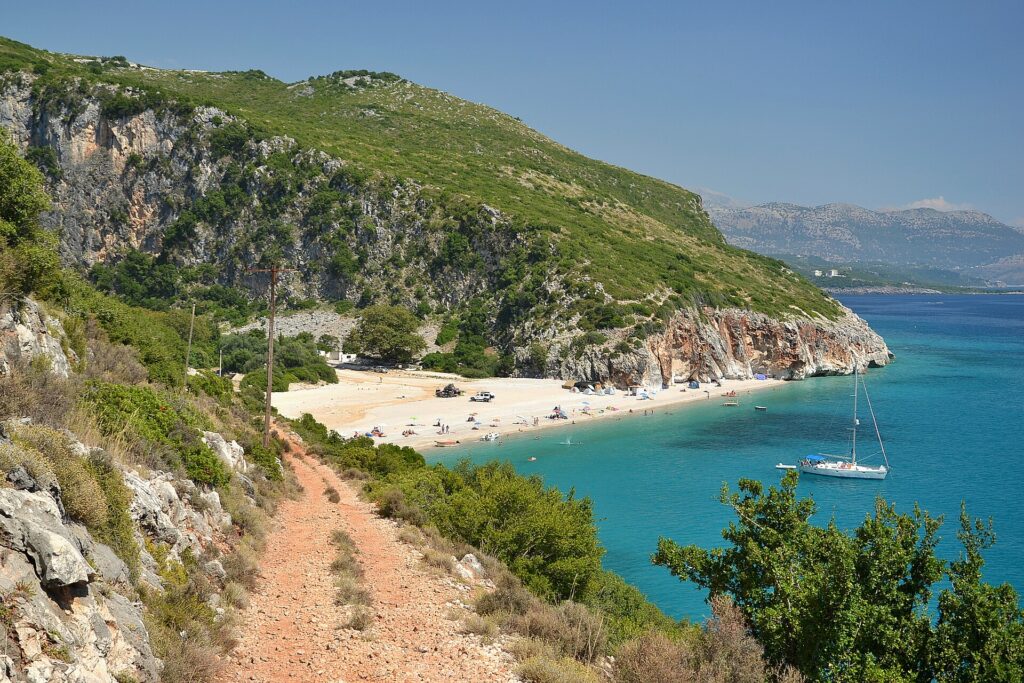
Dhermi is where Albania’s coast reaches its most dramatic. The beach is backed by mountains, the water shifts between shades of blue and green, and the vibe is more upscale than Ksamil or Saranda. Nearby Gjipe Beach — accessed by a hike down a canyon — is one of the wildest, most beautiful spots in the entire Mediterranean. If you’re the adventurous type, Gjipe is non-negotiable.
Himara
Himara often gets overshadowed by its flashier Riviera neighbors, but it’s my personal recommendation for families and longer stays. It’s a real town — not just a tourist strip — with a genuine Greek-influenced old town on the hill, several good beaches within walking distance, and an increasingly excellent restaurant scene. Livadhi Beach and Potami Beach are beautiful without being overcrowded. The pace is slower here, the prices are lower, and the local character is stronger. For a week-long beach holiday, Himara hits the sweet spot between convenience and authenticity.
The Llogara Pass
You can’t talk about the Riviera without mentioning the drive that gets you there. The Llogara Pass (1,027 meters above sea level) is the gateway between the Adriatic coast near Vlora and the Ionian coast of the Riviera. The road winds up through a national park of ancient pine forests, and then — without warning — the entire southern coastline opens up below you. It’s one of the most dramatic viewpoints in the entire Mediterranean, and I’ve driven it dozens of times without getting tired of it. Stop at one of the roadside restaurants at the top for grilled lamb with a view that money can’t buy anywhere else in Europe.
Planning your Riviera trip: I recommend at least 4–5 days for the Riviera if you want to do it justice. Base yourself in Saranda or Himara and day-trip to beaches. If you’re short on time, 2–3 days with a car will let you hit the highlights. June and September are the golden months — warm water, manageable crowds, and the best light for those Instagram shots that will make your friends jealous.
“The first time I drove the Llogara Pass and saw the Riviera spread out below — the mountains dropping into blue — I pulled over and just stared. After 21 years, that view still stops me.”
Southern Albania — UNESCO Cities & Mountains
Southern Albania isn’t just beaches — the interior holds some of the country’s most remarkable destinations.
Berat
I’ve already mentioned Berat in the day trips section, but it deserves emphasis. The “City of a Thousand Windows” is Albania’s most iconic image — those white Ottoman houses stacked up the hillside, reflecting in the Osum River below. The castle quarter (Kalaja) is one of the few in the world still inhabited, with families living in houses that are centuries old. Don’t miss the Onufri Museum inside the castle, with stunning Byzantine icons. Full guide: Berat Day Trip from Tirana.
Gjirokastër — The City of Stone
If Berat is the gentle, photogenic sibling, Gjirokastër is the dramatic one. This UNESCO-listed city is built entirely of stone — stone roofs, stone streets, stone walls — cascading down a steep hillside below a massive castle. It’s the birthplace of both Albania’s most famous writer (Ismail Kadare) and its most infamous dictator (Enver Hoxha). The old bazaar, the Zekate House, and the castle with its captured American spy plane are all must-sees.
Gjirokastër is also the gateway to the Blue Eye (Syri i Kaltër), a hypnotic natural spring where water bubbles up from underground in an impossibly deep shade of blue. It’s one of Albania’s most visited natural sites, and it lives up to the hype.
The Permet detour: If you’re heading to Gjirokastër from the north, consider routing through Permet — a small town in the Vjosa River valley known for its thermal baths, its wine (some of Albania’s best vineyards are here), and its gloriously good food. The drive along the Vjosa — Europe’s last wild river — is spectacular. Permet is also the base for visiting the Lengarica Canyon, a narrow gorge with thermal springs and ancient stone bridges that feels like something out of a fantasy novel.
Getting between Berat and Gjirokastër: The direct road between these two UNESCO cities takes about 3–3.5 hours and passes through some of Albania’s most dramatic mountain scenery. It’s a logical itinerary for anyone exploring southern Albania: Tirana ? Berat (overnight) ? Gjirokastër (overnight) ? Blue Eye ? Saranda/Riviera.
Where to Eat — Albanian Food
Albanian food is one of the country’s best-kept secrets, and I say that as someone who’s eaten here daily for over two decades. It’s Mediterranean at its core — fresh vegetables, lamb, cheese, olive oil — with Ottoman and Italian influences layered in.
Must-try dishes:
- Tavë kosi — lamb baked in yogurt. Albania’s national dish and absolutely heavenly.
- Byrek — flaky pastry filled with cheese, spinach, or meat. Every bakery makes it, and no two are the same.
- Fergese — a rich bake of peppers, tomatoes, and cottage cheese. Pure comfort food.
- Qofte — grilled meatballs, usually served with fresh salad and bread. Simple and perfect.
- Paçe — a hearty tripe soup that’s the traditional hangover cure. Not for the faint-hearted, but beloved by Albanians.
- Fresh seafood — especially along the coast. Grilled fish, mussels in Saranda, and octopus in Ksamil are outstanding.
Where to eat well: Skip the tourist traps near major monuments. The best food is often at unassuming places a few streets back — family-run restaurants (“restorant familjar”) where the menu is whatever they cooked that day. In Tirana, Pazari i Ri is food heaven. Along the Riviera, follow the locals.
Wine deserves special mention. Albanian wine is an emerging revelation. The country has been making wine for 6,000 years, and the modern wine industry — with indigenous grape varieties like Shesh i Bardhë and Shesh i Zi (literally “white flat” and “black flat”) — is producing bottles that win international competitions. Visit u00c7obo Winery near Berat, Kantina Alpeta near Permet, or any of the dozen excellent vineyards in the Berat and Korçë regions. A bottle of excellent Albanian wine at a restaurant costs u20ac5–8.
Raki is the national spirit. Nearly every family in Albania makes their own raki (grape brandy), and you will be offered it. At breakfast. Before lunch. After dinner. With coffee. It ranges from smooth and elegant to “this might be jet fuel.” Accept a glass, sip slowly, and enjoy the ritual. Refusing raki is like refusing friendship.
Breakfast in Albania is typically savory: byrek from the bakery, fresh bread with cheese and tomatoes, or a full plate of eggs, olives, and feta. Many hotels serve excellent buffet breakfasts. And the bakeries (“furra”) — found on literally every block — are a daily pleasure. Fresh byrek straight from the oven for u20ac0.50–1 is one of life’s great affordable luxuries.
I’ve written an exhaustive guide covering regional specialties, restaurant recommendations, and what to order: Albanian Food: The Complete Guide.
Is Albania Safe?
Yes. Full stop.
I know this is the question that holds most people back, and I understand why — Albania’s reputation from the 1990s (the chaos, the pyramid schemes, the news footage) still lingers in people’s minds. But that Albania is 30 years in the past.
Here’s the reality in 2026: Albania is safer than most Western European capitals for tourists. Violent crime against visitors is essentially nonexistent. Petty theft exists (as it does everywhere), but it’s less common than in Rome, Barcelona, or Paris. I’ve raised a family here. I walk the streets of Tirana at midnight. I’ve never had an incident in 21 years.
The usual travel common sense applies — don’t flash expensive items, watch your belongings in crowded areas, be cautious driving at night on rural roads. But genuinely, safety is one of Albania’s strongest selling points.
Solo female travelers: Albania is widely regarded as one of the safer destinations in Europe for solo female travelers. Women traveling alone report overwhelmingly positive experiences — locals tend to be protective rather than predatory. That said, catcalling exists (as it does across Southern Europe), and the usual nightlife precautions apply. Use your common sense, but don’t let fear hold you back.
Driving safety: Honestly, driving is the biggest risk in Albania. Road accident rates are higher than the EU average, partly due to aggressive driving culture and partly due to road infrastructure that’s still catching up. Drive defensively, avoid driving at night on rural mountain roads, and don’t feel pressured to match the speed of local drivers.
Scams: Tourist scams are remarkably rare compared to other Mediterranean destinations. You won’t encounter the bracelet scam, the petition scam, or the aggressive street vendors that plague Rome or Barcelona. Occasional taxi overcharging happens (always agree on the price beforehand or use a meter), and some restaurants in very touristy spots might charge higher prices — but outright scams are uncommon.
For a much deeper dive into specific safety topics (solo female travel, driving, nightlife, scams to watch for), read my full article: Is Albania Safe? A Local’s Honest Assessment.
Money & Practical Tips
Albania runs on the lek (ALL), but euros are widely accepted — especially in tourist areas, hotels, and for larger purchases. That said, you’ll get a better deal paying in lek, so I recommend having both.
Currency & Money
- Exchange rate: Roughly 100 ALL = €0.93 (as of 2026). Easy math: divide by 100, and that’s approximately your euro amount.
- ATMs: Available in all cities and most towns. Withdraw in lek to avoid conversion fees.
- Cards: Accepted at hotels, larger restaurants, and shops. Cash is still king at smaller places, markets, and rural areas.
- Tipping: Not expected but appreciated. Rounding up or leaving 5–10% is generous by local standards.
- For a full cost breakdown, see my Cost of Living in Tirana 2026 guide.
SIM Cards & Internet
Buy a local SIM card at the airport. Vodafone Albania and One Telecommunications both have booths at Tirana airport. A tourist SIM with 15–30GB of data costs €5–10 and lasts 30 days. WiFi is excellent in Tirana and good in most tourist areas.
Language
Albanian (Shqip) is the local language, and it’s unlike anything you’ve heard — it’s its own branch of the Indo-European language family. English is widely spoken by young people, especially in Tirana and tourist areas. Italian is also common among older Albanians (thanks to Italian TV). Learning a few Albanian words — “faleminderit” (thank you), “mirëdita” (good day) — will earn you enormous goodwill.
Power & Plugs
Albania uses European Type C/F plugs (same as most of continental Europe), 230V. If you’re coming from the UK, US, or Australia, bring an adapter.
Accommodation
Albania’s accommodation scene has matured rapidly. You’ll find everything from u20ac8/night hostels to boutique hotels, family-run guesthouses, and increasingly, Airbnbs. Booking.com has the best coverage for Albania. Airbnb works well in Tirana and on the Riviera. For guesthouses in smaller towns, you might need to book through Albanian platforms or simply show up — many excellent places in the mountains and rural areas don’t list online.
Rough price guide:
- Hostel dorm: u20ac8–15/night
- Budget guesthouse/private room: u20ac20–35/night
- Mid-range hotel: u20ac40–80/night
- Boutique/luxury: u20ac80–150/night
- Riviera apartment (Airbnb): u20ac30–70/night (doubles in August)
Book early for July-August on the Riviera — popular properties sell out months in advance. Off-season, you’ll find deals everywhere.
Albanian Culture — What to Know
Understanding Albanian culture will transform your trip from good to unforgettable. This isn’t a country where you observe from a distance — Albanians will pull you in.
Hospitality is sacred. The Albanian concept of besa — keeping your word, protecting your guest — runs deep. If you’re invited into someone’s home (and you will be), accept. You’ll be offered coffee, raki (homemade grape brandy), food, and probably more food. Refusing feels rude, but don’t worry — they genuinely want you there.
Coffee culture is serious. Albanians drink more coffee per capita than almost any country in Europe. A “kafe” isn’t just a drink — it’s a social ritual. Meetings happen over coffee. Friendships are maintained over coffee. Deals are sealed over coffee. Every neighborhood has its regular café where the same people sit at the same table every day.
Family is everything. Albanian society is deeply family-oriented. Multi-generational households are common. Sunday lunch is sacred. Weddings are enormous (300+ guests is standard). And Albanian parents are fiercely proud of their children — prepare to see many, many photos.
The xhiro is a daily ritual. Every evening, Albanians take a xhiro — a leisurely walk through the city center, greeting friends, window-shopping, eating ice cream. In Tirana, the main boulevard fills with families every evening. In smaller towns, the whole community joins. It’s one of my favorite things about living here.
Religious tolerance is remarkable. Albania is one of the few countries in the world where Muslim, Orthodox Christian, and Catholic communities have lived together peacefully for centuries. Interreligious marriage is common and unremarkable. During major holidays, it’s normal for Muslim families to celebrate Christmas with their Christian neighbors, and vice versa. Pope Francis, during his visit to Albania in 2014, called the country a model of religious harmony.
The communist legacy is everywhere but Albanians approach it with a mix of dark humor and genuine reflection. The bunkers dotting the landscape have become an unlikely national symbol. The Bunk’Art museums in Tirana are world-class explorations of that era. Younger Albanians are curious about the communist period but don’t define themselves by it — they’re too busy building something new.
Music and festivals: Albanian folk music (particularly the UNESCO-listed polyphonic singing of the south) is hauntingly beautiful. But the modern music scene is vibrant too — Tirana hosts several summer music festivals, and Albanian pop music (“muzikë popullore”) plays everywhere from cafu00e9s to car radios. If you visit during a festival or holiday, expect fireworks, feasting, and dancing in the streets. Albanians know how to celebrate.
A few cultural tips to remember:
- Nodding means “no” and shaking your head means “yes” — the opposite of most countries. This catches everyone off guard at first.
- Remove your shoes when entering someone’s home.
- Don’t refuse offered coffee or food — it’s considered impolite. At minimum, take a sip or a bite.
- Haggling is acceptable at markets but not in shops or restaurants.
- Albanians are incredibly proud of their country — genuine compliments about Albania go a long way.
I’ve been observing and participating in Albanian culture for over two decades, and I still discover new nuances.
For a deep dive into Albanian customs, traditions, and social norms, read my Complete Guide to Albanian Culture.
Frequently Asked Questions
Do I need a visa to visit Albania?
Most likely not. Citizens of the EU, US, UK, Canada, Australia, and many other countries can enter Albania visa-free for up to 90 days (or up to one year for EU citizens during the tourist season). Check Albania’s Ministry of Foreign Affairs website for the latest requirements for your nationality.
How much money do I need per day in Albania?
Budget travelers can manage on €25–40/day (hostel, local food, public transport). Mid-range travelers should budget €50–80/day (private room, restaurants, some activities). Albania is comfortably the cheapest destination in Europe.
Is Albania in the EU?
No — Albania is an EU candidate country and has been in accession negotiations since 2022. It’s not in the Schengen zone either, so it has its own border controls. However, Albania uses many EU-aligned systems and standards.
Can I drink the tap water?
In Tirana, the tap water is generally safe but doesn’t taste great — most locals and expats drink filtered or bottled water. Outside Tirana, stick to bottled water. It’s cheap (€0.30–0.50 for 1.5L) and available everywhere.
What’s the best way to get from Tirana to the Riviera?
By car is best (4–5 hours to Saranda via the highway and coastal road). Buses run daily from Tirana to Saranda (about 5–6 hours, €10–15). The drive over Llogara Pass is one of the most scenic in Europe. See my getting around guide for detailed transport options.
Is Albania good for solo travelers?
Absolutely. Albania is one of the best solo travel destinations in Europe. The hostels are social, the locals are incredibly welcoming to solo visitors, and the safety level is high. Many solo travelers — especially women — report feeling safer in Albania than in more “established” destinations.
Can I use my European health insurance (EHIC) in Albania?
No. Albania is not in the EU, so EHIC cards don’t work here. Get travel insurance that covers Albania. Healthcare is affordable even without insurance (a doctor visit costs €15–30), but for anything serious, you’ll want coverage that includes medical evacuation.
Start Planning Your Albania Trip
Albania is not a country that needs you. It was here long before the tourist boom, and it’ll be here after. But right now, there’s a window — a moment where you can experience a place that’s genuine, affordable, beautiful, and still finding its footing on the world stage. That window won’t last forever. Prices are rising. Resorts are being built. The Albania of 2026 is not the Albania of 2030.
So come now. Come with an open mind and a flexible schedule. Talk to people. Accept the raki. Get lost in Berat’s cobblestones. Swim at Gjipe when nobody else is there. Sit in a Tirana café at 11 AM and watch a city figure out who it wants to be.
I came here 21 years ago for what was supposed to be a short stay. I never left. Albania has a way of doing that to people.
Some final tips from 21 years of experience:
- Learn five Albanian words. Faleminderit (thank you), mirëdita (good day), si jeni (how are you), po (yes), jo (no). The reaction you get will be worth it.
- Download offline maps. Cell coverage is good but not universal, especially in mountain areas and on the Riviera road.
- Bring a power bank. You’ll be taking more photos than you expect.
- Pack for variety. Albania’s weather can change quickly, especially in the mountains. A light rain jacket is useful year-round.
- Don’t over-plan. Albania rewards spontaneity. Some of my best experiences here have been unplanned detours, unexpected invitations, and restaurants I stumbled into.
- Come with an open heart. Albania isn’t a polished product. Things won’t always work perfectly. But the imperfections are part of the charm, and the people will make up for any inconvenience a hundred times over.
Start exploring:
- Tirana City Guide: Your First 72 Hours
- Getting Around Albania
- Albanian Food: The Complete Guide
- Is Albania Safe?
- Ksamil Beach Guide
- All Travel Articles
- Interactive Albania Map
Written by Elvis Plaku, who has lived in Tirana, Albania since 2004. This guide is based on 21+ years of personal experience, thousands of kilometers driven, and more tavë kosi than any doctor would recommend.
Tirana Essentials
- 25 Best Things to Do in Tirana — Museums, neighborhoods, nightlife, and outdoor activities picked by a local
- The Best Rooftop Bars in Tirana — Where to catch sunset over the city, from Sky Tower to the Blloku terraces
- Where to Eat in Tirana — 30+ restaurants, cafes, and street food spots with real prices
- Tirana Neighborhoods Guide — Where to stay, safety, rents, and the character of each area
- Self-Guided Walking Tours — 3 curated routes through history, food, and art
- Practical Travel Tips — Visa, money, SIM cards, transport, safety, and cultural etiquette