
Key Takeaways
- Three self-guided walking routes covering Tirana’s history, food culture, and art scene, totaling about 9.5 km and 7.5 hours of walking.
- Tirana welcomed over 1.2 million international tourists in 2024 (INSTAT), but most visitors only see Skanderbeg Square. These routes go deeper.
- Street food runs 50-300 ALL (roughly 0.40-2.50 EUR) per item. A full sit-down lunch rarely exceeds 1,500 ALL (12 EUR).
- Sidewalks are uneven. Wear sturdy shoes, bring water, and watch for cars at crosswalks.
I’ve been walking Tirana’s streets for over 40 years, and the city still surprises me. Last spring, I was cutting through a back alley behind the old Blloku neighborhood when I stumbled onto a brand-new mural covering an entire apartment building. Nobody had announced it. No Instagram post, no press release. Just a massive painting of an old woman carrying bread, appearing overnight like the city was talking to itself. That’s Tirana for you.
Most visitors land here, snap a photo of Skanderbeg Square, maybe grab a macchiato in Blloku, and head south toward the Riviera. I get it. But Tirana rewards those who walk it slowly. This city has been painted, demolished, rebuilt, occupied, liberated, and painted again so many times that every block tells a story. You just have to know where to look.
So I’ve put together three self-guided walking tours that cover the Tirana I know: the history you can touch, the food you should eat, and the art that’s transforming this place in real time. Each route takes between 2 and 3 hours. You can do all three in a single ambitious day, or spread them over a long weekend. Either way, wear comfortable shoes (I’ll explain why). And if you’re new to the city, start with our 72-hour Tirana city guide for orientation.
Table of Contents
Prefer a guide to going solo?
If you would rather not navigate alone, a small-group Tirana walking tour covers the same ground with the stories behind it.
See guided walking tours →Route 1: The History Walk (2.5 hours, ~3 km)
Prefer a guide to lead the way? Book a small-group walking or city tour with a local.
See guided Tirana tours →Duration: 2.5 hours | Distance: ~3 km | Stops: 8
Best time: Morning (9-11 AM) | Difficulty: Easy, flat terrain
Tirana has been continuously inhabited for over 2,000 years, though the city as we know it was formally founded in 1614 by Ottoman general Sulejman Bargjini. According to INSTAT, the capital’s metropolitan population now exceeds 900,000, roughly a third of Albania’s entire population. This walk connects eight sites that trace the arc from Ottoman prayer halls to Cold War surveillance to post-communist reinvention. It’s the story of Tirana in footsteps.
I’ve walked versions of this route hundreds of times. I used to cross Skanderbeg Square on my way to university, back when half of it was still a parking lot. The square you’ll see today is completely different, redesigned in 2017, and honestly it’s one of the best things that’s happened to this city.
Stop 1: Skanderbeg Square — Start at the center of everything. This 40,000-square-meter plaza is one of Europe’s largest pedestrian squares, redesigned by Belgian firm 51N4E and winner of the 2018 European Prize for Urban Public Space. Stand near the Skanderbeg statue and look around: you’ll see the Ottoman mosque, communist-era government buildings, Italian fascist architecture, and modern glass towers all visible from one spot. That’s Tirana’s identity in a single panorama. Give yourself 15-20 minutes to take it in.
Stop 2: National History Museum — The biggest building on the north side of the square, unmistakable because of the enormous socialist-realist mosaic on its facade. The mosaic shows Albanians through the ages, from Illyrians to partisan fighters, carrying weapons and flags. Inside, the museum costs 700 ALL (about 6 EUR) and covers everything from ancient Illyrian artifacts to the communist era. The communist-period rooms are the most powerful. Budget 45 minutes to an hour. Pro tip: the museum is closed on Mondays.
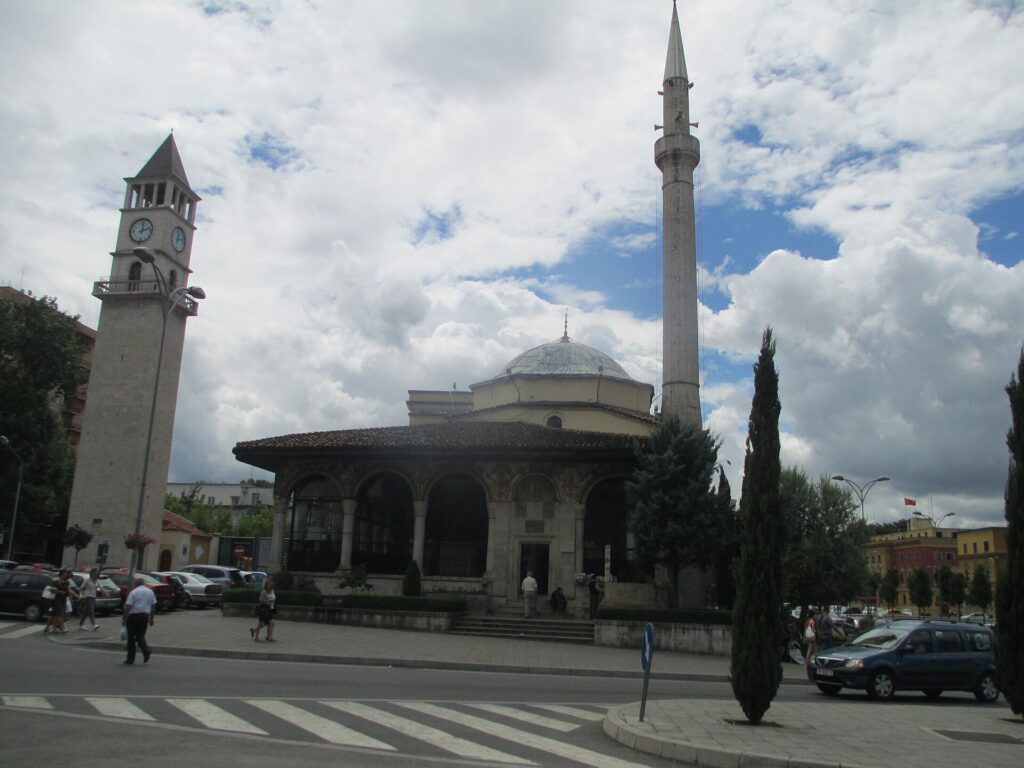
Stop 3: Et’hem Bey Mosque — Walk south from the museum to the small, beautiful mosque at the corner of the square. Built between 1789 and 1823, it survived the communist regime’s demolition of religious buildings because of the historical value of its frescoes. When Albania’s communist government banned all religion in 1967 (the only country in the world to constitutionally declare itself atheist), this mosque was locked but not destroyed. On January 18, 1991, 10,000 people gathered here for the first public prayer in 24 years. That moment marked the beginning of the end. Free to enter. Remove your shoes.
Stop 4: Clock Tower (Kulla e Sahatit) — Right next to the mosque, this 35-meter Ottoman clock tower dates from 1822. You can climb to the top for 200 ALL (about 1.60 EUR) and get a panoramic view of the square and surrounding rooftops. The stairs are steep and narrow, and it gets hot inside during summer. But the view is worth the minor discomfort. Takes about 10 minutes including the climb.
Stop 5: Tanners’ Bridge (Ura e Tabakeve) — Walk east along Rruga Murat Toptani toward this 18th-century Ottoman stone bridge. It once crossed the Lana River at a spot where leather tanners worked. Today the river has been diverted underground and the bridge sits in a small park, slightly surreal without water beneath it. It’s one of the oldest structures in Tirana, and most tourists walk right past it. Five minutes is enough, but take a photo. It’s genuinely beautiful.
Stop 6: House of Leaves (Shtëpia e Gjetheve) — Continue south to this former surveillance headquarters, now a museum officially called the Museum of Secret Surveillance. During the communist era, the Sigurimi (secret police) used this building to tap phones, monitor citizens, and collect intelligence. The exhibits include original wiretapping equipment, hidden cameras, and files on ordinary people. Deeply unsettling and absolutely essential. Entry is 700 ALL (6 EUR). Budget 30-45 minutes. Closed Mondays.
But here’s the thing about this museum. When I was a kid, nobody talked about what happened in that building. Everyone knew, but nobody said it out loud. The fact that it’s now a public museum, telling the full story, still feels significant to me every time I walk past it.
Stop 7: Pyramid of Tirana (Piramida) — Walk down Rruga Ibrahim Rugova to the unmistakable concrete pyramid. Originally built in 1988 as a museum dedicated to dictator Enver Hoxha (designed by his daughter and son-in-law), it became the most controversial building in the country. It was a nightclub, a NATO base during the Kosovo crisis, a homeless shelter, and for years just an abandoned ruin. In 2023 it reopened as TUMO, a free technology and creative arts center for young Albanians. You can walk around and on top of it. The views from the sloping concrete walls are fun. Free. 15-20 minutes. Check our full Pyramid guide for the complete story.
Stop 8: Former Blloku and Enver Hoxha’s Villa — Continue south into the Blloku neighborhood. Until 1991, this entire area was sealed off for the exclusive use of communist party leaders. Ordinary Albanians couldn’t even walk on these sidewalks. Today it’s Tirana’s busiest nightlife and cafe district. Look for the modest yellow villa on Rruga Ismail Qemali, set back behind a wall. That was Enver Hoxha’s personal residence. There’s no plaque, no sign, nothing. It’s just there. Read our Blloku neighborhood guide for dining and nightlife recommendations.
Route 2: The Culture & Food Walk (3 hours, ~4 km)
Planning a Trip to Tirana?
Get my free Tirana in 48 Hours checklist with day-by-day itinerary, prices, and local tips.
Get the Free Checklist →Duration: 3 hours | Distance: ~4 km | Stops: 8
Best time: Late morning (10 AM start) | Difficulty: Easy with one gentle uphill to Grand Park
Albania’s food market sector has grown steadily as tourism increased, with Tirana’s New Bazaar (Pazari i Ri) attracting an estimated 15,000 daily visitors during peak summer months, according to local municipality reports. This walk starts at the best food market in the country and ends at the lake, threading through cathedrals, street art, and the kind of street food that costs almost nothing and tastes like somebody’s grandmother made it. Because somebody’s grandmother probably did.
I’ll be honest: Tirana’s food scene has changed more in the last five years than in the previous fifty. When I was growing up, eating out wasn’t really something families did. Now there are restaurants on every corner. But the best food is still the simplest stuff, the things you eat standing up or sitting on a plastic stool. That’s what this walk is about.
Stop 1: New Bazaar (Pazari i Ri) — Start at the main entrance on Sheshi Avni Rustemi. The market was completely rebuilt in 2017 and it’s gorgeous: arched stone arcades, stalls overflowing with fresh produce, spices, olives, cheeses, and dried meats. Walk through the center aisle first, then loop around the perimeter where the sit-down restaurants are. The atmosphere is best before noon, when local families do their shopping. Free to enter. Spend 30-45 minutes browsing.
Stop 2: Byrek at the Bazaar — Before you leave the market, buy a byrek from one of the corner bakeries. Byrek is Albania’s national snack: flaky phyllo dough filled with cheese (me djath), spinach (me spinaq), or minced meat (me mish). A large triangle piece costs 50-100 ALL (0.40-0.80 EUR). Eat it standing up, folded in wax paper, like everyone else. The cheese version with fresh djath i bardhe (white cheese, similar to feta) is the classic. For a deep dive into Albanian cuisine, see our complete food guide.
Stop 3: Qofte Stand on Rruga Luigi Gurakuqi — Walk west from the bazaar and look for one of the small qofte (meatball) stands along this street. Grilled lamb-and-beef qofte served on a plate with bread, onion, and sometimes a tomato-pepper sauce. A plate of 4-5 qofte costs 250-400 ALL (2-3.30 EUR). If you see a place packed with locals and a grill smoking out front, that’s the one. Don’t worry about hygiene ratings. These places have been feeding Tirana since before food safety inspectors existed (and they’re fine).
Stop 4: Resurrection Cathedral (Katedralja Ngjallja e Krishtit) — Continue southwest to the Orthodox Cathedral of the Resurrection, completed in 2012. It’s the largest Orthodox church in the Balkans, and its interior is stunning: enormous mosaics, a massive chandelier, and a painted dome that took years to complete. The building itself is modern, which surprises some people expecting ancient stone. Free entry. Give it 15-20 minutes. Whether you’re religious or not, the artwork inside is exceptional.
Stop 5: St. Paul’s Cathedral (Katedralja e Shën Palit) — A 10-minute walk south takes you to the Catholic cathedral, a simpler, modern building completed in 2002. Albania is unique in Europe for having significant Muslim, Orthodox, and Catholic populations living side by side with almost zero religious tension. Walking between these two cathedrals in under 15 minutes puts that reality into perspective. Free entry. 10 minutes.
Did you know?
Albania is one of the few countries in the world where Muslims, Orthodox Christians, and Catholics have coexisted peacefully for centuries. During World War II, Albanian families, many of them Muslim, sheltered Jewish refugees under the code of besa (sworn honor), making Albania one of the only European countries where the Jewish population actually increased during the war. Read more in our Communist Albania article.
Stop 6: Komuna e Parisit Murals — Walk southeast toward the Komuna e Parisit area (near the old Paris Commune neighborhood). This stretch of residential buildings has become an open-air gallery. Large-scale murals cover apartment blocks, turning communist-era concrete into canvases. The themes range from Albanian folklore to abstract geometry to political commentary. Keep your eyes up. The best murals are above ground level, painted on the upper floors of five-story buildings. 15-20 minutes of wandering.
Stop 7: Grand Park of Tirana (Parku i Madh) — Continue south to Tirana’s biggest green space. The park covers 230 hectares and wraps around the Artificial Lake. On weekday mornings, you’ll see joggers, dog walkers, and elderly couples doing their daily xhiro (evening stroll, though in this case it’s a morning version). There are a few lakeside cafes where you can sit, order a kafe turke (40-60 ALL, about 0.35-0.50 EUR), and rest your feet. This is what locals actually do on weekends. 20-30 minutes.
Stop 8: Artificial Lake and Taiwan Complex Area — Walk along the lake’s eastern shore and you’ll reach the Taiwan Complex area, a cluster of newer restaurants, bars, and cafes that has become popular in the last few years. Named (confusingly) after a Taiwanese government-funded agricultural project decades ago, the area now has some of Tirana’s best casual dining. Stop for lunch here. Expect to pay 800-1,500 ALL (6.50-12 EUR) for a full meal with a drink. I’d recommend the grilled fish or any of the traditional tavë dishes. End the walk at the south end of the lake with a strong Albanian espresso and watch the city from a comfortable distance.
“Albanians don’t eat to fuel the body. They eat to fuel conversation. Every meal is an event, every coffee is a meeting, every table is a gathering. If you eat alone in Tirana, someone will eventually join you.”
Route 3: The Art & Architecture Walk (2 hours, ~2.5 km)
Duration: 2 hours | Distance: ~2.5 km | Stops: 6
Best time: Afternoon (3-5 PM for best light) | Difficulty: Easy, flat urban terrain
Tirana’s visual transformation began in 2000 when then-mayor Edi Rama ordered hundreds of drab communist apartment blocks painted in bright colors, a project covered by the New York Times and exhibited at the Venice Biennale. That decision turned the city into a living experiment in urban art. This walk takes you through layers of Tirana’s visual identity, from painted facades to gallery walls to the stark geometry of communist-era architecture alongside 21st-century glass towers.
What most articles about Tirana’s painted buildings miss is the politics behind them. Rama wasn’t just an artist-mayor making things pretty. He was a former painter himself who understood that changing how a city looks can change how its people feel about their future. The paint came before the money. People criticized him for spending on aesthetics when the city couldn’t even collect garbage reliably. But it worked. It changed the psychology of the place.
Stop 1: The Painted Buildings of Blloku and Central Tirana — Start at the intersection of Rruga Ismail Qemali and Rruga Sami Frasheri in Blloku. Look up. The apartment blocks here were among the first to be painted in Rama’s project, and the colors have been refreshed and changed several times since. Walk north along Rruga Barrikadave and you’ll see buildings in orange, turquoise, pink, and geometric patterns. The contrast between the Soviet-style architecture and the wild color choices is the whole point. 20 minutes of walking and looking up.
Stop 2: National Art Gallery (Galeria Kombetare e Arteve) — Walk northeast toward the gallery on Bulevardi Deshmoret e Kombit. The building itself is communist-era (you can tell), but the collection inside is fascinating. The permanent exhibition includes socialist-realist paintings from the Hoxha era: heroic workers, partisan fighters, smiling farmers. Whatever you think of the politics, the technical skill is remarkable. There’s also a rotating contemporary exhibition. Entry is 300 ALL (about 2.50 EUR). Budget 30-40 minutes. Closed Mondays.
Stop 3: Postbllok Memorial — Walk south toward the Postbllok memorial area near the Pyramid. This small open-air installation combines a section of the Berlin Wall (donated by Germany) with a communist-era bunker and guard tower from the perimeter of the old Blloku restricted zone. It’s a potent combination: the physical artifacts of two different forms of repression, side by side. Most people spend 10-15 minutes here, reading the plaques and taking it in. Free. For the full context of Albania’s communist period, see our Communist Albania article.
Stop 4: Street Art Murals (Rruga Abdyl Frasheri and Surroundings) — Head back east along Rruga Abdyl Frasheri and into the side streets around the old Blloku perimeter. This area has the highest concentration of independent street art in Tirana: political stencils, abstract murals, paste-up portraits, and graffiti that ranges from crude to genuinely beautiful. Unlike the Rama-era painted buildings (which were government-commissioned), these murals are grassroots, unofficial, and constantly changing. Look for the narrow alley behind the former Italian Embassy. 20-25 minutes of wandering.
Stop 5: Palace of Congresses and Communist-Era Architecture — Walk north to Bulevardi Deshmoret e Kombit, the main ceremonial boulevard. On the east side, you’ll see the Palace of Congresses (now called the Palace of Congress or sometimes the Conference Center). This brutalist structure hosted Communist Party congresses and official events. Along this boulevard, notice the symmetry: the government ministries, the university buildings, the wide Italian-designed axis (Mussolini’s architects laid out this boulevard in the 1930s, and Hoxha’s regime kept the scale). The architecture tells a story about power, control, and the desire to make Tirana look like a capital. 15 minutes of observing.
Stop 6: Modern Tirana: TID Tower, Tirana International Hotel, and the New Skyline — Finish at the northern end of the boulevard near the Tirana International Hotel (built in 1979 as the city’s first “international standard” hotel) and the TID Tower, the tallest building in the country at 85 meters. Standing here, you can see communist concrete, Italian rationalist design, Ottoman minarets, and glass-and-steel towers all in one view. This is what makes Tirana architecturally unique: nothing was demolished to make way for the new. It’s all just stacked together, layer upon layer. Take a coffee at one of the cafes near here and absorb it. End of route.
What Should You Wear, Bring, and Know Before Walking Tirana?
According to weather data from the Albanian Meteorological Institute, Tirana averages 265 sunny days per year and summer temperatures regularly exceed 35 degrees Celsius. That matters when you’re planning 2-3 hours of walking on concrete. Here’s what I’d tell a friend before sending them out on these routes.
- Wear proper walking shoes. Not sandals, not fashion sneakers. Tirana’s sidewalks are genuinely uneven. Cracked tiles, missing manhole covers, random holes. I’m not exaggerating. Ankle support matters here. This isn’t Paris.
- Carry water. From May through September, dehydration is a real concern. There are very few public drinking fountains. Buy a 1.5-liter bottle from any market (50-80 ALL, about 0.40-0.65 EUR) and carry it with you.
- Start early in summer. If you’re walking between June and September, start the morning routes by 9 AM. By noon, the asphalt radiates heat and the shade disappears. The afternoon art walk works better during these months because many of the stops are in shaded streets.
- Bring sunscreen and a hat. Albanian sun is stronger than most Northern Europeans expect. Apply before you leave. There’s no shame in carrying an umbrella for shade, either. Albanians do it regularly.
- Cash is king. Museums and food stalls mostly accept cash only. ATMs are everywhere, and they dispense Albanian Lek. Cards work at sit-down restaurants and larger cafes, but the byrek stand won’t take Visa. Keep 2,000-3,000 ALL (16-25 EUR) on you.
- Schedule a kafe break. Every route should include at least one proper coffee stop. Albanian coffee culture is serious. A macchiato or espresso costs 80-120 ALL (0.65-1.00 EUR) almost everywhere. Sit down, slow down. This is how locals walk: stop, coffee, continue. Check our Tirana city guide for specific cafe recommendations.
How Safe Is Walking in Tirana? An Honest Assessment
Tirana ranks as one of Europe’s safest capitals for violent crime, with Albania’s 2023 homicide rate at 1.1 per 100,000 population (UNODC), lower than the EU average of 1.3. Personal safety isn’t the concern here. But walking in Tirana comes with its own set of challenges that no travel blog seems willing to mention honestly. So I will.
I walk this city almost daily. Here’s what you need to know:
Sidewalks are a work in progress. Some stretches are beautifully paved, especially around Skanderbeg Square and the main boulevards. Others are cracked, uneven, or simply missing. In some neighborhoods, the sidewalk just ends and you’re walking in the road. This is improving every year, but it’s still a reality in 2026.
Crosswalks don’t guarantee safety. Albanian drivers are… let’s say “assertive.” Pedestrian crossings exist, and technically drivers should stop. Many do. Some don’t. My rule: make eye contact with the driver before stepping out. If they see you, they’ll stop. If they’re on their phone (which happens too often), don’t assume anything. Right turns on red are common even where they shouldn’t be.
Cars park on sidewalks. This is my personal frustration as someone who walks daily. Drivers park on sidewalks, forcing pedestrians into the road. The municipality has been cracking down on this, but enforcement is inconsistent. Just be aware that you may need to step into the street occasionally to get around parked vehicles.
That said, Tirana is safe for walking tourists. I’ve never heard of a visitor being mugged, pickpocketed incidents are rare compared to Western European capitals, and locals are generally helpful if you look lost. The biggest risk is twisting your ankle on a loose tile, not crime.
Would I walk these routes after dark? The History Walk and Art Walk, absolutely. The streets are well-lit and busy until late. The Food Walk through Grand Park is fine until sunset but I’d skip the lake area after dark, not because it’s dangerous, but because it’s poorly lit and less populated.
Would You Rather Have a Guide?
Prefer a guided walk? Browse top-rated Tirana walking tours on GetYourGuide, free cancellation on most. (Affiliate link, supports this site at no extra cost to you.)
According to GetYourGuide, bookings for Tirana walking tours increased by over 200% between 2022 and 2025, reflecting Albania’s growing popularity as a European destination. I’ve designed these routes to be fully self-guided, but I understand that some people prefer having someone explain things along the way. No judgment.
If you’d rather join a guided walking tour, here are your main options:
- Free walking tours — Several operators run “free” (tip-based) walking tours departing from Skanderbeg Square daily, usually at 10 AM. They cover much of the History Walk route and last about 2.5 hours. Tips of 1,000-2,000 ALL (8-16 EUR) are standard.
- GetYourGuide and Viator — Both platforms list guided Tirana walking tours ranging from 15-45 EUR per person. These typically run 2-3 hours and include a local guide. Search for “Tirana walking tour” on either platform. [AFFILIATE_PLACEHOLDER: GetYourGuide – “Tirana Walking Tour”]
- Food-specific tours — A few operators run dedicated food tours through Pazari i Ri and Blloku, with tastings included. These cost 35-60 EUR and last 3 hours. Worth it if food is your main interest and you want someone to handle the ordering.
- Private guides — For 80-150 EUR, you can hire a private guide for a half day. This is the best option for families or anyone who wants a customized route. Many guides are young Albanians who speak excellent English and have fascinating personal stories about growing up during the transition from communism.
My honest recommendation? Do the History Walk self-guided (the stops speak for themselves), consider a guide for the Food Walk (they’ll take you to places you won’t find on Google Maps), and do the Art Walk on your own with good headphones and a podcast. For more things to do beyond Tirana, check our best day trips from Tirana.
Frequently Asked Questions About Walking Tours in Tirana
How walkable is Tirana compared to other European capitals?
Tirana is very walkable in terms of size. The entire city center fits within a roughly 3-km radius from Skanderbeg Square, and all three routes in this guide stay within that area. The challenge isn’t distance but infrastructure. Sidewalks are uneven, crosswalks aren’t always respected, and there’s no real pedestrian zone outside the main square. That said, it’s far more compact than Rome or Athens, and you won’t need public transport for any of these routes.
What’s the best time of year for a Tirana walking tour?
April through June and September through October are ideal. Temperatures sit between 18-28 degrees Celsius, the sun is manageable, and the city isn’t in full summer heat mode. July and August work if you start early (before 10 AM) and take long midday breaks. Winter (December through February) is mild by Northern European standards, 5-12 degrees Celsius, but it rains frequently. I’d avoid walking tours on rainy days since the uneven sidewalks become slippery.
Is Tirana safe for solo female travelers walking alone?
Yes. Tirana is genuinely safe for solo travelers of all genders. According to the Numbeo Crime Index, Tirana consistently ranks as “low” for crime and “high” for safety, scoring better than many Western European capitals. Standard precautions apply: stay aware of your surroundings, keep valuables secure, and avoid unlit areas late at night. But in my experience, Albanian culture places enormous value on hospitality and protecting guests, and solo tourists are treated with respect.
Do I need to download any apps for navigating Tirana?
Google Maps works well for navigation. Download the offline map of Tirana before you arrive in case you lose signal. For rides, forget Uber and Bolt, they don’t operate here. Use Speed Taxi, Clust, or VrapOn. Our getting around Albania guide covers all transport apps in detail. For restaurant reviews, TripAdvisor and Google Reviews both have good Tirana coverage.
Can I combine all three walking routes in one day?
You can, but it’s a long day, roughly 9.5 km and 7.5 hours of active walking, plus food and coffee stops. I’d recommend starting with the History Walk at 9 AM, taking a long lunch break at Pazari i Ri (bridging into the Food Walk), and finishing with the Art Walk in the late afternoon. Alternatively, spread them across two days: History + Food on day one, Art on day two. Your feet will thank you.
| Route | Duration | Distance | Stops | Budget |
|---|---|---|---|---|
| History Walk | 2.5 hrs | 3 km | 8 | 1,600 ALL / 13 EUR |
| Culture & Food Walk | 3 hrs | 4 km | 8 | 2,500 ALL / 20 EUR |
| Art & Architecture Walk | 2 hrs | 2.5 km | 6 | 300 ALL / 2.50 EUR |
Tirana doesn’t look like the postcard version of a European capital. There are no cobblestone lanes winding between medieval churches (well, there’s one Ottoman bridge, but you get the point). It doesn’t have the polish of Lisbon or the grandeur of Vienna. What it has is something harder to find: a city that’s still becoming itself, visibly, in real time.
Every time I walk these routes, I notice something different. A new cafe where a car mechanic used to be. A mural that wasn’t there last month. A tree growing through the roof of an abandoned communist-era building. Tirana doesn’t stand still, and that’s what makes walking it so rewarding.
I started this blog in 2004, back when most people couldn’t point to Albania on a map. Tirana was grey, potholed, chaotic, and full of possibility. It’s still potholed and chaotic (the colors have improved). But the possibility has turned into something real. If you walk these streets with open eyes, you’ll see it too.
And if you’re planning to explore beyond the capital, start with our day trips from Tirana guide or our complete Albania travel guide for the bigger picture.
What do you think?
Have you walked through Tirana? Which route interests you most, or would you add any stops I missed? If you’ve done a self-guided walking tour here, I’d love to hear what surprised you.
Subscribe to monthly updates
Get honest Albania travel tips, local guides, and new posts straight to your inbox. No spam, unsubscribe anytime.
