
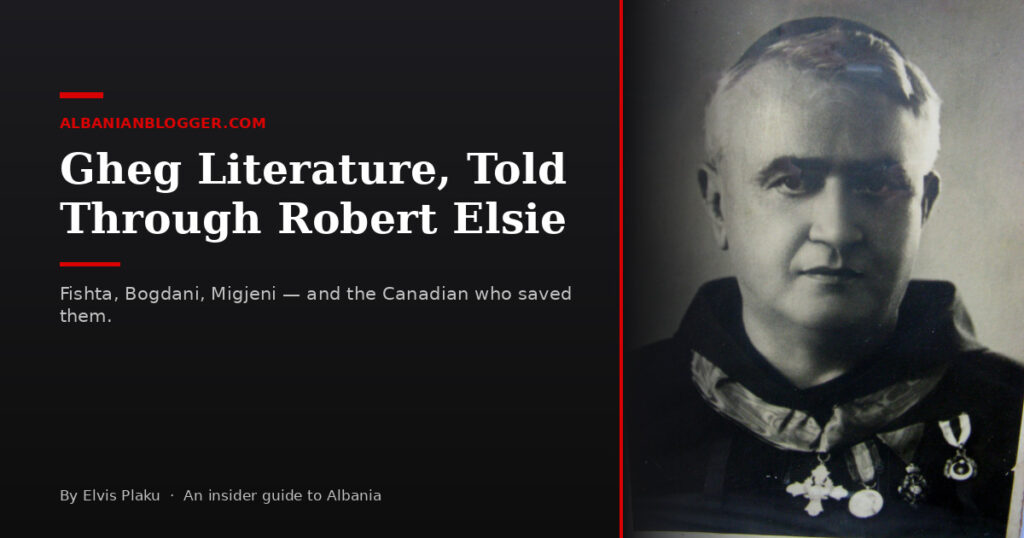
There’s a foreigner buried in Theth.
If you’ve made the drive up into the Albanian Alps — past Shkodra, up the switchbacks, into that valley that doesn’t feel like it belongs to the same country as Tirana — you’ve been near his grave. A Canadian. Born in Vancouver, of all places. He asked to be buried there, in the mountains of northern Albania, and in 2017 that’s where they put him.
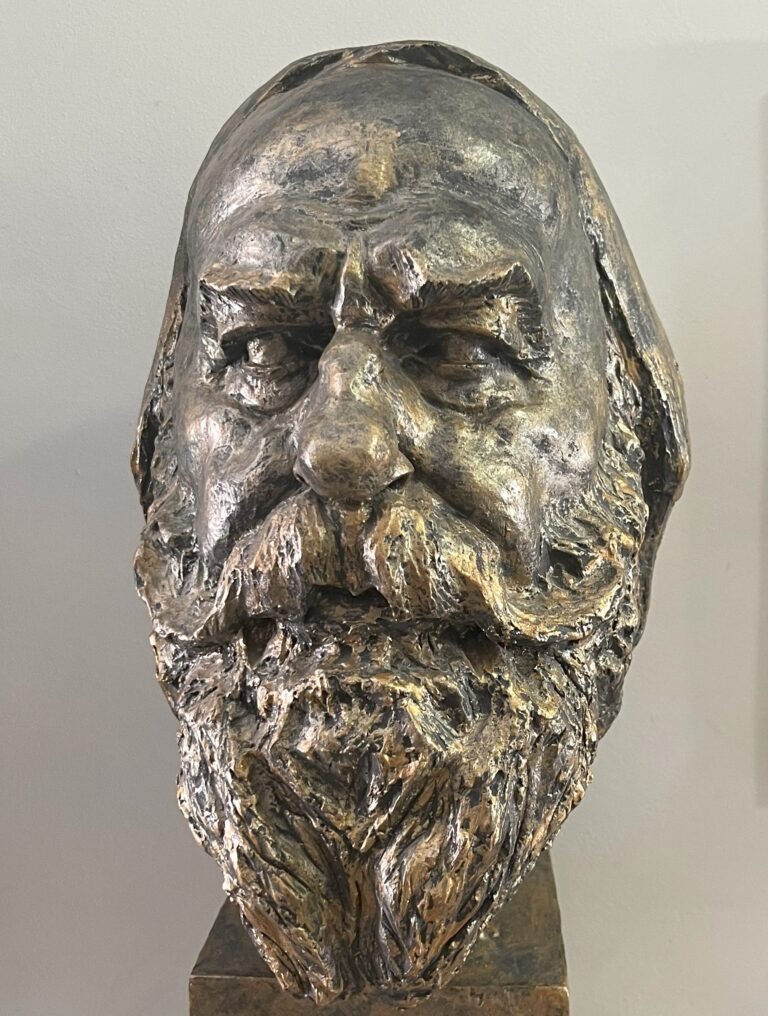
His name was Robert Elsie, and the reason I want to tell you about him is this: he spent his life reading and translating books that most of us, the Albanians who actually live here, have never read. Books written in our own language. By our own people. About our own history. And the strange, slightly embarrassing truth is that if you want to read a lot of that northern literature in English today — or even understand what it was — you go through a Canadian.
This is the story of Gheg literature. The literature of the north. And the man who, more than anyone, kept it from disappearing.
Key Takeaways
- Gheg is the Albanian of the north — Shkodra, the Alps, Kosovo — and for centuries it was the language of our oldest books, from the very first printed Albanian book in 1555.
- After 1944 the communist regime banned northern Catholic writers like Gjergj Fishta, and in 1972 Standard Albanian was fixed on a southern (Tosk) base — leaving a whole literary tradition stranded.
- Robert Elsie (1950–2017), a Canadian scholar buried in Theth, translated that literature into English and built the largest archive of Albanian writing ever to appear in another language.
- Through him you can read Fishta’s epic The Highland Lute, Bogdani’s 1685 prose, and the northern mountain epics — most of them in English before they were ever easy to find in Albanian.
Table of Contents
First, what "Gheg" even means
If you grew up here, you already know this in your bones, even if nobody ever sat you down and explained it.
Albanian comes in two big flavors. Gheg in the north — Shkodra, the Alps, the highlands, and across the border in Kosovo and parts of Montenegro and North Macedonia. Tosk in the south. The rough dividing line is the Shkumbin river, somewhere around Elbasan, and once you start listening for it you hear it everywhere. The nasal vowels in the north. The way a man from Shkodra says a word and a man from Gjirokastra says the same word and they are not, quite, the same word. (If the dialect split fascinates you, I went deeper into it in this piece on the Albanian language and its dialects — also, as it happens, through Elsie.)
For most of our history nobody decided that one was "correct." Before the Second World War, people wrote in both. And here’s the part that surprises people: the literary capital of the Albanian language was the north. Shkodra. The Catholic city, with its Franciscan and Jesuit schools, its printing connections to Italy, its priests who could read Latin and Italian and chose to write in Albanian anyway.
The oldest Albanian books — the real foundation stones of our written language — are Gheg books. That’s not a northern boast. That’s just where the printing presses and the educated clergy were.
The man who went looking
Planning a Trip to Tirana?
Get my free Tirana in 48 Hours checklist with day-by-day itinerary, prices, and local tips.
Get the Free Checklist →Robert Elsie was born in Vancouver in 1950. Nothing about that says "Albania."
He trained as a linguist — classics, Celtic studies, a doctorate from the University of Bonn. He was the kind of person who learns languages the way other people collect stamps. And in the late 1970s, through the University of Bonn, he got something almost nobody in the West had at the time: access to communist Albania. The most closed country in Europe. A place you did not casually visit.
Most people who got a look behind that curtain came back with stories about bunkers and paranoia. Elsie came back having decided to spend his life on Albanian literature — a subject he later called, with a kind of affectionate honesty, a "Cinderella subject." Valuable, beautiful, and almost completely ignored by the universities that fund things.
He kept at it for forty years. He worked as a translator for the German foreign ministry, then as an interpreter at the war crimes tribunal in The Hague — he was in the room for the Miloševi? trial. But the real work, the work he’s remembered for, was the more than sixty books he wrote, edited, and translated. A professor at the University of Toronto once called him "by far the most prolific Albanian scholar." Not the most prolific Canadian one. The most prolific one, full stop. Think about that for a second.
"Albania — it amazes and exhausts me, it drives me crazy, but it’s never boring." — Robert Elsie, as quoted in Prishtina Insight
I read that line and thought: yes. That’s it exactly. That’s a man who actually knew the place, not one who admired it from a distance.
The oldest books we have are northern books
Here’s where Elsie becomes useful as a guide, because he’s the one who can walk you back through the whole thing without losing you.
Start in 1555. A Catholic priest named Gjon Buzuku finishes a book called the Meshari — a missal, a book for the Mass — and it becomes the oldest surviving printed book in the Albanian language. Written in Gheg. There’s exactly one copy left in the world, sitting in the Vatican Library, and it was lost for almost two hundred years before a Skopje archbishop stumbled on it again in 1740. One copy. The entire written history of our language hangs off that single surviving book.
Did you know?
The first printed book in Albanian — Buzuku’s Meshari of 1555 — survives in a single copy, held in the Vatican Library. It was missing for roughly two centuries before being rediscovered in 1740.
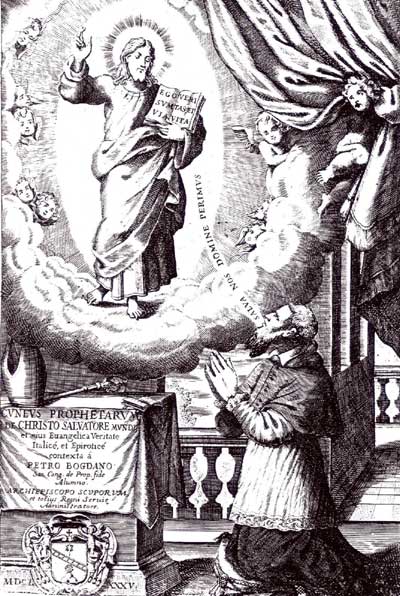
Then keep walking forward. Pjetër Budi, a bishop, publishes around 3,300 lines of original Albanian poetry in the early 1600s. Frang Bardhi compiles the first Albanian dictionary in 1635. And then comes the one that really gets me: Pjetër Bogdani, an archbishop, who in 1685 publishes a work called the Cuneus Prophetarum — "The Band of the Prophets" — in Padua.
Why does that one matter? Because scholars consider it the first original prose work of real substance in Albanian. Everything before it was mostly translation — religious texts brought over from Latin and Italian. Bogdani sat down and wrote, in Albanian, his own thing. And he deliberately tried to build his literary language on the Shkodra dialect. The north again.
1555 — Buzuku’s Meshari, the first printed Albanian book (Gheg).
1635 — Frang Bardhi’s Dictionarium latino-epiroticum, the first Albanian dictionary.
1685 — Bogdani’s Cuneus Prophetarum, the first original Albanian prose, built on the Shkodra dialect.
This is the part I find quietly amazing. The dialect that Bogdani chose to write his masterpiece in — Gheg, the Shkodra Gheg — is the same dialect that, three centuries later, would be pushed to the margins of our own official language. We’ll get to how that happened. But hold onto the irony: our first real book of original prose was written in the dialect that the state would eventually decide was not the standard.
Fishta, and the name that was forbidden
If you remember one name from this whole article, make it this one: Gjergj Fishta.
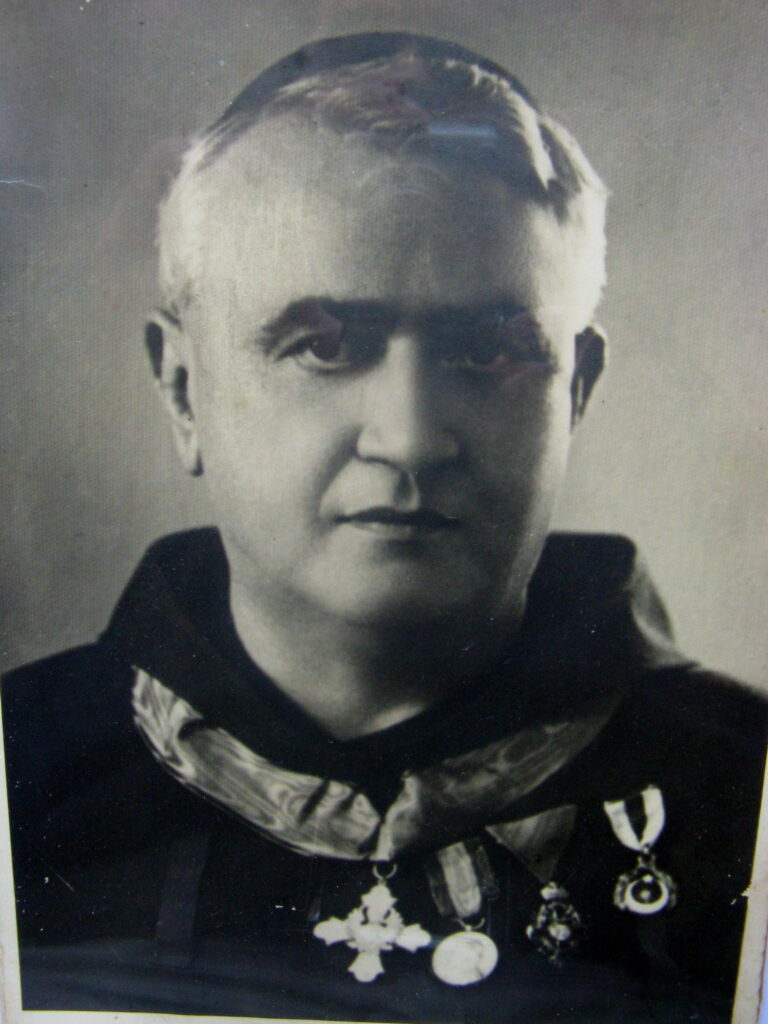
Fishta was a Franciscan friar, born in 1871 in a small village in the Zadrima region near Shkodra. And he wrote the closest thing we have to a national epic — a poem called Lahuta e Malcís, "The Highland Lute." He worked on it for over thirty years, releasing it in pieces between 1905 and 1937, and when it was finished it ran to thirty cantos and more than fifteen thousand lines of verse. He belongs on any honest list of the figures who shaped this country — the kind of list where you also find the names in my roundup of famous Albanians.
What’s it about? The north. The mountains. The Albanian highlanders and their long, bloody resistance against the Ottomans and against Montenegrin encroachment, roughly across the years 1862 to 1913 — the run-up to our independence. It’s named after the lahuta, the one-stringed instrument that the old mountain bards played while they sang epic songs, because that’s exactly the tradition Fishta was writing out of. He took the oral songs of the highland singers and turned them into a written epic. An Austrian scholar of his day called him the most ingenious poet Albania ever produced.
And then, in 1944, the communists took power. And Fishta — Catholic, northern, nationalist, everything the new regime distrusted — was erased.
I don’t mean he fell out of fashion. I mean his name became forbidden. For nearly five decades, you did not teach Fishta, did not print Fishta, did not say Fishta out loud in the wrong room. An entire generation of Albanians grew up never having read the most important poem in their own language. They didn’t lose the book — they were denied it, deliberately, by their own government.
Think about what it takes to ban a poet so completely that even saying his name becomes dangerous. That is how much the north’s literature frightened the people in charge.
Here’s where Elsie closes the loop. Decades later, working with the poet Janice Mathie-Heck, he produced the first complete English translation of The Highland Lute — published in London and New York in 2005. The first time, ever, that you could read Fishta’s epic in English. His co-translator described what they were after: keeping the "colloquial, archaic, majestic, and heroic feel" of the original while still making it land for a modern reader. A Canadian and a Canadian poet, between them, giving Fishta a second life in a second language — while back home he was only just being allowed back into the schoolbooks.
Migjeni — the north turns modern
Not everyone from the north wrote about heroes and mountains.
Migjeni — that’s a pen name, squeezed out of his real name, Millosh Gjergj Nikolla — was born in Shkodra in 1911 and was dead of tuberculosis by 1938. Twenty-six years old. In that short life he wrote poetry that broke completely from everything before it. No glorious highlanders, no national epic. Migjeni wrote about poverty. Sickness. Hunger. The misery he actually saw around him. (If you want to feel the city that produced him, I wrote about a night out in modern Shkodra — the same streets, a very different mood.)
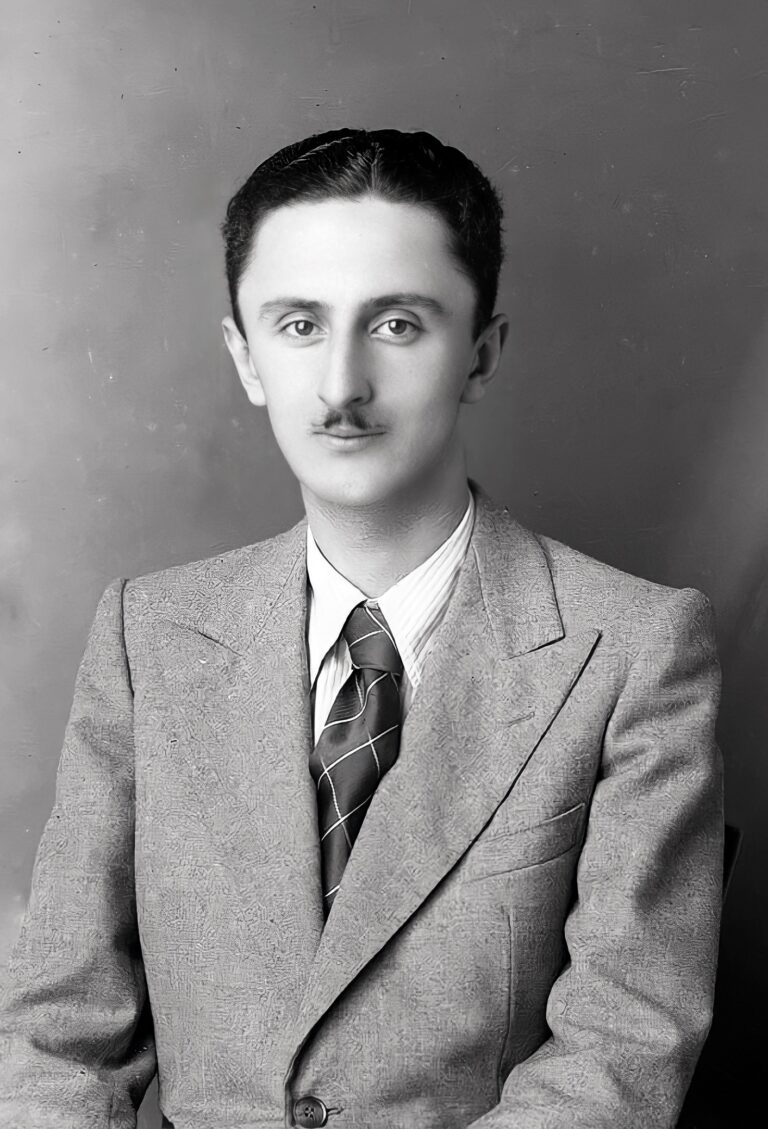
His one collection, Vargjet e Lira — "Free Verse" — was printed in Tirana in 1936 and banned almost immediately, before it could really circulate. (A pattern is forming here, isn’t it.) When it was finally republished years later, the editors quietly dropped a couple of poems they worried would offend the Church.
What I love about putting Migjeni next to Fishta is that they came from the same city, the same Gheg-speaking north, within a generation of each other — and they point in completely opposite directions. Fishta is the tradition reaching its peak. Migjeni is the tradition cracking open into something modern and raw and uncomfortable. Both of them northern. Both of them, for different reasons, inconvenient to the people who later controlled what Albanians were allowed to read.
Why all of this nearly vanished
So how does a whole literary tradition — the oldest one we have — end up needing a Canadian to rescue it?
Two things happened, stacked on top of each other.
The first you already know: the communist regime, after 1944, suppressed the northern Catholic writers as a matter of policy. Fishta banned. The Franciscan and Jesuit world of Shkodra dismantled. A clean political decision about who got to be remembered. (It’s a recurring theme if you read Albanian history from the beginning — who controls the story controls the past.)
The second is quieter and, honestly, more interesting. In November 1972, a Congress of Orthography met in Tirana — 87 delegates, from Albania and Kosovo and the diaspora — and settled on a single Standard Albanian. The standard they chose was built mainly on Tosk, the southern dialect. Which, if you remember your recent history, happened to be the dialect of the south, where the people running the country came from.
I want to be fair here, because this gets emotional fast and it shouldn’t. A small language genuinely benefits from one agreed standard — it helps schooling, publishing, holding a scattered people together. That part is real. But the cost was also real: a thousand years of literary momentum had been in Gheg, and now the official language tilted south. Younger Albanians were educated in a standard that made the older northern books feel slightly foreign on the page. The literature didn’t get burned. It just slid out of reach — wrong dialect, wrong politics, wrong moment.
That’s the gap Elsie walked into. Not a pile of ashes. A library that its own people had been quietly taught to stop reading.
The thing outsiders miss
Albanian literature didn’t start in Tirana in the 20th century. It started with northern Catholic priests writing in Gheg in the 1500s and 1600s. The "newer" standardized south-based Albanian is, in literary terms, the recent arrival.
What he left behind
Elsie died in 2017, in Berlin, of a brutal disease that takes away your movement piece by piece. And he asked to be buried in Theth.
I keep coming back to that choice. A man born on the Pacific coast of Canada, who could have been buried anywhere, who chose a graveyard in the Albanian Alps — the heart of the Gheg-speaking north, the exact landscape that produced the literature he gave his life to. It’s not a small gesture. It’s a man saying: this is where I belong now.
What he left us is concrete. There’s an archive — albanianliterature.net — that holds, by its own description, the largest collection of Albanian literature ever translated into English. There are his big reference books, the History of Albanian Literature, the Short History, the kind of volumes that an entire field now rests on. There are the translations: Fishta’s Highland Lute, the northern mountain epics, the early Catholic writers. If you are an English speaker who wants to understand what Albanians wrote before the world was paying attention, you are almost certainly reading Elsie, whether you realize it or not.
And here’s the part that sits with me, as someone who’s lived here for over two decades and writes about this country for a living. We needed him. A foreigner had to come and tell us how rich our own northern literature was, because for two generations we’d been steered away from it. That’s not a comfortable thought. But the comfortable thing about it is the ending — the books are back. Fishta is taught again. The Meshari is celebrated as the treasure it is. The north’s literature is no longer forbidden or forgotten.
A Canadian helped make sure of that, and then he went up into the mountains to stay.
Over to you
Did you grow up reading Fishta — or did you, like a lot of us, only meet him later? And had you ever heard of Robert Elsie before now? Tell me in the comments.
Subscribe to monthly updates
Get honest Albania travel tips, local guides, and new posts straight to your inbox. No spam, unsubscribe anytime.

Robert Elsie ahas been a major source for me in learning about Albania ever since my first trip 13 years ago. His website http://www.elsie.de is packed with information on history, litterature, language etc. But, when loading the site now, I get the message that the site is not secure. I wonder, is anyone maintaining this site to meet such requirements? Who manages this legacy?
Hi Nils,
yeah I have been using the same website for over two decades now. About the management it is all stated here: http://www.elsie.de/contact.htm – though I’ve often thought about making a copy of all his websites to ensure that they stay up long term. Thank you for reading my blog.