
By Elvis Plaku — Tirana-based blogger since 2004
FTC Disclosure: This post contains affiliate links. If you book through my recommended link, I earn a small commission at no extra cost to you. I only recommend trips I’d genuinely take.
Here’s something most travel guides about North Macedonia won’t tell you: Albanians have been going to Ohrid for generations. Long before “Lake Ohrid” appeared on Instagram or in Lonely Planet’s best-of lists, families from Tirana, Elbasan, and Pogradec were making the drive on summer weekends, crossing the border at Qafë Thanë, and spending the day wandering those Byzantine lanes above the lake. Ohrid wasn’t a discovery for us. It was just where you went.
So when international visitors ask me about doing an Ohrid day trip from Tirana, I find myself in an interesting position. I’m not giving you the tourist perspective. I’m telling you how Albanians actually do this trip — what to expect at the border, why Pogradec on the Albanian side is worth stopping for, and whether the drive or an organized tour makes more sense for you specifically.
Key Takeaways
- Lake Ohrid is a UNESCO World Heritage Site shared between North Macedonia and Albania — one of Europe’s oldest and deepest lakes, over 3 million years old.
- The drive from Tirana to Ohrid town takes 2.5 to 3 hours; the Qafë Thanë border crossing adds 20-60 minutes depending on the season.
- You’ll need a valid passport (not just an EU ID card) to cross into North Macedonia.
- The organized day trip from Tirana runs ~$50 per person with over 1,351 verified reviews on GetYourGuide.
- Pogradec, on the Albanian shore of the same lake, is an easy and rewarding bonus stop — especially for koran trout, the lake’s famous endemic fish.
Book This Day Trip
Lake Ohrid & St Naum Monastery — Full Day from Tirana
4.8 stars · 1,351+ reviews · ~$50 per person · Free cancellation
Affiliate link — I earn a small commission if you book. Doesn’t change your price.
There is also a deeper reason Ohrid feels familiar to Albanians. This whole region was the heart of the ancient Illyrian world long before any modern border was drawn, and Albanians are among the oldest peoples of these lands, here before the Slavic migrations of the 6th and 7th centuries reshaped the Balkans. Ohrid’s history is layered and genuinely shared, and that is part of why, for us, crossing the lake has never felt like going abroad so much as visiting a place our story has always touched.
What Is Ohrid, Exactly?
Lake Ohrid is one of the oldest lakes on earth, estimated at over 3 million years old, and it shows. The lake supports at least 200 endemic species found nowhere else — including the koran trout, a fish you’ll see on every menu in town (UNESCO World Heritage List, 1979/2019 inscription). The surrounding landscape has been inhabited since ancient times, and the old town of Ohrid sits on a bluff above the water with churches, monasteries, and Byzantine-era ruins layered on top of each other in a way that takes half a day to properly absorb.
UNESCO inscribed the Ohrid region in 1979, initially covering the part in North Macedonia; in 2019 the inscription was extended to include the Albanian shore, formally recognizing the lake as shared heritage. That extension matters for this guide, because the Albanian shore of Lake Ohrid, including the town of Pogradec, is part of the same protected ecosystem.
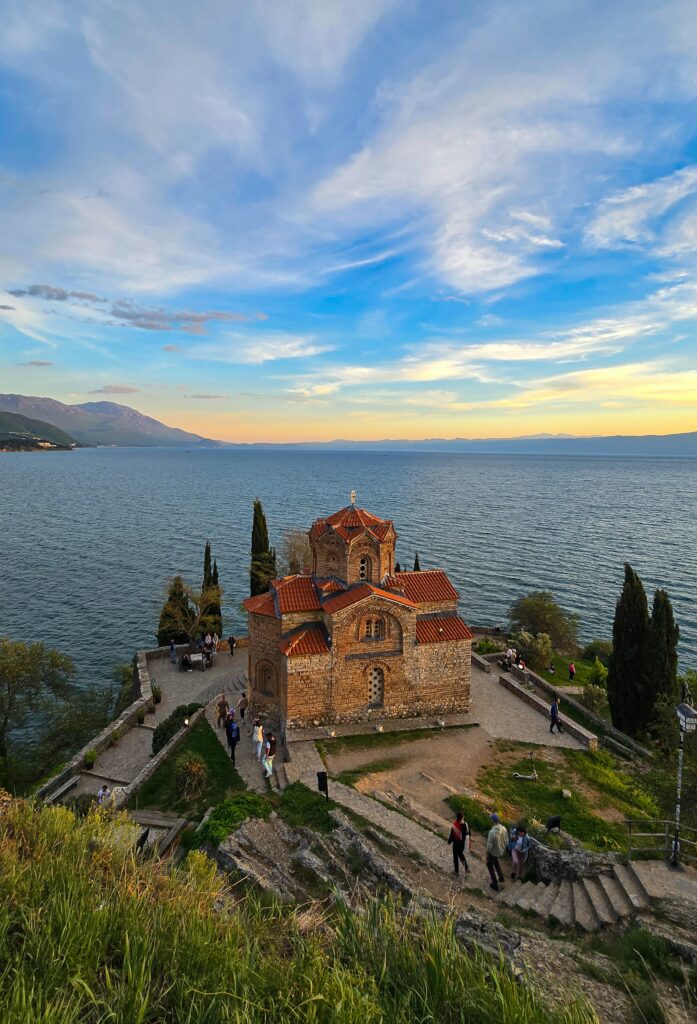
Ohrid town itself is compact and very walkable. The old town climbs from the waterfront up to the fortress of Tsar Samuel, with the 13th-century Church of St John the Theologian at Kaneo — the one you’ve definitely seen in photographs, perched on a cliff above the water — sitting about halfway up. St Naum Monastery is 29 km south of town along the lakeshore, near the Albanian border. Both belong on the itinerary.
Lake Ohrid, shared between North Macedonia and Albania, is one of Europe’s oldest and deepest lakes at an estimated 3 million years of age and 288 meters at its deepest point. UNESCO inscribed it as a World Heritage Site in 1979 for its natural value and extended the inscription in 2019 to include the wider cultural and natural region. The lake supports over 200 endemic species, including the koran trout (UNESCO, 2019).
How Far Is Ohrid from Tirana?
Planning a Trip to Tirana?
Get my free Tirana in 48 Hours checklist with day-by-day itinerary, prices, and local tips.
Get the Free Checklist →The distance from Tirana to Ohrid town is approximately 185-190 km by road, and that number is a little misleading. In most countries, 190 km takes about two hours. Albania is not most countries.
The most direct route goes via the SH3 through Elbasan, then southeast toward the Albanian-North Macedonia border at Qafë Thanë (on the Albanian side) or Sveti Naum (on the Macedonian side). This stretch of road passes through some genuinely beautiful mountain terrain before dropping down into the lake basin. The total driving time is 2.5 to 3 hours in reasonable conditions, not counting the border.
The alternative route goes via Pogradec on the Albanian shore of the lake, which adds about 30-40 minutes but gives you the option to stop there — more on that below.
The Border Crossing: What No One Tells You
This is the part that catches first-time visitors off guard, and it’s worth spending a few paragraphs on because it genuinely shapes the day.
You need a passport. Not an EU ID card, not a driver’s license. A valid passport. Citizens of most EU countries, the US, UK, Canada, and Australia can enter North Macedonia without a visa for stays up to 90 days, but they must have a passport. Albanian citizens cross with their ID card or passport. If you’re joining a group tour from Tirana, the tour operator will confirm document requirements, but double-check this yourself before the day.
Border wait times vary dramatically. In the off-season, the crossing at Qafë Thanë can take 10-15 minutes. In July and August, when half of Tirana seems to be heading to Ohrid for the weekend, the queue can stretch to an hour or more. Organized tours typically leave Tirana early enough to beat the worst of it.
The approach is stunning, for what it’s worth. The road climbs through the mountains before the border, and on the Macedonian side you get your first view of the lake from above — that specific blue against the mountains is the kind of sight that makes you forget you spent 45 minutes in a queue.
Currency note: North Macedonia uses the Macedonian Denar (MKD). Euros are widely accepted in Ohrid’s tourist areas and at St Naum, but you’ll get better value with local currency. ATMs are available in Ohrid town. Albanian lek are not accepted.
The primary road border crossing between Albania and North Macedonia for travelers on the Tirana-Ohrid route is Qafë Thanë (Albanian side) / Han i Elezit–Sveti Naum (Macedonian side). Albanian citizens enter North Macedonia with a national ID card; most Western passport holders (EU, US, UK, Canada, Australia) enter visa-free for up to 90 days with a valid passport. Summer weekend wait times can reach 60 minutes or more (Ministria e Punëve të Brendshme, Shqipëri, 2024).
Don’t Skip Pogradec: The Albanian Side of the Lake
Here’s the insider move that most Ohrid day-trip guides completely miss. Before you cross the border, or on your way back, stop in Pogradec.
Pogradec sits on the Albanian shore of Lake Ohrid, about 20 km south of the border crossing. The same lake. The same water. Completely different atmosphere.
The town has a lakefront promenade that Albanians have been coming to for decades — this was a holiday town during the communist era, and you can still sense that slightly faded resort character mixed with new investment and restaurants. In summer, the promenade fills up in the evenings with families, the lake catches the light, and the whole thing feels genuinely Mediterranean in the best way.
What you should eat: koran trout. The koran (Ohrid trout, Salmo letnica) is an endemic species to Lake Ohrid and the surrounding rivers, and it’s on the menu at every restaurant in Pogradec. This is not a tourist invention — locals have been eating koran here for as long as there have been restaurants. Grilled, with salad and local wine. That’s the lunch.
Drilon National Park is 3 km from Pogradec and worth 30-45 minutes if you have time. It’s a small park centered on natural freshwater springs that feed into the lake, with swans, boats for hire, and a genuinely pleasant parkland along the water. Families with children love it. The entrance is small; the park doesn’t need more than an hour.
Most international visitors to Lake Ohrid don’t realize that the Albanian side of the lake — Pogradec, Drilon, the Lin peninsula with its ancient mosaics — is part of the same UNESCO inscription and equally worth visiting. Albanians know this intuitively, but international travel content almost always treats “Lake Ohrid” as synonymous with North Macedonia only.
What to See in Ohrid Town
You’ll have 3-4 hours in Ohrid itself on a day trip from Tirana. That’s enough to see the highlights without rushing, as long as you’re strategic.
The Old Town and the Waterfront
The old town is where you want to spend most of your time. Start at the waterfront, walk up through the cobbled streets past the Church of St Sophia (an 11th-century Byzantine church converted from a mosque back to a church in 1913), and keep climbing to the Samuel’s Fortress at the top. The views from the fortress are the best in town — the lake stretches to the horizon and the surrounding mountains are dramatic in clear weather.
The Church of St John the Theologian at Kaneo is a 10-minute walk from the fortress along the clifftop path. This is the most-photographed church in North Macedonia for good reason: it sits on a rocky promontory directly over the water, and the combination of the Byzantine architecture and the blue lake below is genuinely special. Early morning or late afternoon light is best, but even at midday it earns the walk.
St Naum Monastery
St Naum Monastery sits 29 km south of Ohrid town, right on the Albanian border. The monastery was founded in 905 by Saint Naum of Ohrid, a disciple of Saints Cyril and Methodius and, with Saint Clement, one of the figures who developed the early Cyrillic script at the Ohrid Literary School. The bones of St Naum are kept in the church here.
The setting adds to the experience. Natural springs on the monastery grounds feed directly into the lake, and the water coming up through the gravel is so clear and cold it feels unreal. Peacocks wander the courtyard freely, which sounds like a tourist gimmick but is actually disarming and charming. From the monastery terrace, you’re looking back across the lake toward Albania. On a clear day, you can see the Albanian shore.
Most organized tours from Tirana include St Naum as part of the route, typically stopping here before or after Ohrid town.
The spring-fed water at St Naum is one of those small details that sticks with people long after the postcard-perfect church photos have blurred into a general memory of “that trip to Macedonia.” Worth going in slow enough to notice it.
Self-Guided vs Organized Tour: The Honest Take
Let me be direct about this, because it’s the question that matters most for planning.
The case for self-driving: If you’re already renting a car in Albania, the drive to Ohrid is beautiful and manageable. You get flexibility — you can stop in Pogradec, linger at St Naum, and return on your own schedule. The roads are fine (the Albanian side has some mountain curves, the Macedonian side is smooth once you’re past the border). Parking in Ohrid town is available and inexpensive.
The case for the organized tour: The border crossing paperwork, the currency exchange, the navigation from Ohrid to St Naum and back — these are all small frictions that add up. At approximately $50 per person with 1,351+ reviews and a 4.8-star rating (GetYourGuide, 2025), the organized tour from Tirana represents genuinely good value. It also gives you a guide who can provide context for what you’re looking at in both the old town and at St Naum.
My honest recommendation: If you’re renting a car and spending more than a week in Albania, drive it — and include Pogradec as a stop on the way. If you’re in Tirana for a few days and want to do Ohrid without logistics stress, book the tour. The border alone, with its variable wait times and currency transition, is enough reason to let someone else handle it for a day.
Lake Ohrid & St Naum Day Trip from Tirana
4.8 stars · 1,351+ verified reviews · ~$50 per person
Includes: transport from Tirana, border crossing, guided Ohrid old town & St Naum visit
Komani Lake day trip from Tirana
What Does the Ohrid Day Trip Cost?
Organized tour from Tirana: approximately $50 per person (GetYourGuide 2025 pricing). Includes transport, guide, and entry to sites included in the tour. Some entrance fees for specific churches or the fortress may be separate.
Self-guided by car: Fuel for the return trip (roughly 380 km total) will cost approximately 3,500-4,500 ALL (€30-40) depending on your car and fuel prices. Add the entrance to St Naum monastery (around 100 MKD / €1.50), optional boat rental at the springs (200-300 MKD / €3-5), and lunch in Pogradec (800-1,200 ALL / €7-10 for koran trout with sides). Budget €50-70 per person for a comfortable self-guided day, excluding car rental.
Ohrid entrance fees: The old town itself is free to walk. Samuel’s Fortress charges a small entry fee (around 120 MKD / €2 per person as of 2024). Individual churches may have their own fees of 50-100 MKD each. These are typically not included in organized tour prices and are paid on-site.
Currency tip: Get Macedonian Denar from an ATM in Ohrid town rather than exchanging at the border. ATMs typically offer better rates, and you won’t need large amounts.
When to Go
Ohrid is one of the most popular summer destinations in the Western Balkans, and July-August visitor numbers reflect that. The organized Ohrid Day tour from Tirana has reviews spread across all seasons, suggesting year-round demand, but peak season brings crowded streets and longer border waits.
Best months for a day trip: May, early June, and September. The weather is warm enough for the lake and the old town, the border queue is manageable, and Ohrid itself has room to breathe. September in particular is the local choice — the tourists thin out, the lake is at its warmest from summer heating, and the light is golden.
July and August: Beautiful, busy. Ohrid’s old town gets crowded. St Naum fills up. The border can take an hour or more on Friday afternoons and Sunday evenings. If this is your only window, go early in the morning and come back before the afternoon rush.
Winter (November-March): Ohrid is quieter, some restaurants close, and the lake is cold, but the town itself is atmospheric and uncrowded. Fewer organized tours operate; check availability. The border is fast.
Practical Tips and Honest Warnings
Start early. Organized tours from Tirana typically depart at 7:00-8:00 AM. If you’re driving yourself, aim for the same. You want to be at the border before 9:00 AM in summer to avoid the buildup.
Bring your passport. Say it again for emphasis: passport, not just an ID card, for non-Albanian visitors crossing into North Macedonia.
Cash in both currencies. Albanian lek for the Albanian side (Pogradec, fuel, coffee). Macedonian Denar for everything on the Macedonian side. Credit cards are accepted in most Ohrid restaurants and larger shops, but smaller sites and boats at St Naum are cash only.
Wear comfortable shoes. The old town is cobbled. The path to Kaneo and the fortress involves steep uphill walking. This is not a sandals-and-rolling-suitcase kind of town.
Book accommodation in advance if staying overnight. Ohrid rewards a night or two stay if you can manage it. The day trip gives you a genuine introduction, but one night lets you see the old town at sunrise and the waterfront at midnight, which are different experiences entirely.
Don’t eat lunch in the first tourist restaurant you see on the waterfront. Walk up into the old town and find something with a view and a menu that isn’t just translated captions. Or save your appetite for koran trout in Pogradec on the way back.
Based on seasonal travel patterns observed across Albanian-run tour operators and the Tirana-Ohrid road during summer months, the single most common complaint from self-guided travelers is underestimating border wait time on summer weekend afternoons. The return crossing on Saturday and Sunday evenings, when Albanians who spent the weekend in Ohrid are heading home, can add 90 minutes to the return journey. Plan accordingly.
FAQ
Do I need a visa to visit Ohrid from Albania? Citizens of Albania cross into North Macedonia with their national ID card or passport, no visa required. For other nationalities, North Macedonia allows visa-free entry for most EU, US, UK, Canadian, and Australian passport holders for stays up to 90 days. Always check your country’s current status before travel. Organized tours will confirm document requirements at booking.
How long does the Ohrid day trip from Tirana take? The full day runs 12-14 hours door-to-door. Organized tours typically depart Tirana at 7:00-8:00 AM and return by 8:00-9:00 PM. Driving yourself follows a similar timeline: 2.5-3 hours driving each way plus 20-60 minutes at the border plus 4-5 hours on the ground in Ohrid and at St Naum.
Is Ohrid worth visiting as a day trip, or should I stay overnight? A day trip is genuinely worthwhile. You’ll see the old town, walk to Kaneo, visit Samuel’s Fortress, and get to St Naum. That said, Ohrid rewards an overnight stay if you have the time: the town changes character in the evening when the day-trippers leave, and the early morning light on the lake from the old town is something a day trip can’t give you.
What is Pogradec and is it worth visiting? Pogradec is a town on the Albanian shore of Lake Ohrid, about 20 km from the border crossing. It’s on the same lake as the North Macedonian Ohrid, part of the same UNESCO-protected ecosystem. Worth visiting for the lakefront promenade, koran trout (the lake’s famous endemic fish), and Drilon National Park with its natural springs. If you’re driving, a 45-60 minute stop here on the way to or from Ohrid adds real value.
Can I do the Ohrid day trip without renting a car? Yes. The organized day tour from Tirana handles all transport — pickup, border crossing, and return. Without a car and without a tour, getting to Ohrid independently requires connecting buses via Elbasan or Pogradec, which is technically possible but turns a day trip into an overnight at minimum.
What is St Naum Monastery and is it included in tours? St Naum is a 9th-century Eastern Orthodox monastery 29 km south of Ohrid on the lakeshore, practically on the Albanian border. Founded by Saint Naum of Ohrid, it houses natural springs that feed directly into the lake, freely roaming peacocks, and the saint’s tomb inside the church. Most organized day tours from Tirana include it. If you’re self-driving, it’s a 30-minute drive from Ohrid town on a good road along the lake.
I’ve been watching Ohrid appear on international travel lists for years now, always described as a discovery, a secret, the Dubrovnik you haven’t heard of yet. Every time I see it framed that way, I think about all the Albanian families who’ve been making this drive since before I was born, pulling up to the waterfront in Pogradec for grilled koran, then crossing into North Macedonia like it was the most ordinary thing in the world. Because for us, it was.
The lake doesn’t care about the narrative. It’s been there for 3 million years. It’ll be there long after the travel trends move on. If you haven’t been, go. And if you’re passing through Pogradec on the way back, stop and eat the fish.
Elvis Plaku has lived in Tirana his entire life and has been writing about Albania since 2004. Albanian Blogger is powered by Sfida.PRO.
Subscribe to monthly updates
Get honest Albania travel tips, local guides, and new posts straight to your inbox. No spam, unsubscribe anytime.
