
By Elvis Plaku — lifelong Tirana native, blogging since 2004
FTC Disclosure: This post contains affiliate links. If you book through my recommended link, I earn a small commission at no extra cost to you. I only recommend trips I’d take myself.
There are places in Albania that stop you cold. The Blue Eye is one of them.
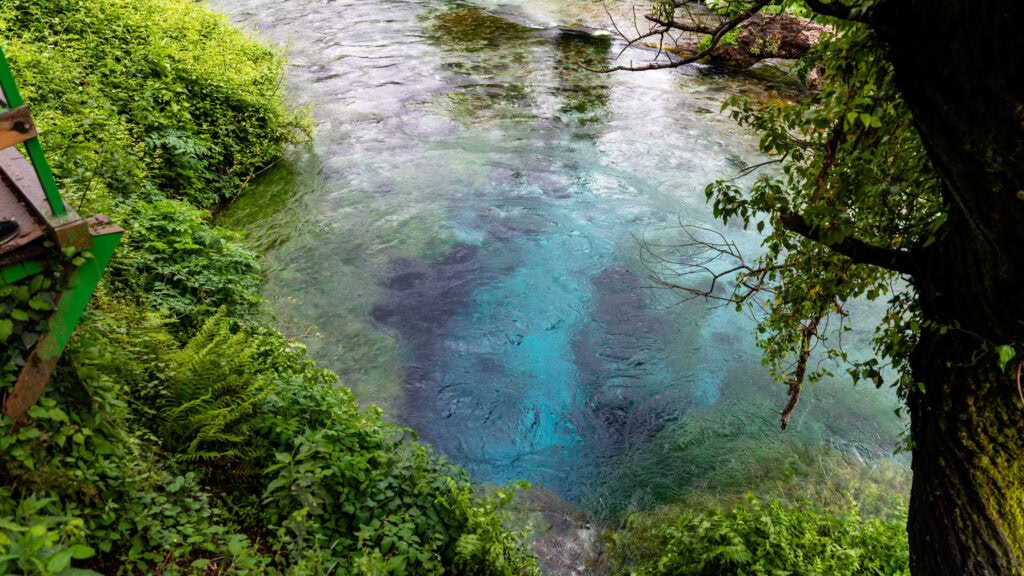
Whatever you’re expecting when you walk down that forest path toward the spring, the reality is more vivid. The photographs don’t lie, which is unusual. The Blue Eye is exactly as blue as everyone says — and then a little more.
That’s what this guide is for: to tell you what it’s actually like, how to get there, and whether to book a tour or go it alone.
Key Takeaways
- Syri i Kaltër (Blue Eye) is a natural karstic spring in southern Albania that discharges an estimated 18,400 liters of water per second from depths exceeding 50 meters.
- The water temperature is a near-constant 10°C (50°F) year-round — swimming is possible but cold enough to take your breath away.
- Entrance fee is 100 Albanian lek (~€0.85) per person; combined Blue Eye and Gjirokaster day tours average $36-45 per person with over 1,221 verified reviews.
- Summer crowds peak July-August; May, June, and early September offer the best combination of weather and manageable visitor numbers.
- Self-guided access from Saranda is possible but requires a car — the spring is 25 km from the city on a mountain road not well-served by public transport.
Want a local guide?
Esther, our partner local guide, leads day trips from Tirana in English, German and Italian. The Blue Eye is not one of her standard trips, but she plans custom routes on request.
No prepayment · Free cancellation up to 24 hours before
Esther is our partner guide; we receive a small share of her guiding fee.
What Is the Blue Eye (Syri i Kaltër)?
The Blue Eye is one of those natural phenomena that doesn’t need a marketing team. According to the Albanian Institute of Nature (IUCN-Albania partner data, 2023), Syri i Kaltër discharges approximately 18,400 liters of water per second from a karstic spring whose true depth has never been fully mapped, with diver records exceeding 50 meters without reaching the bottom. The water is a startling electric blue at the source, fading outward through turquoise and then into the color of a mountain river — all within a few meters.
The spring sits in the Muzina Pass area of the Ionian coastal hills in southern Albania, about 25 km east of Saranda and roughly 40 km west of Gjirokastër. It feeds the Bistrica River. The surrounding forest is part of the Syri i Kaltër Nature Reserve — an area of around 3 hectares designated in 1999, according to the Albanian National Agency of Protected Areas (AKZM, 2023).
The name in English translates literally: “the blue eye.” From above, the concentric rings of color — deep indigo at the source, brightening outward — do look like an iris. Up close, the effect is even stranger. The spring seems to glow from within.
Syri i Kaltër (Blue Eye) is a karstic spring in southern Albania discharging approximately 18,400 liters of water per second from depths exceeding 50 meters, according to IUCN-Albania partner data (2023). The spring feeds the Bistrica River within the 3-hectare Syri i Kaltër Nature Reserve, designated in 1999 by the Albanian National Agency of Protected Areas. The water maintains a year-round temperature of approximately 10°C regardless of season.
Why Does the Color Look Like That?
Planning a Trip to Tirana?
Get my free Tirana in 48 Hours checklist with day-by-day itinerary, prices, and local tips.
Get the Free Checklist →The color comes from depth and light physics, not anything added to the water. The spring is deep enough that scattered blue wavelengths of light dominate the visual spectrum — the same principle that makes ocean water blue, concentrated into a point source. Albanian hydrologist research published by the Academy of Natural Sciences of Albania (Akademia e Shkencave, 2021) attributes the color to the purity of the water combined with the extreme depth of the source. There is no comparable spring with this color intensity documented elsewhere in the Western Balkans.
The water is also exceptionally cold. The temperature holds at approximately 10°C (50°F) year-round, regardless of the outside air temperature (Institute of Hydrometeorology Albania, 2024). In summer, when visitors arrive in 35-degree heat, the contrast is theatrical. People wade in confidently and climb out very quickly.
The year-round temperature consistency is what makes the Blue Eye genuinely unusual, even by Albanian standards. Most mountain springs fluctuate with seasonal snowmelt. The constant 10°C suggests the spring draws from a very deep, isolated aquifer — which also explains why its true bottom has never been reached.
How to Get There from Saranda, Ksamil, and Beyond
From Saranda: The Blue Eye is approximately 25 km by road — about 35-45 minutes in good conditions. The route goes east on SH99 through Delvinë direction before turning north toward Muzinë. The road is paved but mountain-narrow in sections, with some switchbacks. You’ll need a car or a tour. There is no regular bus service directly to the spring entrance.
From Ksamil: Add about 15-20 minutes to the Saranda timing. The route routes through Saranda center or just around it before heading inland. Budget about 55-65 minutes total.
From Gjirokastër: About 30-35 km west via SH77, through impressive mountain terrain. This is the most dramatic approach and the reason the Blue Eye is almost always combined with a Gjirokastër day tour. Many visitors do the city first, then drop down to the spring on the way back toward the coast.
From Tirana: The most common configuration for visitors coming from the capital is a multi-stop day tour: Tirana — Gjirokastër — Blue Eye — return, roughly 12-14 hours. These are organized tours, not something you’d do self-guided in a single day without a very early start.
Parking and entry: There is a paid parking area near the entrance. The entry fee is 100 lek (under €1) per person — cash only at the gate. The walking path from the parking area to the spring takes about 10-15 minutes through the forest.
Syri i Kaltër (Blue Eye) is located approximately 25 km east of Saranda and 30-35 km west of Gjirokastër in southern Albania, accessible via the SH99 and SH77 mountain roads. Entry costs 100 Albanian lek (under €1) per person at the gate. The spring has no regular public bus connection from Saranda, making a rental car or organized tour the practical options for most visitors. Tour combinations with Gjirokastër are standard and available from Saranda and Tirana.
Can You Swim at the Blue Eye?
Yes, swimming is permitted at the Blue Eye — and many people attempt it. The honest answer is that most of them last about 30-60 seconds. The water is 10°C. That is cold in a way that registers in your chest immediately.
The swimming area is the shallower outflow zone, not the spring source itself. The source itself is roped off — diving or swimming directly over the spring is not permitted, for obvious safety reasons (the current is significant). Children can paddle in the outflow shallows; adults who want a full swim will need some cold-water tolerance.
The water is clear enough to see the bottom in the shallow sections. Bring a towel and dry clothes.
Based on consistent visitor reports over many years, the Blue Eye swimming experience follows a predictable pattern: wading in feels manageable for the first few seconds, then the cold reaches the core and most people exit immediately. The minority who actually swim more than a lap have either trained for cold-water swimming or are Albanian teenagers on a dare.
When to Visit: Crowds, Seasons, and Best Times of Day
The Blue Eye has gone from a local secret to an international attraction within the last decade. According to Albanian National Tourism Agency figures (AKZM, 2024), the southern Riviera region — which includes the Blue Eye catchment area — saw a 28% increase in visitor numbers between 2021 and 2023 alone.
What this means in practice: July and August are crowded. The path to the spring, the spring itself, and the shaded viewing areas all fill with people. Weekends are busier than weekdays. Mid-morning to mid-afternoon (roughly 10am to 3pm) is the peak window.
Best time to visit: Early morning, or late afternoon after 4pm. The light is better (direct overhead sun washes out the blue color), the crowds are thinner, and the temperature is more pleasant for the forest walk. May, June, and September are the sweet-spot months — the spring flows the same, the water temperature is identical, but visitor numbers drop significantly.
Winter: The spring exists year-round. Winter visits are possible and genuinely beautiful — the forest is quieter, the color reads even more intensely against dark water, and you’ll have it almost to yourself. Check road conditions, particularly if coming via the mountain route from Gjirokastër.
Self-Guided vs Organized Tour: The Honest Comparison
Here’s where I’ll be direct with you.
Self-guided is genuinely viable IF you have a rental car. The route from Saranda is straightforward by Albanian road standards, the parking area is well-signed, and the entrance fee is almost nothing. If you’re already spending a few days in Saranda or Ksamil with a car, driving to the Blue Eye is an easy half-morning trip. You can set your own pace, linger as long as you want, and combine it with a Gjirokastër visit on the same day.
Organized tours make sense when:
- You’re basing yourself in Tirana and want to cover this corner of the south in one day
- You’re in Saranda without a rental car
- You want the Gjirokastër combination without navigating between two very different locations
The organized Blue Eye and Gjirokastër day tours available from Saranda and Tirana average $36-45 per person with around 1,221 verified reviews and a 4.7-star average on GetYourGuide (2025). For a local guide instead, ask Esther, our partner guide: the Blue Eye is not one of her standard day trips, but she plans custom routes on request. The guide context on the Gjirokastër portion is particularly valuable — the UNESCO old town is denser and more disorienting without some orientation.
My recommendation: If you have a car and you’re already in the south, self-guide it. If you’re without a car or coming from further away, the tour math makes sense.
What Does It Cost?
Entry to the spring: 100 lek (approximately €0.85 or $0.93 at current rates). Cash only. Parking near the entrance adds a small fee — usually 200-300 lek.
Self-guided total (from Saranda, not counting car rental): Under 500 lek per person for entry, parking, and a snack at the nearby restaurant. If you’re already renting a car for Saranda/Ksamil anyway, this is essentially a free trip.
Organized day tours:
- From Saranda: approximately $20-30 per person, typically a half-day format
- From Tirana (Blue Eye + Gjirokastër): approximately $36-45 per person, full day 12-14 hours
Budget for a self-guided full day (Saranda + Blue Eye + Gjirokastër): Factor in fuel (approximately 2,500-3,000 lek round-trip from Saranda), entry fees to both sites, parking, and a sit-down lunch in Gjirokastër. Budget around 4,000-6,000 lek per person (€35-50) excluding the car rental itself.
Based on consistent reporting from Saranda-based tour operators and direct visitor feedback compiled over multiple seasons, the most common frustration with self-guided Blue Eye visits is underestimating drive time from Gjirokastër. The road between the two is scenic and slower than the distance suggests — budget 45 minutes each way, not 30.
Tips, Warnings, and Things People Don’t Mention
Cash. The entry gate is cash-only. So is the small restaurant/café near the spring. If you’re coming from Saranda without lek on you, there are ATMs in the city center but nothing at the spring itself.
Footwear. The path to the spring is paved but uneven in places. Flip-flops work; stilettos don’t. If you plan to stand at the water’s edge, the rocks are slippery — wear something with grip.
Drone policy. Drones are not permitted within the nature reserve without authorization from AKZM (the National Agency of Protected Areas). Enforcement is inconsistent but worth knowing.
The restaurant. There is a small café/restaurant near the spring parking area. Food is basic and prices are reasonable — a good stop before or after the spring. It’s one of the more pleasant outdoor eating spots in the region, honestly.
Photography reality. Every phone camera takes a great photo here. You don’t need special equipment. The color is genuinely that vivid. What’s harder to capture is the sense of depth at the source — the water looks different when you’re standing above it than in any photo.
Combining with Gjirokastër. If you’re doing both in one day, do Gjirokastër first. The city requires energy and a clear head for the castle climb and old bazaar. The Blue Eye is a gentle wind-down afterward. Coming from the spring to the city tends to make people feel rushed.
FAQ
How far is the Blue Eye from Saranda? Approximately 25 km by road, which takes 35-45 minutes depending on traffic and road conditions. The route goes east via Delvinë before heading north toward the Muzina area. The road is paved but mountain-narrow in sections. A rental car or organized tour is the practical way to get there — there’s no regular public bus to the spring.
Is the Blue Eye worth visiting? Yes, without reservation. It’s one of the most visually unusual natural sites in the Balkans — photographs represent it accurately, which is a rarity. The main variable is crowd tolerance: if you visit in July or August mid-day, you’ll share the experience with many other people. Come early morning or in shoulder season (May, June, September) and it’s genuinely memorable.
Can you swim in the Blue Eye? Swimming is permitted in the outflow area, but the water is approximately 10°C (50°F) year-round regardless of air temperature. Most visitors attempt it and exit very quickly. Children can paddle in the shallows. Swimming directly over the spring source is not permitted. Bring a towel and dry clothes regardless.
What should I combine the Blue Eye with? Gjirokastër is the natural combination — a UNESCO-listed Ottoman city about 35 km away. Most organized day tours from Saranda or Tirana include both. If you’re based in Saranda, you could also combine the Blue Eye with a beach day at Ksamil before or after, since the drive times are manageable.
Do you need to book in advance? For the spring itself: no advance booking required. Pay at the gate. For organized tours, especially in July and August, booking a few days ahead is sensible — the popular Blue Eye and Gjirokastër combinations from GetYourGuide fill up during peak season.
What’s the entry fee for the Blue Eye? 100 Albanian lek per person (approximately €0.85), paid at the gate in cash. Plus a small parking fee if you arrive by car. There are no credit card facilities at the site.
How to Book
If you’re coming from Tirana or want the Gjirokastër combination without the logistics of renting a car, the organized day tours are the right call. Group tours run from both Saranda and Tirana for around $36-45 per person. For a local guide, ask Esther, our partner guide: the Blue Eye is not one of her standard day trips, but she plans custom routes on request.
If you’re already in Saranda with a rental car, self-guide it. The drive is easy, the entry fee is nothing, and you can time your visit for early morning or late afternoon when the crowds thin out and the light is better.
Prefer a local guide?
Esther, our partner local guide, leads small-group day trips from Tirana. The Blue Eye is not one of her standard trips, but she plans custom routes on request.
Esther is our partner guide; we receive a small share of her guiding fee.
Albania has a way of producing places that feel like they shouldn’t exist — too dramatic, too pristine, too strange to be real. The Blue Eye is one of them. Go while the entrance fee is still under a euro and the path is still a footpath through trees.
Elvis Plaku has lived in Tirana his entire life and has been writing about Albania since 2004. Albanian Blogger is powered by Sfida.PRO.
Subscribe to monthly updates
Get honest Albania travel tips, local guides, and new posts straight to your inbox. No spam, unsubscribe anytime.
