
Key Takeaways
- Lake Shkodra (Lake Skadar on the Montenegrin side) is the largest lake in the Balkans. About 149 km² of roughly 368 km² belongs to Albania, according to the National Tourism Agency.
- The Albanian side is protected: a managed nature reserve, part of a Ramsar wetland, and since June 2026 part of a UNESCO transboundary biosphere reserve.
- Most visitors do the same short loop: Shkodër, the lake road to Shiroka and Zogaj, a fish lunch, a swim or a boat, back by evening.
- The dish to order is tavë krapi, baked carp, which the national tourism site calls the signature dish of the lake area.
- It is easy to add to a Shkodër stay, and the Montenegrin border at Han i Hotit is close if you are travelling on.
Table of Contents
If you have an afternoon to spare in Shkodër, the lake is where I would send you. Not the castle, which you will see anyway, but the lake: the road along the shore, the fish restaurants, the water that looks flat and silver late in the day. It is the easiest escape from the city, and it gets far fewer foreign visitors than the castle does.
You will find it written three ways, and all of them are the same lake. Albanians say Liqeni i Shkodrës, English-language maps say Lake Shkodra or Lake Shkodër, and on the Montenegrin side it is Lake Skadar. This page is about the Albanian shore, which is the quieter one. If you have not read my guide to Shkodër yet, start there for the city. Here I stay on the water.
What the lake actually is
It is the biggest lake in the Balkans, and it is shared. Albania’s National Tourism Agency (AKT) describes it as lying in the north-west of the country on the Montenegrin border, with a total surface of about 368 km² that changes with the season, of which about 149 km² is Albanian. By those figures, a little under half the lake is ours and a bit more than half is Montenegro’s. The border runs through the water.
Lake size and location: AKT, Liqeni i Shkodrës, read 25 November 2026. The Albanian share is my own arithmetic from AKT’s two figures.
The lake is fed by springs and streams and drains to the Adriatic through the Bunë river, which I come back to below. Two more things are worth knowing before you go. The first is that it is shallow for its size, so it warms up quickly in summer. The second is that its surface moves with the seasons, which is why you will see different area figures in different places. I have used AKT’s because it is the national tourism body. Sources disagree on the depth, so I have left that figure out.
For the history and the legends, Rozafa Castle looks out over the lake and the city’s own story is told in one night in Shkodra. I will not repeat them here.
Free checklist
Planning a trip to Tirana?
Get my free Tirana in 48 Hours checklist, with a day-by-day itinerary, prices and local tips.
Protected status on the Albanian side
The Albanian part of the lake has been protected for years, and the protection has recently grown. There are three layers, and they are easy to mix up, so here they are one at a time.
1. Managed nature reserve
AKT states that the Albanian section of the lake is designated a managed nature reserve. In practice this means it is a place to look at and swim in, not a place to build on.
2. Ramsar wetland
The Ramsar Convention lists the Albanian lake and the Bunë river together as “Lake Shkodra and River Buna”, a wetland of international importance for aquatic ecosystems and waterbirds.
3. UNESCO transboundary biosphere reserve
In June 2026 the National Agency of Protected Areas (AKZM) reported that UNESCO had declared Lake Shkodra a transboundary biosphere reserve, placing it in the World Network of Biosphere Reserves. AKZM adds that the nomination file went to UNESCO in September 2025.
Nature reserve and Ramsar: AKT, Liqeni i Shkodrës, read 25 November 2026. UNESCO status: AKZM, “Liqeni i Shkodrës merr vulën e UNESCO-s”, 8 June 2026, read 25 November 2026.
For a visitor, this changes less than you might expect. Nobody will stop you at the water’s edge. But it explains why the shore is not lined with hotels the way so much of the coast is, and it is a good reason to take your rubbish with you.
The lake road to Shiroka and Zogaj
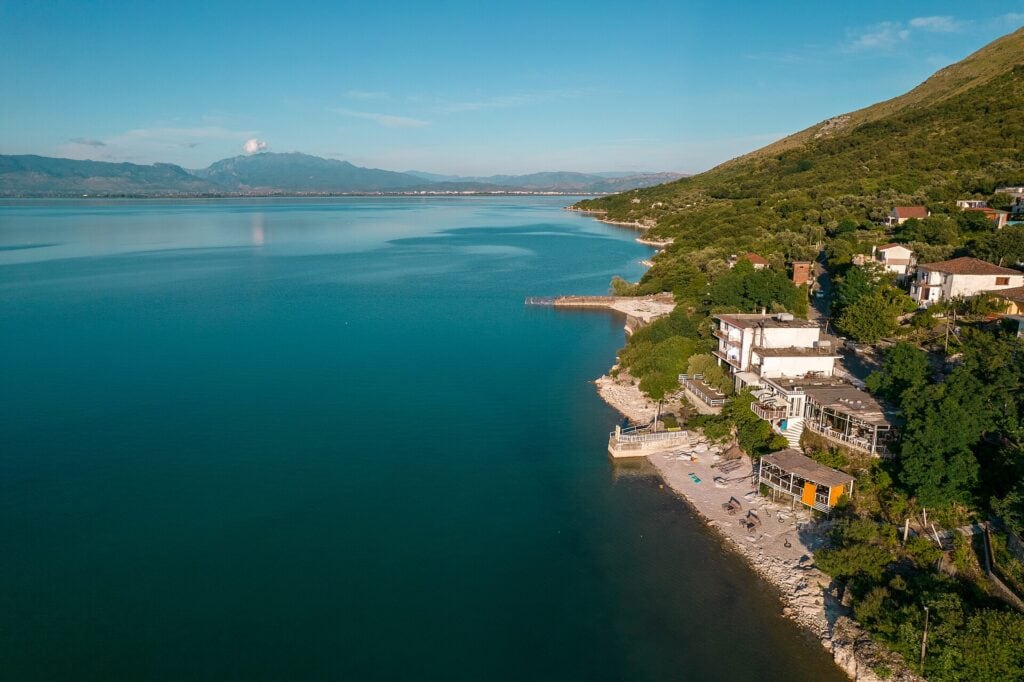
The classic outing is the road along the south-east shore from Shkodër to Shiroka and on to Zogaj. AKT presents Shiroka, Zogaj and Koplik as one route around the lake. In its description Shiroka is the village closest to the city, known for a lakeside promenade, restaurants serving fresh fish and a lively atmosphere. Zogaj lies a few kilometres further on and suits birdwatching, walking and quiet stays, with houses stepping down the slope to the water that look best at sunset. Koplik, further north, is a rural town that works as a gateway to the Albanian Alps.
Route description: AKT, Shirokë – Zogaj – Koplik, read 25 November 2026 (paraphrased from the Albanian page).
What people do there is not complicated:
- Eat fish. Most of the restaurants are family-run and sit on or just above the water. More on the food below.
- Swim. The shore is shallow and pebbly in places, and the water is warm in summer. Bring water shoes if you dislike stones.
- Cycle. The ride out from Shkodër is flat and the road is a natural fit for a bicycle in a city that already runs on them. I describe the city side in the Shkodër guide.
- Do very little. This is the honest answer. A long lunch, a walk along the water, a coffee, the drive back.
Without a car, a taxi from Shkodër is the simple way to reach Shiroka and Zogaj. I could not find an official bus timetable for the lake road, so agree the fare before you set off. For the wider picture on buses and cars in the country, see my guide to getting around Albania.
What to eat: tavë krapi and the lake menu
If you only eat one thing here, make it the carp. The national tourism site lists “Tavë Krapi (Shirokë/Zogaj)” as a dish in its own right. In its words it is a “pjatë simbol e zonës së Liqenit të Shkodrës”, a signature dish of the Lake Shkodra area. According to AKT, the fresh carp is baked in the oven with onion, tomato, peppers, parsley and vinegar, which gives it a mix of sour and sweet, and it is served mainly in the family restaurants of Shiroka and Zogaj.
Dish description: AKT, Tavë Krapi (Shirokë/Zogaj), read 25 November 2026.
Did you know?
The word tavë in Albanian means both the baking dish and what is cooked in it. So “tavë krapi” is simply “carp from the tavë”, and you will see the same word on menus for meat, vegetable and cheese dishes all over the country.
Two practical points. Menus on the lake change with what the fishermen bring in, so do not expect every fish on every day. And prices are not fixed by any list I can point you to, so check the menu before you sit down.
For the other side of Shkodër’s cooking, the town’s own dishes are covered in the city guide.
Boat trips
You can see the lake from the water, but I would not plan around fixed prices. Boats go out from the Shiroka and Zogaj side, and AKT lists canoeing and kayaking among the things to do on the lake. Beyond that, the details change from season to season, and I could not find a single official operator page with a current price, duration or timetable.
Here is what is safe to say, and what is not:
- Safe: boat tours of various lengths are offered by local operators from the Albanian shore, and kayaking and canoeing are part of what AKT lists for the lake.
- Not safe to quote: price, length, departure times and whether a particular boat takes more than a few people. Agree all of it on the pier before you get in.
My advice is plain: decide on the day, ask at the pier what is running, and agree the price and the length before you step on. If the weather turns, the boats will not go.
Day trips from Tirana
Want a day out of the city, planned for you?
Esther, our tour partner, plans day trips to Berat, Kruja, Durrës and Dajti Mountain, with certified local guides on site. Tell her your date and group size, and she replies personally, in English or German.
Birds and nature
This is a wetland, and the wildlife is the reason it is protected. The Ramsar listing is for aquatic ecosystems and waterbirds, and AKT says the lake’s ecosystem holds hundreds of species of plants and animals and names birdwatching among the activities. Zogaj in particular is described as suited to it.
Which birds you will see depends on the month. A pair of binoculars and early morning or late afternoon will do more than any guided plan.
If you are a keen birder, ask AKZM or the reserve’s administration whether there are staffed viewing points. I could not confirm any.
Mes Bridge and the Bunë river
Mes Bridge is not on the lake itself, but it belongs on the same day. It crosses the Kir river a few kilometres out of Shkodër. According to AKT’s Albanian page it is 108 metres long and 3.4 metres wide, has 13 stone arches of different sizes and shapes, and was built in 1768 by Mehmet Pasha Bushati to link the mountain villages with the city. AKT puts it about 8 km from Shkodër and gives no opening hours or ticket information.
Bridge dimensions and history: AKT, Ura e Mesit, read 25 November 2026.
The Bunë is the lake’s way out. AKT says the lake empties to the Adriatic through it. From Shkodër the river runs south-west towards the sea, and in its lower stretch it is the border with Montenegro. The coast at Velipojë is on the same side of the city, so lake, bridge, river and beach can sit on one map, even if not on one day.
Shkodër is the rare Albanian city where the lake, the mountains, the river and the sea all fit inside a single day’s drive.
If you are working out how much to fit in, my list of day trips from Tirana shows what else the north offers, and the Komani Lake day trip is the mountain-lake alternative: a long, dramatic ferry ride on the Drin instead of a flat, open lake.
Going on to Montenegro: Han i Hotit
If your trip continues north, the lake leads straight to the border. The main road crossing for travellers going towards Podgorica is Han i Hotit on the Albanian side, called Božaj on the Montenegrin side. A second crossing at Murriqan (Sukobin on the other side) exists nearer the coast. Both are listed as open in public references.
Border rules are the one thing I will not guess at. They change, and they depend on your passport and your vehicle. If you are driving a rental car, ask the hire company before you leave Albania whether you are allowed to take it into Montenegro and what extra insurance is needed.
For a short visit, you can also treat the lake as a loop and stay on the Albanian side. Many travellers simply return to Shkodër, then head to the mountains instead. My Theth day trip and the Valbona Valley piece pick up from there.
Best season
Summer for swimming, spring and autumn for everything else. That is my reading of the lake, not a measured fact, so treat it as a rule of thumb.
| Time of year | What it is good for |
|---|---|
| Late spring (May, June) | Cycling, walking, birdwatching, green shores |
| Summer (July, August) | Swimming and boats; hot, busier restaurants, book ahead at weekends |
| Early autumn (September) | Still warm enough to swim, fewer people, soft light for photos |
| Winter | Quiet; some places close, boats may not run, check before you go |
Whichever month you choose, check the weather: the lake can be calm and then grey and windy within an hour.
If you would rather go with a local guide, have a look at our tours page.
Frequently asked questions
Is Lake Shkodra the same as Lake Skadar?
Yes. Shkodra (or Shkodër) is the Albanian name and Skadar is the Montenegrin one. It is one lake, shared by the two countries.
How big is it?
About 368 km² in total, with about 149 km² in Albania, according to the National Tourism Agency. The surface varies with the season.
Can you swim in Lake Shkodra?
Yes, people swim from the Albanian shore around Shiroka and Zogaj in summer. Check local advice on the day, and do not swim alone or in bad weather.
What is tavë krapi?
Carp baked in the oven with onion, tomato, peppers, parsley and vinegar, a signature dish of the lake area according to AKT.
Is the lake protected?
Yes. The Albanian side is a managed nature reserve, part of a Ramsar wetland, and since June 2026 part of a UNESCO transboundary biosphere reserve, according to AKT and AKZM.
How do I get from Shkodër to Shiroka and Zogaj?
By car, bicycle or taxi it is a short trip along the lake road.
Can I cross into Montenegro from here?
Yes, there are road crossings nearby, including Han i Hotit. Check opening hours and entry requirements with the official border authorities before you go.
I think of the lake as the place where Shkodër slows down. The castle and the old bazaar make the city feel busy and historic, and then a short drive down the shore everything flattens into water and reeds and long lunches. Albania is changing quickly, and the lake road is one of the places where you can still feel what the north was like before the crowds arrived. Whether it stays that way depends on how carefully we treat it.
What do you think?
Have you been to Lake Shkodra, on either shore? Did you stay on the Albanian side, or cross over to Montenegro, and which would you pick again?
Featured photo: Zogaj on Lake Shkodra by DGA05, CC BY-SA 4.0, via Wikimedia Commons.
