
Key Takeaways
- Shkodra is one of Albania’s most underrated cities — flat, walkable, bicycle-friendly, with a serious theatre and literary culture the rest of the world hasn’t caught up with.
- A single night took in a sold-out play at the Migjeni Theatre, a packed pedestrian boulevard, the lit-up Cathedral of St. Stephen, and an old bazaar that comes alive after dark.
- A further Montenegro border crossing at Qafë Vranicë is planned but has no confirmed opening date — Hani i Hotit and Muriqan–Sukobin are the crossings that work today, both under an hour from the city.
- The camper van scene is expanding fast — Shkodra sits at the intersection of Lake Shkodra, the Albanian Alps, the coast, and the new northern border route.
- Give it two nights, not one. The city rewards time and wandering.
Table of Contents
- 7:30 PM — Curtain Call at the Migjeni Theatre
- 9:00 PM — The Boulevard That Never Slows Down
- 9:30 PM — A Cathedral, a Book Fair, and the North’s Untold History
- 10:00 PM — The Old Bazaar Comes Alive After Dark
- Next Morning — Working from a Café on a Quiet Street
- Why Shkodra Is About to Get Much Bigger
- Practical: How to Visit Shkodra
I’ve been coming to Shkodra for years. Not as regularly as I should, but often enough to notice something that occasional visitors miss — this city is quietly, confidently coming into its own.
My latest visit started with a phone call from my brother-in-law, Gent Bejko, an actor and theatre professional in Albania. He had written and directed Gomerët e Trojeve — The Donkeys of Troy — a dark comedy premiering at the Migjeni Theatre, Shkodra’s main cultural venue. I drove up from Tirana, and what started as an evening at the theatre turned into one of those unplanned nights that remind you why you love this country.
7:30 PM — Curtain Call at the Migjeni Theatre
The Migjeni Theatre sits near the centre of the city, understated from the outside in the way that everything in Shkodra is understated. Inside it’s a proper theatre — red curtain, elevated stage, rows filling up with locals who actually came to see a play, not out of obligation but out of genuine cultural appetite.
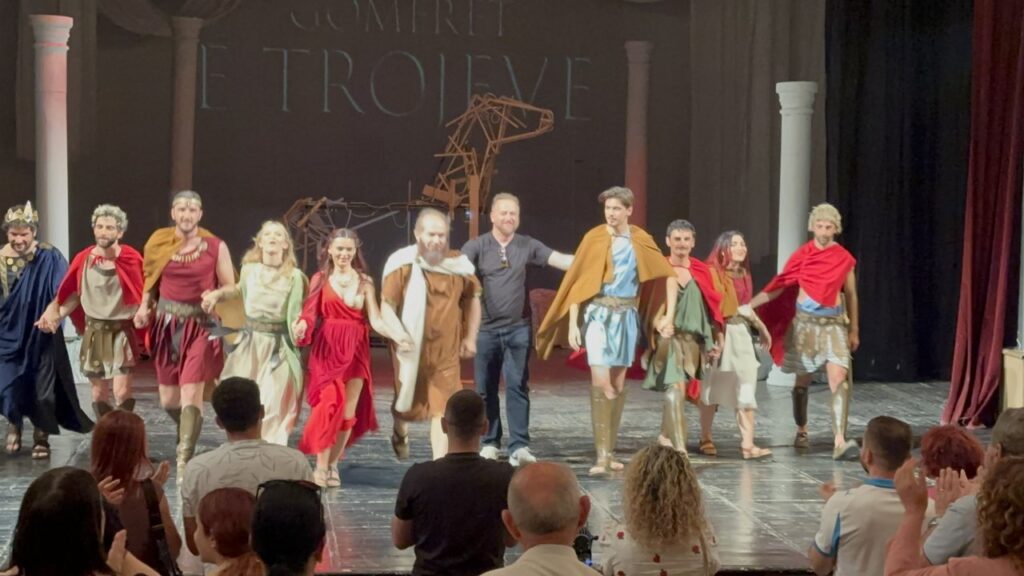
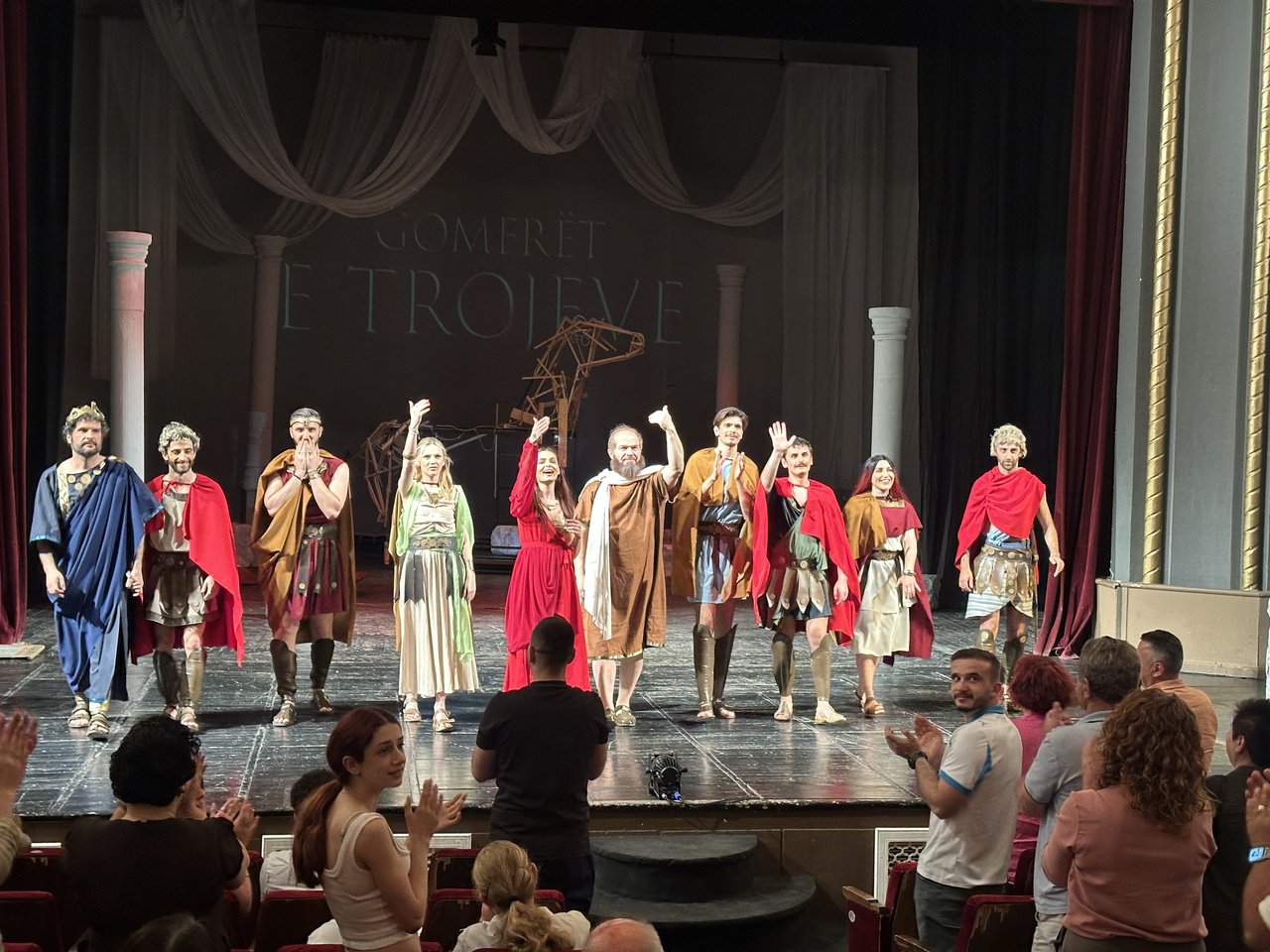
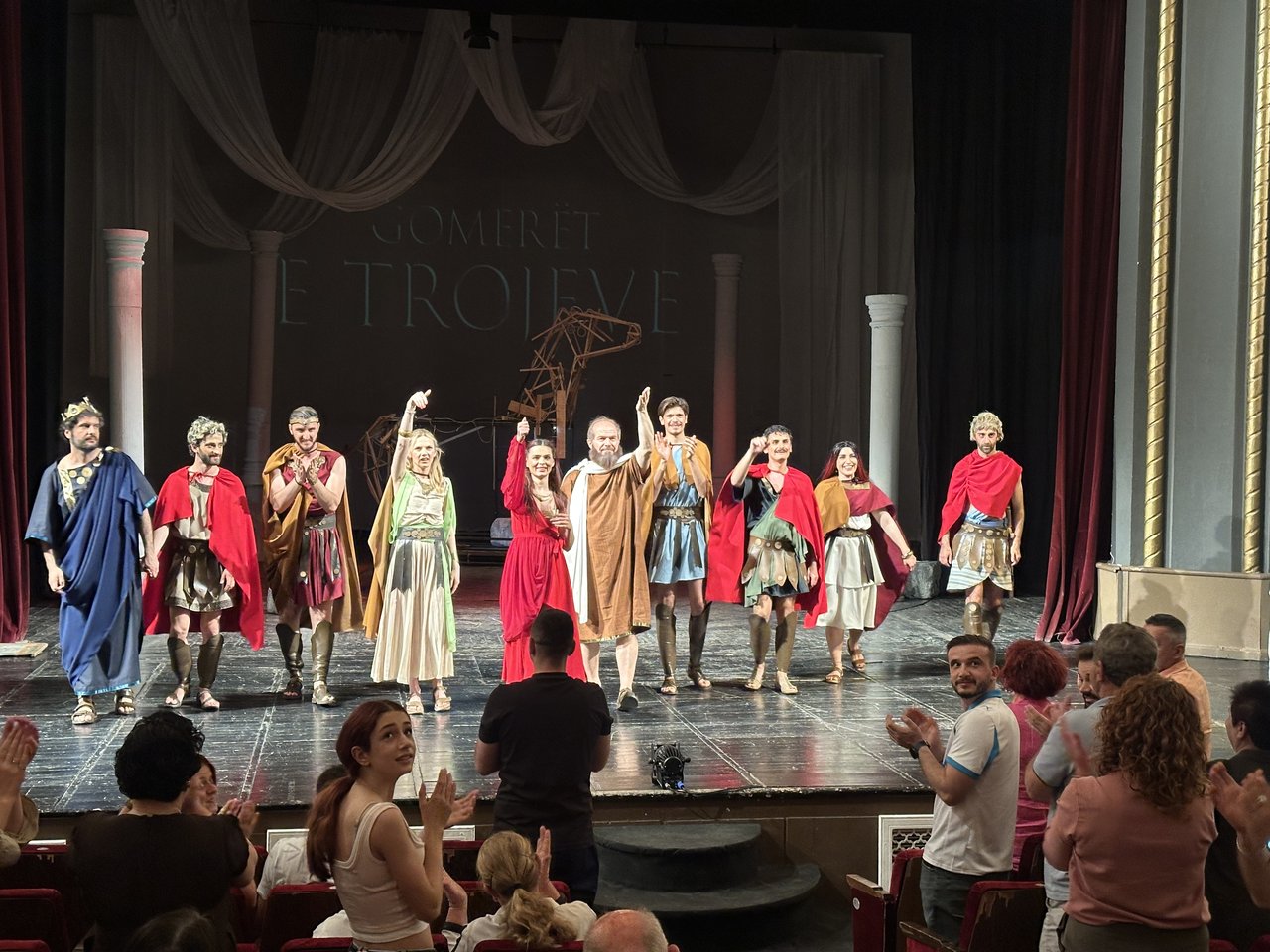
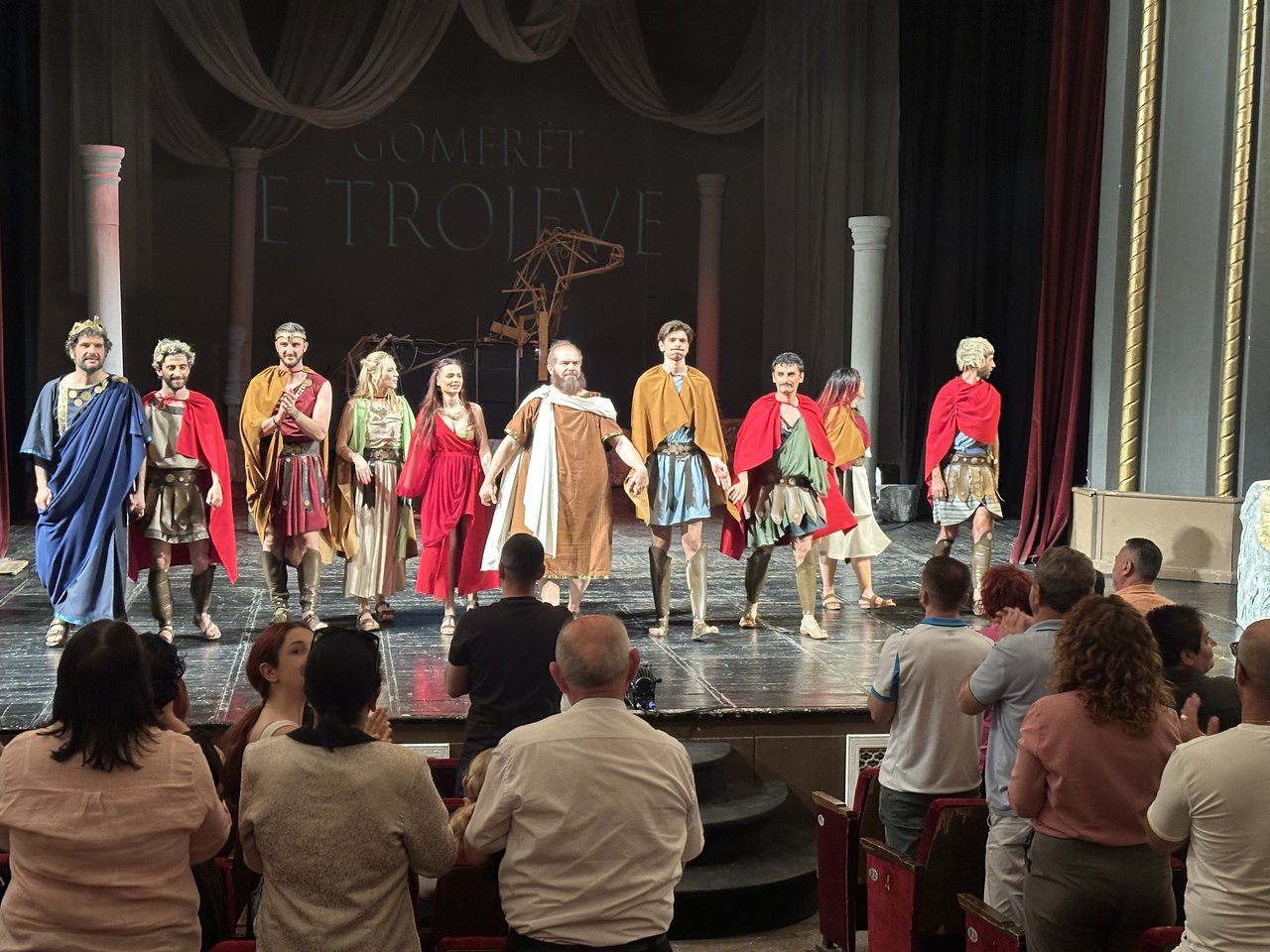
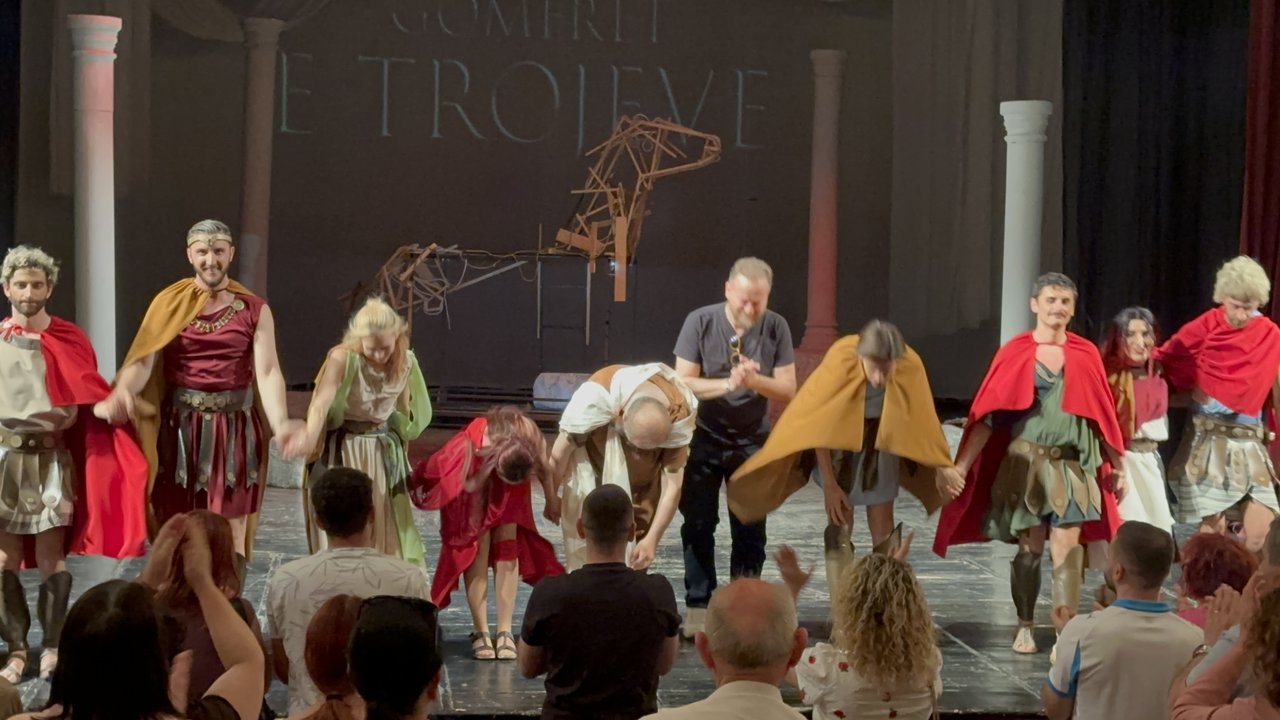
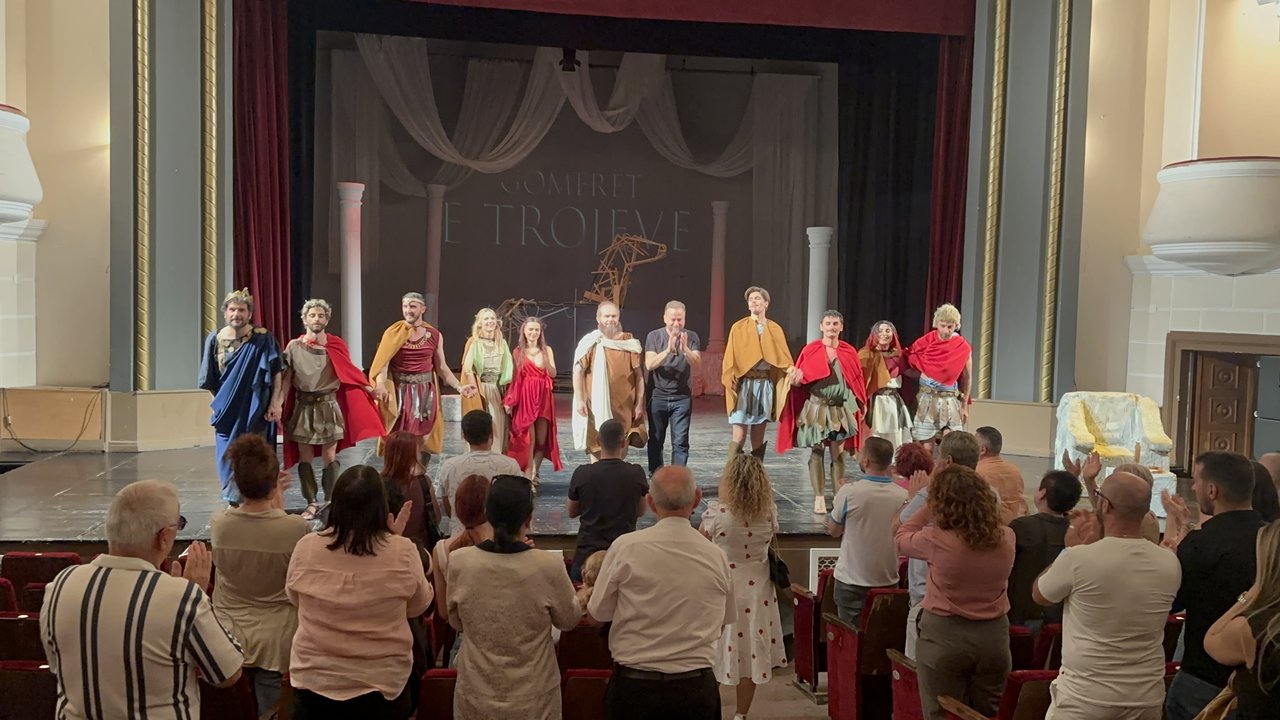
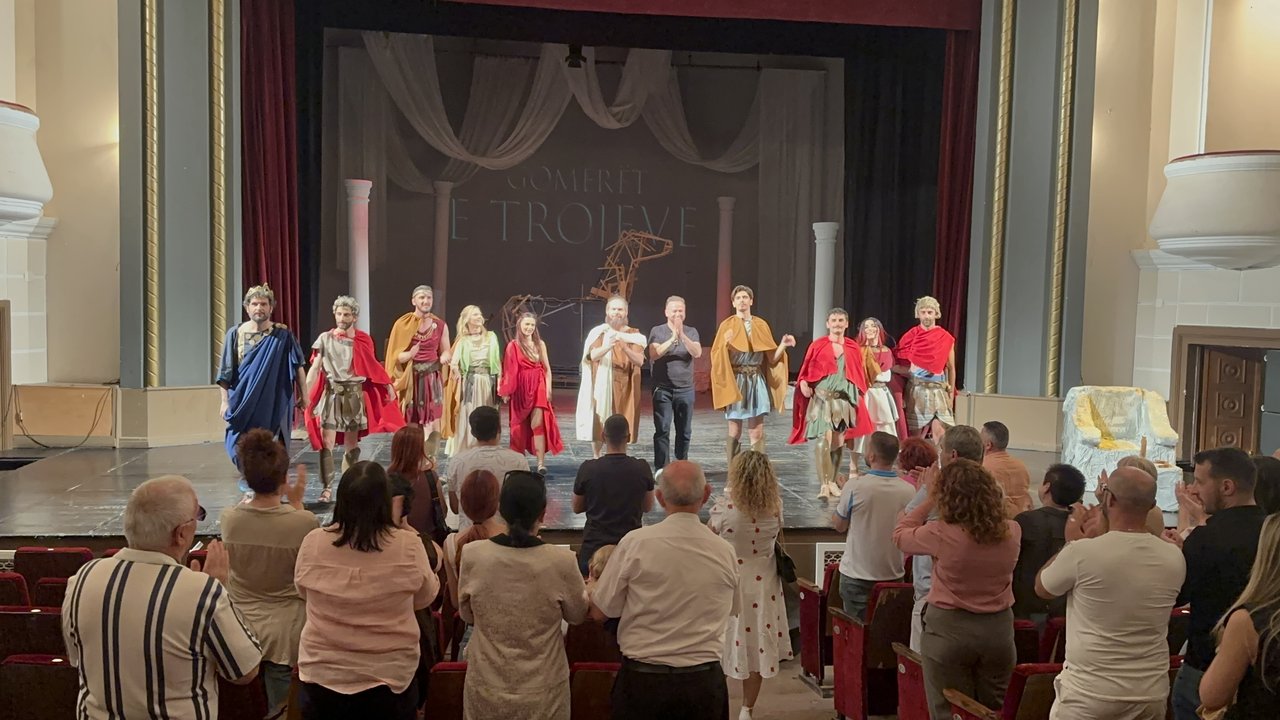
Scenes from Gomerët e Trojeve (The Donkeys of Troy) at the Migjeni Theatre, Shkodra.
Gomerët e Trojeve is a sharp piece of theatre. Gent reimagines the legend of the Trojan Horse as a dark comedy — swapping the hidden Greek warriors for “donkeys” to satirise a society that, as he puts it, has spent 35 years changing only its flags, portraits and faces while staying fundamentally the same. The 95-minute production blends ancient myth with modern Albanian reality through humour, irony and social satire, carried by a cast of well-known stage actors including Pjerin Vlashi, Jozef Shiroka and Lusi Bregu. When the curtain came down and the cast took their bow, the applause was long and real. It struck me then — this city has always taken culture seriously. The north of Albania has contributed disproportionately to Albanian literature, poetry, music, and history. Sitting in that theatre, watching a sold-out show, I felt that weight in a good way.
If you’re timing a Shkodra visit, check the Migjeni Theatre programme. Tickets are inexpensive and the experience is completely authentic.
9:00 PM — The Boulevard That Never Slows Down
Planning a Trip to Tirana?
Get my free Tirana in 48 Hours checklist with day-by-day itinerary, prices, and local tips.
Get the Free Checklist →After the show we walked out into the pedestrian boulevard — Bulevardi Skënderbeu — and I was immediately reminded why Shkodra evenings are something special.
The boulevard was packed. Not tourist-packed, locals-packed. Families, couples, teenagers, groups of older men at outdoor café tables, children weaving between everyone on bicycles. That’s the other thing about Shkodra: the bicycle is still a genuine form of transport here, not a lifestyle statement. You’ll see grandmothers cycling home from the market. You’ll see teenagers on old-frame bikes that look like they’ve been ridden since the 1990s. The flat terrain of the city makes cycling practical in a way that hilly Tirana never could.
Did you know?
Shkodra is widely considered Albania’s cycling capital. The city is almost entirely flat, has bike lanes on most major streets, and locals of every age — from schoolchildren to grandmothers — still use the bicycle as everyday transport.
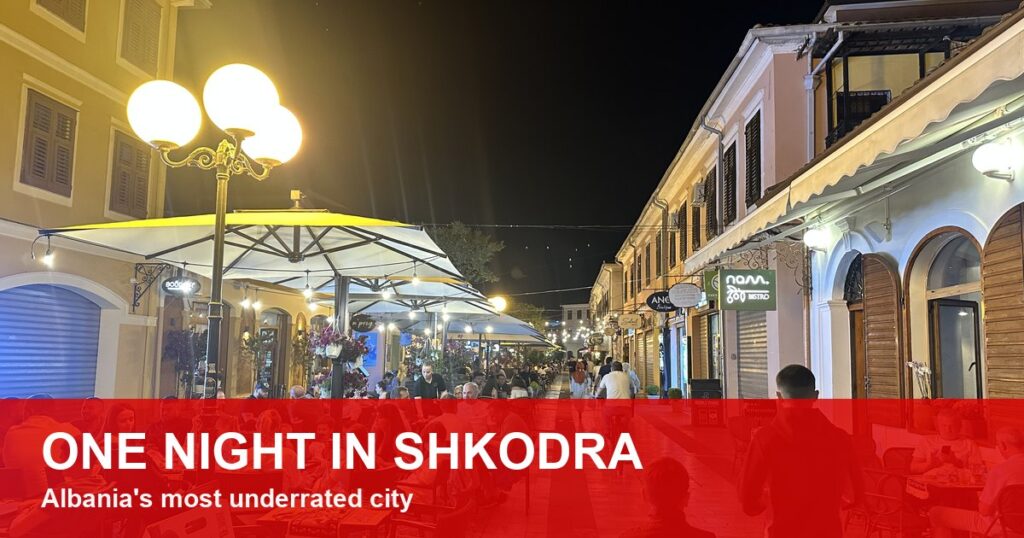
The buildings along the boulevard are low, mostly two and three storeys, a mix of old Austro-Hungarian-influenced facades and newer cafés that have been built with enough respect for the streetscape to not ruin it. String lights. The smell of coffee and byrek. The entire city seemed to be outside at 9 PM on a Tuesday.
9:30 PM — A Cathedral, a Book Fair, and the North’s Untold History
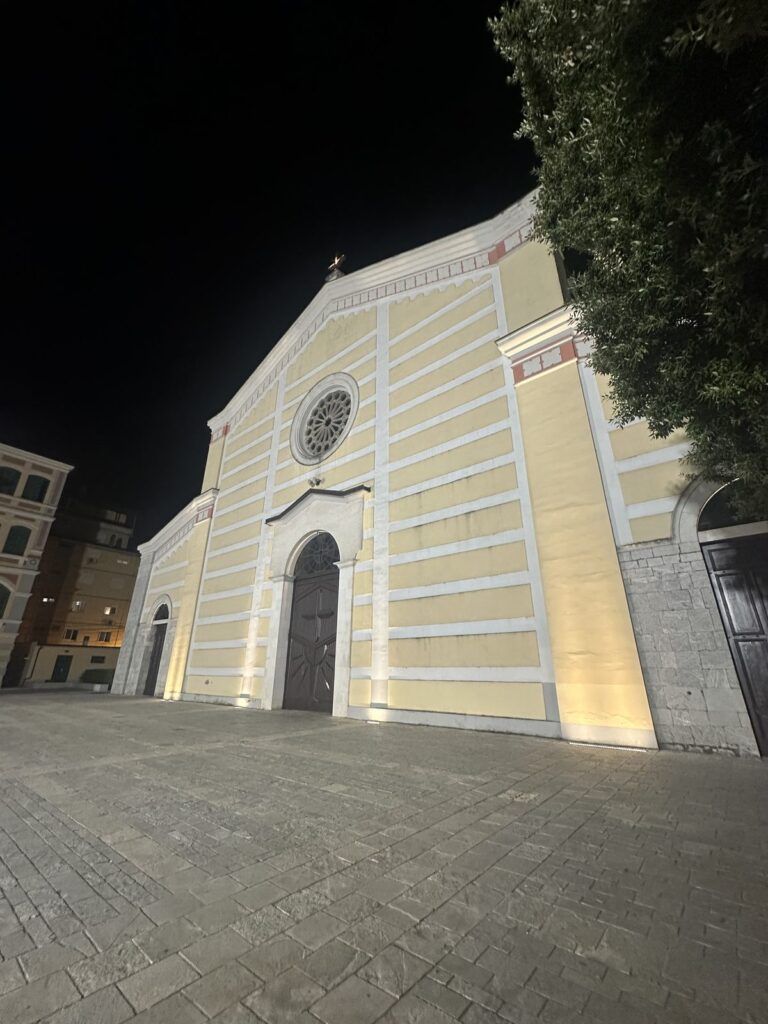
We walked a few minutes from the boulevard and passed the Cathedral of St. Stephen — Katedralja e Shën Shtjefnit — lit up gold against the dark sky. It’s an elegant building, classical proportions, a rose window above the entrance, stone walls that look like they’ve been standing for centuries (they have).
What stopped me was a poster on the wall. The city’s book fair programme, pasted up near the entrance, covered in names, dates, events. Writers, poets, historians. The contributions listed were almost entirely from the northern Albanian territories — Shkodra, Lezha, the Malësia, the lands across what is now the Montenegro border.
The cultural output of northern Albania is genuinely enormous and genuinely underappreciated by the rest of the country, let alone the world.
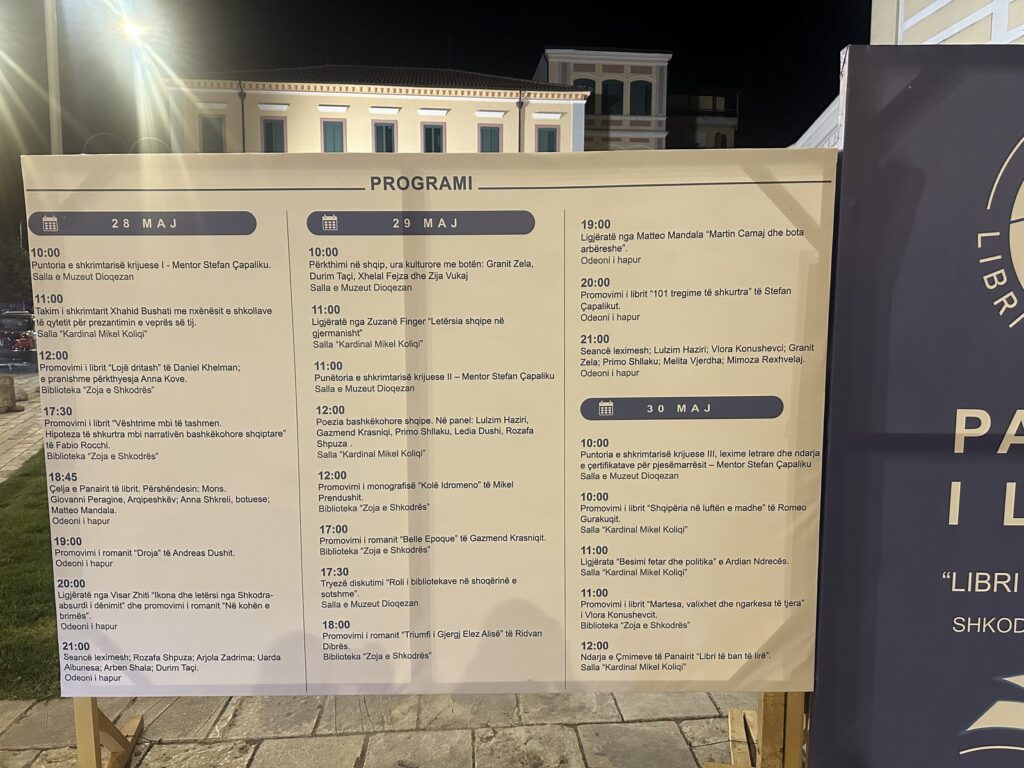
I stood there for a few minutes reading it. Albanian Gheg literature, the oral epics of the north, the role of Shkodra as the centre of early Albanian publishing (a thread that runs deep through Albanian history) — none of this is well-documented in English-language travel writing. There’s real material here for a visitor who comes with curiosity rather than just a checklist.
One day in Shkodra is not enough to scratch the surface. The city rewards time and wandering.
10:00 PM — The Old Bazaar Comes Alive After Dark
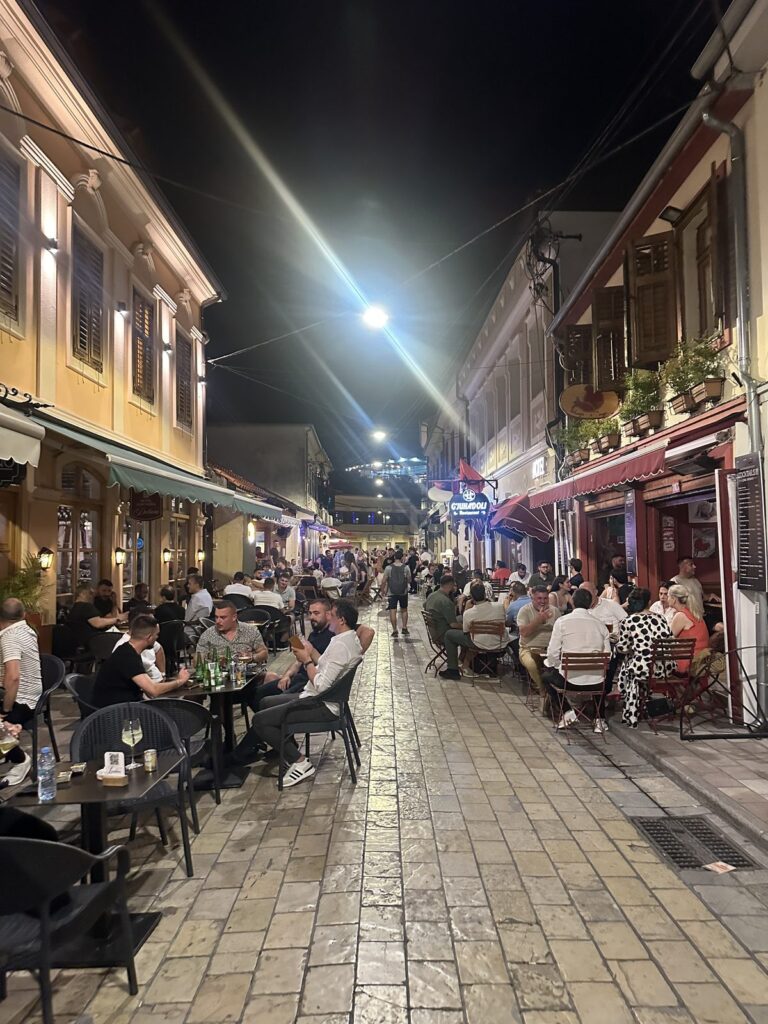
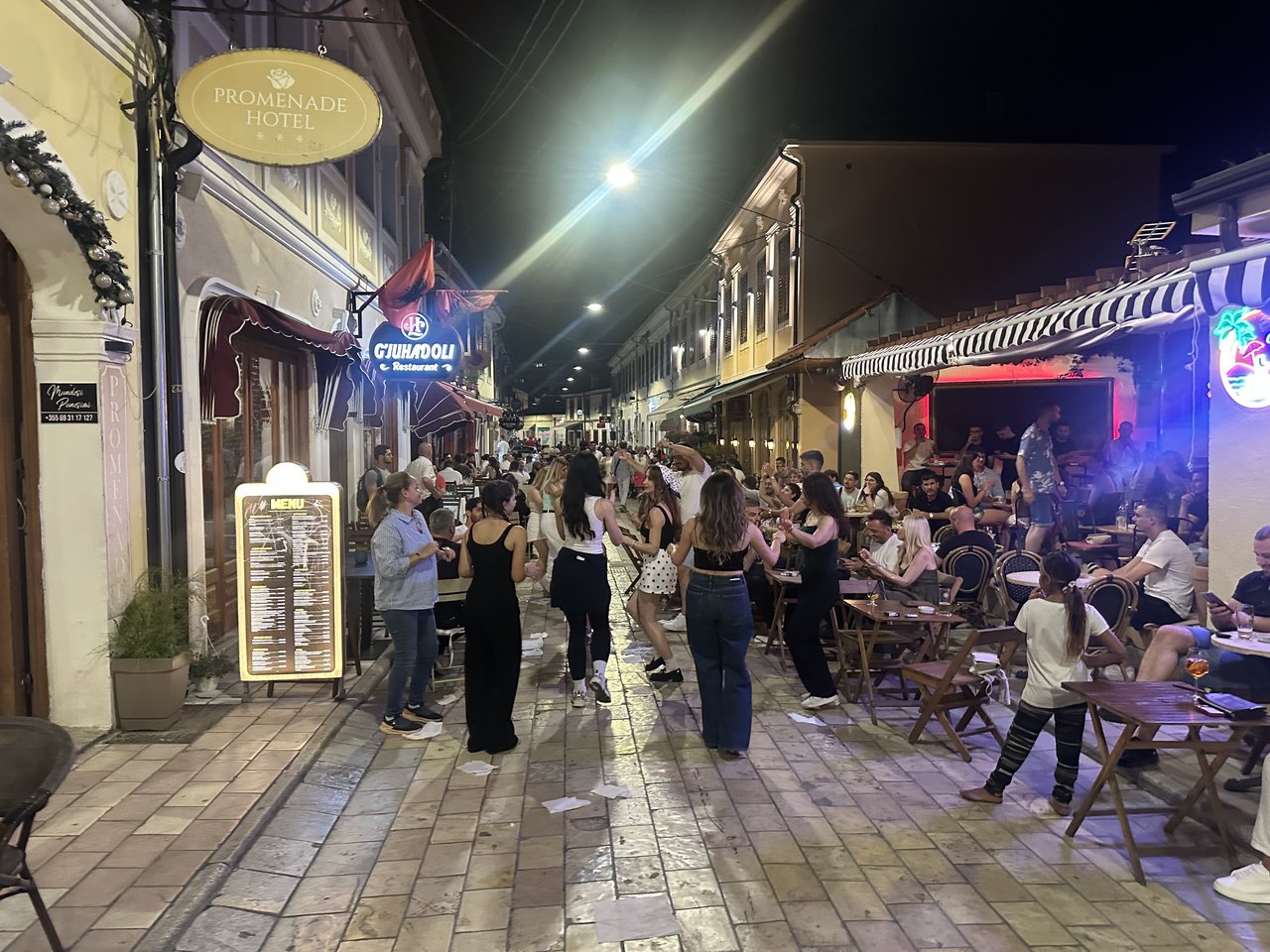
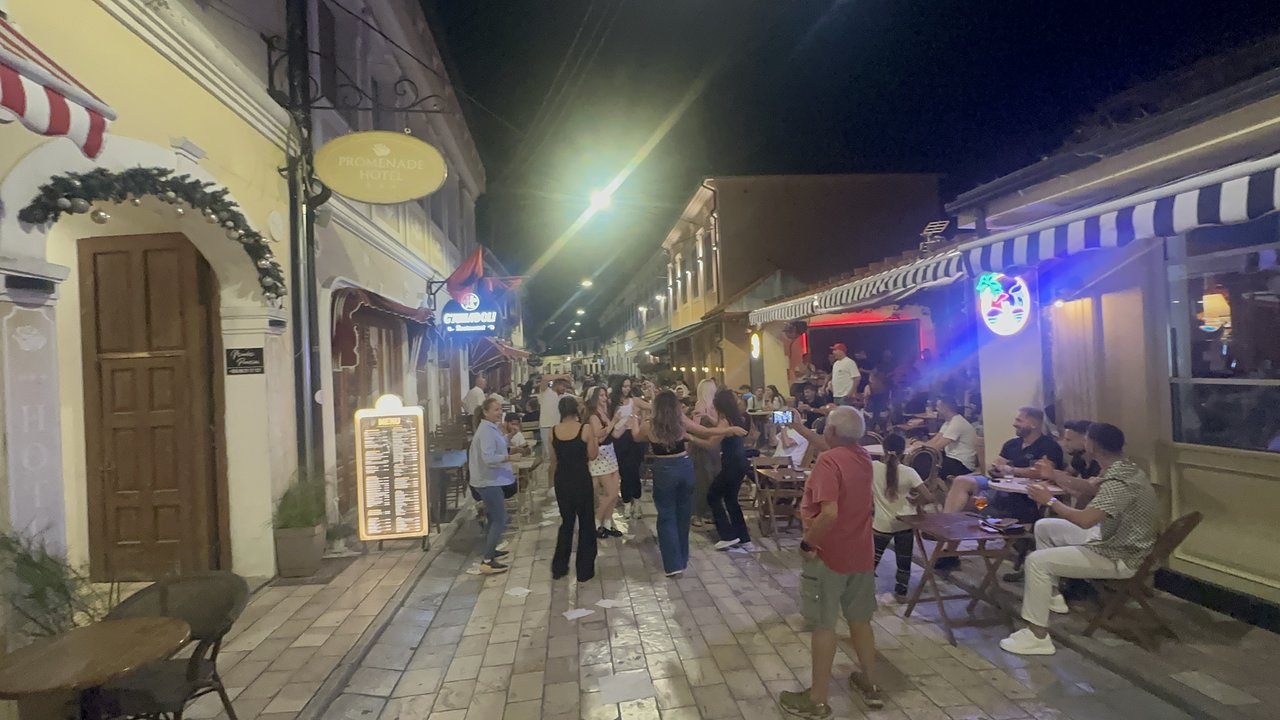
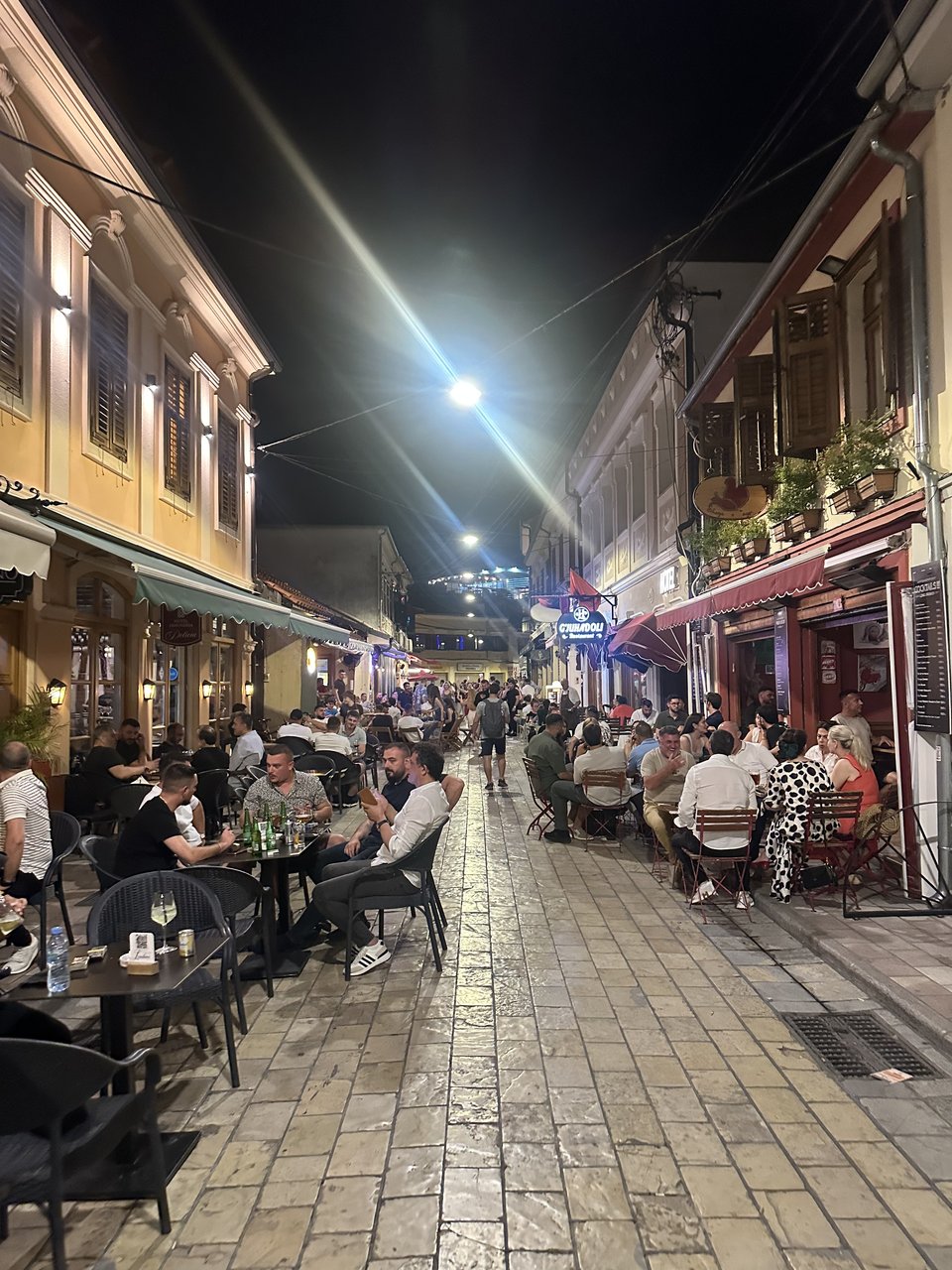
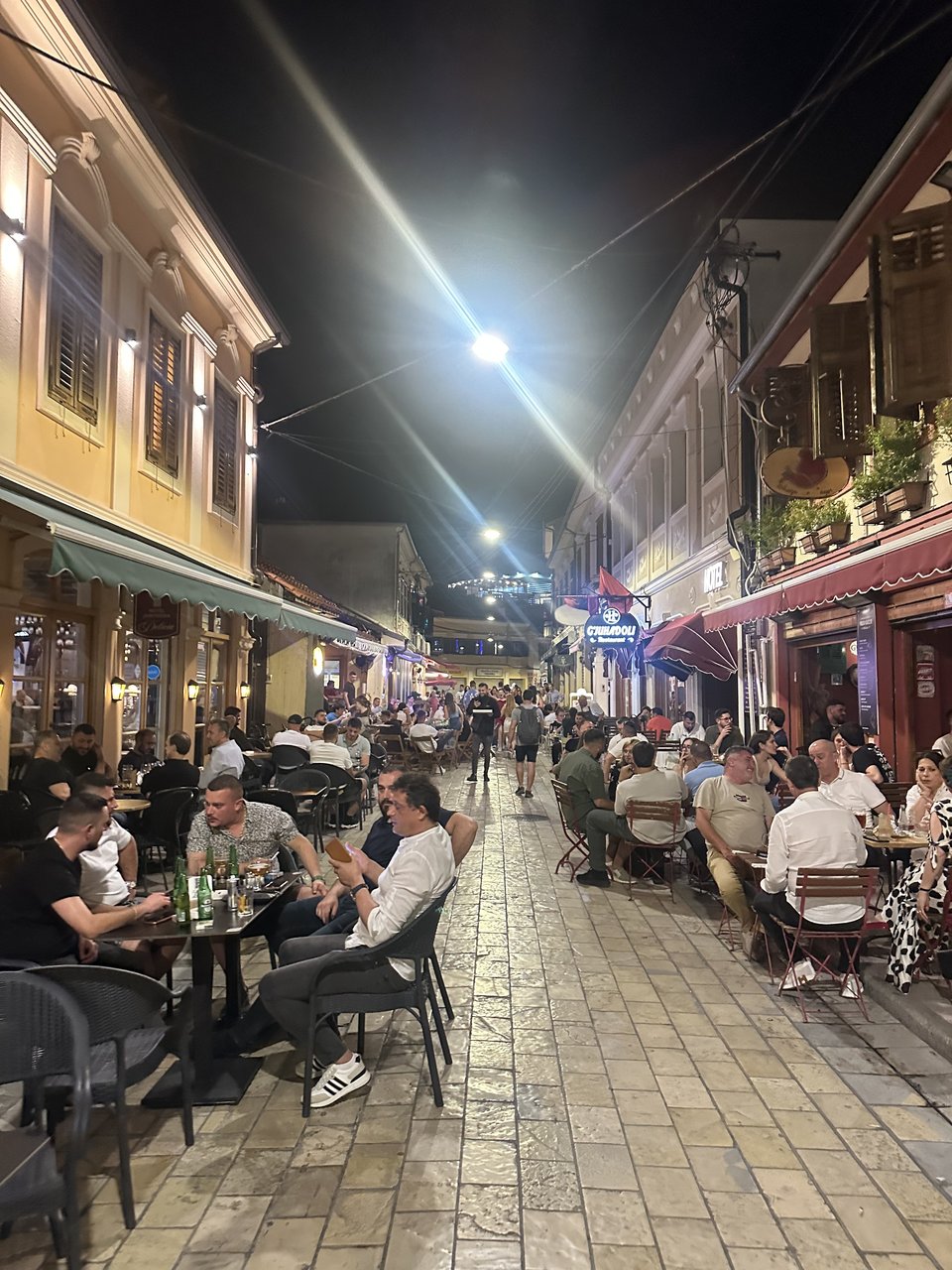
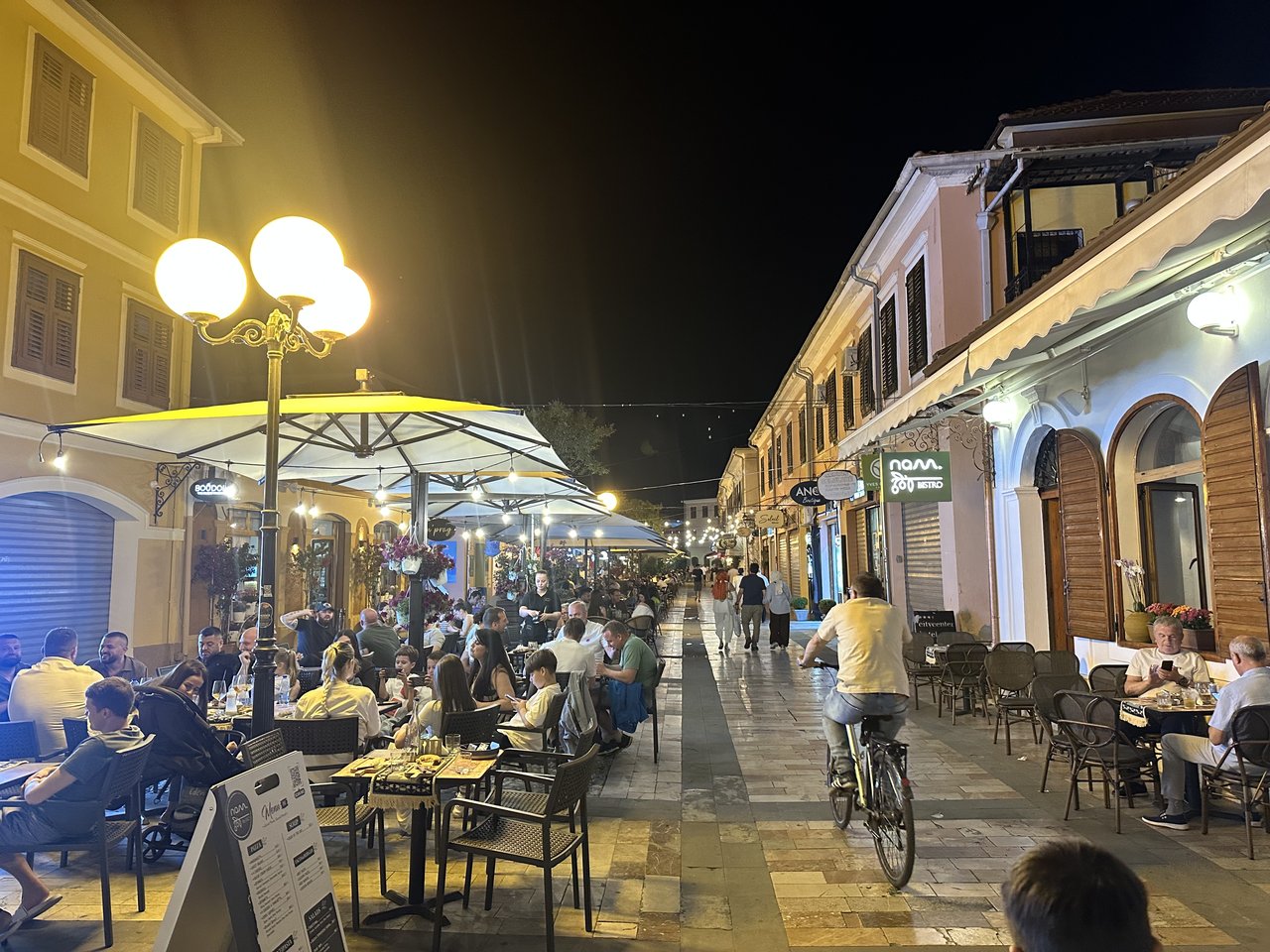
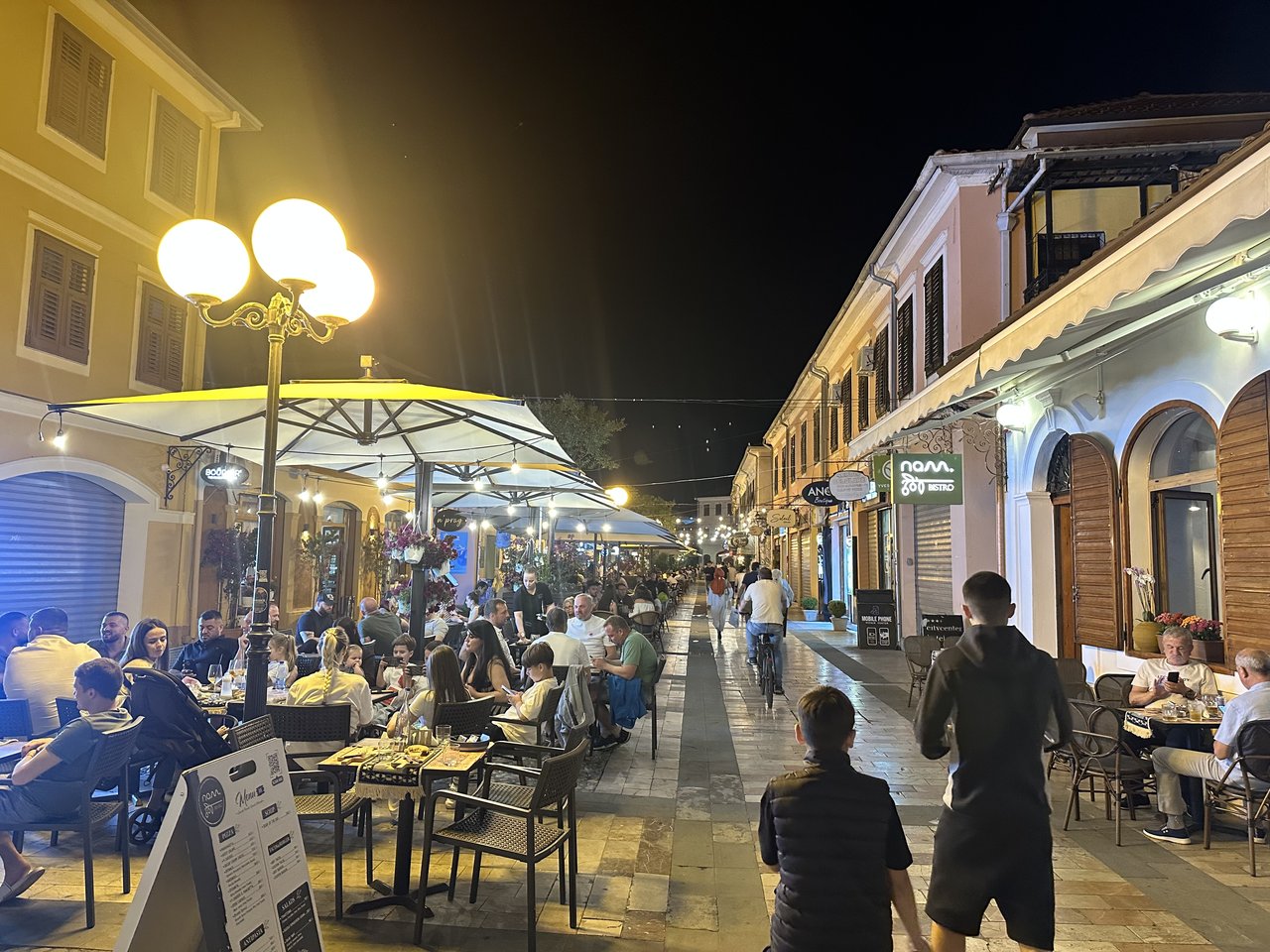
The old bazaar of Shkodra after dark — terraces full, music in every lane.
From the cathedral we wandered into the old bazaar streets — the narrow cobblestone lanes off the main boulevard that feel like a different century — the northern cousin of Tirana’s reborn Pazari i Ri. At 10 PM they were fully alive.
Music was coming from several directions. One bar had people dancing on the pavement outside, full traditional Albanian wedding music at a volume that carried halfway down the street. Another had a guitar set and a crowd that had spilled out of the terrace onto the cobbles. The buildings here are low and stone, some restored, some still showing their age. A bicycle was parked against a wall with a basket full of shopping.
This is the Shkodra that Instagram hasn’t fully discovered yet. Not because it isn’t photogenic — it absolutely is — but because the city doesn’t perform for cameras. It’s just living.
Next Morning — Working from a Café on a Quiet Street
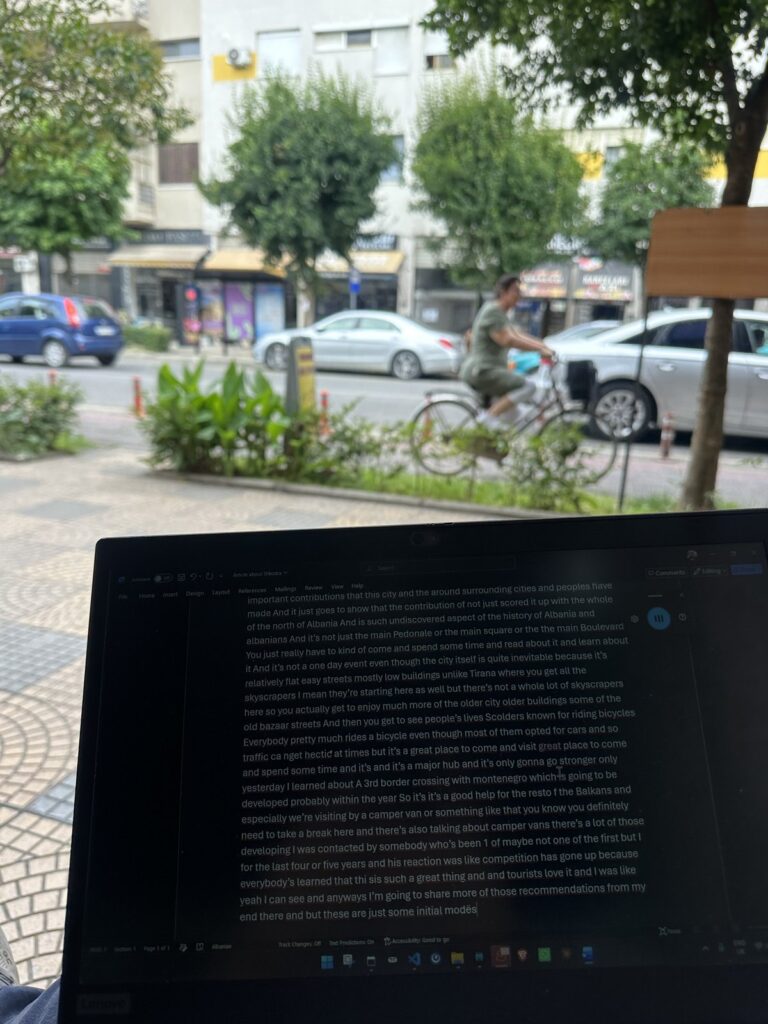
I stayed the night and worked from a café the next morning. Laptop out, coffee arriving without being asked for a second time, the street outside beginning its day at a pace that Tirana has largely forgotten.
Shkodra is a city where the morning starts slow and builds. Street vendors. A woman cycling with a child seat on the back. The sound of a door opening and a bakery beginning work. If you’ve been grinding through a week in Tirana and need somewhere to recalibrate, Shkodra does something to your nervous system that I can only describe as useful.
Why Shkodra Is About to Get Much Bigger
I’ll be honest: Shkodra has been on the verge of taking off for years, and I’ve been saying so for almost as long. What’s different now is that the infrastructure is actually catching up with the potential.
While I was there, I heard about plans for a third border crossing with Montenegro — a new route locals expected to open soon — though as of late 2026 a further crossing at Qafë Vranicë remains planned with no confirmed opening date. For travellers coming from the Balkans overland, this is significant. It positions Shkodra as a genuine gateway hub, not just a stop on the way north.
The camper van scene is also expanding faster than most people realise. I was contacted recently by someone who has been running camper van tours in Albania for four or five years. His take: competition has jumped because everyone has figured out that Albania works beautifully for slow overland travel, and tourists love it. (If you’re wondering about the practicalities, I’ve written an honest take on whether Albania is safe.) Shkodra sits at the intersection of several natural and cultural routes — Lake Shkodra, the Albanian Alps to the east, the Adriatic coast, and now the new Montenegro border.
If you’re planning a camper van trip through the Balkans, Shkodra deserves at least two nights. There are developing camper-friendly spots around Lake Shkodra and the wider area — and unlike some coastal spots that get overrun in summer, the lake-and-mountains landscape around Shkodra holds its character.
Practical: How to Visit Shkodra
This is the short version, aimed at one evening. For the full city guide — Rozafa Castle, the Marubi photography archive, the lake, the cycling, and using Shkodër as a base for the Alps — see our complete local’s guide to Shkodër.
| Detail | What to Know |
|---|---|
| Getting there from Tirana | Approx. 1.5–2 hours by car on the SH1 highway north. Furgons (shared minibuses) run regularly from Tirana’s Zogu i Zi terminal — see my guide to getting around Albania for the full rundown. |
| How long to stay | One full day minimum. Two nights to do it properly — boulevard, old bazaar, cathedral, a morning market, and the Rozafa Castle climb. |
| When to go | Late spring and early autumn are ideal. Summer gets hot but evenings stay pleasant. The cultural calendar runs strongest in the shoulder seasons. |
| For camper vans | Informal spots around Lake Shkodra suit overnight stays. Hani i Hotit and Muriqan–Sukobin are the two crossings that work today; a further one at Qafë Vranicë is planned but unconfirmed. |
Don’t miss:
- Rozafa Castle — hilltop fortress with views over the Drin and Buna rivers into Montenegro. Give it 2–3 hours.
- Lake Shkodra — the largest lake in Southern Europe, shared with Montenegro. The Albanian side near Shiroka is calm and undervisited. Good for camping, cycling, or just sitting.
- The old bazaar streets — especially at night.
- The Migjeni Theatre — check what’s on.
- Bike rental — Shkodra is flat and genuinely made for cycling.
A Final Thought
Shkodra has always been here, doing its own thing, mostly unbothered by the fact that the rest of Albania and the rest of the world hasn’t fully caught up with it. It has a theatre culture, a literary history, a bicycle culture, a nightlife that runs on coffee and community rather than spectacle.
The next time someone asks me where to go in Albania that isn’t Tirana or the Riviera, I’ll give them the same answer I’ve been giving for years: go to Shkodra, stay two nights, and let it show you what it is.
It will.
More from the blog: Best day trips from Tirana · Berat, the city of a thousand windows · Albania travel tips before you go
What do you think?
Have you been to Shkodra? What stood out for you — the bazaar at night, the cycling culture, the theatre scene? Drop a comment below.
Subscribe to monthly updates
Get honest Albania travel tips, local guides, and new posts straight to your inbox. No spam, unsubscribe anytime.
