
Key Takeaways
- Shkodër is northern Albania’s cultural capital — flat, low-rise and genuinely cyclable, with bike lanes on most main streets and a café culture that runs from morning to late.
- It is not a day trip. Two nights is the minimum that does it justice: Rozafa Castle, the Marubi photography archive, the old bazaar, the lake and the pedestrian boulevard each want real time.
- The Marubi National Museum of Photography holds the first photograph ever taken in Albania (1858) and around half a million negatives — the most important historical photographic archive in the country.
- From Tirana it is roughly 1.5–2 hours by car on the SH1, or a furgon from the Zogu i Zi terminal.
- It is the natural base for the Albanian Alps — Theth, Komani Lake and the Valbona valley all start from here — and two Montenegro border crossings sit within easy reach.
Table of Contents
- Why Shkodër Deserves More Than a Day
- Getting to Shkodër from Tirana
- Rozafa Castle
- The Old Bazaar and Rruga Kolë Idromeno
- Marubi: The Archive That Explains the North
- The North’s Under-Told Literary Heritage
- Lake Shkodra and the Mesi Bridge
- A City That Runs on Bicycles
- The Thing Nobody Warns You About: Shkodran Humour
- Where to Eat, Drink and Stay
- Using Shkodër as a Base for the North
- When to Go
- Practical Tips
- Frequently Asked Questions
By Elvis Plaku — Tirana native, blogging about Albania since 2004.
Written from repeated visits through 2026. Opening hours, prices and transport details change — confirm anything time-sensitive before you travel.
Let me be straight about my own position here: I am from Tirana, not Shkodër. I have been coming to this city for years — not as often as I would have liked — and I have never once left feeling I was finished with it. That is the honest starting point for this guide, and it is also the single most useful thing I can tell you about Shkodër. It is a city that does not give itself up on a first pass.
Most itineraries treat it as a stop: a castle photographed on the way to Montenegro, or a night before a bus into the mountains. That is a mistake, and this guide is my case for why. If you want the shorter, more atmospheric version — one evening, a theatre, a boulevard and a bazaar after dark — I have written that separately as One Night in Shkodra. What follows is the full guide: what to see, how to get there, and how to use the city as a base.
Why Shkodër Deserves More Than a Day
Shkodër is an ancient city, and that is not a tourist-brochure adjective — it is the reason the place feels different from anywhere else in Albania. Its history is a long record of a population working to hold on to its own character, and you can still feel that independence in how people carry themselves. Shkodrans are, to put it plainly, a fiercely independent lot.
Physically, it is the opposite of Tirana. Shkodër is relatively flat, the streets are wide rather than pinched, and the buildings are mostly low. A few taller ones have started going up, but nothing like the skyline my own city has grown. The practical consequence is that you actually get to see the older city: the nineteenth-century facades, the bazaar streets, the proportions the place was built with. In Tirana you look up at new towers. In Shkodër you look along old streets.
There is also a demographic shift worth understanding, because it changes the texture of a visit. The city has absorbed a lot of people from the surrounding region over recent decades. Some older residents will tell you, with feeling, that this has changed the town. Whatever you make of that, it means the Shkodër you walk into is a mix of people from across the north — and if you talk to them, you get a far richer picture of the whole region than any single town could give you.
Getting to Shkodër from Tirana
Planning a Trip to Tirana?
Get my free Tirana in 48 Hours checklist with day-by-day itinerary, prices, and local tips.
Get the Free Checklist →It is an easy trip, which is part of why so many people underrate the city — it is simple to pass through.
| Option | What to Know |
|---|---|
| By car | Roughly 1.5–2 hours north on the SH1. The most flexible option, and the one that makes the lake, the Mesi Bridge and the mountain valleys realistic in the same trip. |
| Furgon / minibus | Shared minibuses run regularly from Tirana’s Zogu i Zi terminal. No advance booking; they leave on a loose schedule or once full. See our complete guide to getting around Albania. |
| From Montenegro | The two crossings that matter for Shkodër are Hani i Hotit (Božaj) and Muriqan–Sukobin. Both put you in the city within the hour. |
On my last visit, locals were talking about an additional crossing into Montenegro opening up and what it would do for overland traffic through the north. I want to be careful here, because I have seen that story told as though it were settled: a further crossing at Qafë Vranicë, inland towards Tropojë, is on the books as planned, but I have not seen a confirmed opening date. Treat it as something to watch, not something to plan around.
What is unmistakably real is the camper-van traffic. Someone who has been running camper tours in Albania for four or five years told me his competition has multiplied, simply because everyone has worked out that this country suits slow overland travel. Shkodër sits where the lake, the Alps, the Adriatic and the Montenegrin border all meet, which makes it a natural stop for exactly that kind of trip.
Rozafa Castle
The castle is the one thing nearly every visitor does, and it earns its reputation. It sits on a hill southwest of the centre, and the view is the point: the Drin and Buna rivers below, the lake spreading north, and Montenegro beyond it. Give it two to three hours rather than the twenty minutes a tour bus allows — the site is bigger than it looks from the road, and the walk up is part of it.
Go late in the afternoon if you can. The light is better, the heat has gone out of the day, and you get the lake at its best.
The Old Bazaar and Rruga Kolë Idromeno
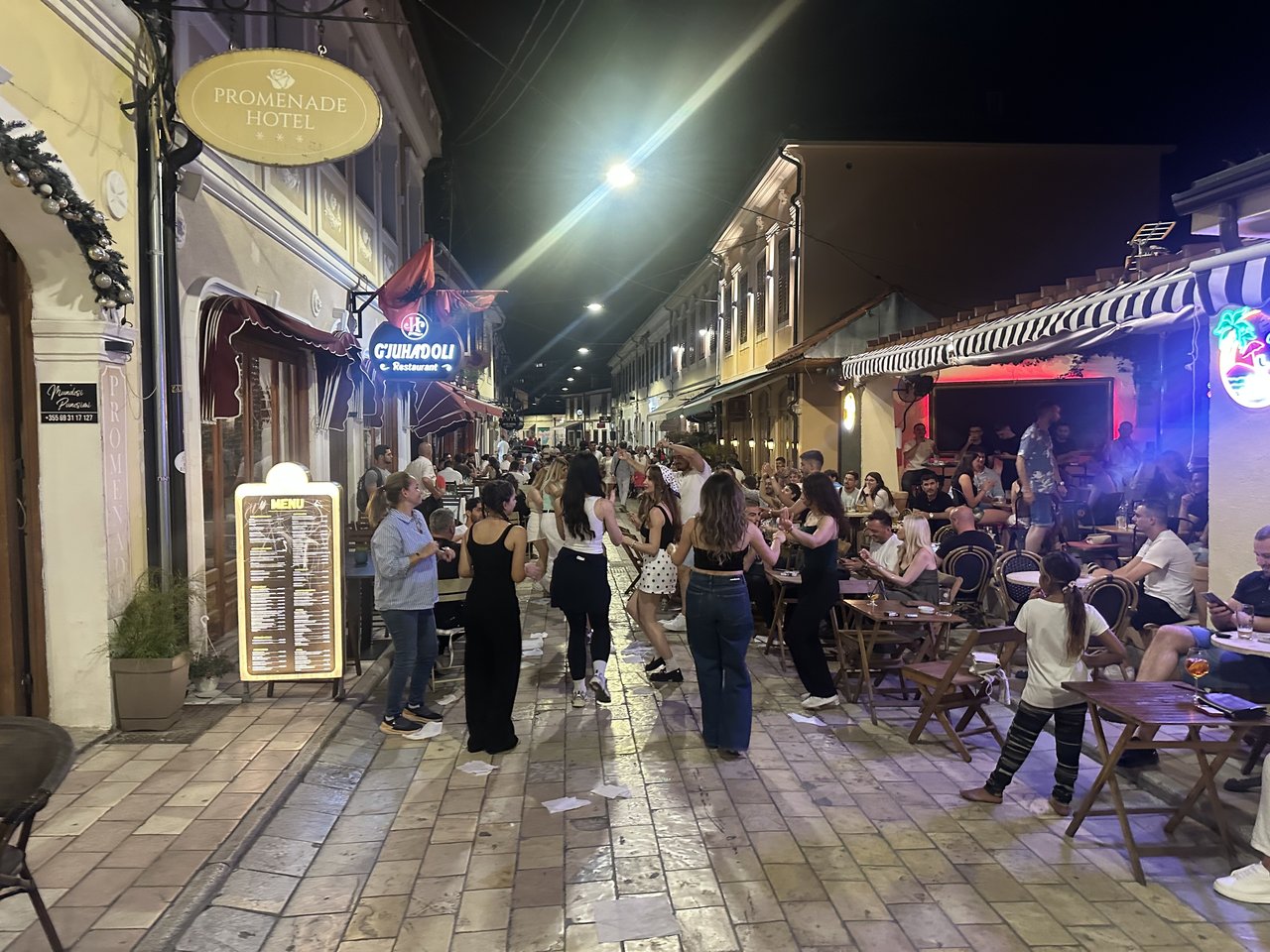
Rruga Kolë Idromeno is the pedestrian spine of the city, and the restored bazaar streets run off it. This is where you understand the scale of old Shkodër: shopfronts at human height, stone and shutters, and a width that was designed for people rather than cars.
Walk it twice — once in daylight to actually look at the buildings, and once in the evening when the whole city comes out. The evening version is a genuine social institution rather than a tourist event, and it is the subject of the companion piece to this guide.
Marubi: The Archive That Explains the North
If you do one indoor thing in Shkodër, do this. The Marubi National Museum of Photography is not a provincial collection of old prints. It is the most important historical photographic archive in Albania and one of the most significant in the Balkans.
The studio was founded in Shkodër in 1856 by Pietro Marubbi, an Italian painter and photographer who settled here. Over three generations, into the 1950s, the Marubi family photographed Albanians — their faces, clothes, towns, weddings, funerals and politics — at a time when almost nobody else was. The archive runs to hundreds of thousands of negatives, including glass plates, and takes in roughly half a million more from other Albanian photographers. The museum in its current form opened in 2016.
Did you know?
The first photograph ever taken in Albania was made by Pjetër Marubi in 1858 — and it is held here, in Shkodër. The same studio photographed the delegation of the Sanjak of Shkodra at the League of Prizren in 1878. When people say the north is central to Albanian history rather than peripheral to it, this archive is the evidence.
The North’s Under-Told Literary Heritage
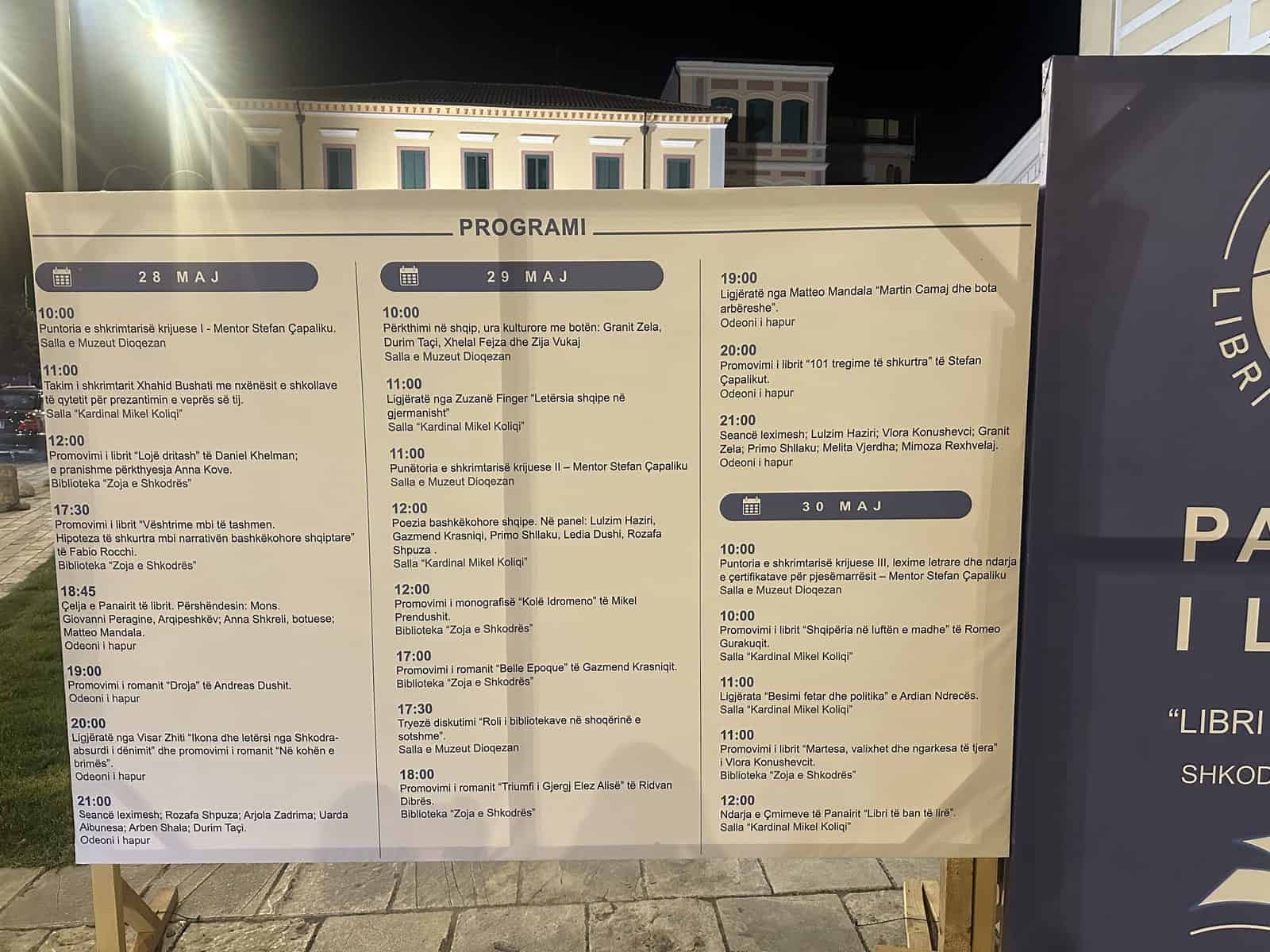
Here is the moment that changed how I think about this city. I was walking past the cathedral with no particular plan when I saw the programme for Shkodër’s book fair posted up outside. I stopped and read the whole thing — and it was dense with names, dates and contributions from this city and the towns around it. Writers, scholars, clergy, printers. A literary and intellectual record stretching back generations.
Almost none of it is known outside Albania, and a fair amount of it is not well known inside Albania either. The contribution of Shkodër and the wider north to Albanian letters is one of the genuinely under-told parts of our history. If that interests you, the story of how much of this material survived at all is worth reading: see the Canadian who gave us back our own books.
This is also the clearest argument against a day trip. You cannot read a city’s intellectual history off a castle wall. You have to be here long enough to notice a poster.
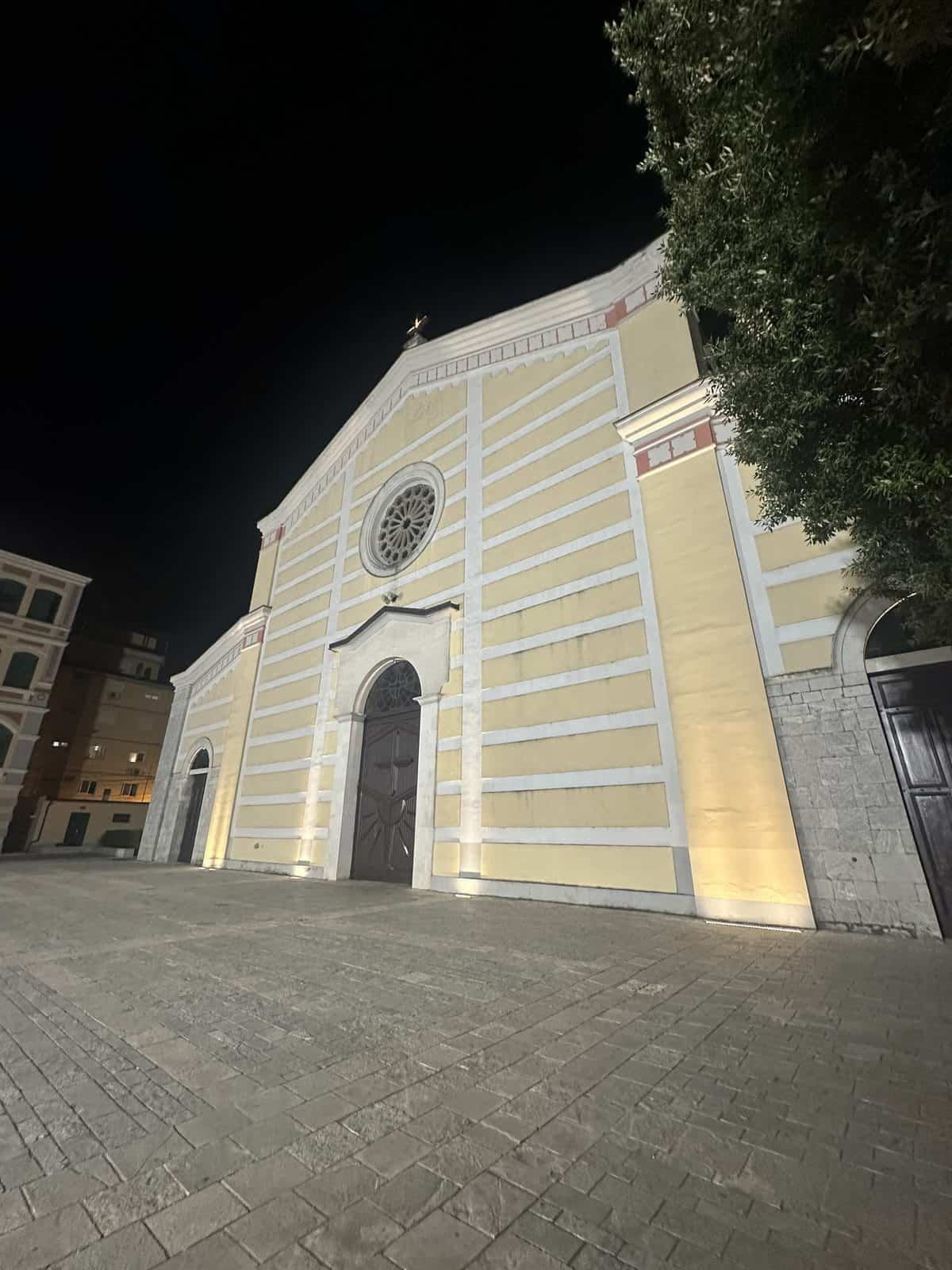
Shkodër is unusual in Albania for how plainly its religious history is written into the cityscape — the cathedral, the Orthodox Cathedral of the Nativity and the Ebu Beker Mosque all within a short walk. For the wider context, our guide to UNESCO sites in Albania covers how this heritage is formally recognised.
Lake Shkodra and the Mesi Bridge
Lake Shkodra — Skadar, on the Montenegrin side — is the largest lake in Southern Europe, and the border runs through it. The Albanian shore around Shiroka is calm and noticeably undervisited: good for a swim, a slow lunch, a cycle, or doing nothing at all. Boat trips run from the Albanian side in season.
A short way out of town, the Mesi Bridge (Ura e Mesit) is an Ottoman-era stone bridge over the Kir river and one of the most photographed structures in the north for good reason. It takes under half an hour to reach and pairs naturally with a drive towards the mountains. Further up that road, Boga and its waterfall mark where the Alps properly begin.
A City That Runs on Bicycles
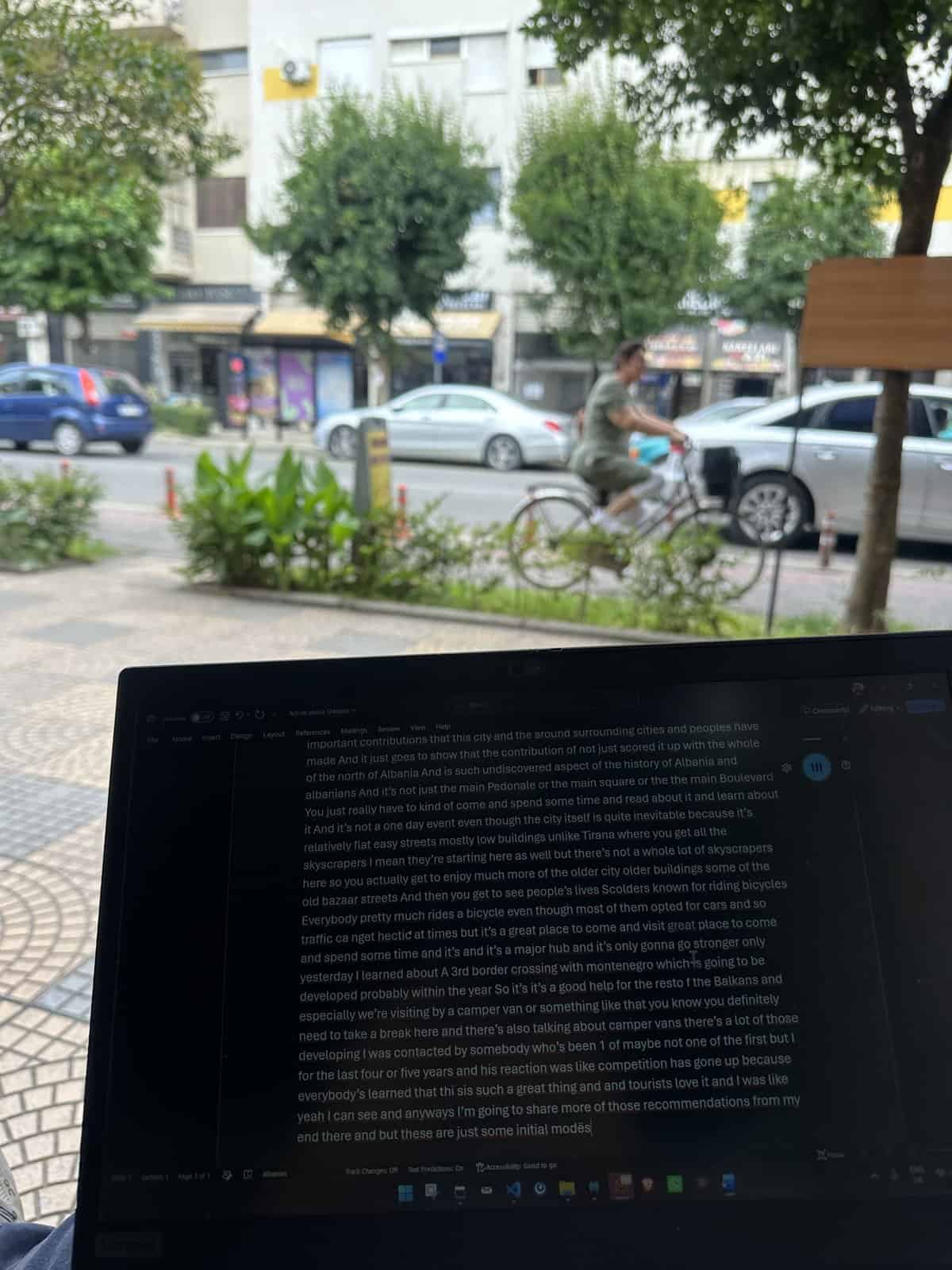
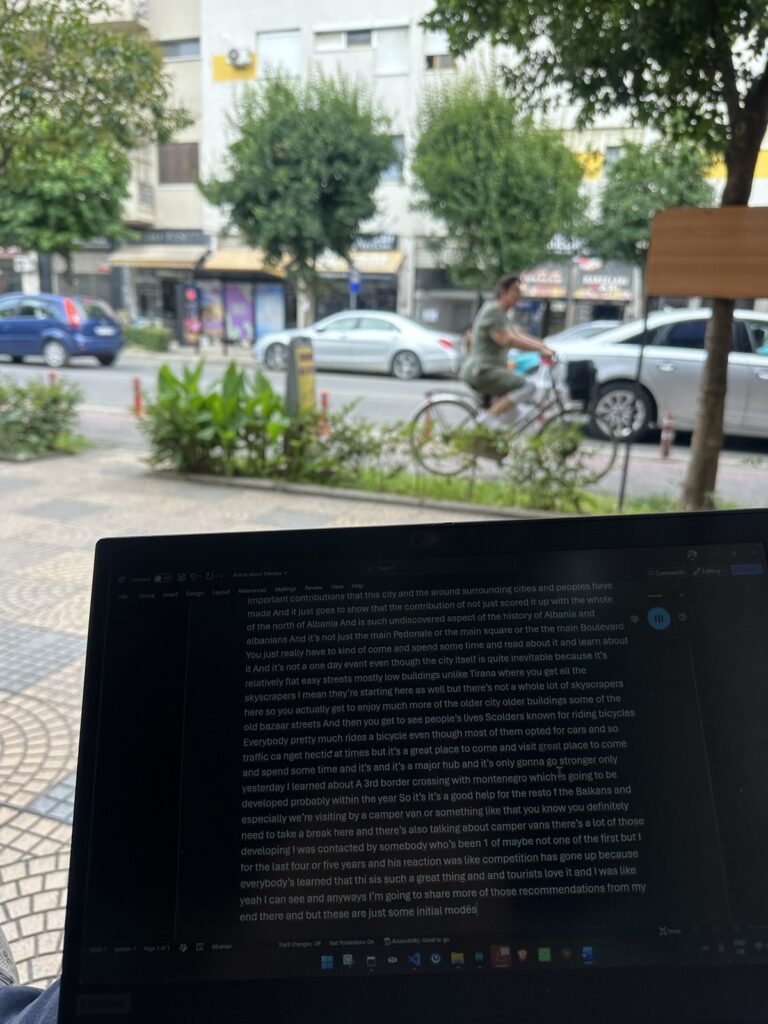
Shkodrans are known across Albania for riding bicycles, and it is not a cliché. Practically everyone rides. The city is flat, the main streets are wide, and there are bike lanes almost everywhere — a combination that exists nowhere else in the country at this scale.
Rent one. It is the correct way to see the city, and it puts the lake shore within comfortable reach. One honest caveat: plenty of people have switched to cars in recent years, and traffic at peak times can get hectic in a way the bicycle reputation does not prepare you for. Ride confidently and assume you have not been seen.
The Thing Nobody Warns You About: Shkodran Humour
This city is funny. Shkodrans have a long-standing reputation as the wits of Albania — a number of the country’s best-known comedians came out of this town and the area around it — and the humour is still there in ordinary conversation, dry and fast and often at their own expense.
I got the clearest demonstration of it at the theatre. My brother-in-law, who works in Albanian theatre, was in a comedic production here, and what struck me was how thoroughly he wove specifically local humour — Shkodran jokes, regional references — through the piece. The audience was completely with it. You could hear that the city recognised itself.
The everyday version of this is that people still know each other. Despite being a sizeable city, Shkodër behaves like a much smaller one: neighbours greet each other by name, cyclists wave as they pass, conversations happen across the street. That extends to visitors with real warmth. It is, more than any single monument, what makes the place worth two nights.
Where to Eat, Drink and Stay
Shkodër’s café culture is the main event, running from early morning to late at night, and sitting in it is a legitimate way to spend an afternoon. A few places that come up consistently and appear on our map of the city — check current hours before setting out, because this is a city where places change hands:
- Tradita G&T — the best-known traditional option in town, in a restored historic building, and the usual answer when someone asks where to eat northern Albanian food.
- San Francisco Restaurant — a long-running local favourite rather than a visitor-facing one.
- Café Amsterdam — a reliable spot to sit for an hour and watch the bicycles go past.
- Hotel Colosseo — the established central hotel, convenient to the boulevard.
- Mi Casa es Tu Casa — the hostel most backpackers heading into the Alps end up in, and a good place to find others going the same way.
For what northern Albanian cooking actually consists of, and how it differs from the south, our Tirana restaurant guide covers the national picture.
Using Shkodër as a Base for the North
This is the strategic case for the city, and it is the one most itineraries miss. Shkodër is the gateway to the Albanian Alps. Almost every serious trip into the north starts here:
- Komani Lake — the ferry through the gorge, one of the most spectacular journeys in the Balkans. Shkodër is the practical launch point.
- Theth — the classic Alps village. Our honest assessment of whether it works as a day trip is worth reading before you commit.
- The Valbona valley — usually reached via Komani, and more rewarding with a night at each end.
- Boga and the Kir valley — the easiest taste of the mountains, close enough for a half day.
Doing any of these from Tirana means long days and a lot of driving. Doing them from Shkodër means you are already there. For how these fit a wider itinerary, see our guide to the best day trips from Tirana.
When to Go
Late spring and early autumn are the sweet spot: comfortable daytime temperatures, the lake still warm enough in September, and the mountain roads open. High summer is hot, though the evenings stay genuinely pleasant and the boulevard is at its liveliest. The cultural calendar — theatre, the book fair, concerts — runs strongest in the shoulder seasons, which is another argument for May, June, September or early October.
Winter is quiet and often wet. The city still works, the cafés are still full, but the mountains largely close to casual visitors.
Practical Tips
- Two nights minimum. One day gets you the castle and a walk. It does not get you the city.
- Rent a bicycle on your first morning. It changes the scale of everything, including the lake.
- Carry cash. Cards work in the larger places, but the bazaar, small cafés and furgons run on lek.
- Check what is on at the Migjeni Theatre. It is a real theatre with a real local audience, not a tourist attraction.
- Talk to people. This is the single highest-return thing you can do here, and the city makes it easy.
- If you are driving to Montenegro, confirm your rental’s cross-border paperwork in advance. Our honest take on whether Albania is safe covers driving conditions too.
Frequently Asked Questions
Is Shkodër worth visiting?
Yes — and worth more time than most itineraries give it. It has the country’s most important photographic archive, a serious theatre and literary culture, an Ottoman-era bazaar quarter, the largest lake in Southern Europe on its doorstep and the Albanian Alps an hour away. The common mistake is treating it as a stop rather than a destination.
How many days do you need in Shkodër?
Two nights is the realistic minimum: one day for the city itself — castle, bazaar, Marubi, the boulevard in the evening — and one for the lake, the Mesi Bridge or a push towards the mountains. If you are using it as a base for Komani or Theth, add a night for each.
How do you get from Tirana to Shkodër?
Roughly 1.5–2 hours north by car on the SH1, or a furgon from Tirana’s Zogu i Zi terminal, which runs regularly without advance booking. Driving gives you the lake, the Mesi Bridge and the mountain valleys in the same trip.
Is Shkodër good for cycling?
It is the best city in Albania for it. Flat, wide streets, bike lanes on most main roads, and a genuine local cycling culture. Rent one. Be aware that car traffic has grown and can be assertive at peak hours.
What is the Marubi museum?
The Marubi National Museum of Photography holds the archive of the Marubi family, who photographed Albania across three generations from 1856. It includes the first photograph ever taken in Albania, from 1858, and hundreds of thousands of negatives. It is the most important historical photographic collection in the country.
Can you visit Shkodër from Montenegro?
Easily. Hani i Hotit (Božaj) and Muriqan–Sukobin both put you in the city within about an hour, which is why Shkodër works well as a first or last stop on a Balkans overland trip. A further crossing at Qafë Vranicë is planned but has no confirmed opening date.
Is Shkodër a good base for the Albanian Alps?
It is the natural one. Komani Lake, Theth, the Valbona valley and the Kir valley are all materially easier from Shkodër than from Tirana, and staying here turns punishing day trips into reasonable ones.
Some place links are affiliate links — if you book through them we may earn a small commission at no extra cost to you.
Tap any place to zoom to it, then “Open in Google Maps” for directions and reviews. Exploring more of the country? See the full interactive map of Albania.
What do you think?
Have you been to Shkodër — or do you live there? What would you send a first-time visitor to that is not in this guide? Drop a comment below.
Elvis Plaku has lived in Tirana his entire life and has been writing about Albania since 2004. Albanian Blogger is powered by Sfida.PRO.
Subscribe to monthly updates
Get honest Albania travel tips, local guides, and new posts straight to your inbox. No spam, unsubscribe anytime.
