
Key Takeaways
- Rozafa Castle (Kalaja e Rozafës) stands on a hill just south-west of Shkodër’s centre, above the point where the Drin and the Bunë meet the lake. Give it two to three hours.
- The legend of the woman walled into the foundations is the reason Albanians say “besa”, keeping your word, when they talk about this place.
- Inside you will find a museum, the shell of a church that became a mosque, and walls that are mostly Venetian. The Ottomans took the castle after the siege of 1478–79.
- Go late in the afternoon for the light. The best views are on the west side, over the water and towards Montenegro.
- Ticket price and opening hours change and I could not find an official published figure, so confirm at the ticket office before you go.
Table of Contents
Ask an Albanian from anywhere in the country what they know about Shkodër’s castle and you will usually get the same answer, and it is not a date or an architect. It is a story about a woman, a promise and a wall.
That is what makes Rozafa Castle different from the other fortresses you may have seen in the Balkans. The stones are impressive, and the view is better than most. But the reason the place matters here is the story attached to it, and once you know the story, the walls read differently.
This is a guide to the castle itself: the legend, what happened here, what you will actually see, and how to fit it into a day. If you are still deciding how long to spend in town, start with my full Shkodër guide, or read the shorter one-night version. You will see the town called Shkodër, Shkodra or Shkoder depending on who wrote the sign. It is the same place.
The legend of Rozafa
The story goes like this. Three brothers set out to build a fortress on the hill. Every day they raised the walls, and every night the walls fell down. A wise old man told them why: the castle would only stand if one of the wives was walled into the foundations. The brothers agreed to keep the secret from their wives and let chance choose. Whoever brought the workers their lunch the next day would be the one.
The two older brothers broke the pact and warned their wives. The youngest brother kept his word and told no one. So the next day it was his wife, Rozafa, who climbed the hill with the food. When she understood what was being asked of her, she did not run. She asked only that an opening be left for her eye, her hand, her foot and her breast, so that she could still see her baby son, hold him and feed him. The walls stood after that.
Versions differ in the details. The National Tourism Agency’s own page calls it a famous story of sacrifice and of besa, keeping one’s word (AKT, Kalaja e Shkodrës, Kalaja Rozafa, read 26 November 2026). Many retellings add that the damp stone by the main gate is Rozafa’s milk, still running.
The oldest known written version is not a folk collection at all. It is in Marin Barleti’s account of the Ottoman siege of Shkodër, which he lived through.
Where the legend is written down. The earliest written form I can point you to is in Marin Barleti’s De obsidione Scodrensi (“On the Siege of Shkodër”), printed in Venice in the early sixteenth century. Barleti was a priest from Shkodër who was inside the city during the siege. Wikipedia dates the book to 1505 in one article and 1504 in another, so I give only “early 1500s” here. The version most Albanians know today comes from the nineteenth-century collections of oral tradition, and the same story, a wife built into a wall, turns up in ballads across the Balkans. Folklorist Alan Dundes collected scholarly essays on it in The Walled-Up Wife: A Casebook (1996), and Robert Elsie included Albanian versions in Albanian Folktales and Legends (1994). If you want to read the story in a translator’s own words, Elsie is where I would start.
Did you know?
The walled-up wife is not only an Albanian story. Variants exist across the Balkans, and the Serbian epic version was published by Vuk Karadžić in 1815 from a recording of the singer Old Rashko. Albanians tell it as their own, and the castle is where they set it.
Here is the part I find most interesting. In most versions the mother is not the victim of the story. She is the one who decides. She sets the terms, she keeps the promise, and she is the one the castle is named after.
Free checklist
Planning a trip to Tirana?
Get my free Tirana in 48 Hours checklist, with a day-by-day itinerary, prices and local tips.
A short history of the castle
The hill has been lived on for a very long time. Wikipedia’s summary of the archaeology says people settled here from the Early Bronze Age, and that the earliest walls found date to the fourth or early third century BC, when the hill was the citadel of the Illyrian city of Skodra. The Labeates and the Ardiaei held it, and Skodra was the Labeates’ capital. The Roman general Lucius Anicius Gallus took the city in the Third Illyrian War, and the Illyrian kingdom ended in 168 BC (Wikipedia, Rozafa Castle, read 25 November 2026). The National Tourism Agency says the same thing more briefly: the fortress was built “as early as the Illyrian period” and rebuilt in later eras (AKT, link above).
Illyrian period: The hill is the citadel of Skodra, capital of the Labeates. Roman forces take the city in 168 BC.
Venetian period: Most of the walls you see today are Venetian work. Wikipedia notes the ruins of a church from the thirteenth century inside. Venice held Shkodër until the Ottoman conquest.
1474: The Ottomans try to take the city under Suleiman Pasha and fail. The outer walls are badly damaged. Antonio Loredan is remembered as the defender.
1478–79: The second and longer siege runs from May 1478 to April 1479 under the Venetian governor Antonio da Lezze. Venice and the Ottoman Empire sign the Treaty of Constantinople on 25 January 1479, giving up Shkodër, and Venice ratifies it on 25 April 1479.
After 1479: The Ottomans turn the church inside the castle into a mosque. The castle stays in Ottoman hands until the early twentieth century, and the siege of 1912–13 is the last great fight over it.
1474 and 1478–79 sieges, commanders and treaty dates: Wikipedia, Siege of Shkodra, read 25 November 2026. Wikipedia is a secondary source, so check these dates against Barleti or a scholarly history before quoting them elsewhere.
The siege is why the story matters. Albanian readers know the second siege as one of the great last stands of the fifteenth century, a few years after Skanderbeg’s death in 1468. It also explains why the castle’s story sits in a chronicle: Barleti wrote down the legend of the wall in a book about a city that was fighting for its own walls.
What to see inside
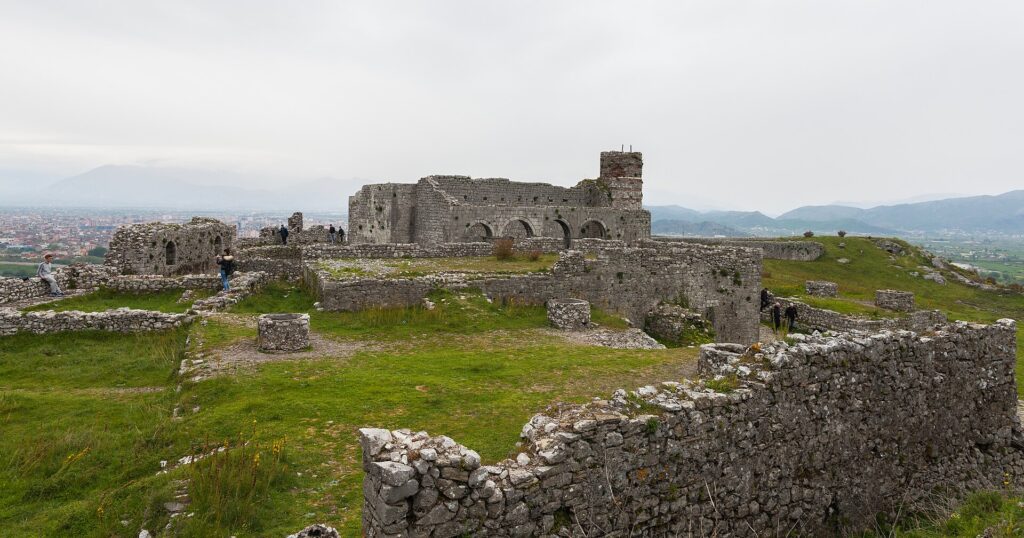
The approach is part of the experience. You walk up a steep path to a gate, pass through successive defensive walls, and reach the main enclosure on top of the hill. Take it slowly. The stone paving is old and uneven, and the hill is exposed to sun in summer and wind in winter.
1. The castle museum
The Museum of Rozafa Castle sits inside the walls and holds finds from the site. Wikipedia mentions a life-sized sculpture of Rozafa by Skënder Kraja there. One visitor review suggests the museum and the castle may keep different hours, so ask at the entrance.
2. The church that became a mosque
Scholars consider the thirteenth-century church to be St Stephen’s, the cathedral. After the Ottoman conquest it was converted into the Fatih Sultan Mehmet Mosque. Today it is a roofless ruin, and you can still read the layers, a church plan with a mosque’s changes on top (Wikipedia, Rozafa Castle, read 25 November 2026).
3. The walls and the view
This is why most people come. From the western walls you see the Bunë and the Drin running towards the lake, Lake Shkodra (Skadar to Montenegrins) opening out beyond them, and the mountains of Montenegro on the horizon. The city spreads out the other way. You can also read the geography that made this hill worth fortifying: it controls the junction of the rivers and the road to the lake.
4. The water at the entrance
Look for the water that runs near the main entrance. In the legend it stands for Rozafa’s milk, and many visitors never connect the two.
There is little shade and not much seating, so bring water and a hat in summer. Wear shoes with grip, because the stones are polished by centuries of feet. The site is not designed for wheelchairs or pushchairs, and the approach is steep.
Getting there from the centre
The castle is close enough to walk. It sits on a hill south-west of the centre, and in my other guide I describe it that way.
The last part is steep either way. If you walk from town, expect an uphill finish in the heat of the day. If you take a taxi, ask the driver to drop you at the gate and agree the return before you set off. A 2025 visitor review mentions that the two lower parking areas on the road up were closed when they went, so do not count on parking close to the gate.
If you are coming from Tirana for the day, the planning is in my guide to getting around Albania, and the transport map shows the main routes.
Tickets and opening hours
I am not going to give you a price or an hour I cannot source. The National Tourism Agency’s pages on the castle carry neither, and I could not find a published figure from the heritage authority that manages the site. Travel sites contradict each other: adult prices quoted range from 200 to 700 lek, and seasonal hours are quoted differently from page to page. Prices and hours here change, and a wrong number costs you a wasted walk up the hill.
So, before you climb: ask at the ticket office at the gate for the current price, the opening hours and whether the museum is included, and carry cash in lek, because some guides say cards are not widely accepted.
Why there are no figures here: no official ticket or hours page was found. AKT’s Rozafa page, Kalaja e Shkodrës, Kalaja Rozafa, read 25 November 2026, refers readers to AKT for hours and prices but carries none.
Day trips from Tirana
Want a day out of the city, planned for you?
Esther, our tour partner, plans day trips to Berat, Kruja, Durrës and Dajti Mountain, with certified local guides on site. Tell her your date and group size, and she replies personally, in English or German.
Best time to go
Late afternoon. That is my advice in the city guide and I stand by it: the light is softer, the stone warms up, and the view over the rivers and the lake is at its best as the sun drops. In summer it also means you miss the worst of the heat on that exposed hill.
Spring and early autumn are the easiest seasons. Winter is quiet and the hill can be windy and wet, and hours may be shorter then, which is one more reason to check before you go.
Nearby: the Lead Mosque, Mes Bridge and the lake
The Lead Mosque (Xhamia e Plumbit) stands at the foot of the castle hill, so it fits naturally into the same visit. It takes its name from the lead sheeting on its domes. It was built in 1773–1774 by Mehmet Pasha Bushati, founder of the Bushati dynasty (AKT, Xhamia e Plumbit, read 25 November 2026).
Mes Bridge (Ura e Mesit) is an old Ottoman stone bridge on the road north-east of the city. It makes a good short stop on the way to the lake or the mountains, and I cover it in the Shkodër guide.
The lake. From the castle you can see Lake Shkodra and, with the right light, understand why it mattered so much. For a very different lake, the Komani Lake day trip shows a very different lake in the mountains.
How it fits a Shkodër day
The castle works best as one half of a day. Spend the morning in town: the old bazaar, the pedestrian street Rruga Kolë Idromeno and, if you like photography, the Marubi archive. Eat lunch, rest, then go up to the castle in the late afternoon and stay for the view. Stay for dinner back in the centre.
If you only have an afternoon, go to the castle first and walk down into the old town afterwards. If you have two days, give the second one to the lake or the mountains. Many people use Shkodër as a base for the north, and the Theth and Valbona posts show what is within reach. For other options from the capital, see the best day trips from Tirana. If you would rather go with a local guide, take a look at our tours page.
If you are coming up from the coast or from Tirana by road, a stop in Lezhë pairs well with the castle.
I keep coming back to the same thing about this hill. Cities usually remember the people who won the battles. Shkodër remembers a woman who kept a promise nobody should have asked her to make, and built its castle around her name. That says something about what Albanians choose to hold on to.
Frequently asked questions
What is the legend of Rozafa Castle?
Three brothers build a fortress whose walls collapse every night. They are told a wife must be walled in. The youngest brother’s wife, Rozafa, is the one who brings the food, and she accepts her fate on one condition: an opening is left for her eye, her hand, her foot and her breast so she can still see and feed her son.
How long do you need at Rozafa Castle?
Allow two to three hours, including the museum and time on the walls for the view.
How much is the ticket?
Published figures disagree and I could not find an official one. Ask at the ticket office at the gate, and carry cash in lek.
Can you walk from the centre of Shkodër?
Yes. It is on the hill south-west of the centre, and the last part is steep.
What is inside the castle?
A museum, the ruins of a church that was converted into a mosque after the Ottoman conquest, defensive walls that are mostly Venetian, and views over the Drin, the Bunë and the lake.
When did the Ottomans take Rozafa?
After the long siege of 1478–79. An earlier attack in 1474 failed. Venice gave up the city in the treaty of January 1479, ratified in April 1479.
Is Shkodër Castle the same as Rozafa Castle?
Yes. People also call it Shkodra Castle, Kalaja e Rozafës, the Castle of Rozafa, or just Rozafa.
What is the best time of day?
Late afternoon, for the light and the lower heat in summer.
What do you think?
Have you climbed up to Rozafa Castle? Which view or which part of the legend stayed with you?
Featured photo: Rozafa Castle by Diego Delso, CC BY-SA 3.0, via Wikimedia Commons.
