
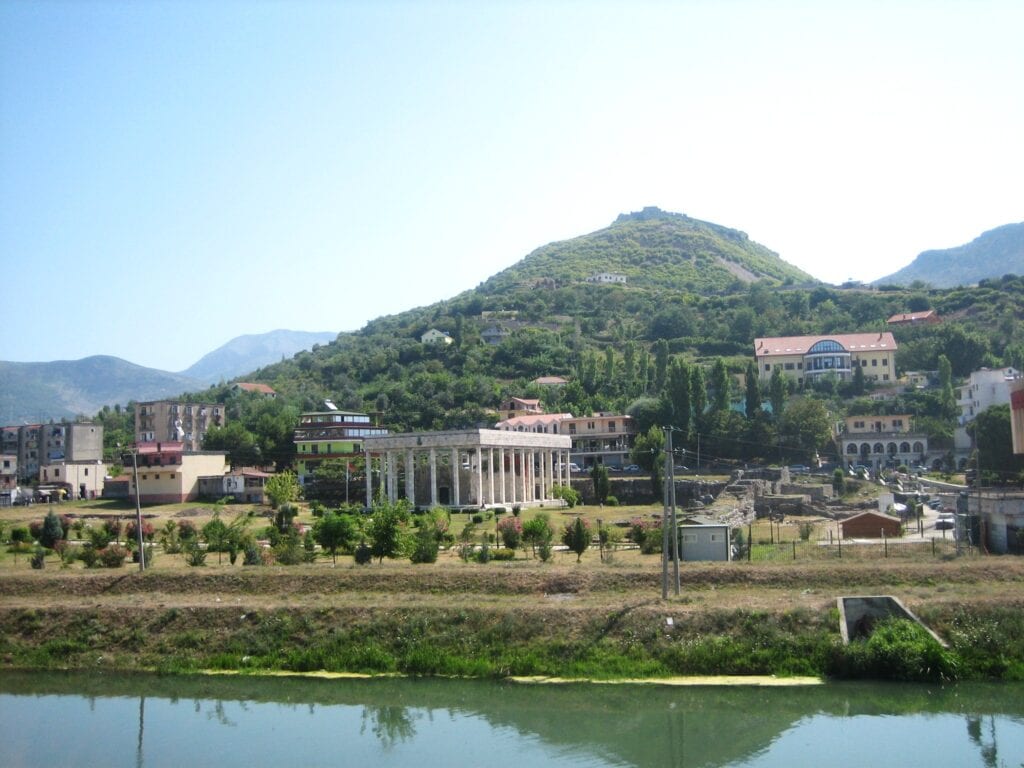
Lezhë is a small northern town with an outsized place in Albanian history — it is where Skanderbeg united the Albanian princes in the League of Lezhë in 1444, and where he is buried. Today it is a quiet stop between Tirana and Shkodër, with a hilltop castle and a memorial church, and the Adriatic beaches of Shëngjin just down the road. Here are the spots worth a look in Lezhë, mapped.
Some place links are affiliate links — if you book through them we may earn a small commission at no extra cost to you.
Tap any place to zoom to it, then “Open in Google Maps” for directions and reviews. Exploring more of the country? See the full interactive map of Albania.
Key Takeaways
- Lezhë is about 70 km north of Tirana on the SH1 — figure on roughly an hour to 90 minutes by car or furgon.
- Skanderbeg, Albania’s national hero, signed the League of Lezhë here in 1444 and is buried at the memorial on the site of the old Cathedral of St. Nicholas.
- The hilltop castle above town has Illyrian-to-Ottoman layers and one of the best views in northern Albania.
- Shëngjin’s beaches and the Kunë-Vain-Tale lagoon nature reserve are both a short drive from the town center, so Lezhë works as a history-plus-coast day.
- Many travelers pair Lezhë with Shkodër as a one- or two-day loop out of Tirana.
Table of Contents
Getting to Lezhë from Tirana
Lezhë sits about 70 km north of Tirana on the SH1, the same highway that continues on to Shkodër and the Montenegro border. By car, the drive normally takes an hour to an hour and a half depending on traffic through Fushë-Krujë and Laç. Furgons (shared minibuses) and buses heading north from Tirana’s bus terminal run through the day and will drop you in Lezhë along the way — for current schedules, operators, and prices on this and every other route in the country, I keep our full guide to getting around Albania updated, so check there before you travel rather than trusting a random number online.
Lezhë is also a natural stop if you’re continuing north: plenty of people break the Tirana–Shkodër drive here for an hour or two at the castle and the memorial, then carry on. If you’re doing that loop, our guide to a night in Shkodra covers what’s worth the stop further up the road.
Free checklist
Planning a trip to Tirana?
Get my free Tirana in 48 Hours checklist, with a day-by-day itinerary, prices and local tips.
Things to Do in Lezhë: At a Glance
The 4 things worth your time in and around Lezhë, in the order I would do them. Jump straight to any of them:
The Skanderbeg Memorial & the League of Lezhë
This is the reason Lezhë matters in Albanian history. On 2 March 1444, the Albanian princes — rivals more often than allies — met in Lezhë and signed the League of Lezhë (Besëlidhja e Lezhës), pooling their armies and revenues under the military command of Gjergj Kastrioti, better known as Skanderbeg. The agreement was struck at the Cathedral of St. Nicholas, and it’s the closest thing medieval Albania had to a unified state. Skanderbeg went on to hold off the Ottoman Empire for roughly two and a half decades, which is why his name is on streets, squares, and children across the country to this day — if you want the fuller story of how deep his name runs in Albanian identity, our piece on famous Albanians you didn’t know touches on his legacy too.
Skanderbeg died in Lezhë on 17 January 1468, and was buried inside the same church where the League had been formed 24 years earlier. According to historical accounts, when the Ottomans finally took the town in the late 1470s they plundered the church, converted it into a mosque, and are said to have opened his grave — believing that pieces of his bones, worn as amulets, would confer his courage on the wearer. Whatever the details, little of the original building survived the centuries that followed.
What stands on the site today is a memorial completed in 1981, built into the ruins of the old cathedral and designed by sculptor Odhise Paskali, the same artist behind the Skanderbeg monument in Tirana’s main square. It’s a quiet, deliberately simple space — a marked grave, weathered stone walls, and a small collection of historical panels — rather than a grand museum, and that plainness is part of what makes it affecting.
Did you know?
The League of Lezhë wasn’t a formal country in the modern sense — it was a military pact between competing noble families (Kastrioti, Arianiti, Dukagjini, Thopia, and others) who agreed to fight under one commander. It’s still taught in Albanian schools as the closest thing to a first national union, nearly 470 years before Albania declared independence in 1912.
Lezhë Castle & the View Over the Drin
Above the modern town, a steep hill carries a castle that has been fortified since Illyrian times, roughly 180 meters above sea level. What you see walking the walls today is a layered site: early Illyrian and Roman foundations, Venetian reinforcement after 1440 as Venice tried to hold onto its Adriatic footholds, and an Ottoman rebuild from 1522 onward that added a mosque and other garrison buildings. Not much of any single period survives intact, but that’s part of the appeal — you’re walking through several centuries stacked on top of each other.
The real reason to make the climb, though, is the view: the Drin River winding out toward the sea, the rooftops of Lezhë below, and on a clear day the Adriatic coastline near Shëngjin. Hours generally run from around 9am to somewhere between 4pm and 6pm depending on the season, and there’s a small entrance fee (a euro or two) payable in cash at the gate. Wear shoes with grip — the path up is uneven in places — and go earlier or later in the day if you want the castle to yourself and softer light for photos.

Shëngjin Beach
Shëngjin is Lezhë’s coastal side — a small port town and beach resort on the Adriatic, roughly 15 minutes’ drive from the town center. It’s a working fishing and cargo port as well as a beach destination, which gives it a slightly different feel from the purely tourist resorts further south on the Riviera: more local families, fewer foreign tour groups, and a promenade that gets genuinely busy on summer weekends with day-trippers from Tirana and Shkodër.
The sand isn’t the finest in the country, but the beach is long, the water shallow enough for kids for a good stretch out, and there are enough seafood restaurants along the front to make lunch part of the plan. If you’re combining the coast with the castle and memorial, Shëngjin is an easy add-on to a Lezhë day rather than a destination in its own right — though plenty of Albanians do treat it as one for a summer weekend.

Day trips from Tirana
Want a day out of the city, planned for you?
Esther, our tour partner, plans day trips to Berat, Kruja, Durrës and Dajti Mountain, with certified local guides on site. Tell her your date and group size, and she replies personally, in English or German.
Kunë-Vain-Tale Lagoon Nature Reserve
Just southwest of Shëngjin, where the Drin River meets the sea, is one of Albania’s more overlooked protected areas. The Kunë-Vain-Tale Nature Park covers roughly 44 square kilometers of lagoons, pine woodland, marsh, and small islands (including Kunë Island itself), and it was one of the first parts of the country to receive any kind of protected status — originally set aside as a hunting reserve back in 1940, long before it became a nature park.
It’s recognized as an Important Bird Area, with close to 200 recorded bird species passing through or nesting here alongside dozens of species of fish, amphibians, and mammals. You don’t need to be a birdwatcher to enjoy it — the lagoon itself is a striking, quiet landscape of still water and reed beds, and there are a handful of simple riverside restaurants near the water where you can get fresh fish and sit out the afternoon heat.

Between the castle where Skanderbeg’s alliance was forged, the church where he’s buried, and a lagoon that was one of the first protected landscapes in the country, Lezhë packs an unusual amount of Albanian history and nature into a town most visitors drive straight past.
Best Time to Visit
Spring (April–June) and early autumn (September–October) are the most comfortable months for the castle climb and walking around town, with mild temperatures and none of the summer haze that can flatten the view from the top. Summer (July–August) is when Shëngjin’s beach and restaurants are liveliest, but it’s also hot and, on weekends especially, busy with domestic tourists — go on a weekday if you can. Winter is quiet everywhere and the memorial and castle are both open, but expect grey skies more often than not and the lagoon walking paths can get muddy.
If you’re building a longer northern Albania itinerary, Lezhë fits naturally alongside other stops covered in our guide to the best day trips from Tirana, whether as a standalone half-day or as the first leg of a longer trip north.
Practical Tips
- Bring small cash. Entrance fees at the castle, and most food and drink around town, are cash-based — small-denomination lek is easiest.
- Wear real shoes. The path up to the castle is uneven cobble and dirt in places, not flip-flop terrain.
- Half a day is enough for the town center. The memorial and castle can both be done in two to three hours; add Shëngjin or the lagoon if you want to make a full day of it.
- Check current transport details before you go. Furgon schedules in Albania shift more often than you’d expect — our general Albania travel tips article covers how to handle transport, cash, and connectivity across the country, not just this route.
- Combine it with Shkodër if you have more than a day. The two towns are close enough on the same road that a Lezhë morning and a Shkodër overnight is a comfortable, unrushed way to see the north.
FAQ
How far is Lezhë from Tirana?
About 70 km by road, on the SH1 highway north toward Shkodër. Driving takes roughly an hour to 90 minutes; furgons and buses cover the same route through the day.
Is Lezhë worth visiting?
Yes, especially if you care about Albanian history — it’s where the League of Lezhë was signed in 1444 and where Skanderbeg is buried. Even a half-day stop covering the memorial and the castle gives you a real sense of the town’s significance, and it pairs naturally with a trip further north to Shkodër or a beach stop at Shëngjin.
Where exactly is Skanderbeg buried?
At the Skanderbeg Memorial in the center of Lezhë, built into the ruins of the old Cathedral of St. Nicholas — the same church where the League of Lezhë was signed in 1444.
How do I get to Shëngjin beach from Lezhë?
Shëngjin is a short drive of around 15 minutes from Lezhë’s town center. It’s easy to combine both in one day.
Is Lezhë Castle open to the public, and is there an entrance fee?
Yes, it’s open daily, roughly 9am to between 4pm and 6pm depending on the season. There’s a small entrance fee, usually a euro or two, payable in cash.
Can I visit Lezhë as a day trip from Tirana?
Yes — the round trip and a few hours in town is comfortably doable in a day, whether you drive yourself or take a furgon. Many visitors also use it as a stop on the way to or from Shkodër rather than a there-and-back trip.
What do you think?
Have you stopped in Lezhë on the way north, or made a special trip for the castle and the memorial? What stood out to you most — the history, the view, or the coast at Shëngjin?
