
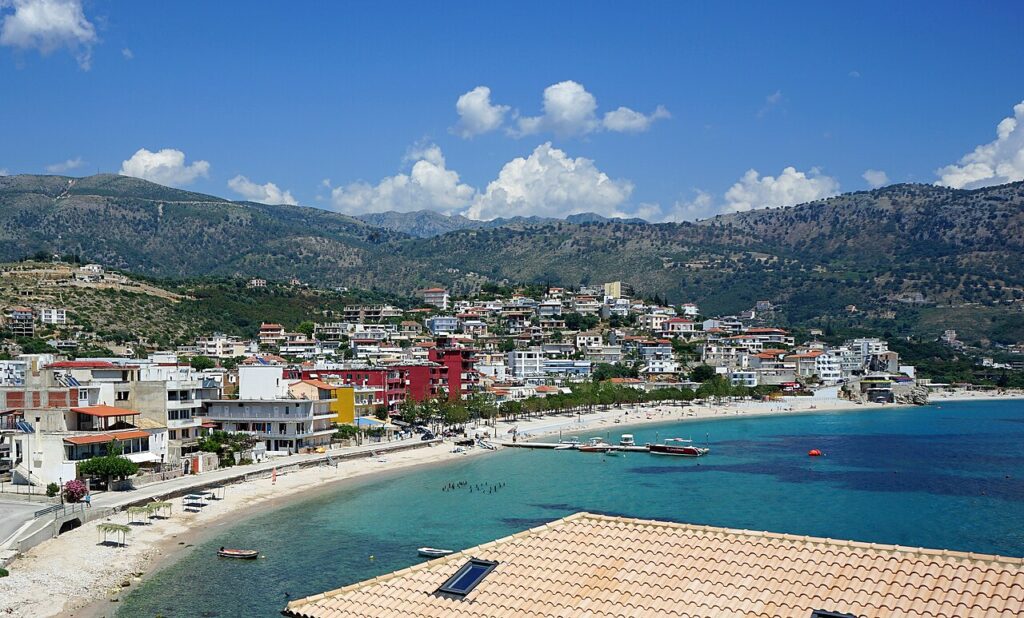
Himarë is the Riviera with a slower pulse — a string of pebble coves and a hillside old town along the coast between the Llogara pass and Sarandë. It has a distinct character (Greek is spoken here alongside Albanian) and some of the clearest water on the coast, without the full crush of the bigger resorts. Here are the spots worth your time in Himarë, mapped.
Some place links are affiliate links — if you book through them we may earn a small commission at no extra cost to you.
Tap any place to zoom to it, then “Open in Google Maps” for directions and reviews. Exploring more of the country? See the full interactive map of Albania.
Key Takeaways
- Himarë is the quieter half of the Riviera — the same clear Ionian water as Ksamil and Sarandë, spread across half a dozen separate coves instead of one crowded strip.
- The Old Town (Kastro) sits above the modern town — a hillside castle district with roots going back roughly 2,500 years and a living Greek-speaking community.
- You need wheels to see it properly — the best beaches (Jalë, Gjipe, Filikuri) are 10–60 minutes from the center by car, boat, or hiking trail, not walking distance.
- Porto Palermo Castle is a worthwhile detour — a 19th-century coastal fortress a few kilometers south, sitting in one of the prettiest bays on this stretch of coast.
- Go in June or September if you can — July–August brings the heat, the crowds, and the highest prices; shoulder season keeps the water warm without the crush.
Table of Contents
Ask most foreign visitors to name a beach town on the Albanian Riviera and they’ll say Ksamil or Sarandë. Ask an Albanian, and Himarë usually comes up first — not because it’s the flashiest stop on the coast, but because it isn’t trying to be. The town is really a scatter of separate settlements strung along a single stretch of shoreline: a modern seafront center, a hillside Old Town above it, and a series of coves and villages reaching south toward Porto Palermo and beyond.
What makes Himarë distinct on a coastline that can start to blur together after a few stops is its layering. You get the pebble-and-turquoise formula that defines the whole Riviera, but also a genuinely old hilltop settlement with its own Greek-speaking community, a 19th-century coastal fortress a short drive south, and beaches that range from a five-minute walk from your hotel to a boat ride or a rope-assisted scramble down a cliff. It rewards people who are willing to move around rather than plant a towel and stay put.
This guide covers how to get there, which beaches are worth the effort (and how to reach each one), the Old Town and its castle, the Porto Palermo detour, where to eat, and when to go.
Getting to Himarë
Himarë sits on the SH8 coastal road, roughly 70 km south of Vlorë and around 60 km north of Sarandë — on paper a short hop, but the road hugs the coastline and climbs over a mountain pass, so allow one and a half to two hours from either direction rather than judging it purely on distance.
Coming from the north, the route out of Vlorë climbs over the Llogara Pass, a winding mountain road through Llogara National Park that tops out at around 1,000 meters before dropping back down toward the coast at Palasë and Dhërmi. It’s one of the more dramatic drives in the country — hairpin turns, pine forest, and sudden views straight down to the Ionian Sea — and it’s also the main reason the Vlorë–Himarë leg takes longer than the map distance suggests. If you’re driving, take it slowly and expect summer traffic to bunch up on the switchbacks.
By Bus and Furgon
Regional buses run the full Vlorë–Sarandë coastal route through Palasë, Dhërmi, Himarë, Qeparo, Borsh, and Lukovë, typically several times a day in summer with fares in the €5–10 range per leg; frequency drops sharply outside the June–September season. Seasonal minivan shuttle services also connect Tirana directly to Riviera towns including Himarë a few days a week during peak summer. Alongside the scheduled buses, informal furgons (shared minibuses that leave when full rather than on a fixed timetable) run the coastal route too — they’re cash-only, paid in Albanian lek, and worth having as a backup plan since printed schedules on this coast are more of a guideline than a guarantee.
For a broader primer on buses, furgons, and how public transport actually works country-wide, our guide to getting around Albania is worth reading before you commit to a route.
By Car
Driving is by far the most practical option once you’re in Himarë itself, since the beaches worth seeing are spread out along several kilometers of coast and public transport between them is thin. If you’re coming from Sarandë, the drive is shorter and flatter than the Vlorë approach, and it also puts you within range of Ksamil and Butrint on the same trip — see our Sarandë and Albanian Riviera guide for how to sequence a longer coastal itinerary.
If you’re based in Tirana and weighing whether Himarë fits into a shorter visit, be realistic about the distance: it’s closer to a three-hour drive from the capital each way, which makes it a stretch as a single day trip. For genuinely quick out-and-back options from Tirana, our best day trips from Tirana guide covers closer alternatives; Himarë works better as an overnight stop or a stage on a longer Riviera loop.
Things to Do in Himarë: At a Glance
Planning a Trip to Tirana?
Get my free Tirana in 48 Hours checklist with day-by-day itinerary, prices, and local tips.
Get the Free Checklist →The 4 things worth your time in and around Himarë, in the order I would do them. Jump straight to any of them:
The Best Beaches in Himarë
Himarë’s beaches aren’t one continuous strip — they’re a series of separate coves along several kilometers of coastline, each with its own character and its own logistics. Some are a walk from the center; others need a car, a boat, or a proper hike.
Spile Beach (In Town)
Spile is Himarë’s town beach, running along the Lungomare Spile promenade right below the modern center — the obvious choice if you don’t want to travel at all. It’s pebble, backed by cafés and restaurants (several with decks extending over the water), and it gets busy in summer precisely because it’s so convenient. Good for a first swim after arriving, less good if you’re chasing solitude.
Livadhi Beach
A five-to-ten-minute drive south of the center, or a 30–60 minute walk if you’d rather hike it. Livadhi is quieter than Spile without requiring serious effort to reach, which makes it a reasonable middle option.
Llaman Beach
Further along the road toward Sarandë, Llaman has a handful of beach bars and restaurants and a slightly more local, less touristed feel than the beaches directly in town.
Jalë (Jala) Beach
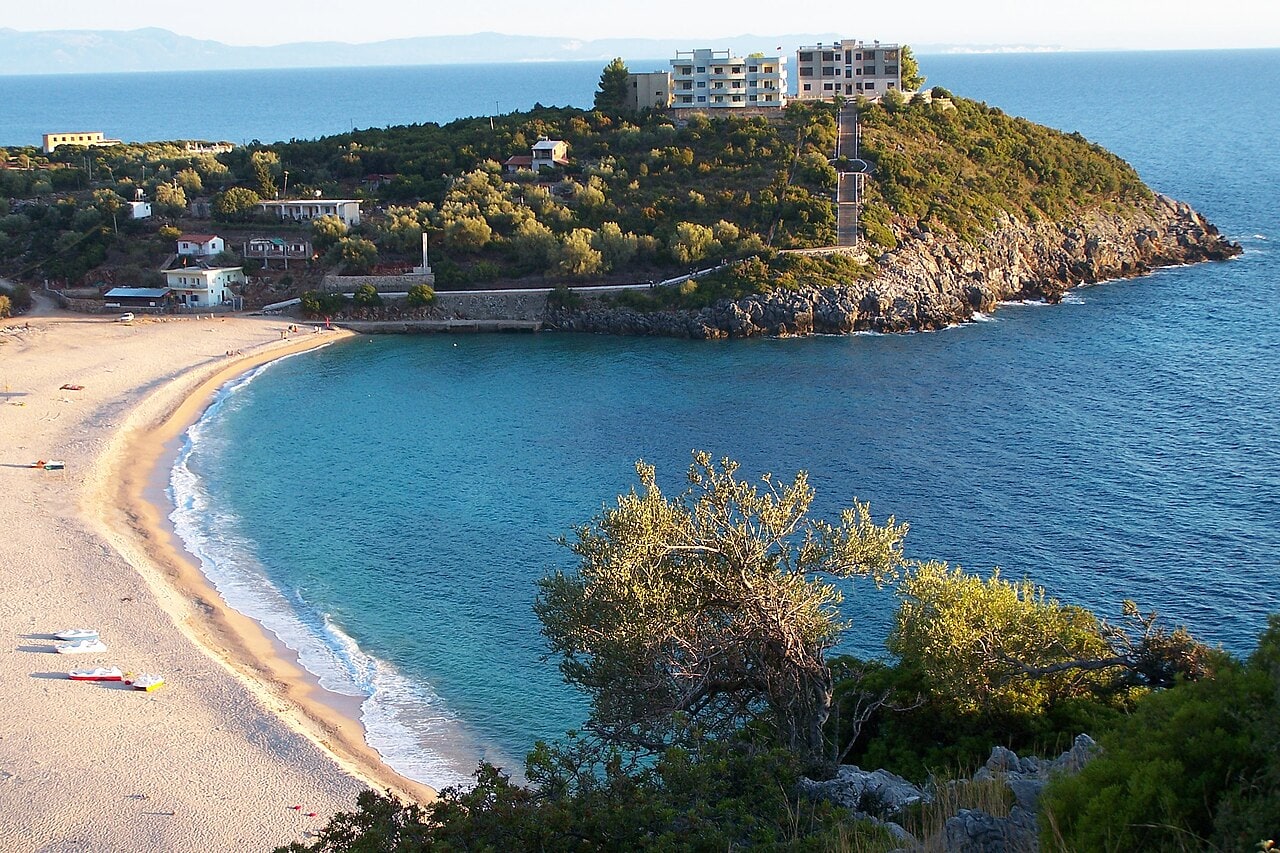
About a 20-minute drive from Himarë center, Jalë is one of the more scenic coves on this stretch, backed by steep hillsides and known for clear water. Paid parking (around 500 lek for the day) is available near the beach in summer.
Gjipe Beach
The one everyone photographs. Gjipe sits at the mouth of a dramatic limestone canyon between Himarë and the village of Vuno, and getting there takes some commitment: either a boat taxi from Himarë’s docks (running regularly in summer) or a hike — roughly 30 minutes down from the Gjipe parking area on a steep path, or the longer canyon trail from Vuno for those who want the full walk. There’s no easy road access, which is exactly why it’s stayed as beautiful as it has.
Filikuri Beach
A genuinely hidden cove south of town: walk along the bay past Potami toward the Oniro/Iliria Palace area, pick up a dirt trail through the scrub, and then descend a steep, rocky final stretch (a fixed rope helps on the last section) to reach the water. Figure on about an hour on foot from Himarë, or arrange a boat if the scramble doesn’t appeal. It’s not a beach for flip-flops or small children, but it’s one of the quietest patches of water in the area precisely because of that.
Himarë Old Town & Castle
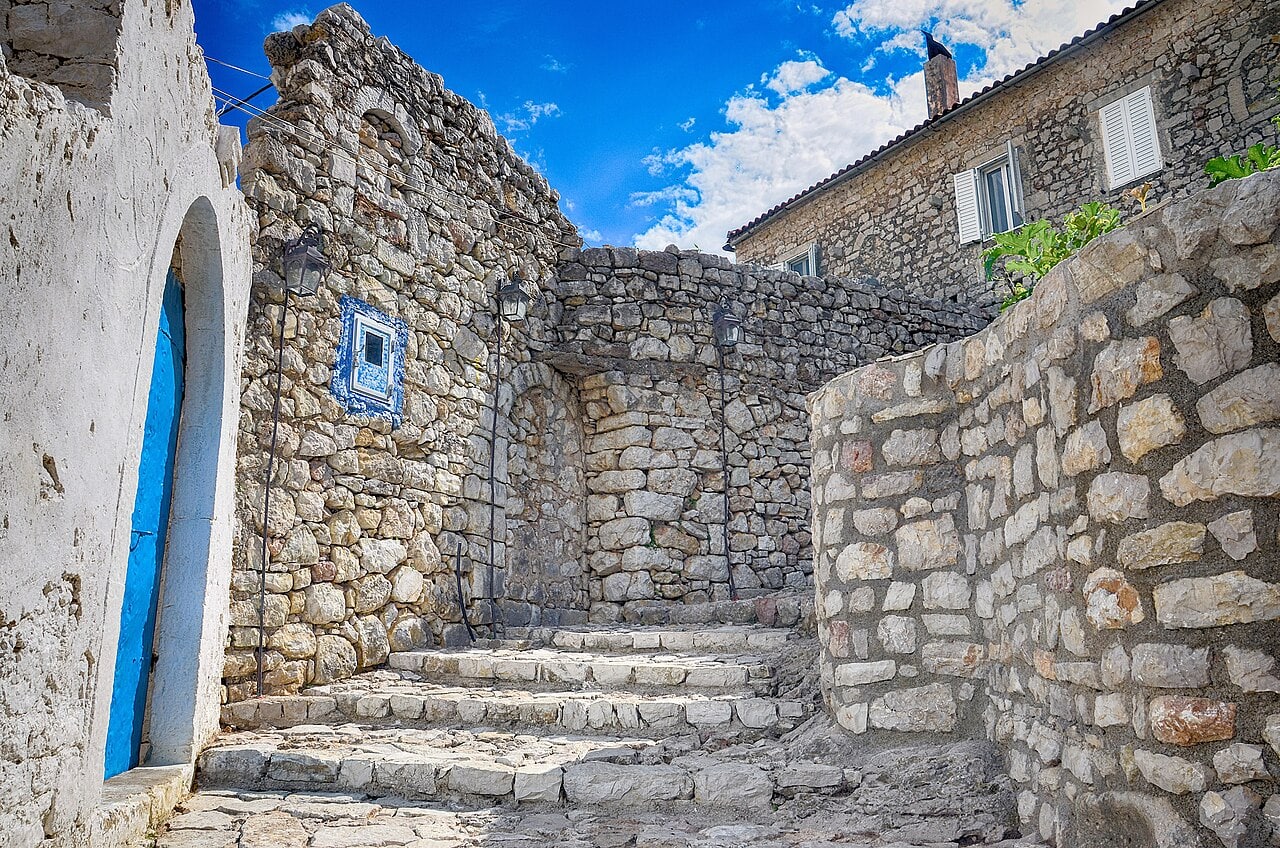
Above the modern seafront town, a steep road climbs to Himarë’s Old Town — known locally as Kastro — a hillside settlement built around a castle whose walls have stood, in one form or another, for roughly 2,500 years. The earliest fortifications on this hill are attributed to the Chaonians, an ancient Greek tribe that controlled much of the surrounding Epirus coast, with the settlement later mentioned in Roman-era writing.
Did you know?
Himarë’s hilltop is believed to have been first fortified as early as the 5th century BC. Walking the walls today, you can see the layering of that history in the stonework itself — rough, megalithic blocks at the base give way to more refined Byzantine masonry higher up, with the ruined Church of Saint Michael, built in the 13th century, still standing inside the walls.
The Old Town declined during the communist period (1944–1991), as families moved down the hill into the newly built seafront town and the state pushed modernization over preservation. Restoration has been slow but steady since, and today Kastro is a genuine, if quiet, place to wander — narrow stone lanes, old houses in varying states of repair, and views back down over the roofs of modern Himarë to the sea.
This is also the historic heart of Himarë’s Greek-speaking community. The coastal Himarë area has long been home to an ethnic Greek population alongside ethnic Albanians — the most recent census put the municipality’s population at around 60% self-identified Albanian and roughly a quarter self-identified Greek, though the exact proportions are genuinely disputed between local and national counts, and it’s not our place to adjudicate that here. What’s not in dispute is that the local Greek dialect, known as Himariote Greek, has been spoken in this pocket of the coast for centuries, shaped by the region’s relative isolation and preserving older forms of the language. For several hundred years under Ottoman rule, Himarë also held a degree of local autonomy rare on this coast, with residents known for maritime trade and a fiercely independent streak. Albanian and Greek are both spoken here today, church signage and place names reflect that dual heritage, and it’s part of what makes the Old Town feel distinct from other Riviera towns rather than a footnote to it.
Porto Palermo Castle & Bay
A few kilometers south of Himarë, the road passes one of the Riviera’s more striking detours: Porto Palermo Castle, sitting on a small promontory in a bay that’s easily one of the prettiest on this stretch of coast. The castle was built in 1804 under Ali Pasha of Ioannina, the semi-autonomous Ottoman-era ruler whose territory once stretched along much of this coastline — some accounts suggest he rebuilt an earlier, possibly Venetian-era fortification rather than starting from nothing, though the structure standing today is very much his.
It’s a compact, three-sided fortress with gun bastions at each corner, originally built on what was a small island before landfill connected it to the mainland. Its purpose was practical rather than decorative: garrisoning troops to keep watch over a local population that had repeatedly resisted Ottoman authority. The castle was declared a protected cultural monument in 1948 and now functions as a small museum you can walk through, with the bay itself — deep blue, ringed by hills, usually far calmer than the open beaches nearby — arguably the bigger draw.
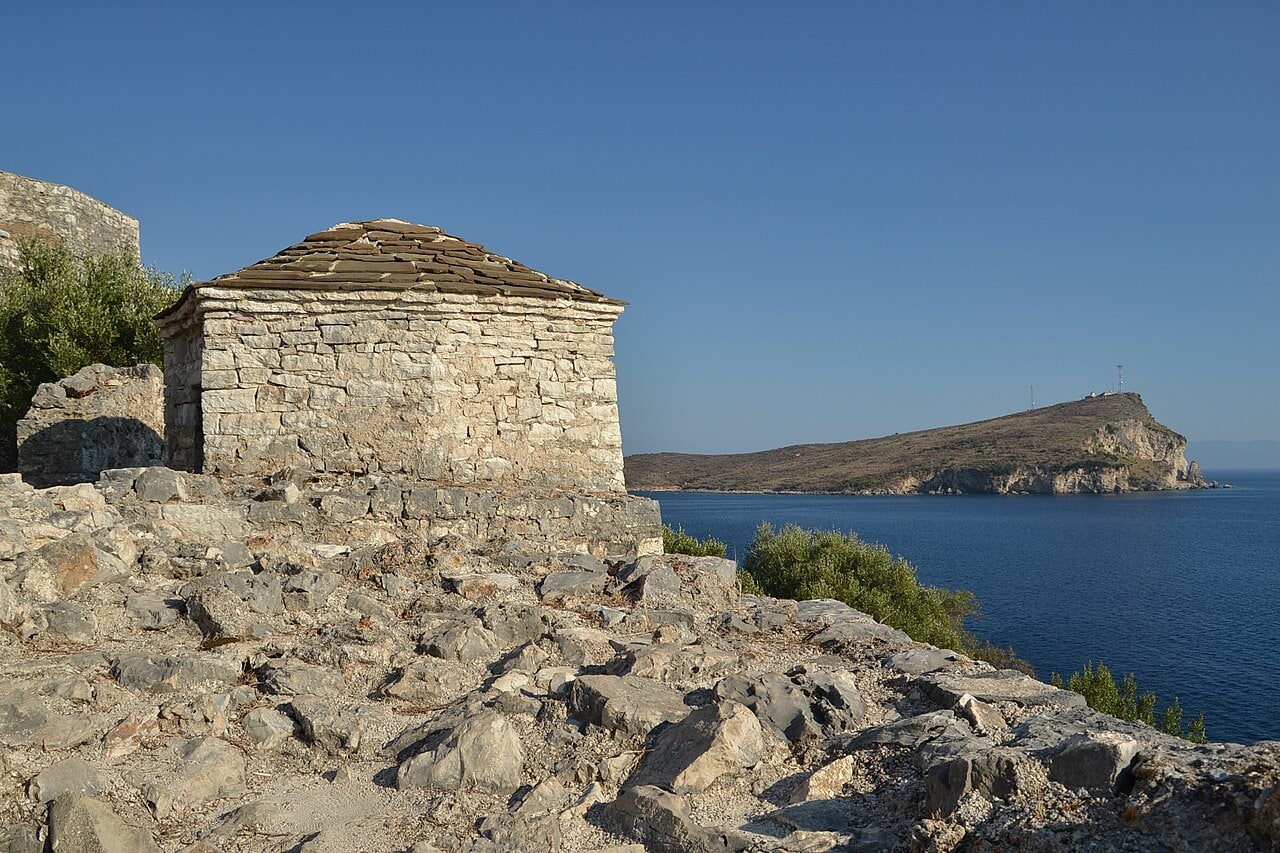
“The Riviera is full of ruins that look better in photographs than they do up close. Porto Palermo is the opposite — a modest little fortress that punches well above its size because of the bay it sits in.”
Pair it with a swim: there’s a beach right beside the castle, and the water inside the sheltered bay tends to be calmer than the more exposed coves further north, which makes it a reasonable stop for families or anyone who’d rather not deal with waves.
Food & Where to Eat
Himarë’s food scene runs on fresh seafood, simply prepared — this is a fishing coast before it’s anything else, and the better restaurants lean into that rather than overcomplicating it. Grilled fish, octopus, and mixed seafood platters are the standard order; along the Spile promenade, tavernas with decks extending out over the water are the classic setting, and octopus in particular comes recommended at several of the long-standing seafront spots.
The town center also has a more varied dining scene than you might expect for its size — Italian-leaning restaurants doing wood-fired pizza and handmade pasta alongside the seafood-focused tavernas, plus a couple of more upscale promenade restaurants offering a step up from the standard beach-bar menu for anyone wanting a proper sit-down dinner.
As with most of the Riviera, prices rise the closer you sit to the water and the higher the season gets. Walking one street back from the seafront, or eating in Llaman or Livadhi rather than directly on Spile, tends to get you the same quality of fish for less.
Best Time to Visit
May–June and September are the sweet spots for Himarë, the same as the rest of the Albanian Riviera: warm enough to swim comfortably, without the peak-July crush or the highest prices. The climate here is Mediterranean — mild winters, hot summers — and July and August regularly push daytime temperatures toward 30°C (86°F), with the beaches, restaurants, and roads to match in terms of crowding.
If your schedule is flexible, shoulder season also makes the drive itself more pleasant — less traffic on the Llogara Pass switchbacks, and no scramble for parking at Jalë or a boat slot to Gjipe. Winter is genuinely quiet; some seasonal businesses close entirely, and it’s more of a fishing-village atmosphere than a resort one.
Practical Tips
- Rent a car if you can. Himarë’s best beaches are spread across several kilometers, and public transport between them is thin outside the main SH8 route. A car turns a frustrating logistics puzzle into an easy day of beach-hopping.
- Carry cash in lek. Furgons, beach parking, and many smaller tavernas outside the main season are cash-only.
- Pack water shoes. Like most of the Riviera, Himarë’s beaches are pebble rather than sand — comfortable water shoes make a real difference.
- Book ahead in July–August. Accommodation in and around Himarë fills up fast in peak summer; shoulder-season travelers have far more flexibility.
- Drive the Llogara Pass carefully, especially after dark or in poor weather — it’s scenic but narrow, with tight switchbacks.
- For a wider set of Albania-specific logistics — SIM cards, tipping, safety, road rules — our general Albania travel tips guide covers the basics that apply beyond just the Riviera.
Frequently Asked Questions
Is Himarë worth visiting?
Yes — it offers the same clear Ionian water as the more famous Riviera stops, spread across several distinct beaches, plus a genuinely old hillside castle town and an easy detour to Porto Palermo, with noticeably fewer crowds than Ksamil or central Sarandë in peak season.
How do I get from Vlorë or Sarandë to Himarë?
By car it’s roughly 70 km (1.5–2 hours) from Vlorë over the Llogara Pass, or around 60 km (about 1.5 hours) from Sarandë. Regional coastal buses and furgons also run the route several times a day in summer, with service dropping off outside the June–September season.
What is the best beach in Himarë?
It depends on what you want: Spile is the easiest (walkable from the center), Jalë and Livadhi are a short drive with more space, and Gjipe and Filikuri are the most dramatic but require a boat or a proper hike to reach.
Is Himarë Greek or Albanian?
Both, in different ways — Himarë is part of Albania, with a population that includes both ethnic Albanians and an ethnic Greek community (the Himariotes) that has lived in the area for centuries and still speaks a local Greek dialect alongside Albanian, particularly in the Old Town.
How many days do you need in Himarë?
Two to three days lets you see the Old Town, work through several beaches, and take the Porto Palermo detour without rushing. It also works well as a one- or two-night stop on a longer Riviera route between Vlorë and Sarandë.
Is Himarë cheaper than Ksamil or Sarandë?
Generally yes, especially away from the main Spile promenade — Himarë sees fewer international tourists than Ksamil, which tends to translate into more reasonable prices for food and accommodation outside the absolute peak weeks of summer.
What do you think?
Have you spent time in Himarë, or is it on your list for a Riviera trip? Which beach would you rate above the rest — Gjipe, Jalë, or somewhere quieter? Drop a comment below.
This guide reflects information available at the time of writing. Bus and furgon schedules, parking fees, and boat-taxi availability to beaches like Gjipe can change season to season — always confirm locally before planning your day around a specific departure time or price.
Subscribe to monthly updates
Get honest Albania travel tips, local guides, and new posts straight to your inbox. No spam, unsubscribe anytime.
