
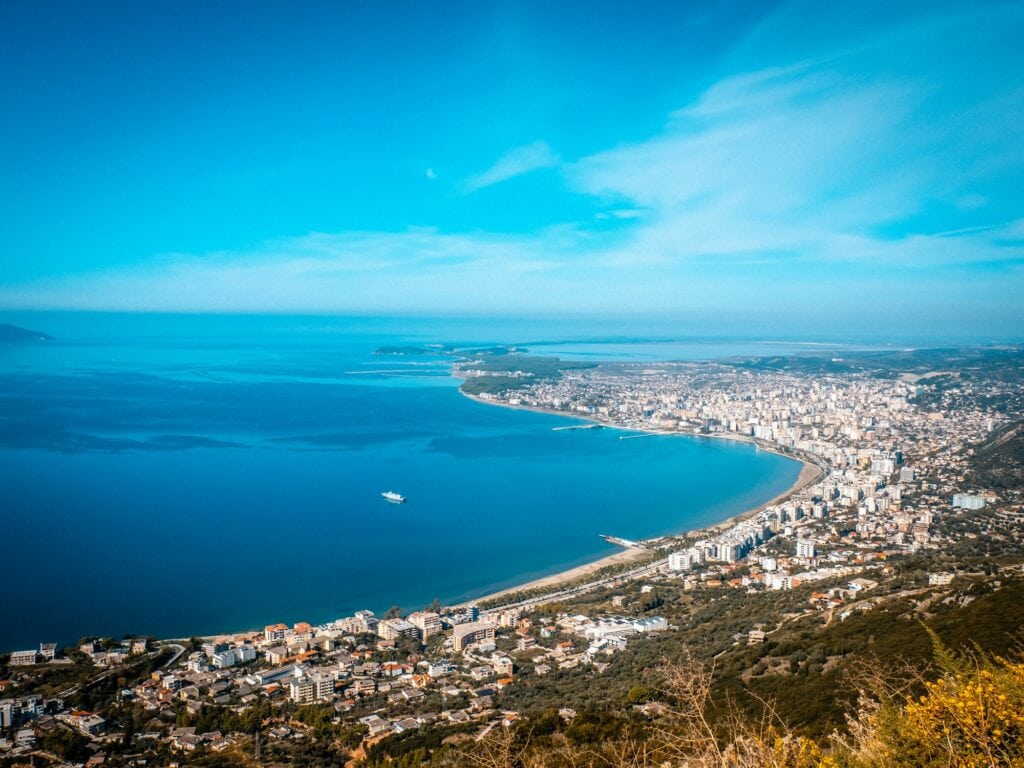
Vlorë is where Albania declared its independence in 1912 — a big coastal city that marks the meeting of the Adriatic and Ionian seas and the start of the Riviera road south over the Llogara pass. It pairs a long city beach and seafront with easy access to wilder coves just out of town. Here is what is worth seeing in and around Vlorë, mapped.
Some place links are affiliate links — if you book through them we may earn a small commission at no extra cost to you.
Tap any place to zoom to it, then “Open in Google Maps” for directions and reviews. Exploring more of the country? See the full interactive map of Albania.
Key Takeaways
- Vlorë is the city where Albania declared independence on 28 November 1912 — Flag Square (Sheshi i Flamurit) and its 17-metre Independence Monument mark the spot.
- It’s about 150–155 km from Tirana, roughly a 2.5-hour drive or bus ride — long for a single day trip, better as an overnight or a stop en route to the Riviera.
- Highlights beyond the monument: the 16th-century Muradie Mosque (Albania’s only known building by Ottoman master architect Mimar Sinan), Kanina Castle above the bay, and Zvërnec Monastery on its own island in the Narta Lagoon.
- Vlorë is the gateway to the Karaburun-Sazan Marine Park, Albania’s only marine national park, and to the Llogara Pass road that opens onto the Riviera.
- The long-awaited Vlora International Airport is still not operating commercial flights as of this writing — Tirana’s Rinas remains the entry point for now.
- Best months: May, June, and September, when the weather is warm, the sea is swimmable, and Vlorë hasn’t filled up with the July–August summer crowd.
Table of Contents
- Getting to Vlorë from Tirana
- Flag Square and the Birth of Independent Albania
- Muradie Mosque and the Old Town
- Zvërnec Monastery and Its Island
- Kanina Castle and the View Over the Bay
- The Lungomare and Vlorë’s Beaches
- Karaburun-Sazan Marine Park
- Gateway to the Riviera: The Llogara Pass
- Best Time to Visit
- Practical Tips
- FAQ
Getting to Vlorë from Tirana
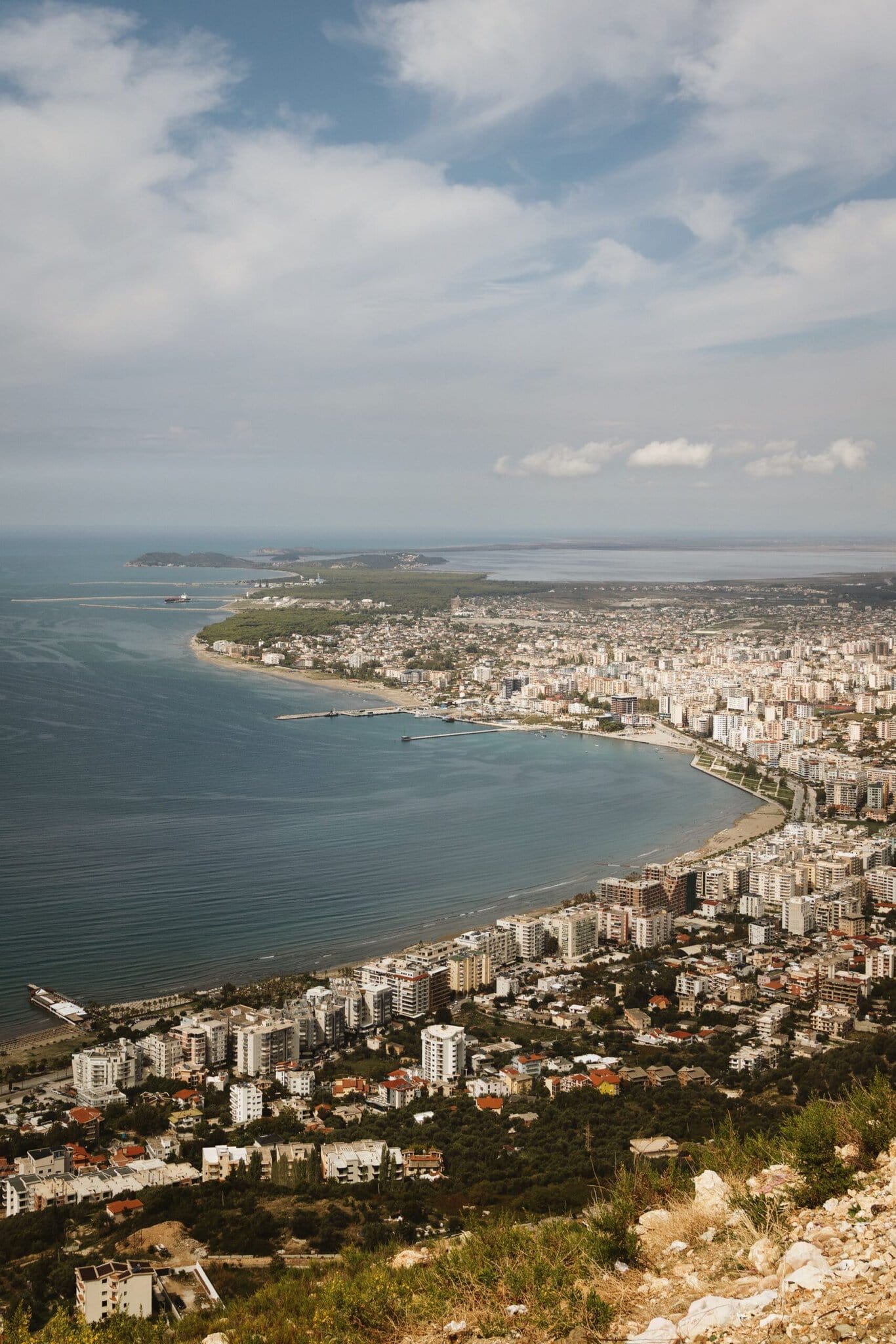
Vlorë sits about 150–155 kilometers south of Tirana, and the trip takes roughly 2 to 2.5 hours by road. That makes it a longer haul than a typical Tirana day trip — doable there-and-back if you start early, but more comfortable as an overnight, or as your first stop heading further south. For shorter outings closer to the capital, our guide to the best day trips from Tirana covers places you can see without committing a whole day to driving.
By bus or furgon. Regular buses and furgons (shared minivans) run from Tirana’s South Terminal throughout the day, with dozens of departures — the route is one of the busiest in the country. A one-way ticket runs around 400–500 lek (roughly €4–5), and the ride takes about 2 to 2.5 hours depending on stops and traffic. For the full picture on buses, furgons, and driving rules across the country, see our guide to getting around Albania.
By car. The SH4 highway from Tirana connects to the SH8 coastal road into Vlorë, and the drive is straightforward and well-paved for most of the way. Having your own car pays off once you’re in Vlorë, since Kanina, Zvërnec, and the Karaburun boat departure points are all easier to reach with wheels than on foot or by local bus.
The Vlora Airport factor. Albania has been building a new international airport just outside Vlorë for several years, and it has repeatedly slipped its opening date — as of mid-2026, it still has no scheduled commercial passenger flights, despite a completed runway and terminal and an assigned IATA code (VLO). Charter flights planned for summer 2026 were cancelled after the airport failed to secure its international operating permits in time. Until that changes, Tirana’s Rinas Airport remains the practical entry point for anyone flying in.
There are three ways to do this and they sort themselves neatly by price. The bus is the cheapest, the furgons — the small private vans — sit in the middle, and a taxi the whole way is by far the most expensive. The vans are what locals actually use: they run all day, with the first ones pulling out around five in the morning, which is the move if you want to arrive fresh with the day still ahead of you. People who go to Vlorë every weekend keep their driver’s number saved and message ahead to check there is space, and I mention that only so you know what you are not getting as a visitor — it is far too much to manage on a first trip.
If you would rather not think about any of it, take a cheap local taxi to the terminal and start there. Green Taxi and Lux Taxi are both fine, or use Patoko, the Albanian ride-hailing app — Uber and Bolt do not operate in Albania, so Patoko is the closest equivalent we have. It will collect you from wherever you happen to be standing without you needing to know the name of the street, which here is genuinely useful. Almost everywhere I would send you is findable on Google Maps.
Things to Do in Vlorë: At a Glance
Planning a Trip to Tirana?
Get my free Tirana in 48 Hours checklist with day-by-day itinerary, prices, and local tips.
Get the Free Checklist →The 7 things worth your time in and around Vlorë, in the order I would do them. Jump straight to any of them:
Flag Square and the Birth of Independent Albania
Every Albanian schoolchild learns this date: 28 November 1912. That’s when Ismail Qemali stood in Vlorë and declared Albania’s independence from the Ottoman Empire, ending nearly five centuries of Ottoman rule and making Vlorë, briefly, the capital of the new state. The square where it happened, Sheshi i Flamurit (Flag Square), is still the city’s symbolic heart.
The square’s centerpiece is the Independence Monument, a bronze sculpture erected in 1972 for the 60th anniversary of the declaration. It stands 17 meters tall, built around a figure of Ismail Qemali, and was created by sculptors Muntaz Dhrami and Kristaq Rama. The plaza around it is planted with palms and pines, and on weekend evenings it fills with Vlorë families out for a walk, much like Skanderbeg Square does in Tirana. Just off the square, the Museum of National Independence occupies the building where the first Albanian government convened in 1913, and it’s worth the short visit if you want more than the monument’s silhouette — exhibits cover the declaration itself and the fragile first years of the new state.
Muradie Mosque and the Old Town
A short walk from Flag Square is a building with an outsized architectural pedigree. The Muradie Mosque was built between 1537 and 1542 under Sultan Suleiman the Magnificent, and it’s attributed to Mimar Sinan — the same imperial architect behind the Süleymaniye Mosque in Istanbul and Selimiye Mosque in Edirne. It’s the only building in Albania linked to Sinan’s name, which is a remarkable thing for a fairly modest-sized mosque to carry.
The building blends Byzantine and Ottoman elements — thick stone walls, a slender minaret roughly 18 meters tall, and carved geometric and floral decoration around the entrance. It’s also known locally as the Xhamia e Plumbit (“Lead Mosque”), for the lead sheeting historically used on its dome. The mosque sits at the edge of Vlorë’s old town, where narrow streets and a handful of older Ottoman-era houses give a sense of the city before the 20th century reshaped most of it.
I have been to the Muradie many times, though I have not gone inside on every visit — mostly I have walked past it, which in Vlorë you do constantly. What I would want you to understand is that it is not a monument. Friends of mine are Muslim and pray there five times a day, and the building is in use accordingly: ordinary and busy on a normal weekday, and noticeably fuller at the Friday prayer. Go in if it is open and you are respectful about it, but go in knowing it is somebody’s working neighbourhood mosque rather than an exhibit.
Zvërnec Monastery and Its Island
About 13 kilometers from central Vlorë, in the middle of the Narta Lagoon, sits one of the more atmospheric small sights in southern Albania. St. Mary’s Monastery, Zvërnec, dates back to somewhere between the 11th and 14th centuries and is dedicated to the Dormition of Mary. It sits on a tiny pine-covered island, and a wooden footbridge roughly 270 meters long is the only way across — no cars, just a walk over shallow lagoon water with birds working the shallows on either side.
Inside, the church still holds partial Byzantine-era frescoes and older religious objects, and the whole complex has been a protected cultural monument since 1963. It’s a genuinely peaceful stop, more about the setting than any single feature — pine trees, still lagoon water, and a church that has quietly survived here for the better part of a millennium.
Did you know?
The Narta Lagoon around Zvërnec is home to an estimated 3,000 flamingos, along with pelicans and other migratory birds that pass through on their way between Africa and northern Europe. Bring binoculars if birdwatching is your thing — the lagoon is one of the better spots on the Albanian coast for it.
Kanina Castle and the View Over the Bay
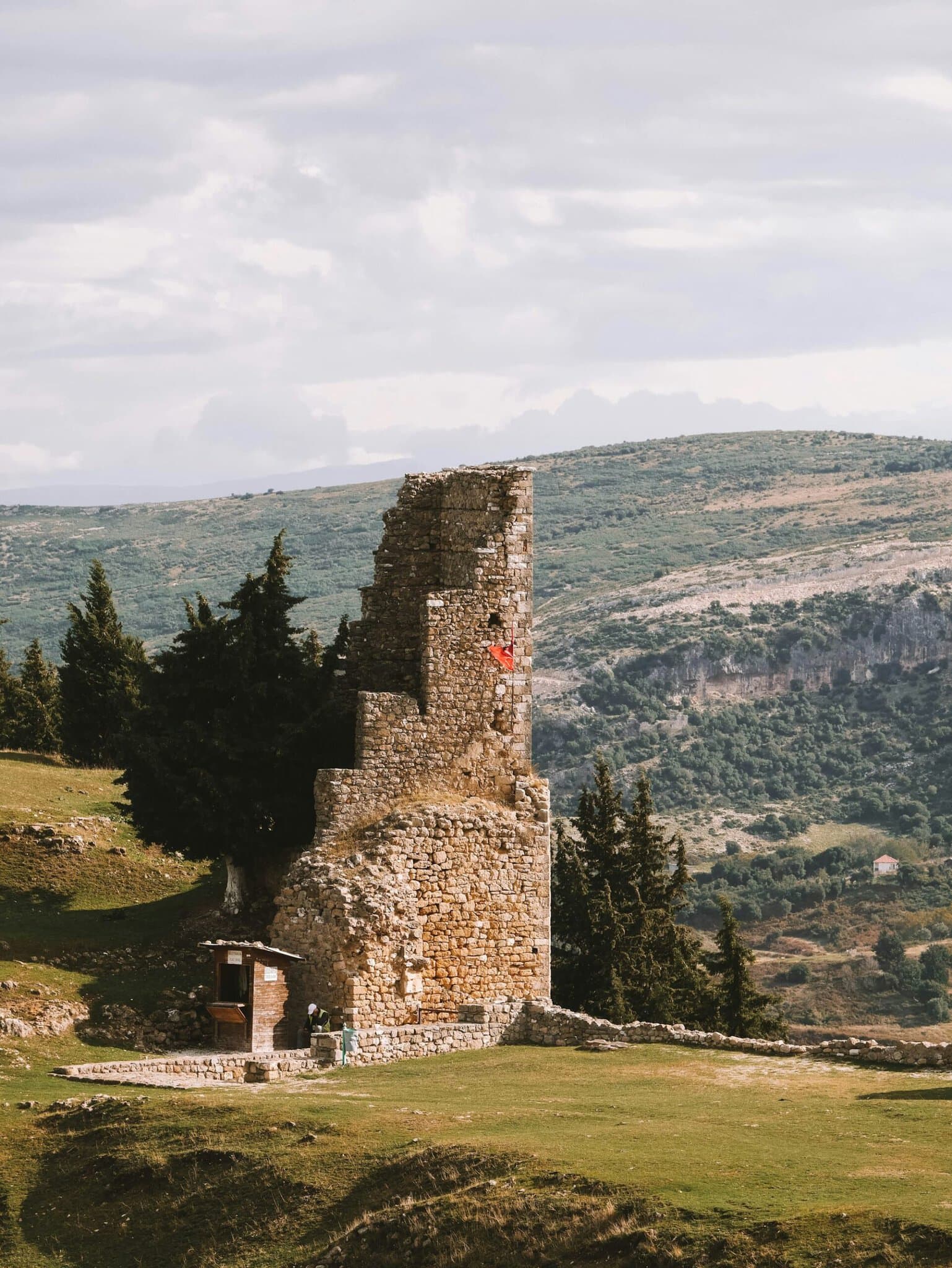
Above the village of Kaninë, about 20 minutes from central Vlorë, a hilltop fortress has been watching over the bay for roughly two and a half thousand years. The site began as an Illyrian settlement, was rebuilt by the Byzantine emperor Justinian I in the 6th century, served as the seat of the medieval Principality of Vlorë in the 14th century, and was later absorbed into the Ottoman defensive network — though it lost most of its strategic importance once the Ottomans built the newer castle down in Vlorë itself in 1537.
Historically, Kanina Castle has one especially notable claim: it’s where Gjergj Kastrioti Skanderbeg, Albania’s national hero, was crowned prince of Arbëria in 1451. Today the ruins are mostly walls and towers rather than an intact fortress, but the reason to make the climb is the same reason it was built here in the first place — the view. From the top, the whole sweep of the Bay of Vlorë opens up, with the city below, the Adriatic and Ionian meeting offshore, and on a clear day, Sazan Island out in the water.
One piece of advice if you are heading up to Kanina: leave it until late in the day. Anything after four or five in the afternoon and you catch the evening light coming across the bay, which is the whole reason to make the climb.
The Lungomare and Vlorë’s Beaches
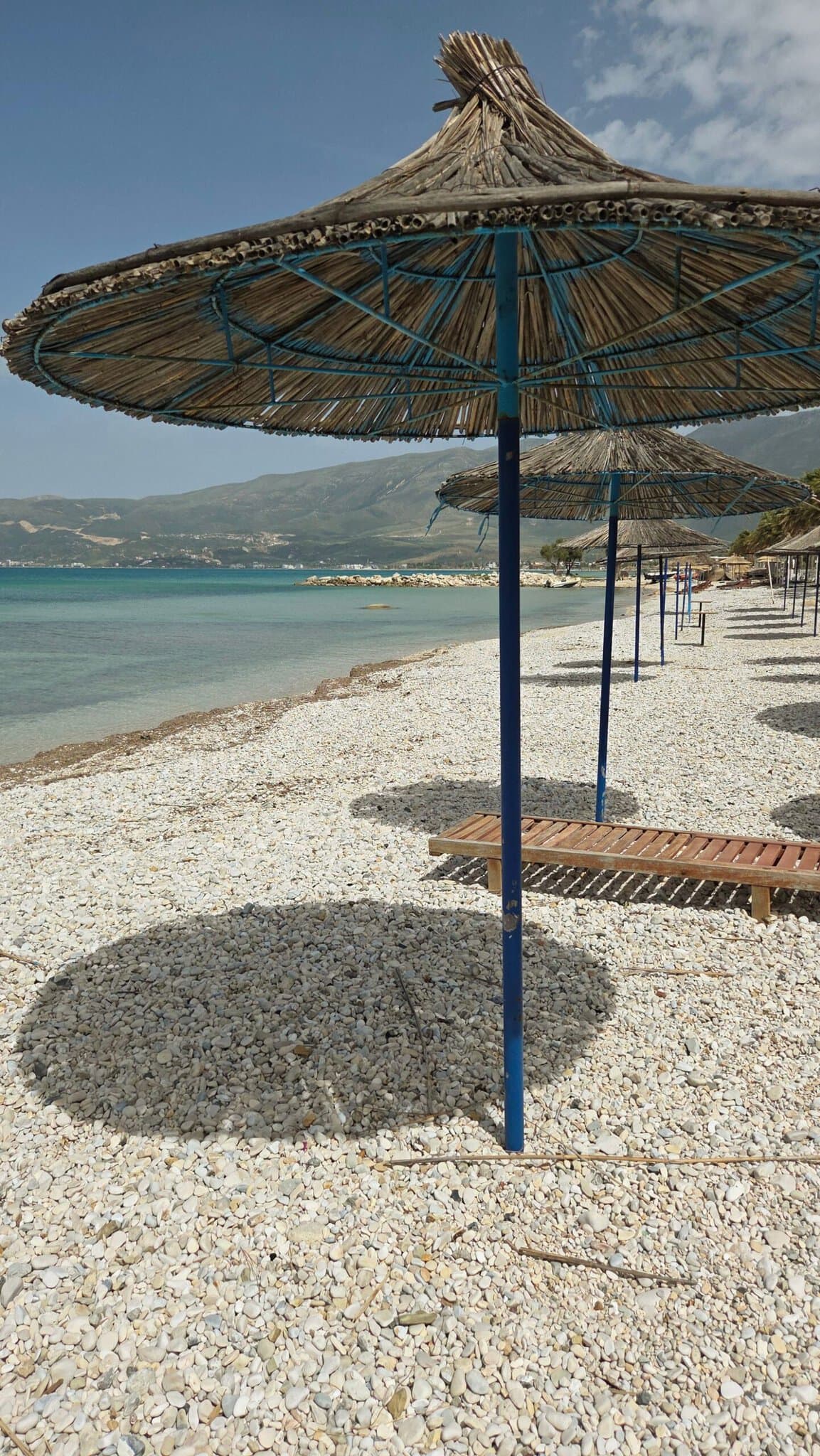
Back down at sea level, Vlorë’s main waterfront is the Lungomare — a long, palm-lined promenade that runs along the city’s beach and functions as Vlorë’s evening living room much the way Tirana’s Blloku does after dark, just with sand instead of bars. The beach itself is shallow for a good distance out, which makes it a popular, low-stress choice for families, and the promenade is lined with cafes, ice cream stands, and seafood restaurants that fill up as the sun drops.
Vlorë doesn’t try to be the Riviera’s showpiece beach — that role belongs to the coves further south. What it offers instead is a proper city on the water: a bay you can watch the sun set into from a promenade table, with history a short walk in every direction.
Vlorë isn’t really competing with the postcard coves further down the coast for water clarity — that’s not really its job. What it does well is give you an easy, walkable seafront attached to an actual city, with restaurants, a working port, and views out toward the Karaburun peninsula and Sazan Island. If you want the more dramatic turquoise-water beaches, they start once you’re past the city and heading toward the Riviera proper.
Karaburun-Sazan Marine Park
Just offshore and across the bay from Vlorë lies Albania’s only national marine park. The Karaburun-Sazan Marine Park, established in 2010, covers both the rugged Karaburun Peninsula and Sazan Island, spanning over 12,000 hectares of coastline and open water. For decades this whole area was a closed military zone — Sazan Island in particular was off-limits — and that isolation is exactly why it stayed so untouched: no overfishing, no coastal development, just cliffs, sea caves, and clear water.
The way most visitors experience it is by speedboat tour, departing from Vlorë’s waterfront. A typical full-day trip runs out to Grama Bay, with stops at sea caves like Haxhi Ali and smaller coves along the peninsula for swimming and snorkeling — the water inside some of these caves has a genuinely striking blue glow where sunlight filters in from underwater openings. Multiple operators run these tours from Vlorë in summer, typically full-day and including snorkeling gear.
Gateway to the Riviera: The Llogara Pass
South of Vlorë, the coastal highway (SH8) begins its climb toward the Llogara Pass — the mountain crossing that carries the road over 1,000 meters before dropping in switchbacks down to the Ionian coast and the start of the Albanian Riviera proper: Dhërmi, Himarë, and eventually Saranda. This is one of the most scenic stretches of road in the Balkans, and Vlorë is where it begins. If you’re continuing south, our full Saranda and Albanian Riviera guide covers what’s waiting on the other side of the pass — the beaches, the drive itself, and where to base yourself.
Even if you’re not continuing all the way to Saranda, it’s worth knowing that Vlorë functions as the practical hinge point of any Riviera trip — the last real city before the coast turns rural and dramatic. Stock up, fuel up, and eat a proper meal here before heading over the pass, especially if you’re driving.
Best Time to Visit
May, June, and September are Vlorë’s best months, without much competition. Temperatures sit in the mid-to-high 20s°C, the sea is warm enough to swim by June (22–24°C), and the city hasn’t filled up with the peak-summer crowd yet. September holds onto warm sea temperatures from a full summer of heating while the heat itself eases off.
July and August are Vlorë’s hottest and busiest months, with daytime temperatures regularly hitting 31–33°C and a real summer-holiday energy along the Lungomare — but also the highest accommodation prices and the biggest crowds at the beach. Winter (November through March) is mild by Northern European standards but rainy, with November averaging the most precipitation of any month; most seasonal beach businesses close, and it’s a quieter, more local Vlorë than the one most visitors picture.
Practical Tips
- Currency: Pay in Albanian Lek (ALL), not euros — tourist-facing places that accept euros usually give a worse exchange rate than an ATM withdrawal. See our broader Albania travel tips for money, SIM cards, and other practical basics before you go.
- A car helps. Kanina, Zvërnec, and the Karaburun boat departure points are all easier with your own wheels, though the Lungomare, Flag Square, and Muradie Mosque are all walkable from the city center.
- Safety: Vlorë is a large, ordinary Albanian city with normal city-sense precautions — nothing unusual for visitors. For the country-wide picture, our guide to safety in Albania covers what to actually watch for versus what’s overblown.
- Book boat tours in advance during summer. Karaburun and Grama Bay speedboat tours fill up on short notice in July and August.
A word on when to come. Arriving in Vlorë in high summer can be genuinely chaotic — the city is crowded and August is the worst of it for traffic. September and October are a different experience entirely, and if you have any flexibility at all, that is when I would go.
One thing that tends to surprise people: there are a lot of Italians living in Vlorë now, and across the south generally. You will sit down for a coffee and realise the table next to you is speaking Italian rather than Albanian. And wherever you end up, the Lungomare is the easy answer — anywhere along that seafront you can stop, sit, and take the view.
Vlorë: FAQ
Why is Vlorë historically important?
Vlorë is where Ismail Qemali declared Albania’s independence from the Ottoman Empire on 28 November 1912, briefly making it the country’s first capital. Flag Square and the Independence Monument mark the spot, and the nearby Museum of National Independence covers the events in detail.
How do I get from Tirana to Vlorë?
By bus or furgon from Tirana’s South Terminal (about 2–2.5 hours, roughly €4–5) or by car via the SH4 and SH8 highways. Vlora International Airport is not yet operating scheduled commercial flights, so Tirana’s Rinas Airport remains the entry point.
Is Vlorë worth visiting, or should I go straight to the Riviera?
Vlorë is worth at least a day on its own — the independence history, Muradie Mosque, Kanina Castle, and Zvërnec Monastery are all real sights, not just a stopover. It also makes a practical base for a Karaburun-Sazan boat trip before continuing south over the Llogara Pass.
Can I visit Zvërnec Monastery without a car?
It’s easiest with a car or taxi, since it’s about 13 km from the city center and public transport options are limited. Some local tours and taxis include it as a stop alongside Kanina Castle.
Is Vlorë safe for tourists?
Yes — Vlorë is a large, ordinary Albanian coastal city, and the usual common-sense precautions apply rather than anything specific to the city. See our full guide to safety in Albania for the broader picture.
What’s the best time of year to visit Vlorë?
May, June, and September, when temperatures are warm, the sea is swimmable, and the city hasn’t reached its July–August peak-season crowds and prices.
What do you think?
Been to Vlorë, Kanina, or Zvërnec? Drop a comment with what stood out to you — or what we should add to this guide.
Continuing south? See our guides to the Albanian Riviera and Saranda, day trips from Tirana, and getting around Albania.
Subscribe to monthly updates
Get honest Albania travel tips, local guides, and new posts straight to your inbox. No spam, unsubscribe anytime.
